
How Student Loan Debt Disrupts Sleep in Older Women
Many retirement-age women blame aging for poor sleep, but student loan debt may be the real driver. This article explains how the chronic stress of debt disrupts sleep through a measurable physiological pathway and why it is a modifiable problem.
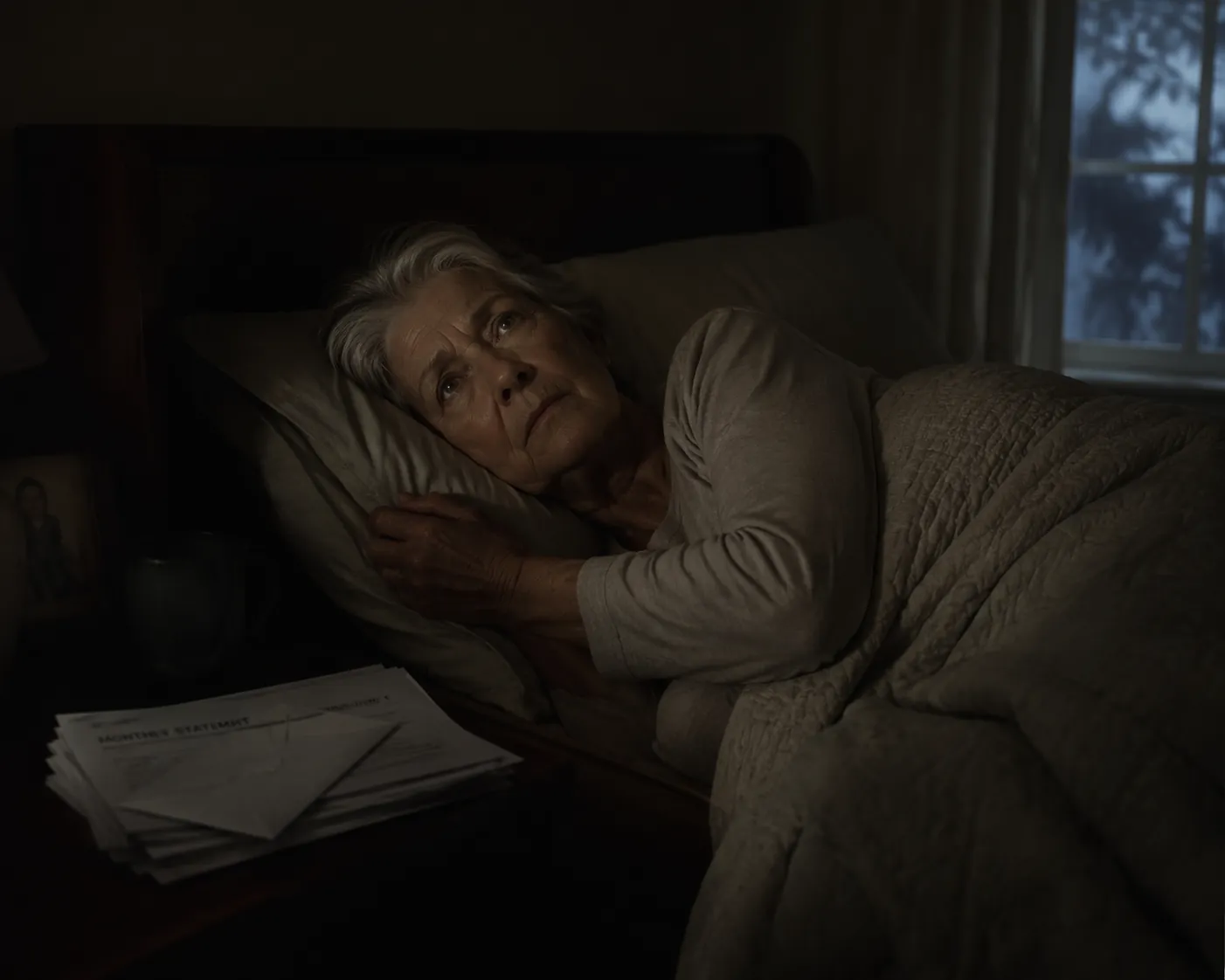
The hour when student loan debt does its cruelest work is often not the hour a bill arrives. It is 2:17 a.m., when an older woman who has already lived through mortgages, childcare, layoffs, caregiving, widowhood, or divorce finds herself awake again, adding numbers in the dark. Social Security. Prescription refills. A daughter who may need help. A Parent PLUS balance that did not disappear when the child became an adult. A notice about repayment. The possibility of default.
It is easy, and far too convenient, to tell her that lighter sleep is simply what happens after 60. Some age-related sleep change is real. Older adults often spend less time in deep sleep, wake more easily, and may have earlier circadian timing. But student loan debt and sleep problems in retirement age women belong in a different category when the debt keeps the brain on alert. Aging can change the architecture of sleep. Chronic financial threat can keep interrupting it.
That distinction matters because one sounds inevitable and the other is at least partly modifiable. If debt stress is feeding insomnia, the answer is not to scold the woman for worrying, hand her a lavender sachet, and call the problem “normal aging.” The better question is what the nervous system is being asked to carry into bed.
What Financial Strain Does to Sleep Continuity
The strongest sleep evidence here does not come from a mood survey or a general question about feeling rested. It comes from polysomnography, the overnight measurement used in sleep research to track sleep stages and awakenings. In a study of 75 older adults, those with ongoing financial strain had a mean sleep efficiency of 73.8%, compared with 80.9% among those without ongoing strain.[1]
Sleep efficiency is not the same as saying, “I had a bad night.” It is the percentage of time in bed actually spent asleep. A woman may be in bed for eight hours, but if worry keeps pulling her into wakefulness, her sleep efficiency falls. She may still be “trying to sleep” for a long time. Her body is not receiving a full night of continuous sleep.
That difference between 73.8% and 80.9% is clinically meaningful because it describes sleep continuity, not just sleep opinion. A night with low sleep efficiency is often a night of more awakenings, longer wake periods after sleep begins, or lighter, more fragile sleep. Prior work discussed in the same paper linked sleep efficiency below 80% with a 1.93 times relative risk for mortality, which is not proof that financial strain caused later death, but it does place poor sleep continuity in a serious health category.[1]
This study did not isolate student loan debt. It measured ongoing financial strain. It was also modest in size and cross-sectional, so it cannot settle causation by itself. Poor sleep can make financial problem-solving harder, just as financial strain can damage sleep. Still, for an older borrower lying awake over loan payments, the finding gives a physiological anchor: financial strain in late life is associated with objectively worse sleep continuity.
How a Loan Balance Follows the Body Into Bed
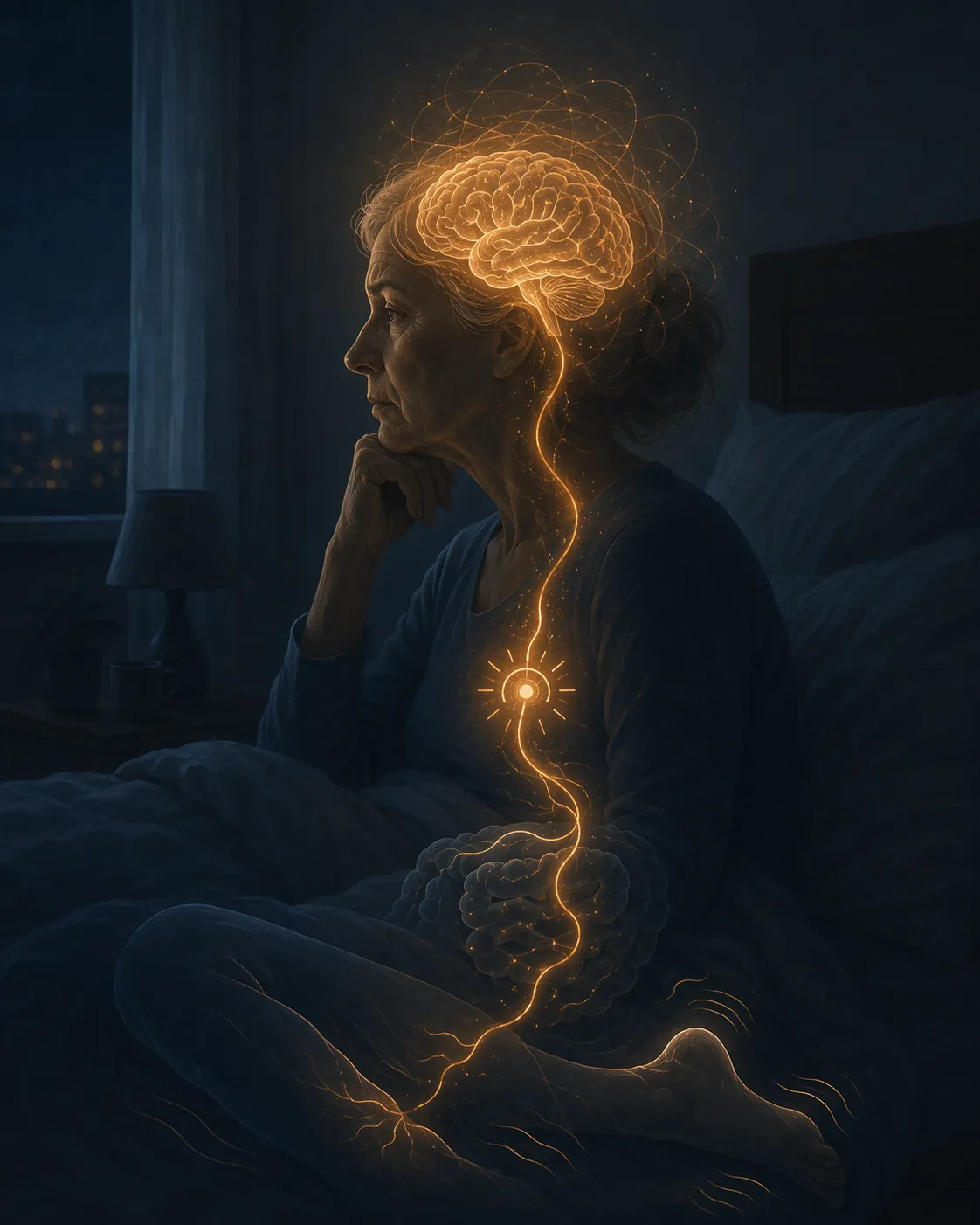
Debt does not need to be physically present on the nightstand to be active at bedtime. The sequence is familiar: the room quiets, daytime tasks stop competing for attention, and the mind starts scanning for unresolved threats. A loan balance is not processed as an abstract number when income is fixed. It becomes a question of safety: Can I make this payment? What if the amount changes? What if I fall behind? What if my Social Security is affected?
A 2025 Rice University report described this bridge from money stress to the bed itself: economic stress was associated with bedtime cognitive arousal, and that arousal was linked to more insomnia symptoms and lower sleep satisfaction.[2] The study population was Army and Air National Guard members, not retirement-age women, so it should not be treated as direct proof for older female borrowers. Its value is mechanistic. It names the middle step many people feel but cannot easily explain: money stress becomes thinking-at-bedtime, and thinking-at-bedtime becomes insomnia.
Bedtime cognitive arousal is not ordinary planning. It is the mind becoming sticky. It returns to the same figures, rehearses conversations with loan servicers, imagines penalties, reviews family obligations, and checks for escape routes. The attention system narrows. Threat monitoring increases. The body prepares for a problem, even when there is no useful action to take at that hour.
That is where the stress physiology becomes important. Chronic financial strain can keep the hypothalamic-pituitary-adrenal axis, often shortened to the HPA axis, more activated than it should be at night. This system helps coordinate the body’s response to threat. When it is repeatedly cued by debt stress, the bedtime body may not downshift cleanly into sleep. Heart rate, vigilance, muscle tension, and stress-hormone signaling can remain too high for stable sleep.
The result is not always dramatic. It may look like taking 45 minutes to fall asleep, waking at 3 a.m. with the same thought loop, or drifting in and out of shallow sleep until morning. A woman may describe it as “I slept, but I never really slept.” That sentence often points to continuity failure: the bed was occupied, but sleep was repeatedly interrupted by a nervous system still doing threat work.
Why Older Women Are Especially Exposed
Student debt is still too often described as if it belongs only to people in their twenties and thirties. That picture is out of date. The Consumer Financial Protection Bureau reported that the number of borrowers aged 60 and older rose from about 700,000 in 2005 to 2.8 million in 2015.[3] The National Consumer Law Center has reported that 3.5 million Americans aged 60 and older hold more than $125 billion in student loan debt.[4]
The women’s side of the story is not incidental. The National Women’s Law Center reports that women hold two-thirds of U.S. student debt, totaling $929 billion, and carry student debt longer than men.[5] That longer carrying time matters when repayment stretches into years when wages may be lower, work may be part-time or impossible, and financial recovery time is shorter.
For many older women, the debt was not taken on in a straight line from college to career to payoff. Some borrowed for their own education after divorce, job loss, or caregiving years. Some borrowed for children through Parent PLUS loans. Some helped family members because that was the responsible thing to do at the time, then reached retirement with less margin than expected.
The margin is where sleep gets vulnerable. Women tend to live longer, which means retirement savings must stretch across more years. The National Institute on Retirement Security reports that women aged 65 and older are 80% more likely than men in that age group to be impoverished.[6] A loan payment that might have been irritating at 45 can become frightening at 67 if it competes with housing, food, transportation, or medication.
Default adds a sharper kind of nighttime fear. Federal student loan borrowers in default can face Social Security offsets of up to 15%, and a GAO/CFPB discussion reported that about 114,000 older borrowers were affected in fiscal year 2015.[7] Not every older borrower is in default, and not every loan carries the same collection risk. But for someone living close to the edge, even the possibility that Social Security could be reduced is enough to keep the body listening for danger.
This Is Not the Same as Normal Age-Related Sleep Change
Older sleep is often lighter than younger sleep. That part should not be denied. Deep sleep tends to decrease with age, awakenings may become more common, and medical conditions, pain, medications, menopause history, caregiving, and circadian changes can all affect sleep. A careful explanation has to leave room for those facts.
But age-related sleep change does not usually explain why the same loan notice, income calculation, or default fear appears in the mind night after night. It does not explain why sleep worsens during repayment uncertainty, improves briefly when a payment plan feels manageable, then deteriorates when paperwork or servicer communication becomes confusing again. Those patterns point toward stress reactivity layered on top of aging, not aging alone.
The distinction is practical. Normal age-related sleep change may mean a woman needs a more regular light schedule, medical review, pain treatment, or adjustment of time in bed. Debt-driven sleep disruption also requires attention to the source of threat and the way that threat is processed at night. Treating the whole problem as “senior sleep” misses the active ingredient.
A useful clinical question is not simply, “How old are you?” It is, “What wakes up when you wake up?” If the answer is the loan balance, the payment portal, the fear of offset, or the shame of still owing money, then the sleep complaint deserves to be understood as a stress-linked insomnia problem until proven otherwise.
| Sleep pattern | More consistent with age-related change | More consistent with debt-driven arousal |
|---|---|---|
| Earlier sleepiness and earlier waking | Often related to circadian timing changes | May occur, but debt thoughts are not the main trigger |
| Repeated awakenings with financial thoughts | Not explained by age alone | Common when threat monitoring continues overnight |
| Long time in bed but little restorative sleep | Can occur with aging or medical problems | Especially concerning when paired with rumination and low sleep efficiency |
| Sleep worsens after loan notices or payment uncertainty | Timing is less typical for aging alone | Suggests stress-linked insomnia pathway |
The Cardiovascular Thread Should Not Be Ignored
Sleep continuity is not only about feeling sharper the next morning, though that would be reason enough to care. Fragmented sleep also intersects with cardiometabolic health. This matters for older women because cardiovascular risk often becomes more visible after midlife, and insomnia symptoms are not harmless background noise.
Student debt has been linked to cardiometabolic risk in younger adults. In an Add Health cohort analysis, adults with consistent or new student debt had higher C-reactive protein levels and higher 30-year Framingham cardiovascular disease risk scores.[8] The study examined adults in early midlife, not retirement-age women, so it cannot be used as a direct estimate of risk for a 68-year-old borrower.
Even with that age mismatch, the finding belongs in the conversation because it fits the chronic-stress model. Debt can become a long-duration exposure. Long-duration stress can affect sleep, inflammation, and cardiovascular risk pathways. The evidence does not prove that a specific older woman’s loan balance caused her hypertension or insomnia. It does support taking her sleep disruption seriously instead of filing it under personality, worry, or age.
What Changes When Debt Is Treated as Part of the Sleep Problem
The point is not that every older woman with student loans has insomnia, or that every case of late-life insomnia is financial. The evidence is more careful than that. No single study follows retirement-age women with student loan debt, measures their polysomnography, tracks their bedtime rumination, and proves the full pathway from loan balance to sleep efficiency. The case is triangulated across late-life financial strain and objective sleep measurement, economic stress and bedtime cognitive arousal, women’s debt exposure, and student debt’s association with cardiometabolic markers.
That is still enough to change the clinical and personal interpretation. If a woman’s sleep worsened as debt became harder to manage, or if awakenings are filled with repayment calculations, the debt belongs in the sleep history. It is not a side note. It may be one of the cues keeping the nervous system from standing down.
Two intervention lanes then become legitimate. One is financial: reviewing whether an income-driven repayment plan, disability discharge, borrower defense, or another payment-reduction or discharge route applies. Income-driven repayment can lower some borrowers’ payments to $0, depending on income and program rules. This is not bedside therapy, but reducing the actual threat can reduce the need for the brain to keep rehearsing it.
The other lane is sleep treatment. Cognitive behavioral therapy for insomnia can be adapted when financial rumination is part of the insomnia pattern. That does not mean pretending the debt is imaginary. It means separating useful daytime problem-solving from nighttime threat loops, tightening the association between bed and sleep, and treating wakefulness in bed as a conditioned pattern that can be changed. For readers looking at the sleep-treatment side, CBT-I for comorbid insomnia is the more relevant framework than generic sleep hygiene.
Aging may make sleep more delicate. Student loan stress can make it defended. Those are not the same problem. For older women carrying debt into retirement, poor sleep may be a treatable stress response rather than an unavoidable feature of getting older.
References
- Financial Strain is a Significant Correlate of Sleep Continuity Disturbances in Late-Life. PMC. 2008.
- Losing sleep over money: Rice study reveals how financial stress follows workers to bed. Rice University. 2025.
- Snapshot of older consumers and student loan debt. Consumer Financial Protection Bureau.
- 3.5 Million Older Americans Have Over $125 Billion in Student Loans. National Consumer Law Center.
- Student Debt and Shrinking Options: A Crisis for Women's Financial Futures. National Women’s Law Center.
- Continuing Challenges to Women's Financial Future. National Institute on Retirement Security.
- Social Security Offsets and Defaulted Student Loans. GAO/CFPB.
- Student Debt and Cardiovascular Disease Risk Among U.S. Adults in Early Mid-Life. PMC. 2022.
Safety & eligibility read
Cross-check against other interventionsExplore the mechanism
Next step
Spot an error or have clinical feedback?
Because this article covers clinical, medication, or safety information, we use a moderated correction channel instead of open public comments. Let us know if something about “How Student Loan Debt Disrupts Sleep in Older Women” needs a closer look.
Send feedback on this article