
How Alcohol Disrupts Sleep in Perimenopause
Learn why the glass of wine that used to help you sleep now backfires during perimenopause, and what to do instead based on current research.
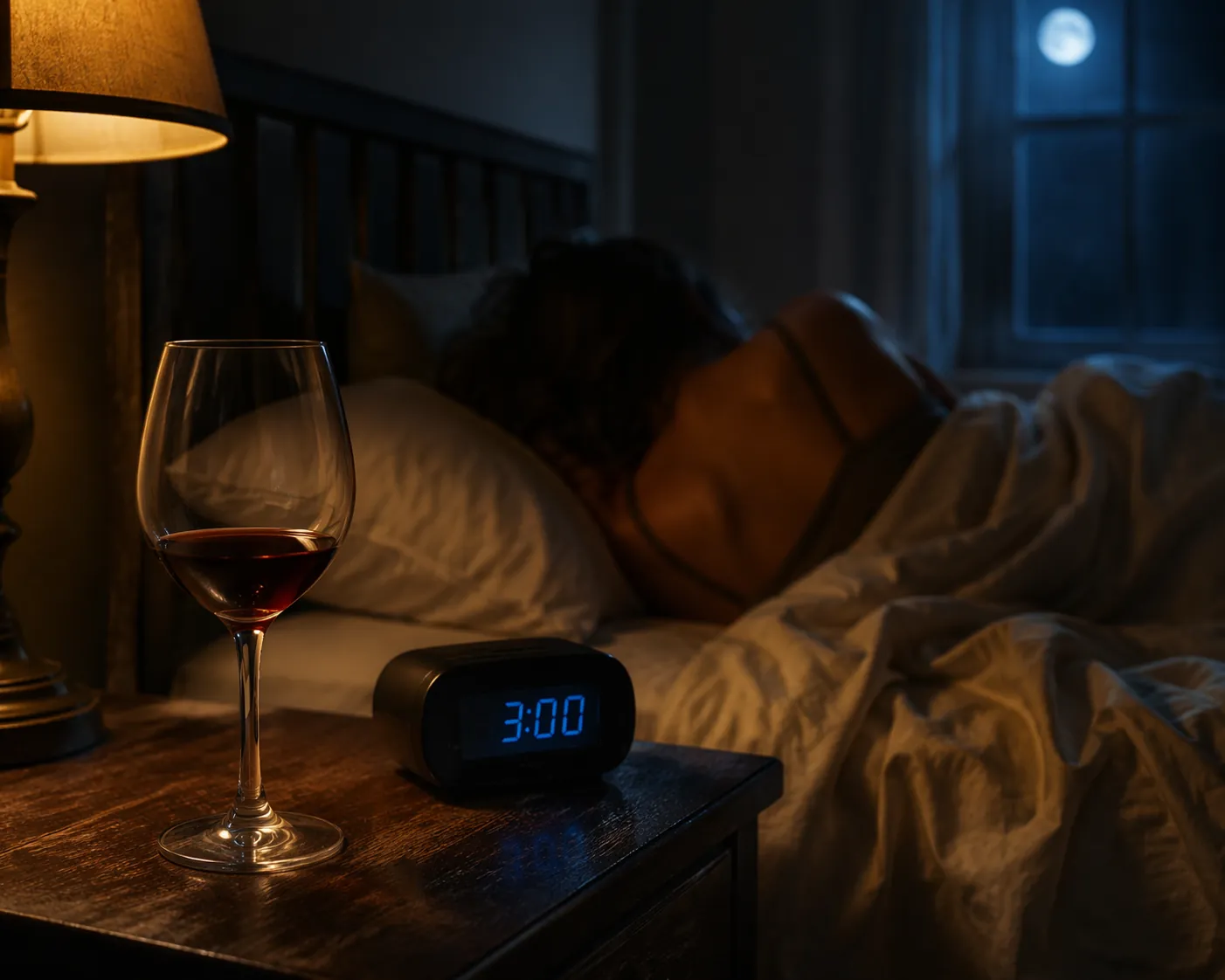
The confusing part is that the glass of wine may still seem to work. You feel the edge come off. Your body gets heavier. Falling asleep takes less effort. Then, a few hours later, you are awake at 3 a.m., too warm, thirsty, anxious, or suddenly alert in a way that does not feel proportional to anything happening in the room.
That sequence is not imaginary, and it is not proof that you have suddenly become weak at sleep. Alcohol can help sleep onset while worsening sleep quality. It is sedating early in the night, but as it is metabolized, it is associated with less REM sleep and more fragmented sleep, especially in the second half of the night, when many perimenopausal women are already vulnerable to awakenings.[1]
This is also why searches for alcohol withdrawal insomnia perimenopause sleep disruption can be so frustrating. A rough night after cutting back or skipping wine is not automatically alcohol withdrawal in the clinical sense. For many moderate drinkers, the more relevant problem is a learned sleep loop: perimenopause makes sleep harder, alcohol becomes the quickest off-switch, and then alcohol makes the later night more unstable.
Why the same drink hits differently now
Perimenopause changes the sleep system around the drink. Estrogen fluctuations affect temperature regulation, which is why a bed that used to feel comfortable can start feeling hostile in the early morning hours. Progesterone, which has a naturally calming and sedating influence for many women, also declines unevenly. Add more nighttime cortisol or stress reactivity, and the nervous system has less margin for anything that fragments sleep.
Alcohol then arrives in a body that is already managing heat, hormone variability, and lighter sleep. Mayo Clinic notes that about 80% of women experience hot flashes during perimenopause, and alcohol is a common trigger that can increase both the frequency and severity of those hot flashes.[2] That matters because a hot flash is not just a sensation of warmth. It can be a full sleep interruption: heat, sweating, a pulse change, sheet adjustment, wakefulness, and then the familiar mental inventory of everything that might go wrong tomorrow.
The old interpretation—“wine helps me fall asleep”—may still be partly true. It is just incomplete. The better sleep question in perimenopause is not only how fast you fall asleep. It is whether your body can stay asleep through temperature shifts, REM-rich periods, and early-morning stress chemistry.
This is where the nightcap becomes a trap rather than a neutral habit. A drink can shorten the first problem, sleep onset, while enlarging the second problem, sleep maintenance. If your main suffering has moved from “I cannot fall asleep” to “I cannot stay asleep,” the trade-off has changed.
The 3 a.m. pattern is a sleep-architecture problem
Sleep is not one uniform state. The first half of the night tends to contain more deep sleep. The second half contains more REM sleep and more natural transitions between sleep stages. Alcohol presses down on the system early, then rebounds later. As blood alcohol levels fall, sleep can become lighter and more broken. Drinkaware summarizes the pattern plainly: alcohol may make you fall asleep faster, but it can reduce REM sleep and leave you feeling less rested.[1]
For a woman in her late 40s who is already waking hot, this can look like a single personal failure: “I was doing so well, and then I ruined the night.” Mechanically, it is often several small disruptions stacking together. Alcohol changes sleep stages. Temperature regulation is less stable. A hot flash or sweat episode pulls the brain toward wakefulness. Once awake, the stress system has an opening.
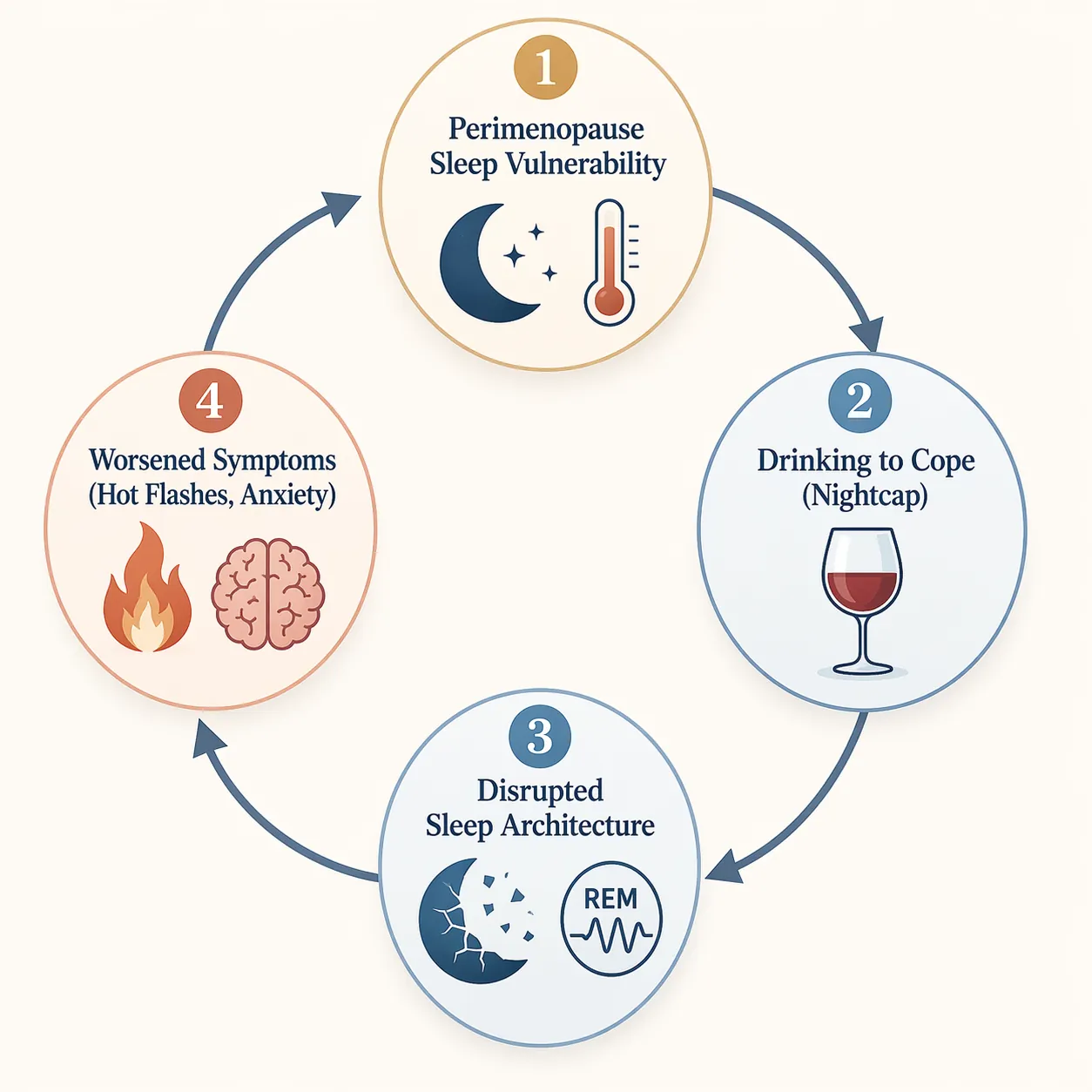
The next day then supplies the reason to repeat the pattern. You are tired and more emotionally reactive. Evening arrives with a slightly lower threshold for distress. The drink promises relief because it has delivered relief before, at least at the front end of the night.
Drinking to cope is not the same as dependence
One of the more useful phrases in the research is “negative-reinforcement drinking.” It means drinking to reduce an unpleasant state: tension, low mood, restlessness, embarrassment about not sleeping, dread of another night awake. It does not automatically mean alcohol dependence. It names a behavior that can make complete sense in the moment and still become costly over time.
In a 2025 study of 936 women ages 40 to 65, Davies and colleagues found that negative-reinforcement drinking motives partially mediated the relationship between menopause symptom severity and hazardous drinking. In plainer terms, women with worse menopause symptoms were more likely to drink to cope, and that coping motive helped explain the link with riskier drinking patterns. Perimenopausal women in the sample had the highest menopause symptoms, highest negative-reinforcement drinking motives, highest negative mood, and lowest well-being. The study also reported that 52% of the sample scored as hazardous drinkers using UK alcohol screening measures.[3]
That 52% figure should not be pasted onto every midlife woman with a wine habit. The study used UK alcohol units and UK low-risk drinking guidance; one UK unit contains 8 grams of alcohol, which is not the same as a standard U.S. drink. The useful point is narrower and more clinically practical: menopause symptoms, mood, and coping-driven drinking can reinforce each other even before a woman thinks of herself as having a drinking problem.[3]
The same paper reported a detail that feels especially important for sleep: among perimenopausal women who reduced drinking, 22.1% cited improving sleep as a primary motive.[3] That is not proof that reducing alcohol fixes every perimenopausal sleep problem. It is evidence that a meaningful share of women are already detecting the connection in their own nights.
The metabolism story is plausible, but not the whole explanation
Many women also notice that alcohol feels stronger in midlife: one glass brings more flushing, worse sleep, or a more pronounced next-day mood dip than it used to. There is a reasonable biological basis for that observation, but it should be stated carefully. University Hospitals describes several age-related changes that can affect alcohol processing in women, including lower lean muscle mass, a higher body-fat ratio, and lower levels of alcohol dehydrogenase, an enzyme involved in alcohol metabolism.[4]
Alcohol may also interfere with the liver’s ability to process estrogen, which could worsen hormone-related symptoms for some women.[4] That does not mean every perimenopausal sleep disruption after wine is caused by slower metabolism. The stronger case is converging: midlife body composition, hormone changes, temperature instability, and alcohol’s known sleep effects all point in the same direction.
A 2025 systematic review and meta-analysis in Frontiers in Neurology also identified alcohol as one factor associated with sleep disorders in perimenopausal women, but alcohol was extracted from 3 of the 22 included studies rather than treated as the sole focus of the review.[5] That supports caution, not overstatement. Alcohol is not the only driver of perimenopausal insomnia. It is one modifiable factor that can matter more once the sleep system is already unstable.
What to try before replacing wine with another sedative habit
The most useful first experiment is not a permanent identity change. It is a clean sleep experiment. For a short, defined period, reduce alcohol or move it earlier in the evening, then track the part of the night that actually concerns you: sleep onset, 2 a.m. to 4 a.m. awakenings, hot flashes, night sweats, heart-racing episodes, dreams, and next-day anxiety.
| If the pattern is | Track this | A useful experiment |
|---|---|---|
| You fall asleep easily after wine but wake hot | Hot flashes, sweating, sheet changes, time awake | Skip alcohol near bedtime or move it earlier and compare second-half awakenings |
| You feel anxious the morning after drinking | Wake time, early-morning thoughts, next-day mood | Compare alcohol nights with non-alcohol nights rather than judging one bad night |
| You cut back and sleep feels worse at first | Sleep onset, caffeine use, bedtime anxiety, urge to drink | Give the experiment enough nights to separate habit disruption from the alcohol effect |
| Pain, allergies, or hot flashes drive the nightcap | The symptom that appears before the drink | Treat the trigger directly instead of using alcohol as the sleep tool |
The phrase “alcohol withdrawal insomnia” can make this part sound more alarming than it needs to be for moderate drinkers. If you have been drinking heavily, daily, or feel shaky, sweaty, panicky, or unwell when you stop, medical guidance matters. But if the main issue is that your familiar nightcap is missing and your brain is protesting the loss of a bedtime cue, the solution is usually not to find a different sedative. It is to build a sleep cue that does not fragment the back half of the night.
That might mean a cooling routine, a lower bedroom temperature, lighter bedding, or more deliberate hot-flash planning. If temperature is the dominant issue, guidance on perimenopause insomnia and heat-sensitive nights may be more relevant than another generic sleep-hygiene list. If pain is the reason you pour wine at night, the better starting point is pain management, including medication safety questions such as whether Tylenol and naproxen can be combined.
CBT-I is the exit ramp, not a punishment
When insomnia has lasted long enough that bedtime itself feels charged, cognitive behavioral therapy for insomnia, or CBT-I, is the treatment with the strongest fit. It does not work by telling you to relax harder. It changes the behaviors and conditioned arousal that teach the brain to treat the bed as a place for wakefulness.
The MGH Center for Women’s Mental Health describes CBT-I as a first-line treatment for insomnia and notes evidence for its use in menopausal women.[6] The National Council on Aging also identifies CBT-I as a first-line, evidence-supported approach for menopause-related sleep problems.[7] For someone stuck in the wine-at-bedtime loop, that matters because the replacement has to target insomnia itself. Swapping wine for another nightly sedating substance may preserve the same dependency on an external off-switch.
In practical terms, CBT-I may involve adjusting time in bed, strengthening the bed-sleep association, changing how you respond to awakenings, and reducing the panic that follows a bad night. Those changes can feel counterintuitive at first, especially if you are exhausted. They are also more precise than the usual advice to “just stop drinking,” which leaves the original insomnia untreated.
It is also worth treating the menopause symptoms directly. Severe hot flashes, night sweats, mood changes, or new anxiety deserve a clinician’s attention. Sleep can improve when the trigger waking you up is managed instead of blurred at bedtime. If you are thinking about over-the-counter sleep aids, allergy medications, or pain relievers as substitutes, it is safer to review the reason you need them and check medication-specific guidance, especially when products are recalled or combined with other drugs.
When to get help
Medical help is warranted if alcohol feels hard to control, if you need more than you used to for the same effect, if stopping causes concerning symptoms, or if family members are worried. It is also warranted when insomnia persists for weeks, mood symptoms are worsening, hot flashes are severe, or you are using alcohol alongside sedatives, sleep medications, opioids, or other substances that can depress breathing or alertness.
For moderate drinkers, though, the first useful frame is often less dramatic: the wine did not suddenly become “bad” because you failed at sleep. Perimenopause changed the conditions around sleep. A drink that once felt like a reliable off-switch can become a front-loaded bargain: easier drowsiness now, more heat and fragmentation later. Seeing that trade clearly makes it possible to stop treating the 3 a.m. wake-up as a mystery.
References
- Alcohol and Menopause: The Facts & Advice for Drinking, Drinkaware
- Mayo Clinic Minute: Why alcohol and menopause can be a dangerous mix, Mayo Clinic News Network
- Women’s alcohol use in mid-life: Associations between menopause symptoms, drinking behaviour, and mental health, PMC
- Does Menopause Change the Way You Metabolize Alcohol?, University Hospitals, 2024
- Factors influencing sleep disorders in perimenopausal women: a systematic review and meta-analysis, Frontiers in Neurology, 2025
- Managing Sleep Problems in Menopausal Women: What Are the Options?, MGH Center for Women’s Mental Health
- Menopause and Sleep: What to Know and How to Improve Your Rest, National Council on Aging
Safety & eligibility read
Cross-check against other interventionsExplore the mechanism
Next step
Spot an error or have clinical feedback?
Because this article covers clinical, medication, or safety information, we use a moderated correction channel instead of open public comments. Let us know if something about “How Alcohol Disrupts Sleep in Perimenopause” needs a closer look.
Send feedback on this article