
How to sleep better in cold weather by life stage
The generic advice to sleep in a cool room doesn't work for everyone in winter. This guide explains why perimenopausal women, pregnant people, older adults, and ADHD adults need different approaches—and what to do instead.
If you lowered the thermostat because you were told that a cool bedroom improves sleep, and then started waking up cold, congested, sweaty, tense, or simply more awake than before, the problem may not be your discipline. The better question in winter is not “What is the best bedroom temperature?” It is “Which thermal problem is my body actually having?”
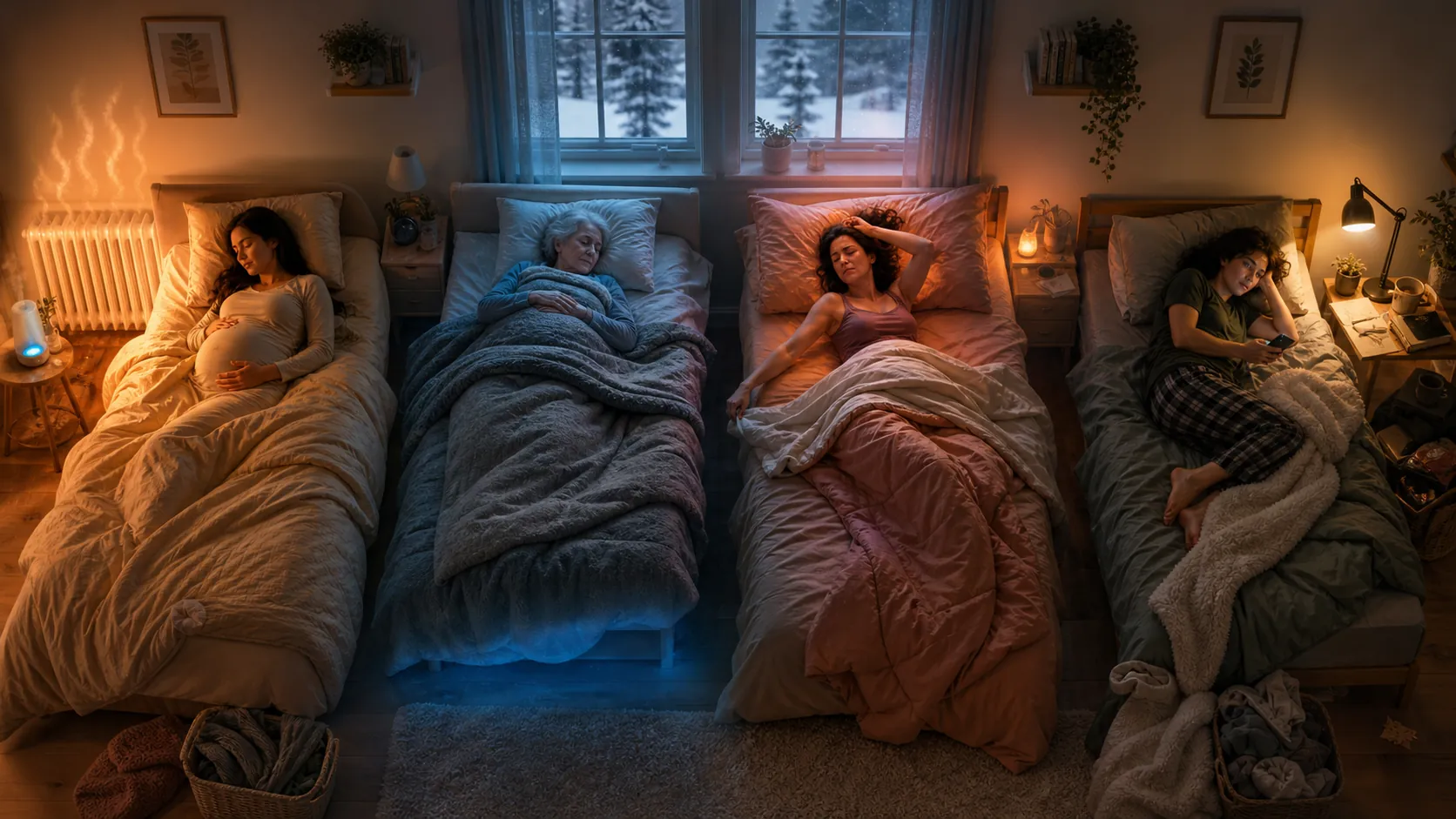
The familiar 60–67°F recommendation has a real physiologic idea behind it: sleep is linked to heat loss from the body, and a slightly cool environment can support that process for many healthy adults. But winter changes the room. Heat dries the air. Radiators and forced-air systems create uneven zones. Heavy bedding traps heat close to the skin. Daylight shrinks. Older bodies, pregnant bodies, perimenopausal bodies, and ADHD nervous systems do not all handle that setup the same way.
The thermostat is not where your body sleeps
A bedroom can read 65°F while the air under the covers is much warmer, more humid, and less ventilated. That small zone between skin, pajamas, sheets, blankets, and mattress is called the bed climate microenvironment. In a sleep review by Okamoto-Mizuno and Mizuno, the comfortable bed climate is described as roughly 32–34°C with 40–60% relative humidity around the body, which is a very different measurement from the air temperature on the wall thermostat.[1]
That distinction explains why winter sleep advice so often backfires. One person in a 65°F room may be sweating under a duvet that traps heat. Another may be losing too much heat at the edge of the bed because circulation and thermoregulation have changed with age. A pregnant person may not be too warm or too cold overall, but may be waking because heated indoor air has made nasal congestion worse. An ADHD adult may have a body clock already running late, then lose the daylight and routine cues that usually help sleep begin.
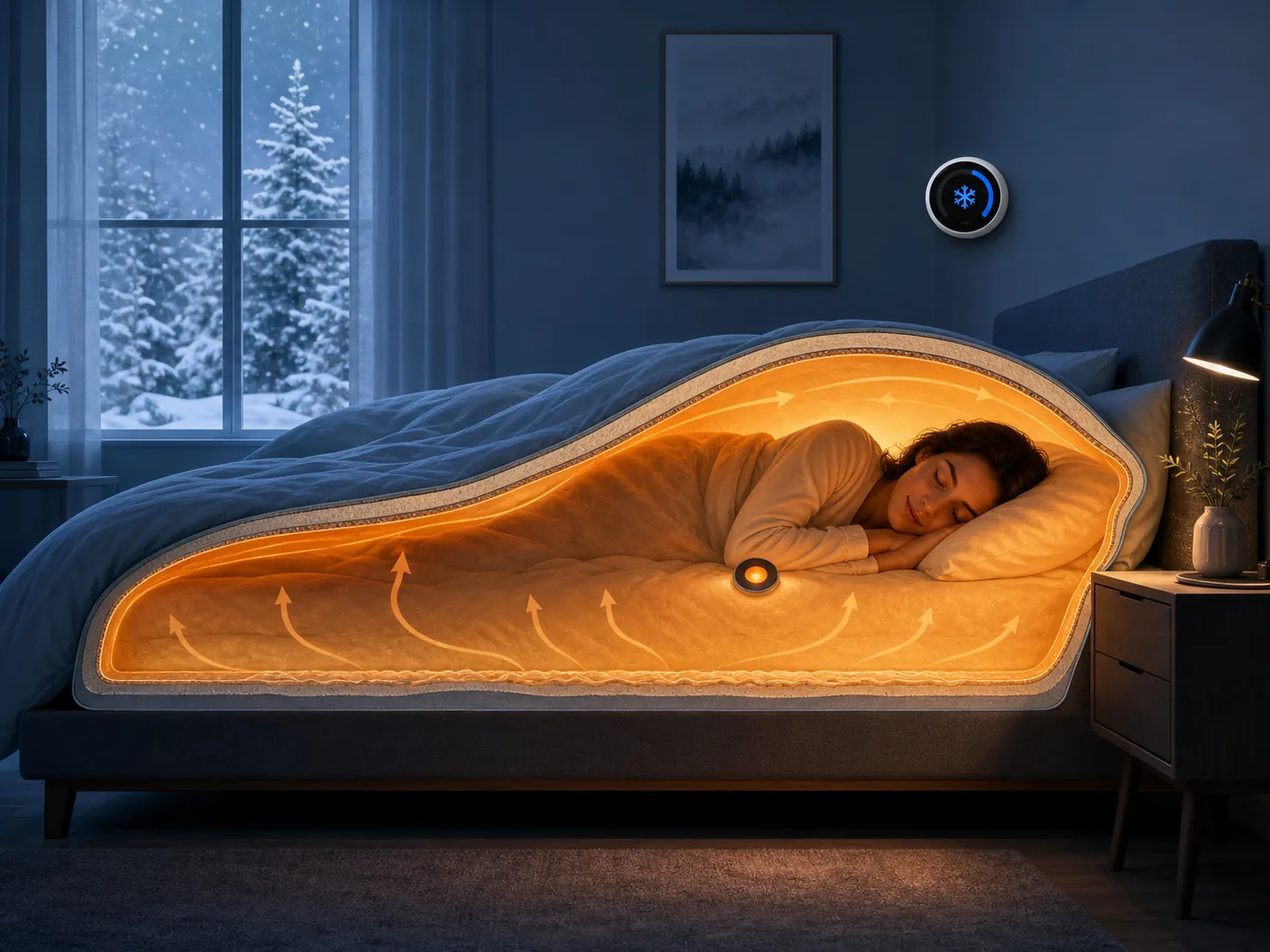
So the goal is not to prove that cool rooms are bad. They are not. The goal is to stop treating the room temperature as if it were the whole treatment plan.
A practical winter sleep check starts at the body
Before changing the thermostat again, separate the problem into the part your body is reporting:
- Cold at the skin: cold hands or feet, shivering, waking curled tightly, or feeling chilled when getting up.
- Heat trapped under bedding: sweating, throwing covers off, waking damp, or needing a cold patch of sheet.
- Dry-air irritation: stuffy nose, dry mouth, sore throat, more snoring, or waking to drink water.
- Circadian disruption: sleepiness arriving too late, trouble starting the bedtime routine, or a winter pattern of low mood and late nights.
- Safety strain: dizziness, chest symptoms, confusion, unusual morning fatigue, or needing sedating medicines to tolerate the night.
Those categories can overlap, but they lead to different adjustments. Lowering the thermostat helps only one of them: excess heat in the room or under the covers. It does very little for dry air, delayed circadian timing, unsafe cold exposure, or pregnancy-related nasal swelling.
Pregnancy: cold advice often misses the nose
Pregnancy sleep in winter is rarely just a temperature problem. Progesterone-related nasal congestion is already common, and it can contribute to mouth breathing, snoring, and more fragmented sleep. Then the heat comes on. Forced-air systems and radiators can dry the bedroom, and dry air can make the nose feel more blocked even when the room is technically “cool enough.”
There is also a simpler point that patients often feel before anyone validates it: feeling cold matters. In a 2021 Japanese study of 2,193 adults, people who reported feeling cold in the bedroom had worse sleep quality scores; the mean Pittsburgh Sleep Quality Index score was 6.7 among those who felt cold compared with 4.3 among those who never felt cold.[2] The housing context matters because the study involved Japanese homes where bedroom temperatures were often below 55°F, so the exact scores should not be copied onto a well-insulated U.S. bedroom.[2] But the direction is still clinically useful: subjective cold perception is not fussiness. It can be part of the sleep problem.
For pregnancy, “sleep cooler” may be the wrong lever if it produces a cold nose, cold feet, or more mouth breathing. The first adjustment is usually to make warmth more breathable and humidity more stable, rather than to make the whole room colder.
- Keep the bed warm enough at the body without trapping heat: lighter layers are easier to adjust than one heavy blanket.
- Watch the air, not just the temperature: if the nose and throat feel dry, bedroom humidity may need attention.
- Avoid using a very cold room to compensate for heavy bedding; that can leave the face and airway uncomfortable while the torso overheats.
- Bring persistent snoring, gasping, high blood pressure concerns, or severe insomnia to a pregnancy clinician rather than treating them as ordinary winter sleep annoyances.
A pregnant person who wakes congested and cold does not need another lecture about ideal sleep hygiene. They need a bedroom setup that protects nasal comfort, keeps the bed climate steady, and leaves enough room to cool off if warmth accumulates after sleep begins.
Older adults: cooler can become a safety issue
This is where generic cool-room advice needs the firmest correction. With age, the body may conserve heat less effectively and may respond more slowly to cold. The National Institute on Aging warns that even mildly cool homes, including indoor temperatures around 60–65°F, can increase hypothermia risk for older adults.[3]
The danger is not always dramatic shivering. In a controlled study of low ambient temperature during sleep, cold exposure altered heart rate variability without necessarily disrupting sleep stages.[4] That means the sleeper may appear to be sleeping while the cardiovascular system is responding to cold. This matters more for older adults and for anyone with cardiovascular disease, frailty, certain medications, or limited ability to notice and correct cold exposure during the night.
The older evidence on winter cold exposure points in the same cautious direction. The Eurowinter Group reported links between cold exposure and winter mortality from ischemic heart disease, a reminder that cold housing is not just uncomfortable; for some people, it is physiologic stress.[5]
A newer study often quoted in this conversation also deserves careful handling. Griffith University reported in 2026 that, in adults 65 and older, a bedroom temperature of 75°F was associated with lower heart rate and reduced stress responses during sleep.[6] That does not mean every older adult should set the bedroom to 75°F in winter. The study examined heat stress during Australian summer, not cold-weather sleep. Its value here is narrower but important: older adults may not share the same thermal target as younger adults, and “cooler is better” should not be treated as universal.[6]
For older adults, the winter target is safer stability. A cool room may still feel good to some, especially with warm bedding and good circulation. But if the room is in the low 60s, if the sleeper wakes chilled, or if there is frailty, heart disease, cognitive impairment, or limited mobility, the advice should shift away from “make it cooler” and toward “prevent cold stress.”
| Winter problem | Adjustment that fits older adults better |
|---|---|
| Waking cold or stiff | Raise the room temperature modestly or add safer, breathable bedding rather than tolerating the chill. |
| Cold hands and feet | Warm the extremities before bed and check that bedding does not leave edges or feet exposed. |
| Overheating under heavy blankets | Use layers that can be removed without making the whole room cold. |
| Dry mouth or nasal irritation | Address air dryness and hydration patterns instead of lowering the thermostat further. |
| Using sedating sleep aids to get through the night | Review medications with a clinician, especially because anticholinergic medicines are generally cautioned against in older adults and can interfere with thermoregulation. |
The medication point is not a small footnote. If an older adult needs sedating medication because the night has become uncomfortable, fragmented, or anxiety-producing, the bedroom setup and the medicine list both deserve review. Cold exposure, dehydration, nighttime bathroom trips, and sedating drugs can combine in ways that increase risk even when each piece looks ordinary by itself.
Perimenopause and menopause: winter heat can trigger night sweats
Perimenopause makes winter sleep confusing because the outside air may be cold while the body is dealing with heat surges from the inside. The usual response is to make the bedroom colder. Sometimes that helps. But for many people, the larger trigger is not outdoor cold; it is the indoor heating pattern: dry air, a warm blast after the heat cycles on, heavy bedding that traps moisture, and then a cold wake-up after covers are thrown off.
A 2019 study on monthly variation in hot flashes, night sweats, and trouble sleeping documented seasonal variation in vasomotor symptoms, which supports what many patients describe: symptoms can change across the year rather than staying fixed at one “menopause sleep” level.[7] That does not prove that every winter sweat is caused by indoor heating. It does make it reasonable to look at the heating cycle and bedding microclimate instead of blaming the person for being unable to tolerate a normal bedroom.
The bed climate concept is especially useful here. A thick winter comforter can create a warm, humid pocket around the torso. When a hot flash or night sweat starts, that pocket becomes hard to escape quickly. The person throws off the blanket, evaporative cooling follows, and then they wake cold. The thermostat may look perfect the whole time.
- Favor removable layers over one heavy duvet, so heat can be released without a full cold shock.
- Keep the room from cycling between very warm and very cool if the heating system allows steadier control.
- Choose sleepwear and bedding that do not trap moisture close to the skin.
- Treat dry air as part of the symptom pattern if waking includes thirst, dry mouth, or nasal irritation.
For perimenopause, the winter move is often not “colder.” It is faster heat release, less moisture trapping, and fewer abrupt swings between overheated and chilled.
ADHD adults: winter disrupts timing before it disrupts temperature
The cold-weather evidence for ADHD is less direct than it is for older adults, pregnancy-related cold perception, or vasomotor symptoms. There is no single controlled trial showing exactly how adults with ADHD should set a winter bedroom temperature. The useful evidence sits closer to circadian timing, light exposure, sensory regulation, and routine stability.
Adults with ADHD have been shown to have delayed temperature and melatonin profiles, which fits the familiar pattern of feeling more awake late in the evening and having trouble initiating sleep.[8] Winter can make that pattern more stubborn because daylight is shorter, outdoor time often drops, and evening routines become easier to derail. Seasonal affective disorder also commonly involves sleep problems and depression symptoms, and the American Academy of Sleep Medicine describes light therapy as a first-line treatment for SAD.[9]
For an ADHD adult, then, “make the room cooler” may be beside the point. If the body clock is late, the problem may begin hours before bedtime. If the room feels sensorily wrong, the issue may be the texture of layers, air movement, noise from heating systems, or the irritation of being cold when trying to start a routine. If winter darkness has removed the usual anchors, bedtime can become an improvisation project at exactly the wrong time of day.
- Put the strongest light cue earlier in the day, especially on dark mornings, rather than relying only on nighttime willpower.
- Make the bedroom thermally predictable before the routine starts, so adjusting blankets and heat does not become a late-night task chain.
- Use bedding layers that are easy to change without fully waking up or starting a new activity.
- Treat sensory comfort as functional, not decorative: scratchy fabric, blowing air, cold feet, and dry mouth can all keep the nervous system engaged.
- If winter brings low mood, hypersomnia, insomnia, or major schedule drift, screen for seasonal depression rather than treating it as a bedroom-temperature problem.
The ADHD adjustment is less about finding a special cold-weather temperature and more about reducing the number of decisions, sensations, and timing conflicts that appear between “I should go to bed” and actual sleep.
What to change first if winter sleep gets worse
A useful winter sleep adjustment usually starts with the least dramatic change. Do not chase a perfect number if the clues are pointing somewhere else.
| If you wake up… | Try adjusting… | Why this is the better first lever |
|---|---|---|
| Cold, tense, or chilled | Room warmth, socks, edge coverage, or lighter but warmer layers | The body may be losing too much heat, especially in older adulthood or pregnancy. |
| Sweaty, damp, then cold | Bedding layers, moisture-wicking fabrics, and heating cycles | The bed microclimate may be overheating even when the room looks cool. |
| Congested, dry-mouthed, or snoring more | Humidity, air direction, nasal comfort, and clinician review if symptoms are significant | Dry heated air can disturb sleep without the room being too warm. |
| Wide awake late at night | Morning light, evening routine timing, and sensory predictability | Winter can weaken circadian cues, especially for ADHD adults and people vulnerable to SAD. |
| Unwell, confused, unusually fatigued, or medically vulnerable | Safety first: warmer indoor conditions and medical review | Cold stress can be silent and is not worth treating as a sleep-hygiene challenge. |
The 60–67°F range remains a reasonable starting point for some healthy adults who sleep well cool. In winter, though, the better target is stable comfort at the body: a bed climate that does not trap heat, air that is not painfully dry, enough warmth to avoid cold stress, and enough daylight or circadian support to help sleep arrive. The right winter bedroom is not the coldest room you can tolerate. It is the room your sleeping body can stay safe and steady in until morning.
References
- Effects of thermal environment on sleep and circadian rhythm. PMC3427038.
- Perception of feeling cold in the bedroom and sleep quality. PMC8648527. 2021.
- Hypothermia: A Cold Weather Hazard. National Institute on Aging.
- Effects of low ambient temperature on heart rate variability during sleep in humans. European Journal of Applied Physiology.
- Cold exposure and winter mortality from ischaemic heart disease. Lancet. 1997.
- This bedroom temperature could help older adults sleep with less stress. ScienceDaily. February 2026.
- Monthly variation of hot flashes, night sweats and trouble sleeping. PMC6934911. 2019.
- Sleep disturbances and circadian rhythm in adults with attention-deficit/hyperactivity disorder. Bijlenga et al. 2013.
- Seasonal Affective Disorder: Sleep problems and depression are common signs. American Academy of Sleep Medicine.
Explore the mechanism
Next step
Spot an error or have clinical feedback?
Because this article covers clinical, medication, or safety information, we use a moderated correction channel instead of open public comments. Let us know if something about “How to sleep better in cold weather by life stage” needs a closer look.
Send feedback on this article