
How to Sleep in Extreme Heat with Perimenopause Night Sweats
Perimenopause narrows the body's thermoneutral zone so much that even a tiny temperature rise can trigger a drenching hot flash. This guide explains why extreme heat makes night sweats worse and lays out evidence-tiered strategies—from bedroom cooling to prescription options—to help you sleep through the worst of summer.
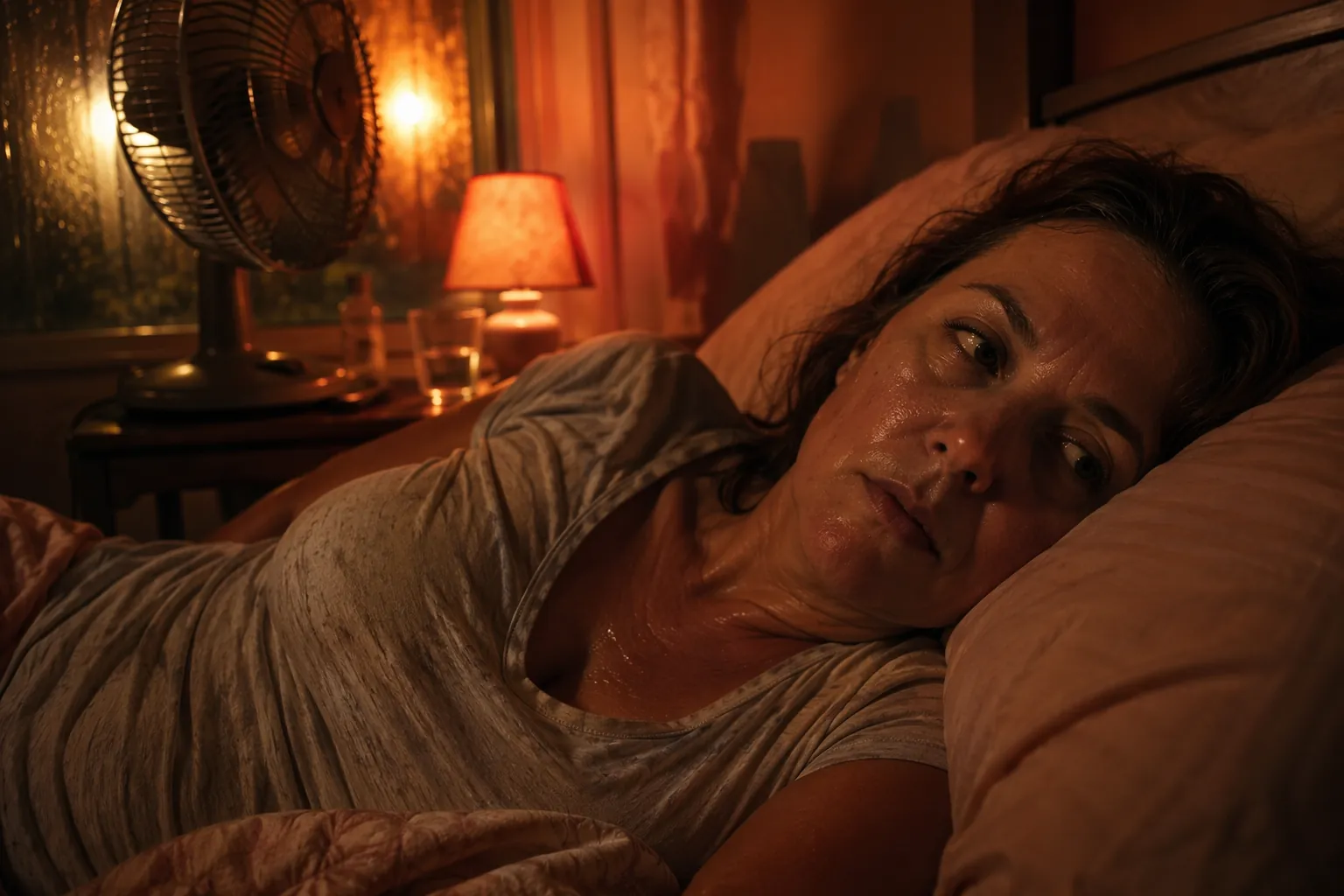
At 3 a.m. in a heatwave, perimenopause night sweats can feel less like “being too warm” and more like a body alarm that will not reset. The bedroom is still holding heat. Humid air keeps sweat on the skin instead of letting it evaporate. A hot flash wakes you, your sleep shirt and sheets get damp, then the cooling overshoots: you throw off covers, cool down too far, shiver, pull the sheet back up, and wait for your body to settle. If the room has not cooled and the air is still heavy, the same cascade can start again.
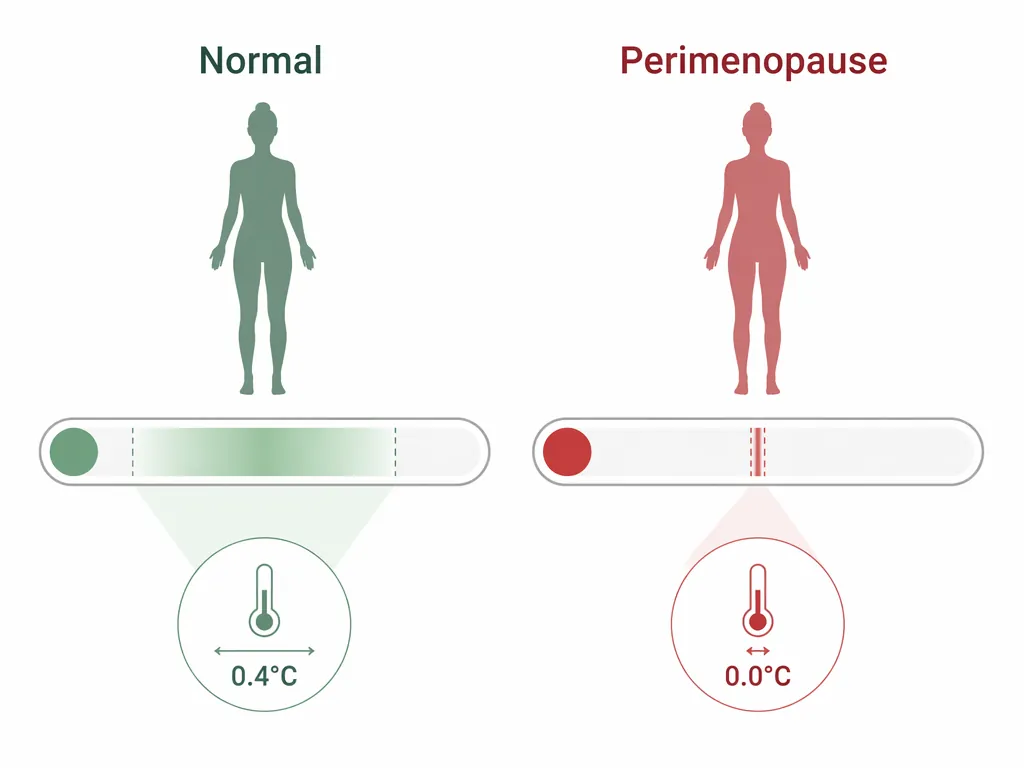
That hair-trigger feeling has a physiologic explanation. In work summarized by Robert Freedman, women with symptomatic menopausal hot flashes had a thermoneutral zone estimated at approximately 0.0°C, compared with about 0.4°C in asymptomatic women.[1] The thermoneutral zone is the small internal temperature range in which the brain does not need to launch heat-loss responses such as sweating or skin blood-vessel dilation. When that range narrows toward zero, a tiny rise in core temperature can be enough to set off a full hot flash.
That number should be used carefully. It comes from Freedman’s research program and laboratory protocol, so it is better understood as the strongest available explanatory model than as a universally replicated measurement for every perimenopausal woman. Still, it explains something patients often describe with remarkable consistency: the body is not “overreacting” emotionally. Its temperature-control threshold has become very narrow.
Why Extreme Heat Makes the Cycle Harder to Break
A hot flash is not only a feeling of heat. It is a coordinated heat-dissipation response. Skin blood vessels open, sweating starts, heart rate may rise, and sleep often breaks. In a cool, dry room, sweat can evaporate from the skin and remove heat. In a hot, humid room, especially when relative humidity is around 70% or higher, evaporation slows. Sweat stays wet instead of doing its cooling work.
That is why summer night sweats can feel so disproportionate. The body launches a cooling response, but the environment blocks part of the exit route. The soaked shirt is not proof that the body cooled efficiently; it may be proof that evaporation failed. Then the practical burden begins: getting out of bed, changing clothes, moving to a dry patch of sheet, trying not to fully wake, and returning to a bedroom that still contains the same heat load.
This is also why advice to “use a fan” can be both partly right and badly incomplete. Moving air helps only if it improves heat loss from the skin. If the room remains very hot, the bedding traps moisture, or the air is already saturated, a fan may reduce misery without reliably preventing the next flash. For broader heat-dome precautions, including when the room itself is unsafe, see how to sleep during a heat dome.
Start by Lowering the Room’s Thermal Load
Bedroom cooling comes first because it addresses the external pressure that keeps pushing a narrowed thermoneutral zone over the edge. Several clinical sleep and menopause resources converge on a cool bedroom range of about 60–67°F, or 15.5–19.5°C, for sleep.[2][3][4][5] That range is not magic, and not every household can reach it during an extreme heat event. But for perimenopausal night sweats, the goal is not simply comfort; it is lowering the chance that a small internal temperature rise will trigger the whole heat-loss cascade.
| Part of the cycle | What helps | Why it matters |
|---|---|---|
| Room stays hot | Air conditioning, shaded windows, moving to the coolest room, limiting heat buildup before bedtime | Reduces the external heat load pressing against a narrowed thermoneutral zone |
| Sweat does not evaporate | Dehumidifier when humidity is high, fan plus dry air, lighter bedding | Evaporation is what turns sweating into actual cooling |
| Heat is trapped against skin | Breathable sleepwear, moisture-wicking or light cotton layers, easy-to-change top layer | Wet fabric that stays against skin can prolong discomfort and trigger chilling afterward |
| Core temperature does not drop before sleep | Lukewarm shower about 90 minutes before bed | Post-shower evaporative cooling can support the normal pre-sleep temperature drop |
Humidity deserves more attention than it usually gets. A bedroom can be technically cooler than the day’s high and still be a poor sleeping environment if the air is heavy enough to keep sweat from evaporating. In humid climates, a dehumidifier may be more useful than another blanket adjustment. The same applies to bedding: breathable layers matter because they permit heat and moisture to leave the body. They are not a cure for vasomotor symptoms; they are a way to stop the environment from amplifying them.
A lukewarm shower about 90 minutes before bed can help for the same reason. The point is not to shock the body cold. A very cold shower can provoke a rebound response in some people. A lukewarm shower leaves moisture on the skin and hair, and the evaporation afterward can support a drop in body temperature as bedtime approaches.[3][4]
Then Target the Nervous-System Trigger
Once the room is as cool and dry as realistically possible, the next question is whether the body is still crossing the threshold from the inside. Hot flashes are linked to central sympathetic activation, and this is where paced respiration becomes more interesting than ordinary relaxation advice.
In controlled trials from Freedman’s group, paced respiration was associated with roughly a 50% reduction in objectively measured hot flash frequency.[6] The breathing pattern used in this line of research is slow, regular diaphragmatic breathing, practiced enough that it can be used during vulnerable periods rather than improvised in panic after waking. The likely value is not that breathing “calms you down” in a vague way; it appears to reduce central sympathetic outflow, which is one of the forces that can narrow the thermoneutral zone.
There is an important limitation: this evidence comes from a single research program, and large independent replication is limited. That does not make paced respiration useless. It means it should be placed in the right tier: low-risk, mechanistically plausible, and supported by controlled trial data, but not equivalent to a prescription treatment for severe nightly awakenings.
A Practical Way to Use Paced Breathing at Night
- Practice before bedtime, not only after a hot flash has already peaked.
- Use slow abdominal breathing with a relaxed exhale; do not strain to take large breaths.
- Try it during the first warm surge, before throwing off all covers, if you can do so safely and comfortably.
- Treat it as one layer in the plan, not as proof that symptoms are under voluntary control.
Be Selective About Trigger Advice
Trigger tracking can help, but it can also become another way women are asked to manage a physiologic problem with endless self-surveillance. Alcohol is worth singling out because it can worsen sleep continuity and is a known hot-flash trigger for many people. If night sweats reliably follow evening drinking, reducing or avoiding alcohol during heatwaves is a reasonable experiment. For a deeper look at that specific pattern, see how alcohol disrupts sleep in perimenopause.
Spicy food, late heavy meals, and stress may matter for some women, but trigger lists should not distract from the larger mechanism. During extreme heat, the bedroom itself may be the trigger. If the air is hot and humid enough, even careful behavior may not prevent repeated awakenings.
When Home Measures Are Not Enough
Prescription options are not interchangeable with fans, fabrics, or breathing exercises. They act on different parts of the hot-flash pathway and carry different safety questions. A clinician conversation is especially appropriate when night sweats are frequent, drenching, newly severe, associated with palpitations or mood disruption, or causing persistent daytime impairment.
Gabapentin
Gabapentin is a nonhormonal prescription option sometimes used for vasomotor symptoms, especially when night symptoms and sleep disruption are prominent. A review of four trials reported hot-flash reductions ranging from 45% to 71%.[7] It can cause side effects such as dizziness or next-day sedation, so dosing, timing, fall risk, other medications, and driving or caregiving demands matter.
Hormone Therapy
Menopausal hormone therapy remains the most effective treatment for vasomotor symptoms in expert consensus, but it is not a casual sleep tip. The risk-benefit discussion changes with age, time since menopause onset, uterus status, breast cancer history, clotting risk, cardiovascular risk, migraine history, and patient priorities.[8] For some women, it is the right tool. For others, the risks or contraindications point elsewhere.
Fezolinetant
Fezolinetant, sold as Veozah, is the newer pathway-specific option in this discussion. The FDA approved it in 2023 for moderate to severe vasomotor symptoms due to menopause.[9] It is a neurokinin 3 receptor antagonist, which means it acts closer to the hypothalamic signaling pathway involved in hot flashes rather than replacing estrogen.
That pathway specificity is clinically interesting, but the safety context belongs in the same breath. In December 2024, the FDA added a boxed warning about rare but serious liver injury with fezolinetant and emphasized liver blood testing before treatment and periodically during treatment.[10] For a reader who cannot take hormones, this may still be an important option to discuss. It is not an over-the-counter workaround for a hot bedroom.
How to Decide What to Try First
The sequence should follow the mechanism. First, reduce the thermal load: cool the room as much as possible, block daytime heat, move to the lowest or coolest sleeping area, reduce humidity, and use bedding that lets moisture evaporate. During dangerous heat, comfort measures are not enough; heat illness prevention takes priority.
Second, support cooling before the first flash. A lukewarm shower about 90 minutes before bed, dry replacement sleepwear within reach, and layers that can be changed without fully waking are not glamorous interventions. They reduce the time spent awake, wet, chilled, and frustrated.
Third, add a nervous-system strategy if the flashes keep arriving despite a cooler room. Paced respiration is reasonable to practice for several weeks because it is low risk and has controlled-trial support, even though the evidence base is not as broad as one would like.
Fourth, bring the pattern to a clinician when the awakenings are frequent, drenching, or eroding daytime function. That conversation can include gabapentin, hormone therapy, fezolinetant, and other individualized options. It should also include the possibility that more than one sleep problem is present.
Night sweats are common during the menopause transition; sources commonly estimate that up to 80% of women experience hot flashes during this stage.[5] Common, however, does not mean every nighttime awakening should be assigned to perimenopause. Loud snoring, witnessed pauses in breathing, morning headaches, high blood pressure, marked daytime sleepiness, or awakenings with choking or gasping should prompt evaluation for sleep apnea or another sleep disorder. For that differential, see sleep apnea or perimenopause.
In extreme heat, relief usually comes from stacking interventions that work on different parts of the loop: lower the room’s heat burden, make sweating effective again, reduce sympathetic activation, or medically widen the narrowed thermoneutral zone. The body is not asking for one perfect trick. It is asking for fewer reasons to cross the threshold.
References
- Menopausal hot flashes: mechanisms, endocrinology, treatment, Journal of Steroid Biochemistry and Molecular Biology, 2014
- The Best Temperature for Sleep, Stanford Lifestyle Medicine
- What Is the Best Temperature for Sleep?, Cleveland Clinic
- Sleep and the menopause, My Menopause Centre
- Menopause and Sleep, Sleep Foundation
- Behavioral treatment of menopausal hot flushes: evaluation by ambulatory monitoring, American Journal of Obstetrics and Gynecology, 1992
- Gabapentin for the treatment of menopausal hot flashes: a review of efficacy and safety, Annals of Pharmacotherapy, 2011
- The 2022 hormone therapy position statement of The North American Menopause Society, The North American Menopause Society, 2022
- FDA Approves Novel Drug to Treat Moderate to Severe Hot Flashes Caused by Menopause, U.S. Food and Drug Administration, May 12, 2023
- FDA adds warning about rare occurrence of serious liver injury with use of Veozah (fezolinetant) for hot flashes due to menopause, U.S. Food and Drug Administration, December 2024
Explore the mechanism
Next step
Spot an error or have clinical feedback?
Because this article covers clinical, medication, or safety information, we use a moderated correction channel instead of open public comments. Let us know if something about “How to Sleep in Extreme Heat with Perimenopause Night Sweats” needs a closer look.
Send feedback on this article