
Can Contaminated Cetirizine Cause Sleep Problems?
Explains whether recalled cetirizine (cross-contaminated with ranitidine) can cause sleep disruption, tracing two separate biological pathways — cetirizine's rare paradoxical insomnia and ranitidine's documented sleep disturbance effects — and who is most at risk.
Yes, contaminated cetirizine could plausibly cause sleep problems in some people, but that is not the same as saying most people who took the recalled tablets should expect insomnia. The July 2026 recall is mainly about ranitidine cross-contamination and the risk of hypersensitivity reactions, including anaphylaxis, not about sleep disruption as the primary safety concern.
The specific recall matters here. Unique Pharmaceutical Laboratories announced a voluntary nationwide recall on July 20, 2026, for four lots of cetirizine HCl 5 mg tablets: GY825029, GY825030, GY825031, and GY825032. The recalled product carries NDC 16571-401-10 and an expiration date of 10/2028. The reason given was cross-contamination with ranitidine, and the FDA-posted notice warns that exposure may trigger serious allergic reactions in people with ranitidine hypersensitivity.[1]
That means the first useful step is not to decide whether “cetirizine is bad for sleep.” It is to check whether your bottle is part of those lots. If it is not, this particular recall does not explain your sleep change. If it is, the sleep question has two separate routes: the ranitidine contaminant may disturb sleep in a susceptible person, and cetirizine itself can rarely cause the opposite of its expected drowsy effect.

The ranitidine pathway is the more direct sleep concern
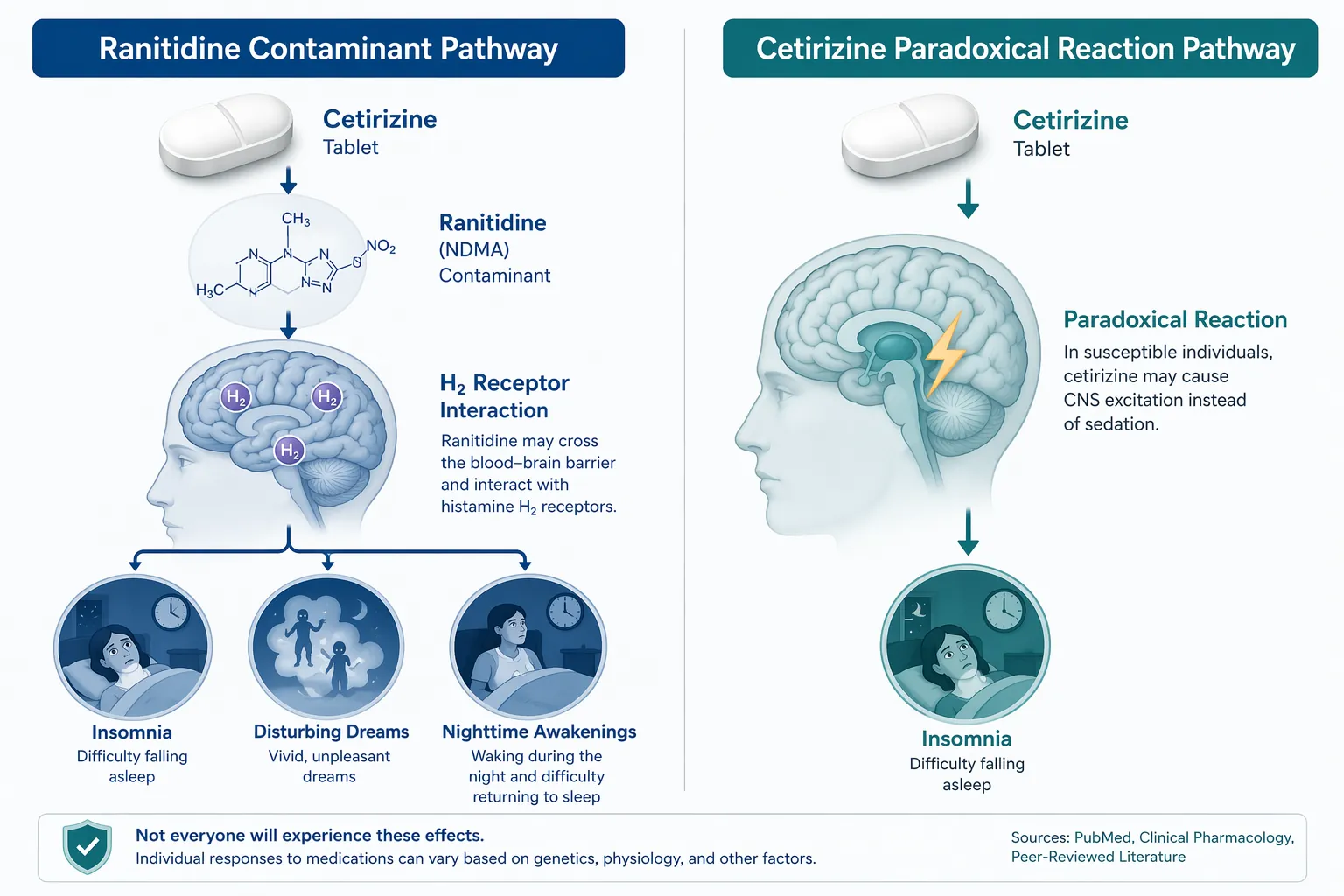
The strongest sleep-specific evidence in this discussion does not come from cetirizine. It comes from ranitidine. A 2018 Cureus case report described a 40-year-old man who developed difficulty falling asleep, disturbing dreams, and nighttime awakenings while taking ranitidine 150 mg twice daily. His symptoms improved after stopping ranitidine and returned when he restarted it, a positive rechallenge. The authors assigned a Naranjo adverse drug reaction score of 8, which falls in the “probable” range.[2]
That rechallenge is why the case deserves attention. A vague complaint after starting a medicine can be coincidence. A symptom that stops after the drug is removed and returns after it is reintroduced is more persuasive, though still not the same as a clinical trial.
There is also a plausible biological route. Ranitidine is an H2 receptor antagonist, in the same broad class as famotidine and cimetidine. A review of central nervous system reactions to H2 blockers described that these drugs can cross the blood-brain barrier and interact with central H2 receptors, giving a mechanism for neuropsychiatric effects in some patients.[3]
Older population data add context, but with limits. In a 1990 cohort study of 37,252 ranitidine patients, drowsiness was recorded in 0.73% and mental confusion in 0.21%.[4] Those findings are not a measurement of insomnia from contaminated cetirizine, and the data are decades old. They do show that central nervous system effects from ranitidine were recognized as rare but clinically meaningful at scale.
Put plainly: if a person took one of the recalled cetirizine lots and then developed new insomnia, vivid disturbing dreams, or repeated nighttime awakenings, ranitidine exposure is a plausible explanation. It is not proven from the recall notice alone, and there are no studies directly testing sleep outcomes in people who used these contaminated cetirizine lots.
Cetirizine itself can rarely push sleep the wrong way
Cetirizine is better known for making people sleepy than for keeping them awake. The NHS lists sleepiness as a common cetirizine side effect, occurring in more than 1 in 10 people.[5] That is why some people are surprised when they feel wired, restless, or unable to fall asleep after taking it.
Rare paradoxical reactions are still documented. Drug safety listings include insomnia among serious cetirizine side effects, and a 2021 case report described worsening sleep terrors associated with cetirizine in a child.[6][7] That pediatric sleep-terror report should not be stretched into a prediction for adults using recalled tablets, but it does reinforce the narrow point: second-generation antihistamines do not produce identical sleep effects in every nervous system.
This second pathway matters even if the recalled product contained only a small amount of ranitidine contamination. A person who already reacts unusually to antihistamines might attribute the whole problem to the contaminant when cetirizine itself is part of the story. The practical question is timing: did the sleep change begin after this product, change when you stopped it, and recur if you were exposed again? Do not intentionally rechallenge yourself to find out; that is a clinical clue to discuss, not a home experiment.
Who should take the sleep signal more seriously
The recall does not make everyone equally likely to lose sleep. The concern rises when the person has a history of unusual medication reactions, known ranitidine sensitivity, new allergic symptoms, or a life stage where one bad night has larger consequences.
Pregnant readers should be especially careful about making abrupt medication changes without guidance. The sleep question is only one layer; uncontrolled itching, congestion, reflux symptoms, allergic reactions, and medication substitutions can all matter during pregnancy. For a replacement-focused discussion by life stage, use Your Life Stage Determines the Safest Cetirizine Replacement.
Perimenopausal women may notice the effect sooner because sleep is often already fragile. A medication that adds vivid dreams, nighttime awakenings, itching after stopping, or nasal congestion after switching can look like “my hormones got worse” when the timing points to a medication event. That does not prove causation, but it makes a short symptom timeline worth writing down.
Adults with ADHD may also detect medication-related sleep changes sharply, especially if stimulant timing, rebound symptoms, caffeine, and antihistamines are all in the same evening. The useful distinction is whether the new pattern is specifically tied to the recalled cetirizine product or whether several sleep-disrupting variables changed at once.
Older adults deserve a lower threshold for clinician input. Antihistamine decisions can become tangled with other sedating or activating medicines, fall risk, cognitive symptoms, reflux medicines, and kidney or liver issues. If confusion, severe drowsiness, agitation, or persistent insomnia appears around the time of recalled-product use, the safest next step is medication review rather than guessing which ingredient is responsible.
How to interpret your own symptoms without overcalling the recall
A single bad night after reading about a recall is not strong evidence of a drug effect. Neither is a pile of online comments from people who are worried, angry, or trying to solve symptoms after the fact. User-reported data can be a useful signal, but it is self-selected and unverified. For example, Drugs.com reviewer data showed insomnia reported by 2.4% of 166 ranitidine reviewers, but that figure should not be read as the true rate of ranitidine-caused insomnia.[8]
The cleaner signal is a pattern: the symptom begins after the medicine, improves after stopping the recalled product, and is not better explained by congestion, itching, stress, caffeine, stimulant timing, alcohol, hot flashes, pain, or another medication change. Even then, the right conclusion is “possible adverse effect,” not certainty.
| Sleep pattern | How to weigh it |
|---|---|
| New disturbing dreams or repeated awakenings after using a recalled lot | More consistent with the ranitidine sleep-disturbance pathway, especially if it improves after stopping |
| Feeling wired, restless, or unable to fall asleep after cetirizine | Could fit rare paradoxical cetirizine insomnia, especially if this has happened with antihistamines before |
| Worse sleep after stopping the recalled product | May reflect allergy rebound, itching, congestion, or anxiety rather than direct drug stimulation |
| One poor night with no clear timing pattern | Too nonspecific to blame confidently on contamination |
If stopping the product makes itching, hives, or congestion worse and that keeps you awake, the recall may still have affected your sleep indirectly. That is a different problem than insomnia caused by ranitidine or cetirizine. For that scenario, Why the Allergy Med Recall Can Ruin Your Sleep is the more relevant guide.
What to do tonight
- Check the bottle against the recalled lots: GY825029, GY825030, GY825031, and GY825032, NDC 16571-401-10, expiration 10/2028.[1]
- If your product matches, follow the recall guidance and stop using the recalled product rather than trying to finish the bottle.
- Watch for allergic symptoms such as hives, swelling, breathing difficulty, or signs of anaphylaxis; those are more urgent than sleep disruption.
- If you are pregnant, older, medically complex, taking multiple medicines, or having persistent insomnia, contact a clinician or pharmacist before choosing a substitute.
- If you were using cetirizine partly because it made you drowsy, read If You Use Cetirizine Drowsiness for Sleep, This Recall Matters before swapping to another sedating antihistamine.
So the answer stays limited: contaminated cetirizine can plausibly cause sleep problems in susceptible individuals, mainly through ranitidine-related sleep disturbance or rare paradoxical cetirizine effects. But sleep disruption is a secondary inferred risk, not a proven common outcome of the recalled lots and not the FDA notice’s central warning.
References
- Unique Pharmaceutical Laboratories Issues Voluntary Nationwide Recall of Cetirizine HCl 5 mg Tablets Due to Ranitidine Cross-Contamination — FDA — July 20, 2026 — link
- Ranitidine-Associated Sleep Disturbance: A Case Report — Cureus — 2018 — link
- Central nervous system reactions to histamine-2 receptor blockers — PubMed — 1991 — link
- Adverse reactions to ranitidine in general practice — PubMed — 1990 — link
- Side effects of cetirizine — NHS — link
- Cetirizine Side Effects — Drugs.com — link
- Cetirizine-induced Sleep Terrors: A Case Report — Journal of Clinical Sleep Medicine — 2021 — link
- Ranitidine Reviews & Ratings — Drugs.com — link
Safety & eligibility read
Cross-check against other interventionsExplore the mechanism
Next step
Spot an error or have clinical feedback?
Because this article covers clinical, medication, or safety information, we use a moderated correction channel instead of open public comments. Let us know if something about “Can Contaminated Cetirizine Cause Sleep Problems?” needs a closer look.
Send feedback on this article