
How a Phone Call Ban Can Improve In-Flight Sleep
The Quiet Skies Act proposes banning in-flight phone calls, but it's not law yet. This article explains the regulatory timeline and offers evidence-based sleep strategies for travelers with perimenopause, pregnancy, ADHD, or older age considerations.
If you searched for “sleep on planes without phone calls 2025 ban,” the first thing to know is that there is no 2025 federal ban already protecting your red-eye. As of July 23, 2026, the Quiet Skies Act is a bill, not a law. Major U.S. airlines already prohibit in-flight voice calls by policy, but Congress has not yet turned that norm into a federal rule.
The proposed change matters because airline policy is easier to erode than federal law. H.R. 9530, introduced in July 2026 by Representatives Greg Stanton, Hillary Scholten, Rick Crawford, and Bresnahan, would require the FAA to finalize a rule banning passengers from making voice calls during flights within 180 days of enactment.[1] That would finish a job Congress already pointed the FAA toward in 2018, when the FAA Reauthorization Act included a cell-call rulemaking provision but no final rule followed.[2]
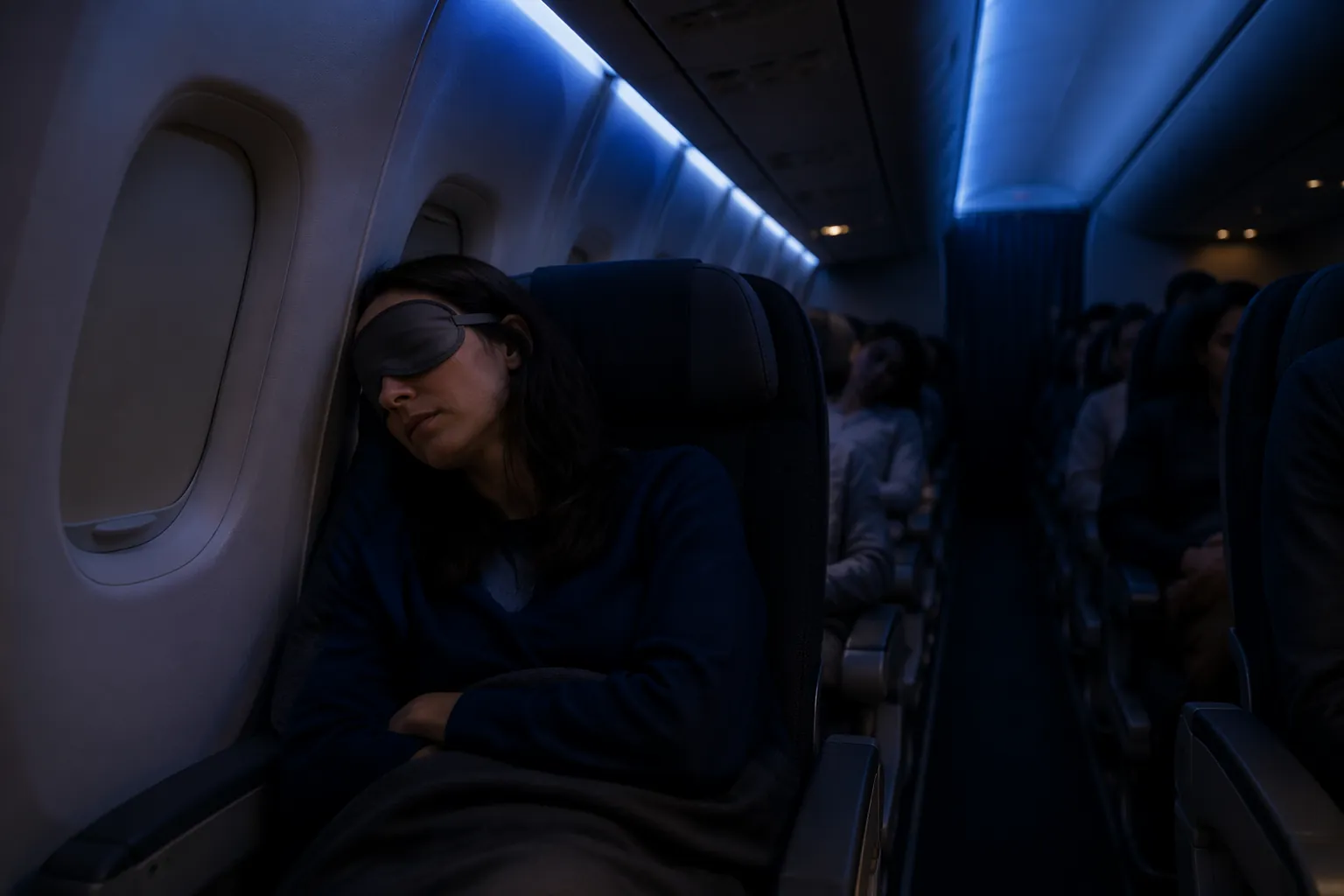
What the Quiet Skies Act Would Actually Change
The confusing part is that many travelers experience the current system as if a ban already exists. On United, American, Southwest, Delta, and other major U.S. carriers, voice calls are not allowed as a matter of airline policy. The proposed law would not suddenly make today’s typical U.S. cabin quiet for the first time. It would make the no-call rule harder to undo, harder to reinterpret, and less dependent on each airline deciding that passenger peace is worth preserving.
That distinction is not trivia. A traveler trying to plan sleep around a flight needs to know whether the cabin environment is protected by law, by airline custom, or by whatever the crew can enforce in the moment. The Quiet Skies Act would move in-flight voice calls from the softer category of carrier policy into a federal prohibition, if it passes and the FAA completes the required rule.
| Question | Status as of July 23, 2026 |
|---|---|
| Are in-flight phone calls federally illegal in the U.S.? | No. The Quiet Skies Act has been introduced but has not become law. |
| Do major U.S. airlines already prohibit voice calls? | Yes, by airline policy. |
| What would H.R. 9530 do if enacted? | It would require the FAA to finalize a ban on in-flight voice calls within 180 days. |
| Why are people talking about this now? | Better in-flight Wi-Fi makes voice calling more technically realistic, so policy gaps matter more. |
The timing is partly technological. A phone call that used to be impractical at cruising altitude is becoming easier as faster satellite Wi-Fi reaches more cabins. British Airways began allowing in-flight voice calls over Wi-Fi in April 2026, and Virgin Atlantic has also been reported as moving in that direction.[3] A community-sourced StarlinkFlights tracker lists 42 airlines with Starlink agreements, a useful signal of how quickly the technical barrier is falling, though individual airline policies still need to be checked carrier by carrier.[4]
That is the real hinge: not whether one passenger can technically place a call, but whether a cabin full of better connectivity slowly becomes a cabin where calls feel normal. For sleep, that shift would be more than an etiquette nuisance.
Why One-Sided Calls Are Worse Than Cabin Hum
Airplanes are already loud. The strange thing is that many people can sleep through the steady roar of a cabin but snap awake when two rows back someone starts narrating a layover, a sales problem, or a family argument. Volume is not the only issue. Predictability matters.
A steady engine-and-airflow wash gives the brain something relatively stable to file as background. Intermittent speech does the opposite. Human conversation changes in pitch, rhythm, emotional tone, and meaning. One-sided phone calls can be especially sticky because the listener’s brain keeps trying to complete the missing half. Even when you do not want to listen, the auditory system keeps sampling the sound for relevance.
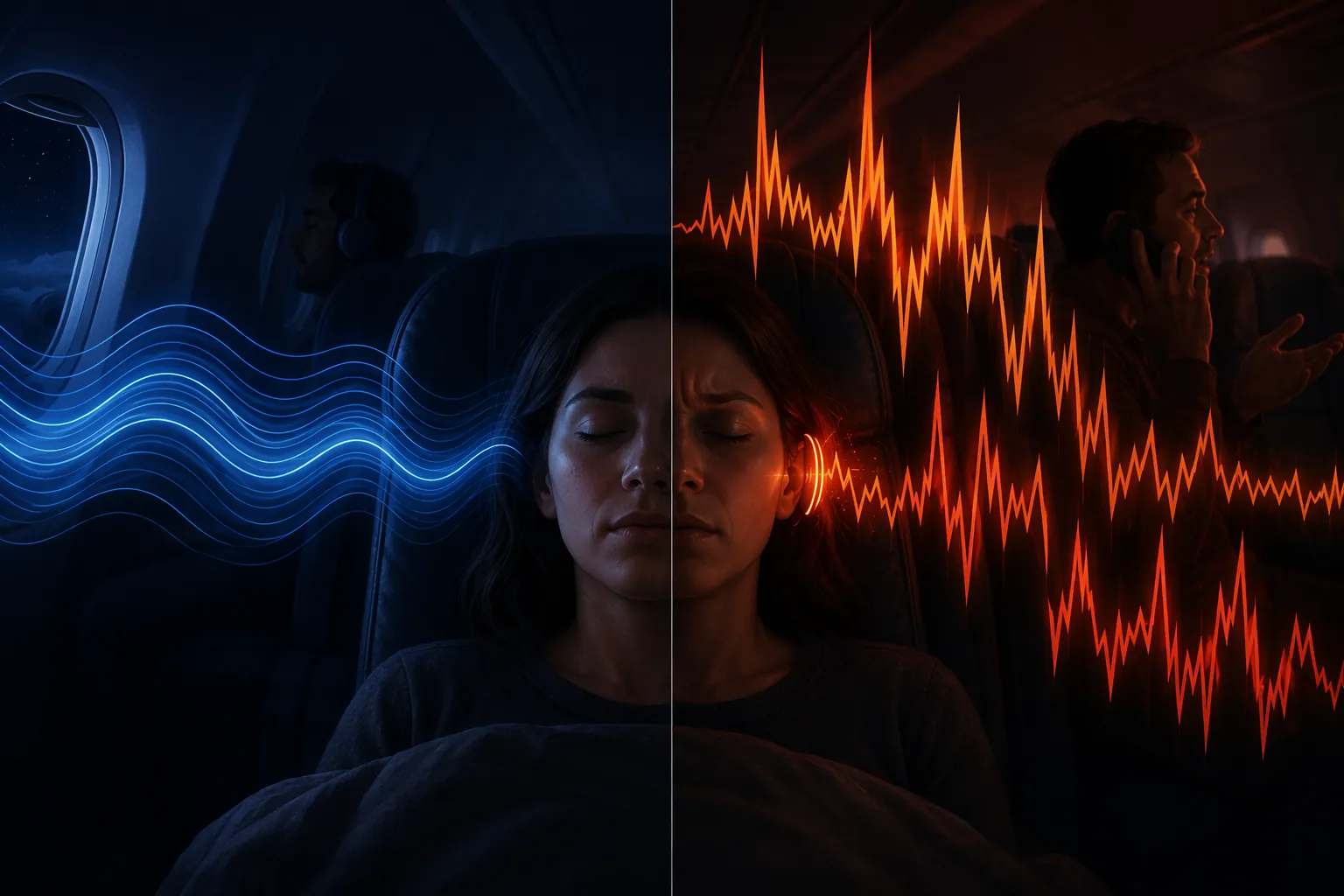
The sleep research here should be handled carefully. A 2026 Verywell Health article, citing a study in Sleep, reported that earplugs helped mitigate the effects of intermittent noise on sleep quality, alertness, and mood.[5] That does not prove that a federal phone-call ban will produce a specific number of extra minutes of sleep for every passenger. It does support a narrower, useful point: reducing unpredictable noise is more relevant to sleep than simply accepting that airplanes are noisy places.
Travel sleep advice often treats “noise” as one bucket. In practice, the cabin contains different kinds of sound. A low, steady hum can sometimes work like accidental white noise. A seatmate’s repeated call attempts, a speakerphone leak, or a business update delivered in half-whispers can keep resetting the body’s alertness. Rob Hitch’s travel-noise guidance makes the same practical distinction: inconsistent noise tends to disturb sleep differently than steady background sound.[6]
This is also where flight attendants enter the sleep story. A cabin with voice calls is not just louder; it gives crews another conflict to manage. The Association of Flight Attendants-CWA has long opposed allowing in-flight cell calls and supports efforts to stop them.[7] That matters for passengers because a tired cabin is already a high-friction space. Every new argument over call volume, call timing, and whose need is more important takes attention away from keeping the flight calm.
Quiet Helps, But It Does Not Solve the Body You Brought Onboard
A no-call cabin removes one disruptive variable. It does not lower a hot flash, un-swell an ankle, settle an ADHD nervous system, or make a complicated medication schedule safe across time zones. That is why the best way to use a quieter plane is not to add a longer packing checklist. It is to identify the thing most likely to wake your body after the cabin settles.
For some travelers, the answer is sound. For others, it is heat, circulation, medication timing, pain, anxiety, bathroom access, or the simple fact that upright sleep is fragile. The quieter cabin becomes the baseline. Your own sleep barrier still needs a plan.
If Perimenopause Makes Flights Feel Too Hot
For a traveler in perimenopause, a silent row does not help much if the body keeps jolting awake from heat. Cabin temperature can swing between chilly boarding, warm taxiing, and cooler cruising. Add a blanket, stress, alcohol, dehydration, and a long dark flight, and a hot flash can become the event that breaks sleep open.
The practical move is to treat temperature control as sleep equipment, not comfort decoration. Wear layers that can come off without standing. Keep the lightest layer breathable. Avoid trapping heat under a heavy scarf or thick hoodie before you are actually asleep. If you use a travel blanket, choose one you can push aside quickly rather than something that pins you in.
Alcohol is worth a stricter look here than most travel articles give it. It may make boarding feel easier, but it can fragment sleep and may worsen temperature instability for some people. On a long-haul flight, the better bargain is boring: water early, a cooling layer within reach, and a seat setup that lets you uncover without disturbing the person beside you.
For route-specific timing on a long overnight itinerary, Restful Ground’s guide to sleeping on the Manila to Los Angeles overnight flight goes deeper into perimenopause and long-haul sleep timing.
If You Are Pregnant, Plan Around Circulation Before Sleep
Pregnancy changes the in-flight sleep problem because stillness has a cost. The goal is not to achieve a perfect uninterrupted sleep block by refusing to move. On longer flights, especially over four hours, the plan needs to include circulation: safe movement, hydration, and clinician-approved compression stockings when appropriate.
That means sleep strategy starts before the eye mask. Ask your prenatal clinician whether compression stockings are appropriate for your pregnancy and flight length. Choose footwear you can get back on if your feet swell. Keep water accessible so drinking does not depend on the service cart. When the seatbelt sign is off, brief walks or ankle movements are not a failure of sleep discipline; they are part of making rest safer.
A quieter cabin can help you fall back asleep after those planned interruptions. That is the point of a proposed phone-call ban for pregnant travelers: not eight uninterrupted hours in an economy seat, but fewer avoidable sound spikes when your body already has legitimate reasons to wake.
If ADHD Makes Every Sound Arrive at Full Force
For many ADHD adults, the problem is not ordinary noise sensitivity in the casual sense. It is the effort of filtering. A cough, a snack bag, a seatback screen, a call notification, and a half-heard conversation can all compete for attention when the task is supposed to be doing nothing.
This is where a no-call cabin and personal sound control work together. Noise-canceling headphones reduce part of the cabin load, but they are often better with a consistent masking sound underneath. Brown noise or pink noise may feel less sharp than bright white noise for some people. The aim is not to make the aircraft silent. It is to give the brain one predictable sound layer instead of dozens of small interruptions.
- Download noise tracks before boarding; do not depend on in-flight Wi-Fi.
- Test the volume while awake so it masks speech without becoming another irritant.
- Use a familiar playlist or sound profile rather than experimenting mid-flight.
- Keep tactile fidgets quiet and low-light if they help you settle without waking a seatmate.
If phone calls become rarer or federally prohibited, that removes one of the hardest sounds to mask: nearby speech with meaning. Headphones can do more when they are not fighting a live conversation.
If You Are Over 65, Be Careful With “Just Take Something” Advice
Older travelers often get the worst version of sleep-aid advice: casual, confident, and too thin on safety. A flight is not the place to discover how a sedating medication interacts with your balance, bladder urgency, blood pressure, memory, or the pill organizer you packed for three time zones.
Dr. Virginia Skiba of Henry Ford Health advises against over-the-counter antihistamines and prescription sleeping pills for flights under 10 hours because of grogginess on landing.[8] That warning deserves extra weight for older adults. Diphenhydramine and similar sedating antihistamines are the kinds of medications clinicians often review carefully in people 65 and older because of anticholinergic effects, confusion risk, and fall concerns.
The safer preflight question is not “What knocks me out?” It is “What will I need to do when I land?” If you must navigate immigration, stairs, a rental car counter, a rideshare pickup zone, or an unfamiliar bathroom after arrival, lingering sedation is not a small inconvenience. It can become the trip’s first hazard.
- Ask a pharmacist or clinician to review any sleep aid against your age, diagnoses, and current medications.
- Check whether an OTC product contains diphenhydramine or another sedating antihistamine.
- Plan time-zone medication timing before departure, especially for drugs that cannot simply shift by guesswork.
- Favor low-risk supports first: light exposure timing, hydration, a stable neck position, and predictable sound masking.
A Quieter Cabin Still Needs a Sleep Plan
If the Quiet Skies Act becomes law, it will not make airplane sleep easy. It will not widen the seat, lengthen the recline, calm turbulence, or make a midnight connection less punishing. What it can do is protect the cabin from a category of intermittent speech noise that is especially hard for tired brains to ignore.
The best case for a phone-call ban is not that it guarantees sleep. It is that it makes the cabin more sleep-compatible, so the strategy matched to your body has a better chance to work.
References
- Stanton Introduces the Quiet Skies Act to Finalize Ban on In-Flight Cell Phone Calls — Office of Congressman Greg Stanton, July 2026
- Summary of FAA Reauthorization Act of 2018 — TWU
- British Airways Allows Inflight Voice Calls on Wi-Fi — AFAR
- Every Airline With Starlink WiFi — Complete 2026 List — StarlinkFlights
- 11 Science-Backed Tips to Sleep Better on a Plane — Verywell Health
- How to Sleep on a Plane: Reduce Noise and Sleep Better — Rob Hitch
- Flight Attendant Union Vows To Fight FCC Plan — AFA-CWA
- A Sleep Expert Shares How To Actually Sleep On A Plane — Henry Ford Health, April 2025
Safety & eligibility read
Cross-check against other interventionsExplore the mechanism
Next step
Spot an error or have clinical feedback?
Because this article covers clinical, medication, or safety information, we use a moderated correction channel instead of open public comments. Let us know if something about “How a Phone Call Ban Can Improve In-Flight Sleep” needs a closer look.
Send feedback on this article