
Why Housing Alone Doesn't Fix Sleep for Homeless Older Adults
Poor sleep quality persists in homeless-experienced older adults even after they obtain housing. This article identifies the clinical and social factors—depression, chronic conditions, pain, and social isolation—that must be addressed for sleep to improve.
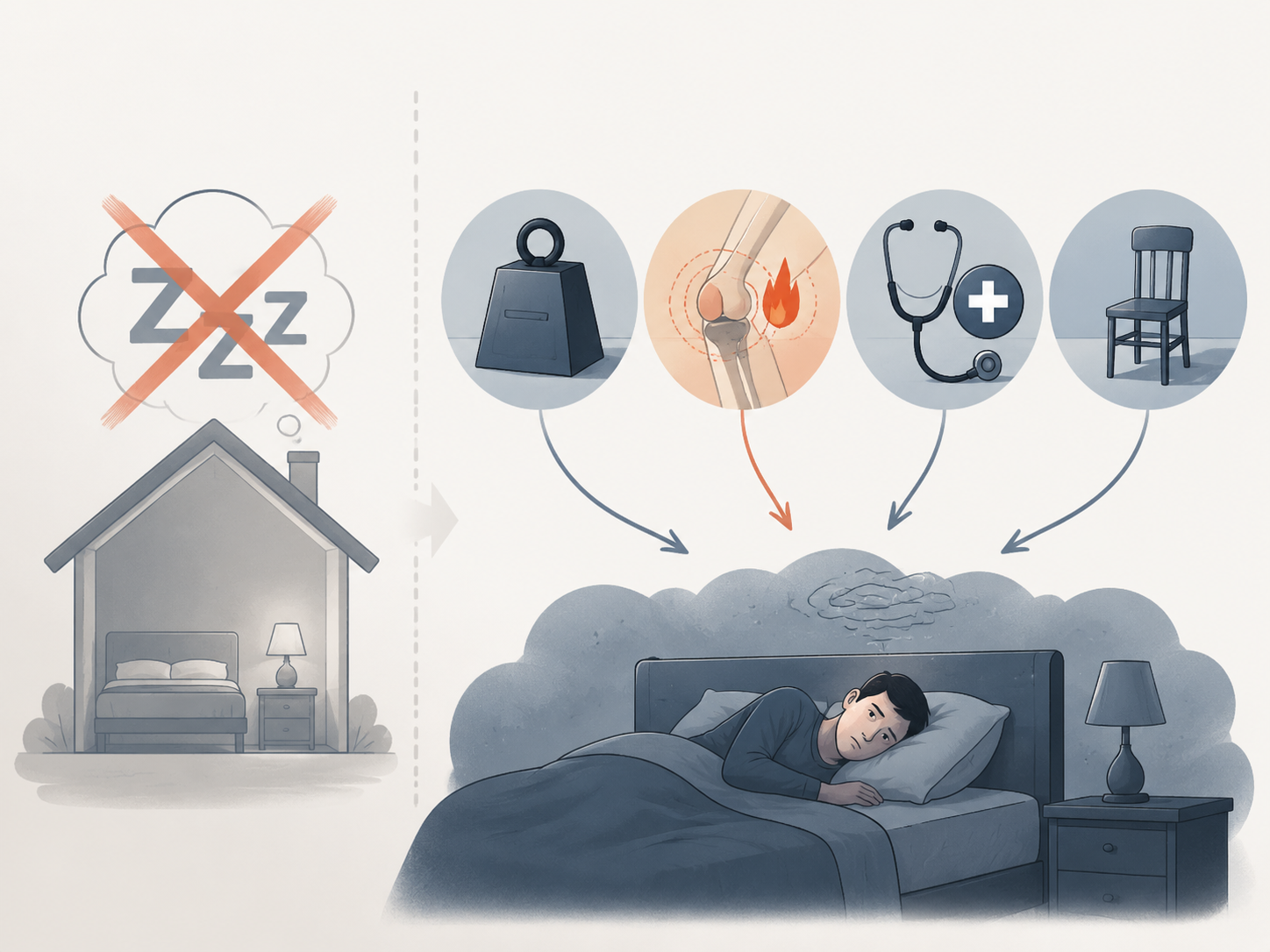
The HOPE HOME data make the central point quickly: in homeless-experienced older adults, poor sleep stays common even after housing, and once depression, pain, chronic illness, ADL impairment, and social connection are accounted for, housing status itself no longer explains much of the difference in sleep quality. In this literature, "older adult" starts at 50 because homelessness is associated with accelerated aging, so the population is younger than a standard gerontology cutoff would suggest. [1]
What the numbers actually say
The sleep burden is not subtle. HOPE HOME found poor sleep quality in 67% of homeless-experienced older adults, using PSQI scores of 6 or higher, compared with 44% to 53% in housed adults age 70 and older; even after housing, 28% still had moderate-to-severe sleep disturbance on PROMIS measures. [1]
- Depressive symptoms: AOR 2.03 for poor sleep quality. [1]
- Chronic conditions: AOR 1.76. [1]
- ADL impairment: AOR 1.85. [1]
- Loneliness: AOR 1.55. [1]
- Having at least one confidant: AOR 0.56, or 44% lower odds of poor sleep. [1]
That pattern matters because it shifts the reading away from housing as the sole lever. Housing opens the possibility of sleep recovery, but it does not override active depression, pain, illness burden, functional limits, or social isolation. [1]
Why sleep hygiene misses the setting
Standard sleep hygiene assumes control over temperature, light, noise, bedding, and bedtime. People with an unstable housing history often do not have that control, and shelter rules can add early wake-ups or crowded sleeping conditions on top of that. So the problem is not that sleep advice is useless; it is that the usual advice is built for a different environment.
The permanent supportive housing literature is a useful reality check. In a longitudinal study of formerly homeless adults in permanent supportive housing, insomnia improved over time, but a substantial subgroup still reported clinically significant sleep disturbance. Housing helped; it did not finish the job. [2]
What deserves attention instead
The most actionable signals are also the most ordinary: treat depression, manage pain, reduce the burden of chronic disease, support function, and make social connection a clinical target instead of a vague nice-to-have. That fits with the loneliness-sleep fragmentation pathway and with the depression-insomnia cycle.
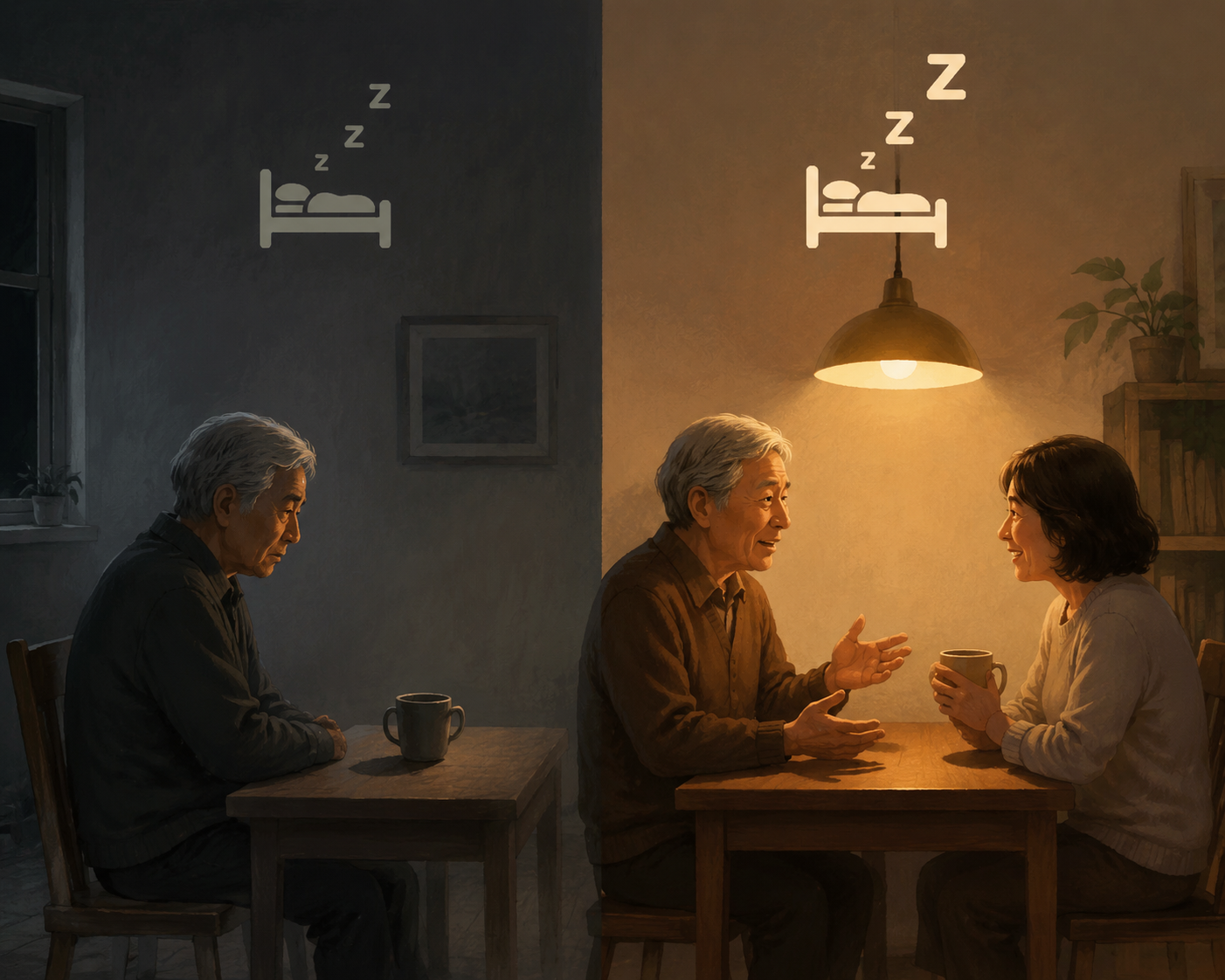
The loneliness finding is especially concrete: having at least one confidant cut the odds of poor sleep by 44%, which makes social support more than a feel-good add-on. In practice, that means the question is not only whether someone has a bed, but whether they have anyone they can actually talk to after the lights go out. [1]
The intervention gap is real
The intervention literature is thin. A scoping review found almost no sleep-specific trials in homeless-experienced adults, with only limited evidence for a mantram repetition program and BBTI standing out as a plausible adapted option rather than a proven fix. [3]
That leaves a sober clinical judgment: stable residence matters, but sleep recovery follows when depression, pain, chronic illness, functional limits, and social isolation are addressed alongside housing. The move-in date is not the endpoint. [1][2]
References
- Sleep Quality among Homeless-Experienced Older Adults: Exploratory Results from the HOPE HOME Study — PubMed Central — PMC10897106
- Investigating sleep disturbance and its correlates among formerly homeless adults in permanent supportive housing — PubMed Central — PMC7959063
- Sleep Health in People Experiencing Homelessness: A Scoping Review — Wiley Online Library — Wiley source
Explore the mechanism
Next step
Spot an error or have clinical feedback?
Because this article covers clinical, medication, or safety information, we use a moderated correction channel instead of open public comments. Let us know if something about “Why Housing Alone Doesn't Fix Sleep for Homeless Older Adults” needs a closer look.
Send feedback on this article