
The confusing part is that loneliness does not always steal obvious hours from the night. A person can go to bed at a reasonable time, stay there for seven or eight hours, avoid late caffeine, and still wake as if sleep never became fully safe. That pattern matters because the best evidence on how loneliness affects sleep quality points less toward shortened sleep and more toward disturbed sleep continuity.
In a systematic review and meta-analysis of 27 studies, Griffin and colleagues found that loneliness was associated with sleep disturbance, with a pooled correlation of r = .28, but was not clearly associated with total sleep duration.[1] That dissociation is easy to miss. It means the problem may not show up as “I slept only four hours.” It may show up as “I was in bed long enough, but the night felt thin, restless, and unconvincing.”
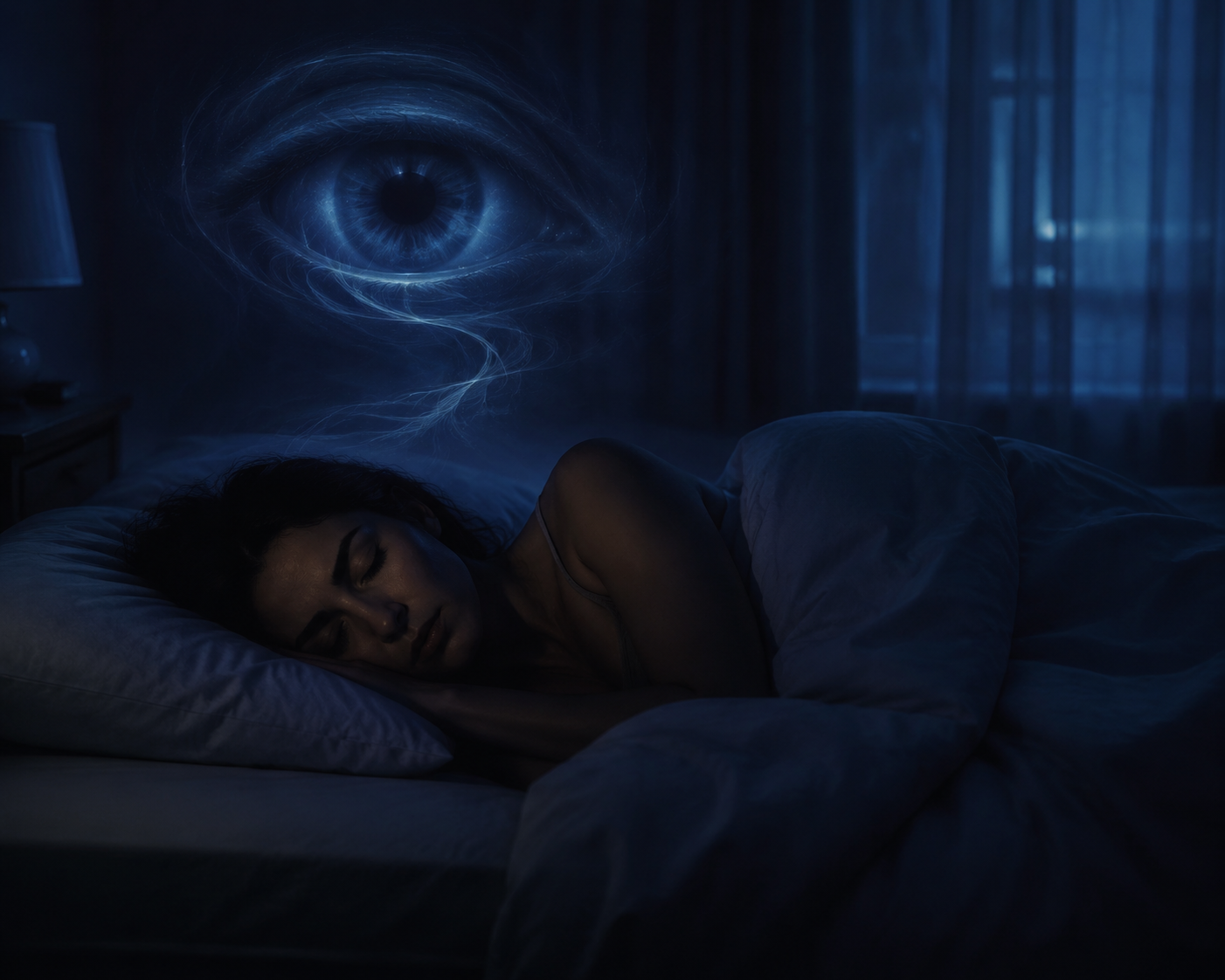
Loneliness changes the quality of sleep before it changes the clock
Sleep duration is a blunt instrument. It can tell you how long a body remained in bed or how long a device estimated sleep, but it cannot by itself tell you whether sleep held together. A night can contain enough minutes and still fail at the work people most need from it: stable restoration, emotional recalibration, and a felt sense of having been released from alertness.
That is why the Griffin finding is more useful than a generic claim that lonely people “sleep less.” The review supports a narrower and more clinically recognizable pattern: loneliness is reliably tied to disturbed sleep, while evidence for reduced total sleep time is weaker.[1] For someone already doing the usual sleep-hygiene tasks, this distinction is not academic. It shifts attention from the number of hours to the nervous system state carried into those hours.
Loneliness also should not be flattened into objective social isolation. A person can live alone and feel socially safe, or live among others and feel unseen, mistrusted, or emotionally unprotected. Sleep seems especially sensitive to that second condition: the felt absence of reliable social safety.
What fragmented sleep actually means
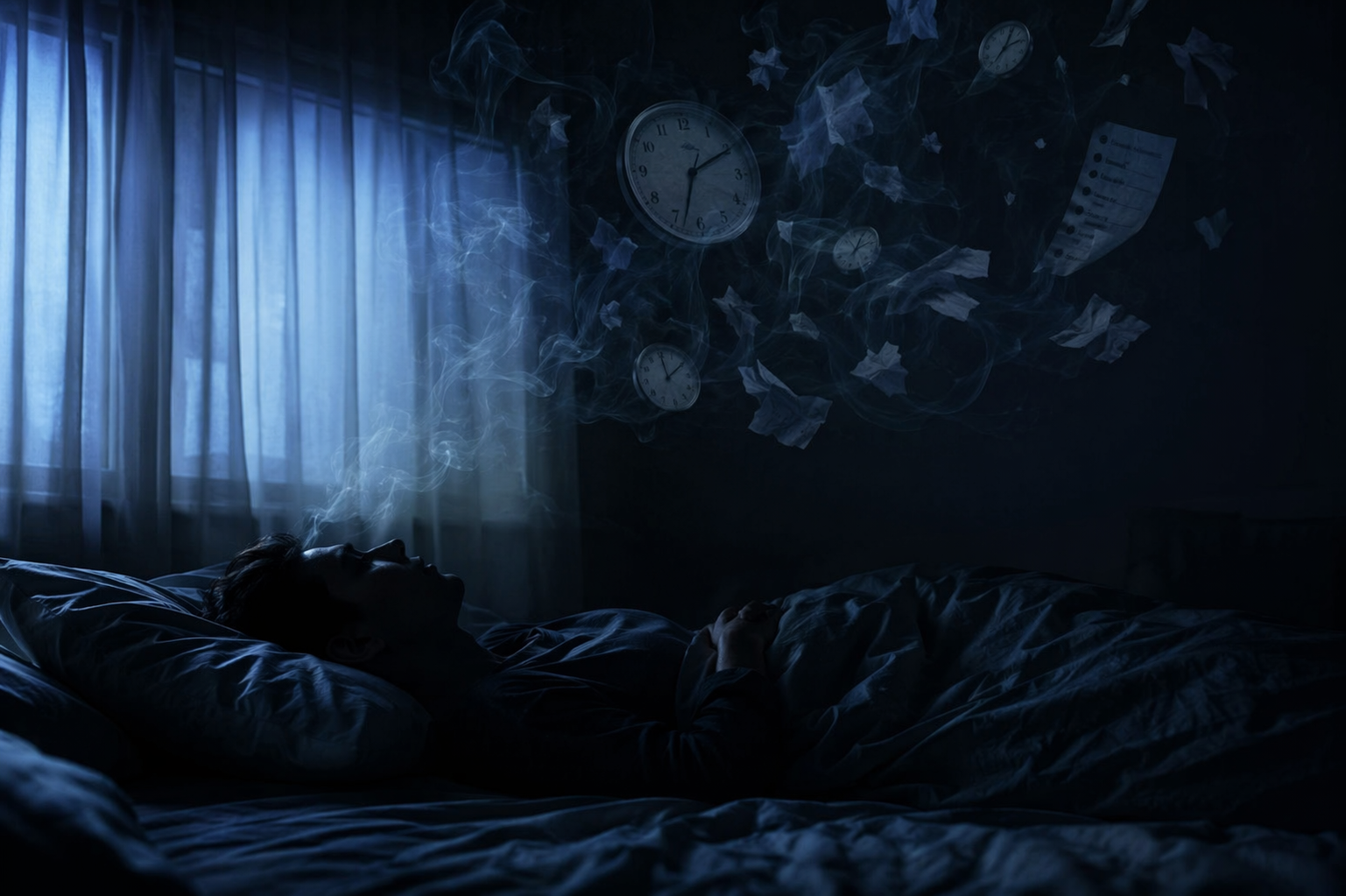
Fragmented sleep does not necessarily mean lying awake for hours. It can mean more brief arousals, more shifts into lighter sleep, and more interruptions in the continuity of the night. Some awakenings are so short that a person does not remember them in the morning. The body may register them anyway.
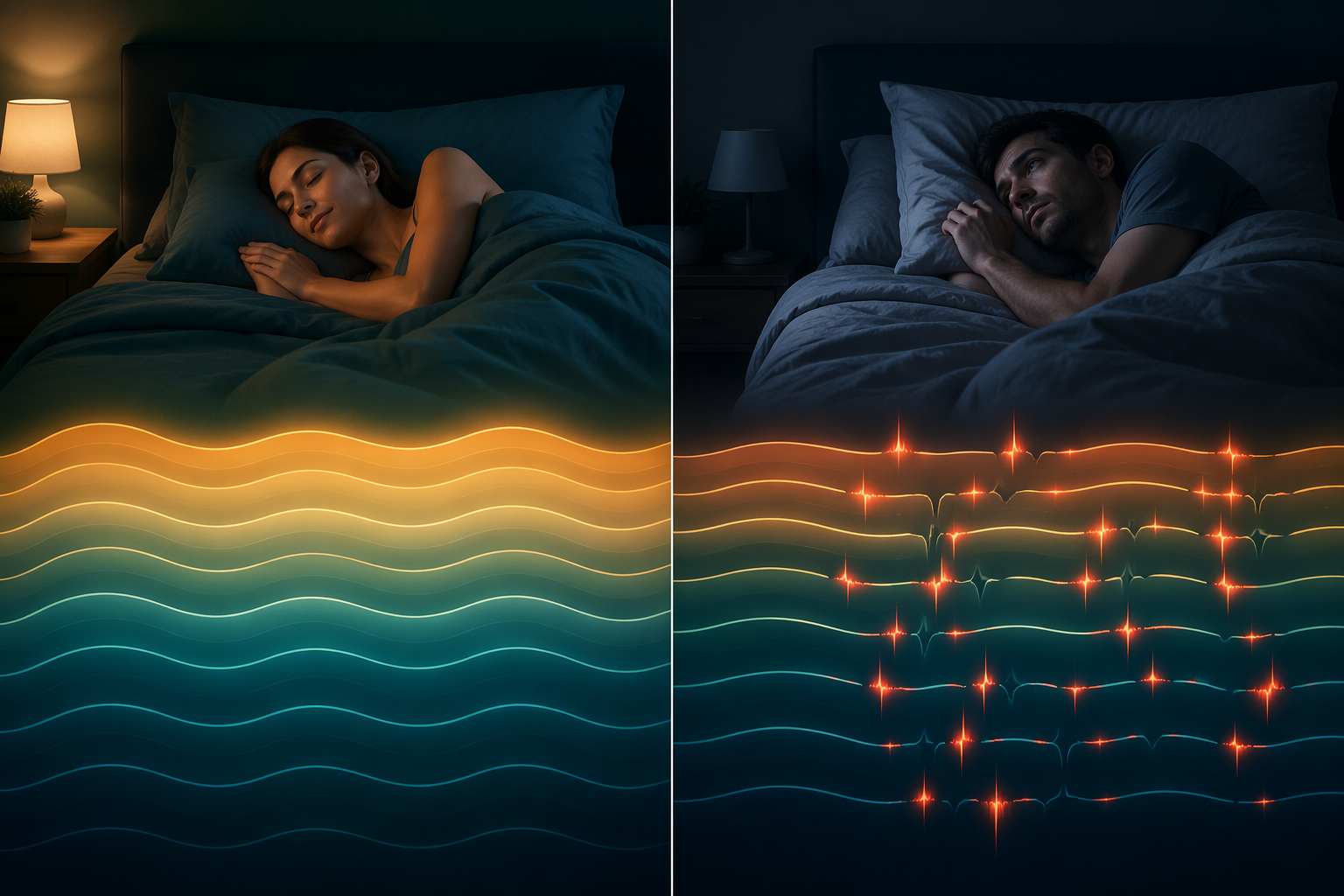
The strongest physical trace comes from a 2011 actigraphy study by Kurina and colleagues in a communal Hutterite population. In that study, each one-unit increase on the UCLA Loneliness Scale was associated with about an 8% increase in objectively measured sleep fragmentation.[2] The setting is important because Hutterite communities are highly communal; loneliness in that context could not be lazily equated with simply being alone.
Actigraphy is not the same as a full sleep-lab study, but it is still a meaningful step beyond asking people how they slept. It uses movement patterns to estimate sleep and wakefulness across real nights. In the Kurina study, loneliness showed up not only as a complaint about sleep but as a more broken sleep pattern.[2]
A useful way to picture this is not a door that stays open all night, but a latch that keeps clicking. The sleeper may not fully wake. The next morning may contain no dramatic memory of insomnia. Still, the repeated interruptions can leave the night feeling unrestorative.
The hypervigilance explanation
John Cacioppo and colleagues framed loneliness as more than sadness about being socially disconnected. In their evolutionary account, loneliness functions partly as a signal that the social environment is unsafe or insufficiently protective, increasing attention to possible social threat.[3] That model helps explain why loneliness would disturb sleep in particular. Deep, consolidated sleep requires the brain to stand down. Hypervigilance asks it not to.
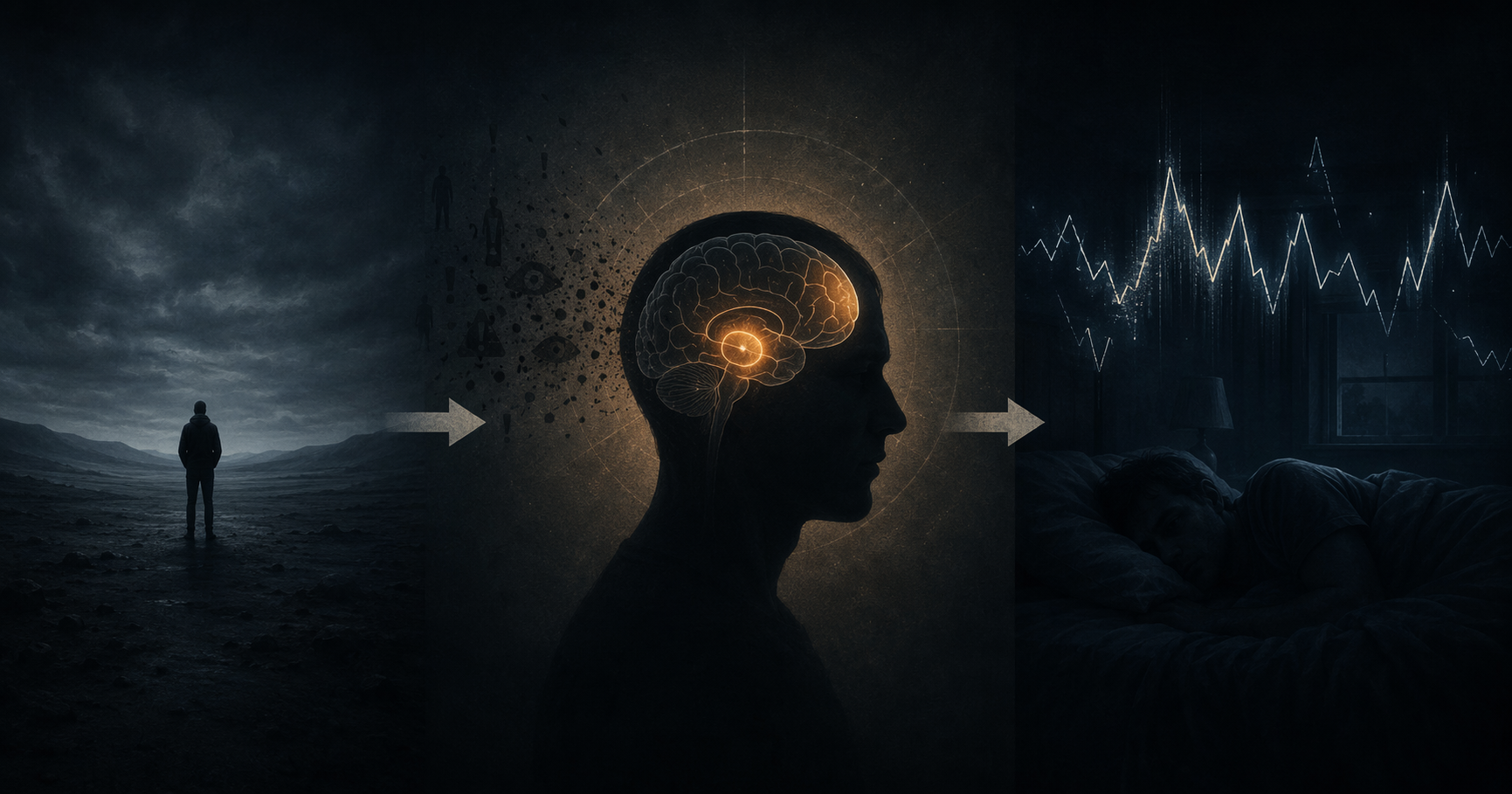
The phrase “sleeping with one eye open” is not a literal diagnosis. It is a useful shorthand for a biological compromise: part of the system is trying to sleep, while another part continues sampling the environment for danger. If the brain reads social disconnection as reduced safety, then nighttime may become less a protected interval and more a period of partial monitoring.
This is also where loneliness overlaps with other forms of threat physiology without becoming identical to them. Financial stress, disaster anxiety, and trauma-related stress can all keep the nervous system on watch. The pathways are not interchangeable, but the shared theme is a body that has trouble granting itself permission to disengage. Restful Ground’s pieces on financial stress and sleep biology, earthquake anxiety at night, and wildfire-related trauma and sleep describe related versions of this safety problem.
The appeal of the hypervigilance model is that it gives the symptom some dignity. Restless sleep in this frame is not a moral failure, a lack of discipline, or proof that someone is exaggerating. It may be an old protective system applying the wrong setting to a modern social wound.
Subjective sleep can be impaired even when devices look calm
The evidence becomes more complicated when researchers compare what people report with what devices measure. That complication should not be treated as an embarrassment. It is one of the most important parts of the story.
In the E-Risk twin study, Matthews and colleagues studied 2,232 young adults and found that loneliness was associated specifically with subjective sleep quality and daytime dysfunction, not with sleep duration or sleep efficiency. Lonelier young adults were 24% more likely to report daytime dysfunction, and the association remained after accounting for depression and anxiety.[4]
That pattern is not the same as proving loneliness independently causes poor sleep in every person. It does suggest that the burden of loneliness may be carried into the next day as fatigue, impairment, or unrefreshing sleep even when standard sleep-duration measures do not show a dramatic loss.
The subjective-objective gap also appears in more recent daily-life work. Johnson, Zawadzki, and Kho found that daily average loneliness predicted poorer subjective sleep quality and shorter self-reported sleep duration in ecological momentary assessment, but they did not find significant associations with objective Fitbit sleep measures.[5] There are at least two reasonable readings of that result. Loneliness may affect the felt quality of sleep more than consumer devices can detect, or consumer wearables may miss the particular fragmentation signal that more specialized methods can capture.
Neither interpretation licenses dismissing the sleeper’s report. A wearable can be useful and still fail to measure what matters most to the person wearing it. At the same time, subjective sleep quality is not pure biology; mood, expectation, and morning distress can color the report. The honest conclusion is narrower: loneliness has a consistent relationship with disturbed and unrefreshing sleep, while the exact measurement channel depends on the tool, population, and night being studied.
Depression complicates the claim, but does not erase it
Loneliness and depression often travel together, and depression itself can disrupt sleep. The Griffin meta-analysis noted that controlling for depression attenuated the loneliness-sleep association in several studies.[1] That matters. If an article treats loneliness as a clean, independent switch for sleep disturbance, it is overstating the evidence.
But attenuation is not erasure. The Kurina actigraphy findings were reported independent of depressive symptoms, and the Matthews twin study found loneliness-related subjective sleep impairment after accounting for depression and anxiety.[2][4] A cautious reading is that loneliness may affect sleep both directly, through social-threat vigilance, and indirectly, through depressive symptoms or anxiety in some people.
This is why persistent nonrestorative sleep deserves more than a loneliness checklist. If low mood, loss of interest, early-morning waking, panic, trauma symptoms, snoring, gasping, restless legs, or severe daytime sleepiness are present, the sleep problem may need clinical evaluation on its own terms. The overlap with the depression-insomnia cycle is real, and it can make simple cause-and-effect stories misleading.
Poor sleep can also make social life feel more threatening
The main direction here is loneliness disturbing sleep, but the loop can run the other way too. Ben Simon and Walker found that sleep deprivation decreased activity in prosocial Theory of Mind networks while increasing activity in Near Space networks involved in threat detection. In their study, sleep-deprived individuals kept 13% to 18% more personal distance and were rated as significantly lonelier by blind observers.[6]
That finding does not prove that one bad night creates chronic loneliness. It does show a plausible neural and behavioral route by which poor sleep may make social contact feel more effortful or intrusive. A lonely person sleeps lightly; the next day, a sleep-deprived brain may read people as less inviting and more threatening; social withdrawal then becomes easier to repeat.
The longitudinal evidence is still mixed. Griffin and colleagues noted that only eight studies had examined loneliness as a risk factor for later sleep difficulties, with inconsistent results.[1] The biology is coherent, and the cross-sectional and experimental pieces fit together in suggestive ways, but the causal timeline is not settled for every population.
What the mechanism implies for a person lying awake
The mechanism does not reduce to “make more friends.” Social safety is not manufactured on command at bedtime, and loneliness is not corrected by scolding someone into more activity. Still, the hypervigilance account does suggest a practical shift: the goal is not only to lengthen sleep opportunity, but to reduce the brain’s need to monitor.
- If the night is long enough but unrefreshing, track sleep quality, awakenings, and daytime function rather than only total hours.
- If loneliness feels strongest at night, treat that as a safety signal, not as proof of personal failure.
- If social contact helps, prioritize low-pressure, reliable connection over intense late-night emotional problem-solving.
- If the bedroom itself feels unsafe or alerting, borrow from anxiety-based sleep approaches: reduce unpredictable noise and light, prepare the room before bed, and avoid making the bed a place for threat scanning.
- If poor sleep persists, evaluate other causes rather than assuming loneliness explains everything.
These steps are modest because the evidence supports a mechanism, not a miracle intervention. The best current reading is that loneliness often damages sleep by making the brain less able to stand down. The result can be fragmented, light, unrefreshing sleep even when time in bed appears adequate. That mechanism is credible and clinically relevant, but it is not a substitute for evaluating depression, insomnia disorder, sleep apnea, trauma, medication effects, or other causes of persistent nonrestorative sleep.
References
- Loneliness and sleep: A systematic review and meta-analysis, Health Psychology Open, 2020.
- Loneliness Is Associated with Sleep Fragmentation in a Communal Society, Sleep, 2011.
- Evolutionary mechanisms for loneliness, Cognition & Emotion, 2014.
- Sleeping with one eye open: loneliness and sleep quality in young adults, Psychological Medicine, 2017.
- Loneliness and sleep in everyday life, Sleep Health, 2024.
- Sleep loss causes social withdrawal and loneliness, Nature Communications, 2018.

Comments
Join the discussion with an anonymous comment.