
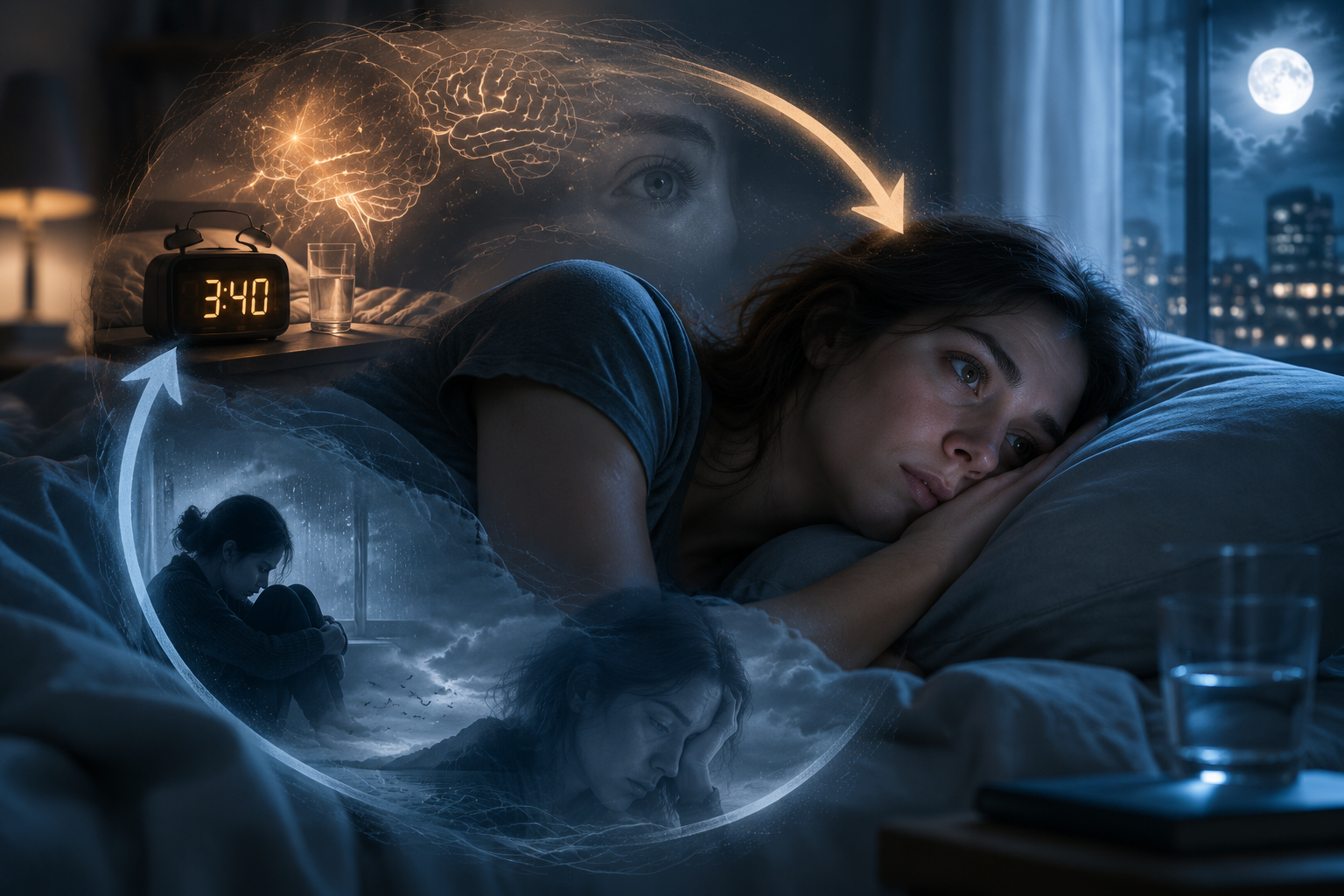
When depression and insomnia arrive together, the most urgent question is usually not academic. If you are awake at 3:40 a.m., already exhausted, already bracing for the mood crash that may follow, you want to know which problem is driving the other — and where there is still room to intervene.
The honest answer is that the direction often runs both ways. Lying awake can weaken emotional regulation, intensify negative thinking, and leave the nervous system less able to recover. Depression can, in turn, disturb sleep timing, worsen early-morning awakening, and make the bed feel less like a place of rest than a place where symptoms gather. Over time, the two can reinforce each other so tightly that separating “cause” from “effect” becomes less useful than finding the most evidence-backed place to break the loop.
The overlap is large. Johns Hopkins Medicine reports that about 75% of people with depression have insomnia symptoms, and that people with insomnia have roughly 10 times the risk of developing depression compared with people without insomnia.[1] Those numbers do not mean every sleepless night is a depression warning sign. They do mean insomnia should not be treated as background noise when mood is worsening.
Insomnia is not just a symptom sitting under depression
For a long time, insomnia was often treated as a downstream complaint: fix the depression, and the sleep will follow. Sometimes that happens. But the better-supported view is more demanding. Insomnia can precede depression, persist after mood improves, and increase future risk in its own right.
The Johns Hopkins Precursors Study is important here because it followed risk across time rather than simply taking a snapshot of people who were already depressed and sleeping poorly. In that long-term cohort, insomnia in young men predicted depression for at least 30 years, supporting insomnia as an independent, long-term risk factor rather than only a coincident symptom.[1]
That finding changes the practical question. If insomnia helps keep the depression-insomnia cycle alive, treating sleep is not cosmetic. It is not merely about feeling a little fresher in the morning. It may be one of the reachable pressure points in a system that otherwise feels locked.
The strongest intervention signal points to CBT-I
The clearest prevention evidence comes from a UCLA trial published in JAMA Psychiatry in 2021. Researchers studied older adults with insomnia, with a mean age of about 70, and found that treating insomnia with cognitive behavioral therapy for insomnia, or CBT-I, reduced the likelihood of major depression by 51% over a 3-year follow-up. Among participants whose insomnia remitted, depression risk fell by 83%.[2]
Those two percentages measure different things. The 51% reduction refers to the overall lower likelihood of major depression after CBT-I in the studied older-adult group. The 83% reduction applies to the subgroup whose insomnia actually remitted. In other words, the trial did not merely show that people attended sessions and later felt better. It tied lower depression risk to successful resolution of insomnia, which is why the result deserves attention.
It also deserves boundaries. This was not a trial of all adults, all ages, and all depression histories. The 51% prevention finding has not been established as a universal estimate for younger adults. It should not be used to promise that CBT-I prevents depression for everyone with sleep trouble. What it does show is clinically meaningful: in older adults with insomnia, treating the insomnia changed future depression risk in a large and measurable way.[2]
CBT-I is often misunderstood as a more serious-sounding version of sleep hygiene. It is not. Sleep hygiene may include helpful supports such as reducing late caffeine, keeping the room dark, and building a consistent bedtime routine. CBT-I is a structured treatment that changes the learned relationship between bed and wakefulness, adjusts time in bed, works with sleep drive, and addresses the anxious or depressive thinking patterns that keep insomnia going. For a fuller explanation of the treatment model, see What Actually Cures Insomnia? CBT-I Explained.
The 2026 American Academy of Sleep Medicine guideline places CBT-I alone as the most efficacious first-line treatment for chronic insomnia, while reserving combination therapy for specific cases.[3] That matters for depression and insomnia because it keeps the hierarchy clear: when insomnia is chronic, the first serious sleep treatment is not a supplement, a tracker score, or another round of generic bedtime advice. It is CBT-I, delivered in a way that fits the patient’s situation. For readers comparing the new guideline with common care options, this 2026 guideline overview is a useful continuation.
When depression is already present, the treatment question becomes more careful. CBT-I can still be relevant when insomnia occurs alongside another condition; the point is not that sleep treatment replaces depression care, but that insomnia may need its own direct treatment rather than waiting passively for mood therapy or medication to solve it. Readers in that situation may want to continue with CBT-I for comorbid insomnia, especially if another medical or psychiatric condition is also in the picture.
| If this describes you | What the evidence suggests |
|---|---|
| Chronic insomnia with mild to moderate depressive symptoms, or depression that is already being treated | CBT-I is a strong first insomnia intervention and may also support mood outcomes. |
| Insomnia that persists after mood improves | Treat the insomnia directly rather than assuming it is only a leftover symptom. |
| Severe depression, rapidly worsening symptoms, or any safety concern | Sleep treatment and depression care should proceed together under clinical supervision. |
| Occasional poor sleep during a stressful week | Start with basic sleep supports, but do not over-medicalize a short-lived pattern. |
For people who want the practical components spelled out — stimulus control, sleep restriction, cognitive restructuring, and what treatment usually asks of you — the CBT-I FAQ is the better next stop than another list of bedtime tips.
Why the loop is biologically plausible
The clinical evidence does not require a perfect biological map before treatment can begin. Still, the shared mechanisms help explain why depression and insomnia can feel less like two separate problems and more like one system repeatedly reactivating itself.
A 2019 review by Fang and colleagues describes several overlapping pathways, including inflammatory signaling, monoamine neurotransmitter systems, shared genetic factors, and circadian clock disruption. The review reports dysregulation involving inflammatory markers such as IL-6, TNF, and CRP; overlap in serotonin and norepinephrine pathways; shared genetic factors estimated at 56% to 74%; and circadian clock gene disruption as part of the connection between insomnia and depression.[4]
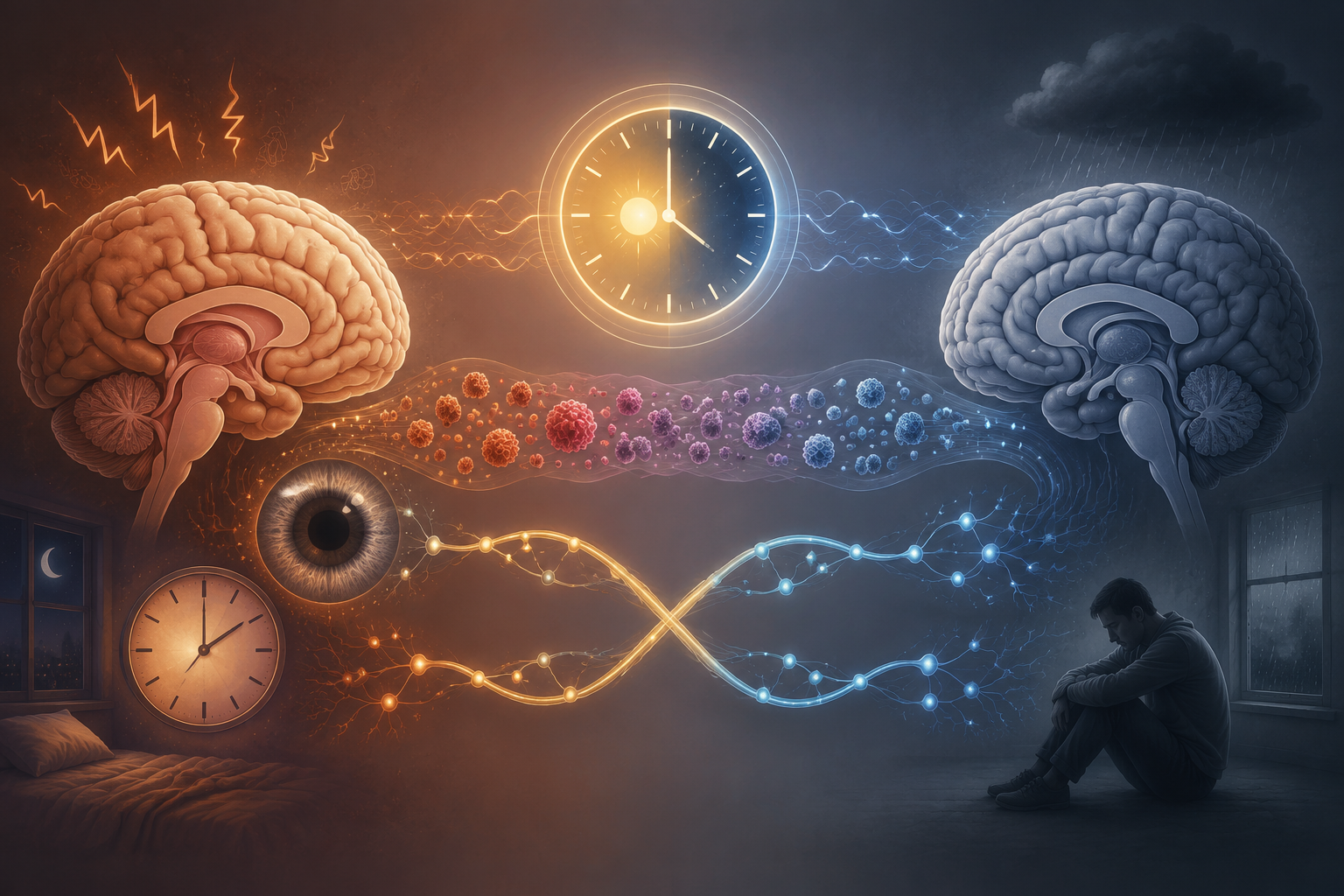
Inflammation is one of the reasons sleep loss can have such a physical quality. Poor sleep can be accompanied by changes in inflammatory signaling, and depression has also been associated with inflammatory dysregulation. That does not mean a routine blood test can neatly diagnose the depression-insomnia cycle, or that inflammation is the single cause. It means the body’s immune signaling is one plausible route by which sleep disturbance and mood disturbance can keep communicating.
The monoamine overlap is similarly useful but easy to overstate. Serotonin and norepinephrine are involved in mood regulation and sleep-wake regulation, which helps explain why depression and insomnia often move together. But neurotransmitter language can become falsely tidy. A person is not awake at night simply because one chemical is “low” or “high.” These pathways are part of a larger regulatory system that includes behavior, timing, stress physiology, light exposure, medications, medical conditions, and learned arousal around sleep.
Circadian disruption is where the biology becomes visible
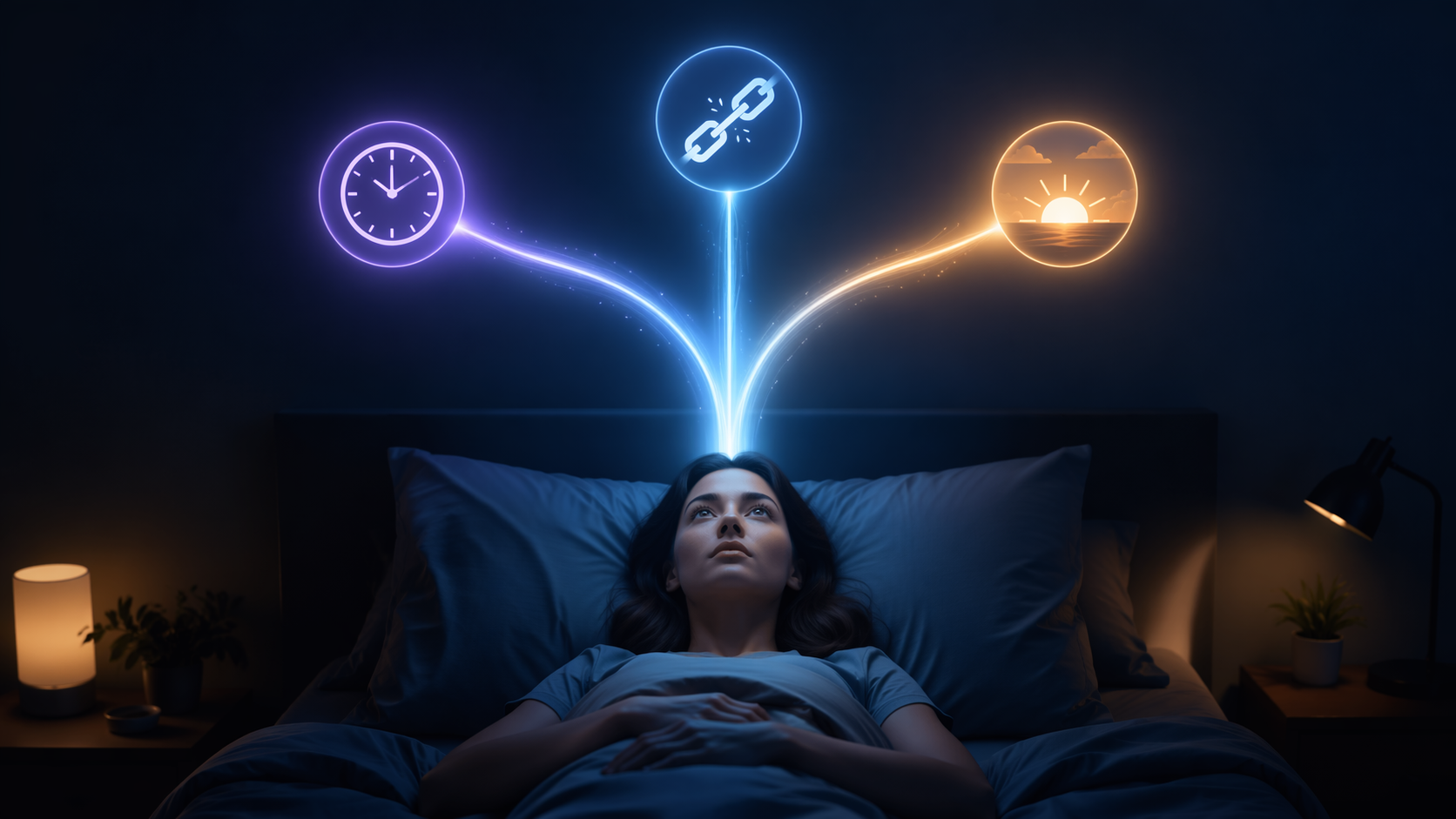
Circadian disruption deserves special attention because it shows up in the lived pattern of the night. Depression can come with early-morning awakening, fragmented sleep, delayed sleep timing, or a sense that the body’s internal schedule is no longer aligned with the clock on the wall. Insomnia can then train the brain to expect wakefulness at precisely the hours when recovery is most needed.
The circadian system helps coordinate sleep pressure, alertness, temperature, hormones, and light response across the day. When that timing system becomes unstable, a person may be sleepy at the wrong time, alert at the wrong time, or awake too early with no reliable way back into sleep. For a deeper explanation of the clock mechanism itself, see Circadian Rhythm Mechanisms.
Early waking is a particularly cruel version of the overlap. It may appear in depression, in insomnia, or in both. The person is not choosing to start the day at 4 a.m.; the sleep system is failing to hold the night together. If staying asleep is the main problem, sleep maintenance insomnia may be the more precise frame than general “bad sleep.”
Contemporary sleep and mental health researchers increasingly describe the relationship as bidirectional rather than one-way. Stanford’s recent framing of the sleep-mental health connection follows that same direction: sleep problems can worsen psychiatric symptoms, and psychiatric symptoms can worsen sleep.[5] The practical implication is not that every reader needs a laboratory explanation. It is that treating sleep and mood as separate silos often misses the way the body actually behaves.
Where sleep hygiene still fits
Sleep hygiene is not useless. A stable wake time, dimmer evenings, less late caffeine, lower alcohol exposure, and a bedroom that supports sleep can reduce unnecessary friction. If those pieces are chaotic, improving them is reasonable. A structured evidence-based bedtime routine can help create a better floor.
But chronic insomnia linked with persistent low mood usually needs more than a cleaner evening routine. The person who has already removed caffeine, bought blackout curtains, and put the phone across the room does not need to be told, again, to relax. They need an intervention that changes the insomnia pattern itself.
That distinction is one reason CBT-I matters. It does not ask the patient to prove they are disciplined enough to sleep. It treats insomnia as a conditioned, physiological, cognitive, and behavioral problem that can persist even when the original trigger has passed.
A practical way to decide what to do first
If insomnia is chronic — difficulty falling asleep, staying asleep, or waking too early despite enough opportunity to sleep — it deserves direct attention. Readers who are unsure whether their pattern has crossed into an insomnia disorder can start with a basic diagnostic overview in the Insomnia FAQ.
When depressive symptoms are mild to moderate, when depression is already being treated, or when insomnia has outlasted other improvements, CBT-I is a serious evidence-backed starting point. The UCLA trial strengthens that case in older adults, and the AASM guideline supports CBT-I as first-line care for chronic insomnia.[2][3]
When depression is severe, worsening, or accompanied by safety concerns, the answer should not be “try to sleep your way out of it.” Mood treatment and sleep treatment need to move together, with clinical care guiding the sequence. Insomnia may still be a valid target, but it should not be used as a reason to delay depression care.
The useful conclusion is narrow and actionable: depression and insomnia can fuel each other, insomnia can carry independent long-term risk, and treating chronic insomnia with CBT-I is often one of the best-supported ways to interrupt the cycle. Not because sleep is simple, and not because depression is minor, but because the night is one place where the loop can sometimes be reached.
References
- Depression and Sleep: Understanding the Connection, Johns Hopkins Medicine.
- New study shows treating insomnia with cognitive behavioral therapy can prevent major depression in older adults, UCLA Health.
- AASM publishes new guideline for combination treatment of chronic insomnia disorder, American Academy of Sleep Medicine.
- The comorbidity of insomnia and depression: a molecular perspective, Journal of Cellular and Molecular Medicine, 2019.
- Sleep and mental health connection: what science says, Stanford Medicine, 2025.
Comments
Join the discussion with an anonymous comment.