
Which Medications Make Heat Dome Nights Dangerous for Older Adults?
Many older adults take medications that affect how their body handles heat. This guide explains which drug classes—diuretics, beta blockers, SSRIs, anticholinergics, and antipsychotics—raise risk during a heat dome night, and provides a medication review checklist to discuss with your prescriber, plus cooling strategies safe for any regimen.
On a heat dome night, the question at the bedside is not only whether an older adult can fall asleep. It is whether the room will cool enough for the body to recover, and whether tonight’s medications change the warning signs the family should watch for.
The first safety line is simple: do not stop, skip, halve, or delay prescribed medication on your own because of the heat. Blood pressure medicine, heart medicine, psychiatric medication, and diuretics can all be risky to change suddenly. The useful move is different: review the whole regimen with a pharmacist or prescriber before the next hot night if possible, and know which symptoms require urgent care.
That review matters because heat dome nights are not ordinary warm nights. During the 2021 heat dome in British Columbia, a study found a 440% increase in community deaths; the average age of people who died was 70, and 75% of deaths were among people 65 or older.[1] The point is not to frighten anyone into distrusting their pills. It is to treat medication as part of the heat-safety plan, especially when sleep is happening in a room that never really cools.
The Medication Classes to Put on the Kitchen Table
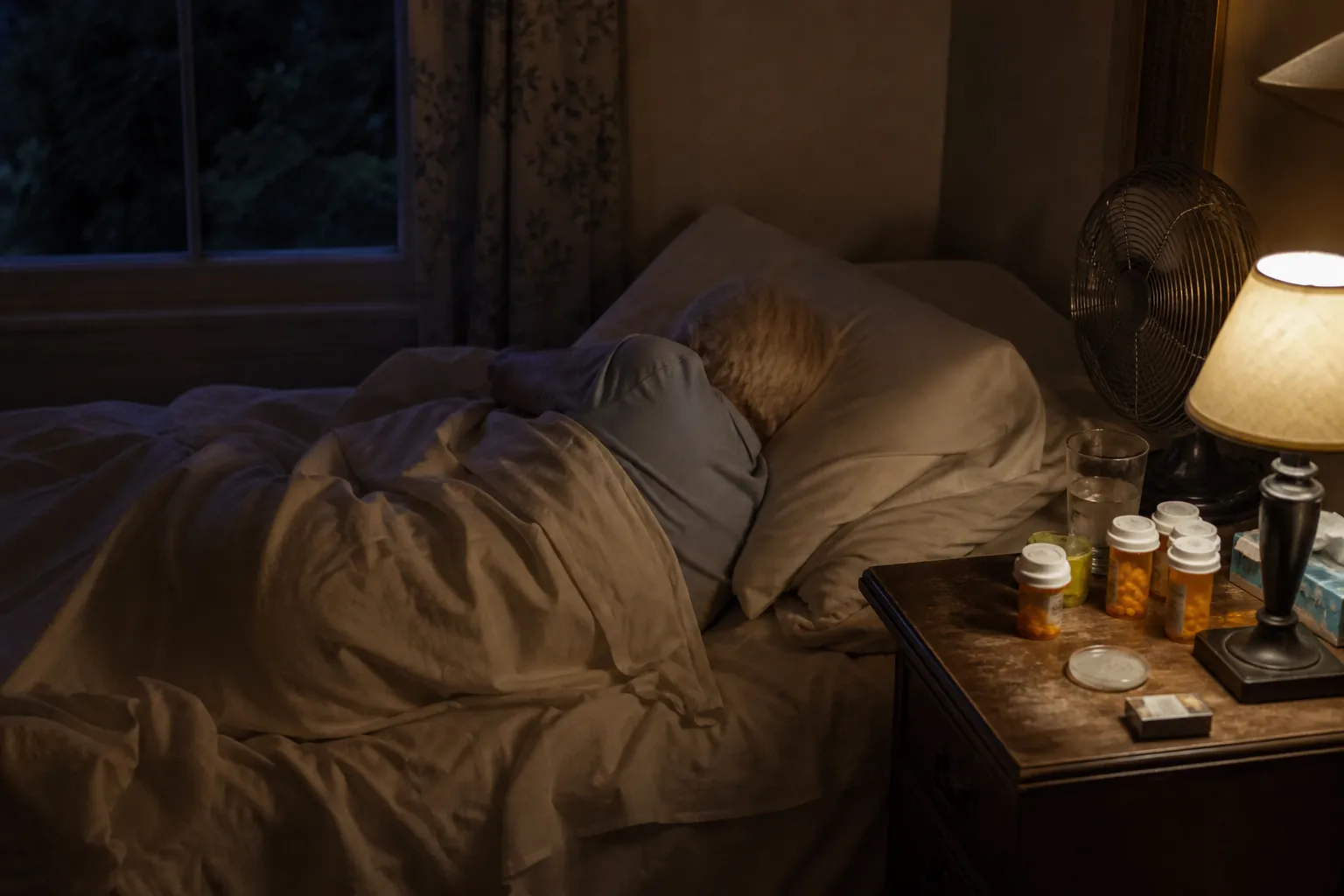
If you are trying to help an older parent, neighbor, or yourself sleep during a heat dome, start by making the medication list visible. Include prescriptions, over-the-counter sleep aids, allergy pills, cold medicines, bladder medicines, supplements, and anything taken only “once in a while.” Heat risk often hides in the combination.
| Medication class or home medicine-cabinet clue | Cooling pathway it may affect | What to ask before the next hot night |
|---|---|---|
| Diuretics, often called “water pills” | Can contribute to volume depletion and electrolyte imbalance | What fluid, weight, blood pressure, or symptom monitoring is appropriate during a heat wave? |
| Beta blockers | Can reduce the body’s ability to increase blood flow to the skin and may reduce sweating | Are there heat-specific signs that should prompt a call, especially if pulse does not rise as expected? |
| Anticholinergic medicines, including some bladder medicines, motion-sickness medicines, and some sleep or allergy products | Can interfere with sweat gland function | Is there a safer alternative during extreme heat, especially for nighttime use? |
| Antihistamines such as diphenhydramine, often found in OTC sleep aids | May have anticholinergic effects that make cooling harder | Should this be avoided or replaced during a heat dome night? |
| SSRIs and SNRIs | Can alter heat perception and may affect sweating or temperature regulation | What heat symptoms should be watched for, and are there medication-specific concerns? |
| Antipsychotics | Can impair central thermoregulation | What urgent signs should the family treat as possible heat illness rather than ordinary confusion? |
| ACE inhibitors or ARBs | May reduce thirst cues or contribute to dehydration risk in heat, especially in combination with other medicines | What hydration guidance is safe for this person’s heart, kidney, and blood pressure history? |
The CDC’s clinical guidance names several medication classes that can increase heat-related risk through different pathways, including diuretics, beta blockers, anticholinergics, SSRIs and SNRIs, and antipsychotics.[2] AARP’s consumer guidance adds the familiar medicine-cabinet examples many families miss, including diphenhydramine in some allergy and sleep products, and notes that multiple medications can compound heat concerns.[3]
Why Nighttime Heat Changes the Problem
Daytime heat gets attention because it feels dramatic. Nighttime heat is quieter and, for older adults, especially unforgiving. Sleep is normally one of the body’s chances to shed heat and reset after the day. If the bedroom stays hot, the body has to keep working while the person is lying still, possibly under sheets, possibly alone, and possibly less able to notice thirst, dizziness, or confusion.
The Duke Heat Policy Innovation Hub, cited by PBS NewsHour, has identified overnight minimum temperature above 75°F as the strongest predictor of heat-related mortality.[4] That does not mean 75°F is a personal danger line for everyone. It does mean the low temperature matters. A night that never cools gives less margin to someone whose medication already limits sweating, thirst, blood-vessel response, or brain temperature regulation.
Indoor temperature is the number to watch when possible. Outdoor forecasts can say the low will be tolerable while an upstairs bedroom, apartment, or room with poor ventilation stays much hotter. If the indoor temperature remains high late into the evening, medication effects become more important, not less, because the person is entering the longest unattended stretch of the day.
What Each Medication Pathway Means at Bedtime
A medication list is more useful when it is read by pathway, not by fear. The question is not “Is this pill bad in heat?” The better question is “Which cooling job might this medicine make harder tonight?”

Diuretics: less reserve when fluid loss adds up
Diuretics help the body get rid of salt and water. They may be essential for blood pressure, heart failure, swelling, or other conditions. In heat, the concern is that the same person may also be losing fluid through sweating, breathing faster, eating less, or drinking less because they do not feel thirsty. The CDC notes that diuretics can contribute to volume depletion and electrolyte imbalance in hot conditions.[2]
At bedtime, the practical question is not “Should we skip the water pill tomorrow?” It is “What is the prescriber’s heat-wave plan for this exact patient?” Some people need daily weights. Some need blood pressure checks. Some have fluid restrictions because of heart or kidney disease. Generic advice to drink a lot more water can be wrong for one person and insufficient for another.
Beta blockers: the pulse may not tell the usual story
When the body is hot, it normally moves more blood toward the skin so heat can leave the body. Beta blockers can interfere with that response by reducing vasodilation and, in some cases, sweating.[2] They can also keep the heart rate from rising in the way family members may expect during distress.
That makes observation trickier. A caregiver may be waiting for a racing pulse before taking the situation seriously, but a beta blocker can make that cue less obvious. For a person on a beta blocker, worsening weakness, dizziness, unusual sleepiness, confusion, faintness, or inability to cool down deserves attention even if the pulse does not seem dramatic.
Anticholinergics and diphenhydramine: sweating can be blocked
Anticholinergic medicines can interfere with sweat gland function, which matters because sweating is one of the body’s main cooling tools.[2] This category is easy to miss because it is not one neat shelf in the medicine cabinet. Some bladder medicines, motion-sickness products, cold remedies, and sleep aids have anticholinergic effects.
Diphenhydramine deserves special attention because many people recognize it as an allergy medicine or as the “PM” ingredient in over-the-counter sleep products, not as a heat-relevant drug. AARP identifies diphenhydramine among medications that can worsen heat intolerance.[3] On a heat dome night, using an OTC sleep aid to force sleep in a hot room may quiet the complaint without making the body safer.
SSRIs and SNRIs: perception and regulation may shift
SSRIs and SNRIs are commonly used for depression, anxiety, pain syndromes, and other conditions. The CDC includes these medications among drugs that may affect heat risk, including through altered heat perception.[2] That phrase matters at home. If a person does not feel as hot as the room actually is, they may resist cooling steps, keep blankets on, or wait too long to mention symptoms.
This is not a reason to stop an antidepressant. It is a reason to treat the room thermometer, hydration instructions, and behavior changes as more reliable than “I feel fine” when the apartment is still hot at midnight.
Antipsychotics: the brain’s thermostat may be less reliable
Antipsychotic medications can impair central thermoregulation, the brain-level control of body temperature.[2] For older adults, this can matter whether the medicine is being used for a psychiatric condition, agitation, sleep, or another prescribed purpose. The heat plan should be made with the prescriber because abrupt changes can cause serious problems.
Families also need a lower threshold for taking confusion seriously. If someone on an antipsychotic becomes newly disoriented, unusually drowsy, agitated, weak, or hard to wake in a hot room, it is not safe to assume the person is just having a bad night.
ACE inhibitors and ARBs: thirst may not be enough guidance
ACE inhibitors and ARBs are widely used for blood pressure, heart, and kidney conditions. AARP notes that these medications may reduce thirst sensation and contribute to dehydration risk during heat, especially when combined with other medicines.[3] The awkward part is that many of the people taking them also have medical reasons not to follow one-size-fits-all hydration advice.
For this group, “drink more” should become a specific question: how much fluid is safe, what counts toward the daily amount, whether electrolytes are appropriate, and what symptoms mean the plan is not working.
The Review Checklist to Use Before the Next Hot Night
If a heat dome is already underway, do what can be done safely tonight: cool the room, check on the person, watch for red flags, and avoid making medication changes without medical guidance. If there is time before the next hot night, this is the checklist to bring to a pharmacist, primary-care office, cardiology office, psychiatry office, or whoever manages the relevant prescriptions.
- Put every medication in one list: prescription drugs, OTC sleep aids, allergy pills, cold medicines, pain medicines, bladder medicines, supplements, and as-needed products.
- Mark the heat-sensitive classes: diuretics, beta blockers, anticholinergics, diphenhydramine or other sedating antihistamines, SSRIs, SNRIs, antipsychotics, ACE inhibitors, and ARBs.
- Ask whether any medication timing should change during extreme heat, especially morning diuretics or nighttime sedating products. Do not change timing until the prescriber or pharmacist confirms it.
- Ask for individualized hydration instructions, including what to do if the person has heart failure, kidney disease, fluid restriction, low blood pressure, or a history of falls.
- Ask what to monitor at home: indoor temperature, blood pressure, pulse, weight, urine color or frequency, dizziness, confusion, weakness, or medication-specific symptoms.
- Ask which symptoms mean urgent care or emergency services, and which symptoms mean a same-day call to the clinician.
A pharmacist can often spot duplicate anticholinergic burden, OTC sleep-aid problems, and combinations that one prescriber may not see. The prescriber is still needed for decisions about changing dose, timing, or whether a temporary heat-wave instruction is medically appropriate.
Red Flags Can Look Different in Older Adults
Many families picture heatstroke as heavy sweating, flushed skin, and obvious distress. In older adults, that picture can be misleading. Jefferson Health notes that heatstroke in older adults may occur without heavy sweating, and symptoms such as confusion can be mistaken for dementia progression.[5]
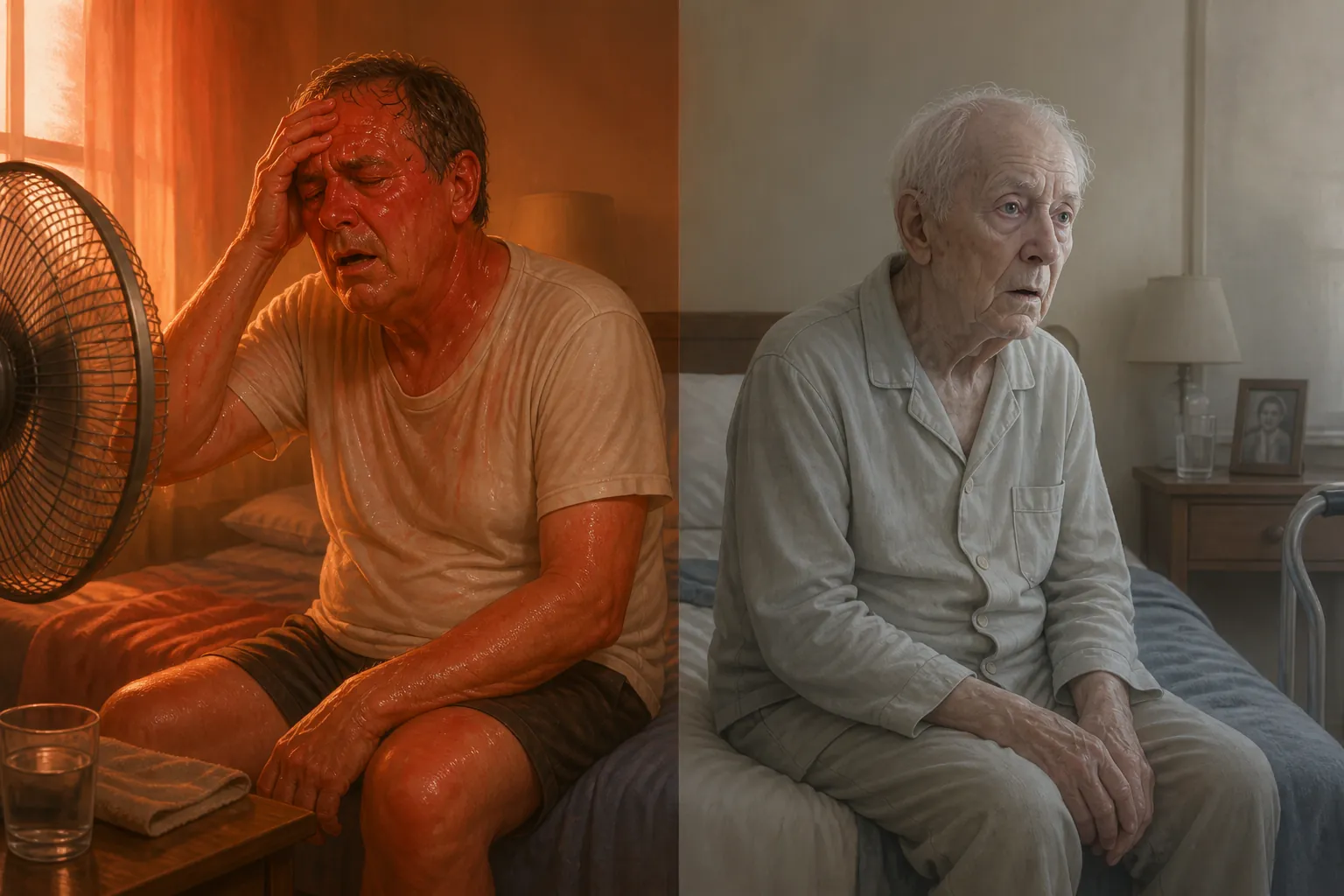
That detail should change the night check. Do not wait for sweat. Do not wait for the person to complain of feeling hot. In a hot room, new confusion, unusual irritability, faintness, trouble walking, vomiting, severe weakness, rapid worsening, or difficulty waking should be treated as possible heat illness. If symptoms are severe, sudden, or frightening, seek emergency care.
The same caution applies when someone has dementia, depression, Parkinson’s disease, stroke history, or a psychiatric condition. A hot night can make it too easy to explain away a dangerous change as “just the usual.” If the change is new and the room is hot, heat belongs on the list of suspects.
Cooling Steps That Are Safe Regardless of the Medication List
Medication review does not replace cooling the sleeping environment. It helps decide how closely to watch and what to ask, but the room still has to be made safer. The most useful cooling steps are the ones that do not depend on knowing the perfect diagnosis.
- Measure the indoor temperature where the person sleeps, not just the outdoor forecast.
- Move sleep to the coolest room available, even if that means a temporary bed in a lower-level room.
- Use air conditioning if available; if not, consider a cooling center, a family member’s home, a library, or another cooled place before bedtime so the body gets relief.
- Use fans carefully: they can help with comfort, but in very hot indoor conditions they may not be enough by themselves.
- Use light bedding and loose sleep clothing, and remove unnecessary blankets that may stay in place out of habit.
- Try a cool shower, cool cloths, or cool packs wrapped in cloth before bed, especially at the neck, armpits, or groin.
If the person lives alone, the plan also needs a check-in time. A call at 7 p.m. is not the same as knowing whether the bedroom is still hot at 11 p.m. For someone on heat-sensitive medications, it is reasonable to ask a direct set of questions: What does the room thermometer say? Are you dizzy? Are you more confused than usual? Have you urinated today? Are you able to drink the amount your clinician said was safe?
What Not to Do When the Heat Arrives
The mistakes that worry me most are the quiet ones: skipping a heart pill because the forecast looks scary, taking an extra sleep aid because the room is miserable, or telling a confused older person to “just drink more water” without knowing whether they have a fluid restriction.
- Do not stop prescribed medication without a prescriber or pharmacist’s guidance.
- Do not add OTC sleep aids or sedating antihistamines without checking whether they have anticholinergic effects.
- Do not rely on sweating as the main danger sign in an older adult.
- Do not assume thirst is a reliable guide, especially with ACE inhibitors, ARBs, cognitive impairment, or advanced age.
- Do not treat a fan in a hot room as the same thing as a cooled room.
Housing, isolation, cost, and access to cooling matter. Some people cannot simply turn on central air. That makes the medication review more important, not less, because it identifies who needs earlier relocation to a cooler place, more frequent check-ins, or a clearer threshold for urgent care.
A Bedtime Checklist for a Heat Dome Night
When the heat dome is already here, the plan has to be short enough to use while everyone is tired.
- Check the sleeping-room temperature and move to the coolest available place.
- Look at the medication list for diuretics, beta blockers, anticholinergics, diphenhydramine, SSRIs, SNRIs, antipsychotics, ACE inhibitors, or ARBs.
- Follow the existing prescribed regimen unless a clinician has already given heat-wave instructions.
- Use safe cooling steps: lighter bedding, cool cloths, a cooler room, air conditioning or a cooled public/private location when available.
- Check for red flags that may appear without heavy sweating: new confusion, severe weakness, fainting, vomiting, trouble walking, unusual drowsiness, or difficulty waking.
- Call a pharmacist or prescriber for medication-specific questions before the next hot night; seek urgent care for severe or rapidly worsening symptoms.
Older adults taking heat-sensitive medications need individualized review and safer sleeping conditions. The task is not panic and it is not self-adjustment. It is knowing the full medication list, knowing the red flags, cooling the room as much as possible, and involving a pharmacist or prescriber before changing the regimen.
References
- The 2021 heat dome: a mortality analysis of British Columbia's public health disaster, BCCDC, https://pmc.ncbi.nlm.nih.gov/articles/PMC8835552/
- Heat and Medications – Guidance for Clinicians, CDC, https://www.cdc.gov/heat-health/hcp/clinical-guidance/heat-and-medications-guidance-for-clinicians.html
- Medications That Increase Your Sensitivity to Heat, AARP, https://www.aarp.org/health/conditions-treatments/medications-heat-intolerance/
- How to stay cool and safe in a heat wave, even without air conditioning, PBS NewsHour, https://www.pbs.org/newshour/health/how-to-stay-cool-and-safe-in-a-heat-wave-even-without-air-conditioning
- How to Recognize the Signs of Heatstroke in Older Adults, Jefferson Health, https://www.jeffersonhealth.org/your-health/living-well/how-to-recognize-the-signs-of-heatstroke-in-older-adults
Safety & eligibility read
Cross-check against other interventionsExplore the mechanism
Next step
Spot an error or have clinical feedback?
Because this article covers clinical, medication, or safety information, we use a moderated correction channel instead of open public comments. Let us know if something about “Which Medications Make Heat Dome Nights Dangerous for Older Adults?” needs a closer look.
Send feedback on this article