
How Florida Heat and Humidity Make Night Sweats Worse
Florida's high humidity amplifies perimenopause night sweats by blocking sweat evaporation and narrowing the body's temperature tolerance. Learn which environmental and behavioral changes—dehumidifier settings, cooling routines, and trigger timing—can break the cycle and help you sleep through summer nights.
The maddening Florida version of night sweats is that the room can look “right” on paper. The AC is running. The thermostat says 68°F. The sheets may even feel cool when you first get in. Then sometime around 2 a.m., you wake up drenched, chilled on the surface, hot underneath, and wide awake because the sweat has nowhere useful to go.
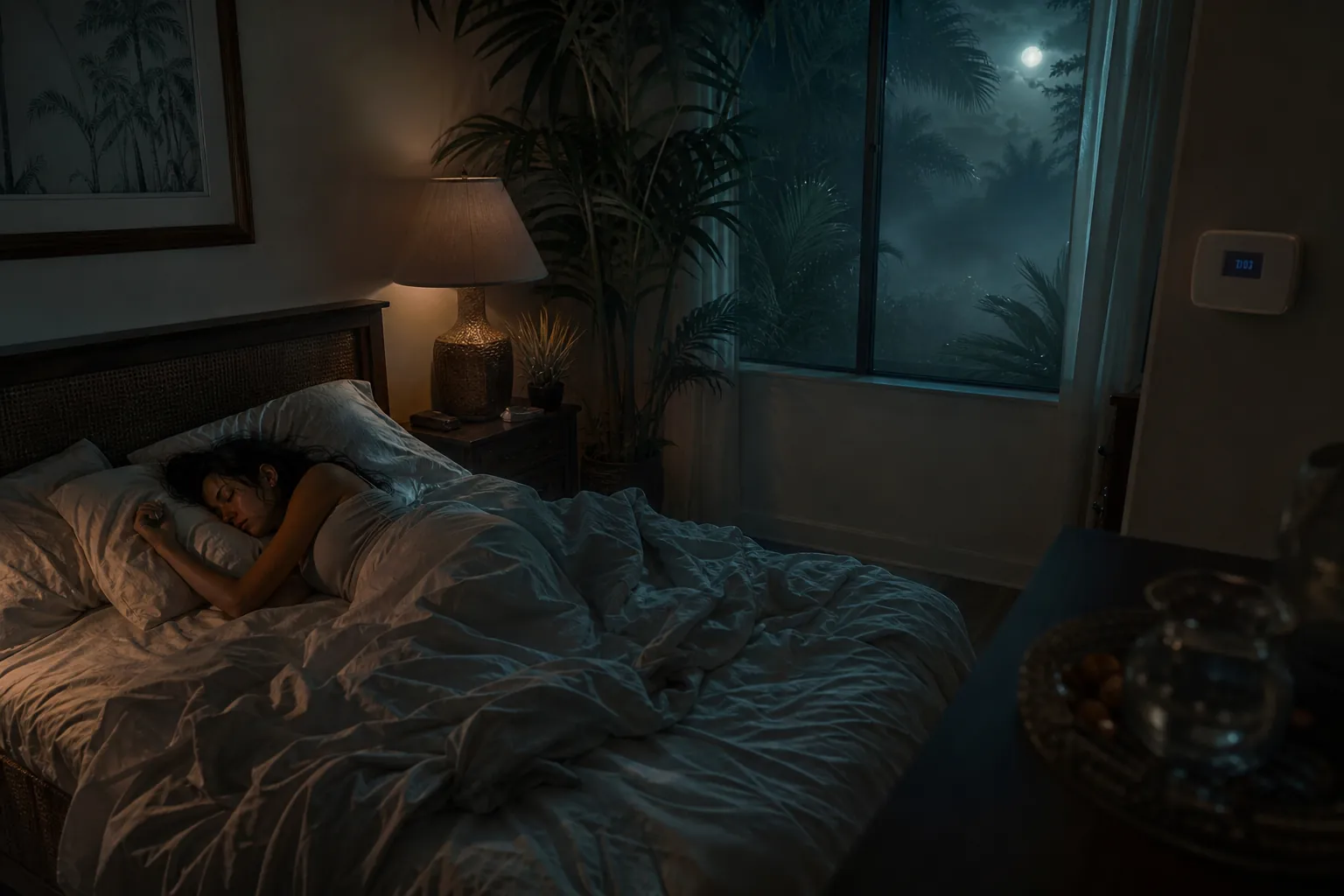
That is why the usual advice to “make the room cooler” can miss the most important part of Florida night sweats: in a humid bedroom, sweat does not evaporate efficiently. During perimenopause, that matters more than it used to, because the body’s temperature alarm is already easier to trip.
Hot flashes and night sweats are common enough that no one should read a soaked pillowcase as a personal failure. Roughly 75–85% of women experience hot flashes or night sweats during the menopausal transition, depending on the population studied and how symptoms are measured.[1] The Florida problem is not that perimenopause is unusual. It is that the climate can make the body’s cooling response less effective once an episode starts.
Why a Cool Room Can Still Feel Unbearable
Perimenopause changes the margin for error. As estrogen declines, the hypothalamic thermoneutral zone narrows, meaning a smaller rise in core temperature can trigger a full vasomotor response: flushing, sweating, skin heat, then the cold damp aftermath.[2] In plainer bedroom terms, your body may react to a temperature shift that it would have tolerated more quietly a few years earlier.
Sweat is supposed to help solve that problem. When it evaporates from skin, it carries heat away. But high relative humidity loads the air with moisture, so evaporation slows. The sweat stays on the skin and in the fabric longer, cooling takes longer, and the damp bedding can keep you uncomfortable even after the hot flash itself has passed.[3]
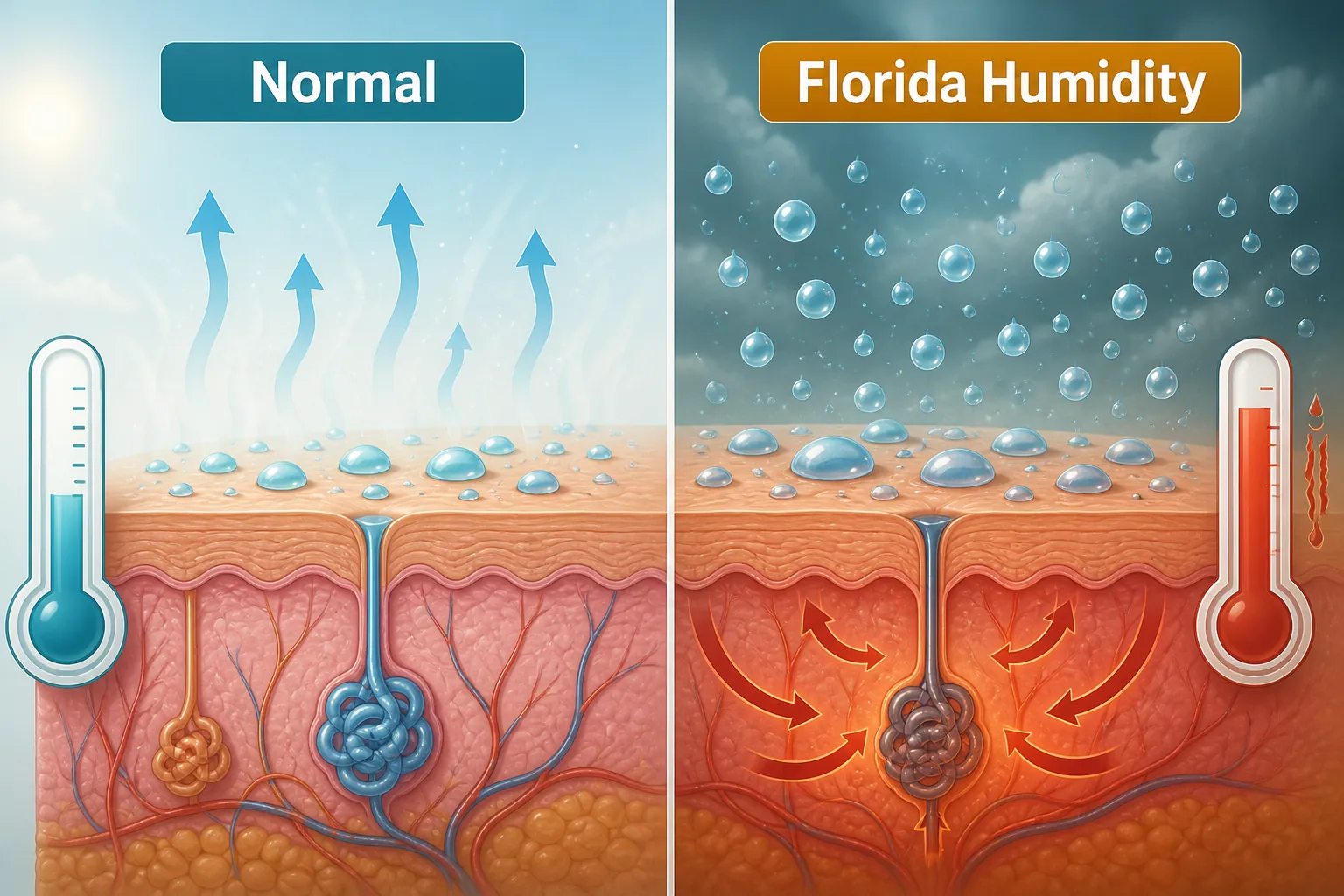
That is the loop: perimenopause makes the trigger threshold smaller, then humid air makes the recovery slower. A thermostat only measures one side of the room. It does not tell you whether the air is dry enough to let sweat do its job.
A representative hot-humid Florida night can sit above 70% relative humidity, while sleep-environment guidance commonly points to 30–50% as an ideal humidity range.[3][4] That does not mean every Florida bedroom must hit a perfect 45% every night. Summer storms, older HVAC systems, leaky windows, and power costs are real constraints. But it does mean that relative humidity deserves equal billing with temperature, especially if you are already keeping the room cool and still waking soaked.
Start With the Bedroom Air, Not Another Blanket Strategy
The first useful measurement is not another guess at whether the room “feels” cool. Put a small hygrometer near the bed and check the overnight relative humidity. If it is regularly in the 60s or 70s, the room is asking your skin to cool itself in air that is already crowded with moisture.
| Bedroom variable | Practical target |
|---|---|
| Air temperature | About 65–67°F if you tolerate it without waking chilled |
| Relative humidity | Aim for 40–50% where feasible; 50–60% may still be meaningful progress in Florida |
| Air movement | Ceiling fan counterclockwise for a downward cooling breeze |
| Bedding | Moisture-wicking, breathable layers that dry quickly |
| Mattress feel | Avoid heat-trapping foam if it keeps warmth under the torso |
Temperature still matters. Many sleep-environment recommendations place the ideal bedroom temperature around 65–68°F, with individual comfort and health needs affecting where someone lands.[4][5] For night sweats, though, turning the AC down without lowering humidity can leave you cold and wet rather than cool and dry.
A dehumidifier is often the more direct tool. In Florida-like humid conditions, a bedroom dehumidifier may reduce relative humidity by about 15–25 percentage points, depending on room size, moisture load, door position, and drainage setup.[3] That kind of drop can move a room from “sweat sits on skin and sheets” toward “sweat has a chance to evaporate.”
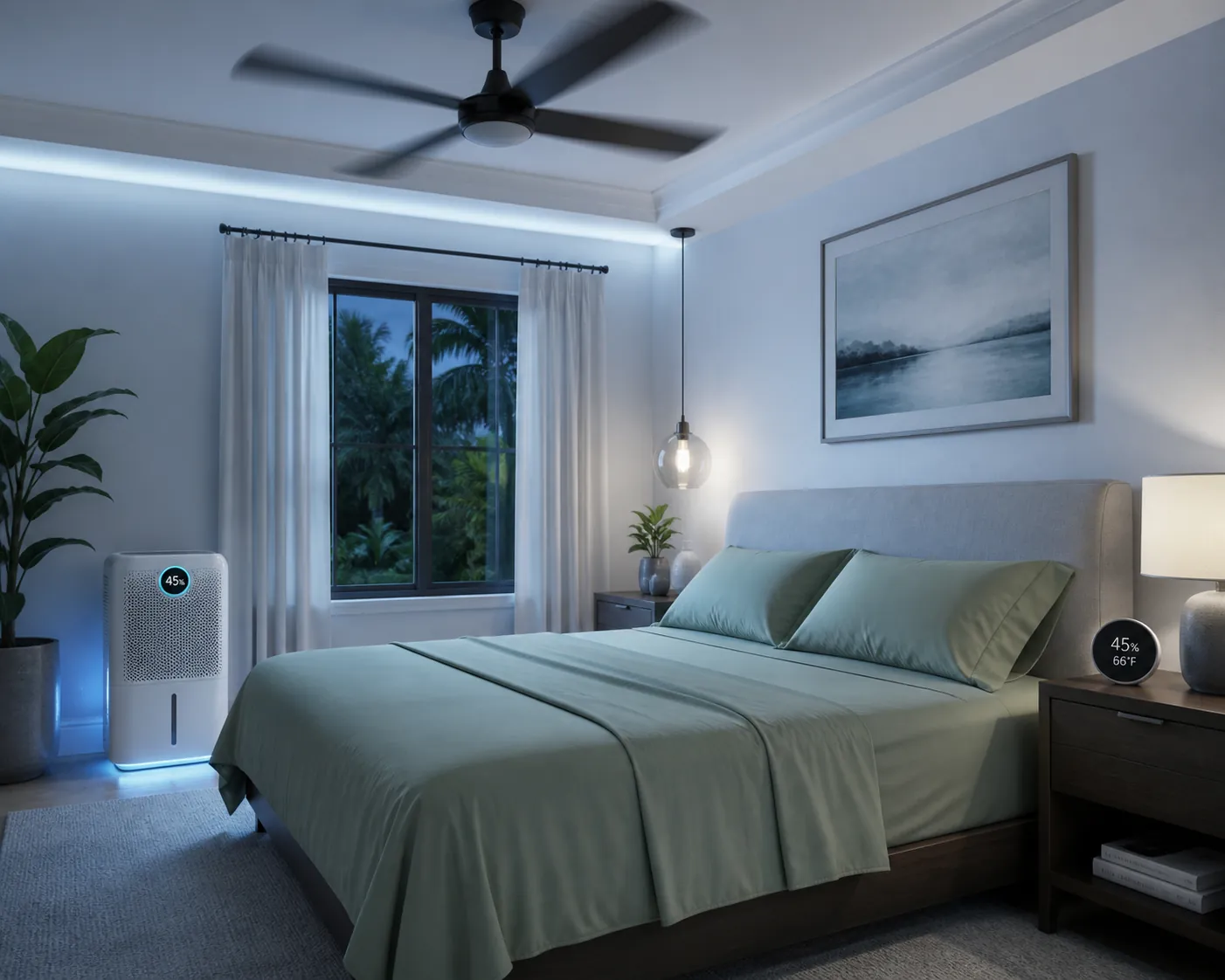
A realistic target is worth more than a perfect one. If the room is starting around 70% relative humidity, getting it into the 50–60% range may already reduce the swampy feeling. When the house, weather, and equipment allow it, 40–50% gives the body a better evaporation window without pushing the room into an overly dry range.
Fan direction matters because moving air helps evaporation. In summer, a ceiling fan should usually run counterclockwise so it pushes air downward across the bed. This does not lower the room’s actual temperature, but it can help sweat leave the skin faster if the air is not too saturated. For more on bed placement and airflow paths, see bedroom airflow and perimenopause sleep.
Then look at what touches the body. Heavy comforters, dense mattress pads, and slow-drying cotton layers can hold moisture after the first sweat. Tencel and bamboo rayon are useful directions for sheets or sleepwear because they tend to feel smoother and manage moisture better than basic cotton when sweating is the main problem. The goal is not a luxury bedding overhaul. It is to shorten the wet phase so one episode is less likely to keep waking you for the next hour.
Mattress material can quietly work against the rest of the room. Memory foam is more likely to retain heat than latex or hybrid innerspring designs, especially around the torso and hips.[4] If the mattress feels warm from below even when the air feels cool above, a more breathable mattress design or a less insulating topper may matter more than another set of “cooling” sheets. For a deeper mattress-specific path, see this guide to mattress combinations for perimenopause hot flashes.
Make the Bed Recoverable After the First Sweat
The first night sweat is not always the only problem. Damp fabric changes the next hour of sleep. A wet pillowcase chills the neck, a damp fitted sheet clings to the back, and a soaked top layer can trap heat and moisture at the same time. The room may be cool, but the bed has become its own humid microclimate.
Build the bed so you can remove moisture quickly without fully waking yourself. A thin washable top layer, a spare pillowcase within reach, and a breathable blanket instead of one heavy comforter can make a 2 a.m. reset shorter. If layering is where your setup keeps failing, cooling bedding layers for menopause night sweats goes deeper into that part without turning the whole bedroom into a laundry project.
This is also where Florida power outages deserve a separate plan. If the AC and dehumidifier are unavailable during storm season, humidity management becomes much harder. That is not a willpower problem. It is a different risk scenario, and it needs its own safety-first approach; start with sleeping without power until restoration rather than trying to force normal summer-night advice onto an outage.
The 90-Minute Cooling Window Before Bed
Once the bedroom air is doing less damage, timing becomes the next control point. A lukewarm shower about 90 minutes before bed can support evaporative cooling and a temporary drop in core temperature for roughly an hour.[3] The timing matters: too close to bedtime, and you may climb into bed damp or warm from the bathroom; too early, and the cooling effect may be gone before sleep begins.
The shower should be lukewarm, not cold enough to make you tense or hot enough to steam the bathroom and add humidity back to your hair, skin, and sleepwear. Dry off fully. Give the bathroom fan time to clear moisture. Then get into breathable pajamas or sleepwear that will not hold dampness against the chest, back, or groin.
Hydration is not a cure for night sweats, but poor timing can make the night harder. Front-load fluids earlier in the day, then taper close to bed so thirst does not meet repeated bathroom trips. If you sweat heavily or exercise in the evening, electrolyte-spiked hydration earlier in the evening may be more useful than chugging plain water right before lying down. The point is to enter the night neither overheated nor overfilled.
Cut Off Heat Triggers Before They Reach the Pillow
Alcohol is one of the easiest triggers to underestimate because it may initially feel relaxing. But alcohol can promote vasodilation and is commonly listed among night-sweat triggers; avoiding it within three hours of bed is a practical cutoff to test.[1][5][6] This is not a moral rule. It is a way to learn whether one glass at 8:30 p.m. is part of why the sheets are soaked at 2 a.m.
Spicy foods deserve the same timing treatment. Capsaicin can disrupt thermoregulation, and keeping spicy meals or snacks out of the two- to three-hour window before bed may reduce one avoidable heat signal.[1][6] In Florida summer, the body is already negotiating warm outdoor air, a humid bedroom, and a narrower temperature tolerance. Late heat-triggering food simply gives the system one more nudge.
If you want to test triggers without turning dinner into a spreadsheet, change one variable for a week: alcohol timing, spicy-food timing, evening shower timing, or bedroom humidity. Night sweats fluctuate, so a single good or bad night does not prove much. A pattern across several nights is more useful than one dramatic wake-up.
When Humidity Control Is Not Enough
Bedroom humidity and pre-bed timing can reduce severity and recurrence, but they do not treat the hormonal driver of perimenopausal vasomotor symptoms. They also do not explain every case of night sweats. Persistent night sweats can be associated with medications, thyroid disease, anxiety, infections, sleep disorders, malignancy, and other medical causes, and primary-care evaluation is recommended when symptoms are persistent, unexplained, or accompanied by concerning features.[7]
It is time to involve a clinician if night sweats are new and intense, drenching on a regular basis, paired with fever or unexplained weight loss, disrupting work or driving, or complicated by other medical conditions or medications. For perimenopause or menopause symptoms, that conversation may include hormone therapy options or nonhormonal medications, depending on personal risk factors and preferences. Environmental changes can make Florida nights less punishing; medical care is the next layer when the body is asking for more than a better room setup.
In a dry climate, a cooler thermostat may solve more of the problem. In Florida summer, the thermostat is only half the cooling system. For perimenopause night sweats, lowering bedroom humidity is not a bonus comfort tweak; it is part of how sweat becomes cooling instead of another wet layer keeping you awake.
References
- Night Sweats in Women — Sleep Foundation
- Menopausal Hot Flashes: Mechanisms, Endocrinology, Treatment — PMC/NIH
- Night Sweats & Menopause Relief for Summer — Concierge Medicine of Westlake
- Best Humidity Level for Sleeping — Sleep Foundation
- 6 Reasons Why You Sweat in Your Sleep — Cleveland Clinic
- 5 Ways to Stop Night Sweats — Temple Health
- Persistent Night Sweats: Diagnostic Evaluation — AAFP
Explore the mechanism
Next step
Spot an error or have clinical feedback?
Because this article covers clinical, medication, or safety information, we use a moderated correction channel instead of open public comments. Let us know if something about “How Florida Heat and Humidity Make Night Sweats Worse” needs a closer look.
Send feedback on this article