
Perimenopause Sleep Prep for Heat Dome Nights
Perimenopausal women already face sleep disruption from hot flashes and impaired thermoregulation. A heat dome compounds this by eliminating the overnight cooldown that normally brings relief. This guide explains how to prepare — from room prep and hydration scheduling to cooling protocols designed for vasomotor physiology — before the heat dome arrives, backed by evidence that women lose significantly more sleep per degree of nighttime heat than men.
The night before a heat dome is not the time to discover that your fan only rearranges warm air, your ice water has become a bladder alarm, and your “cool shower before bed” bought you twenty pleasant minutes followed by a hotter rebound. If you are in perimenopause or menopause and already wake from hot flashes or night sweats, the problem is not simply that the bedroom is too warm. It is that the room may stay warm at the exact moment your body needs somewhere cooler to dump heat.
That is why ordinary heat-wave sleep advice can feel oddly incomplete. Breathable pajamas and lighter sheets help, but they do not change the fact that a vasomotor episode can arrive from inside the body even when the thermostat looks reasonable. During a heat dome, the missing piece is the nighttime cooldown. The outdoor air stays high, walls and upper floors hold heat, and the usual post-flash relief window can shrink or disappear.
The evidence is not a single neat trial of “perimenopause plus heat dome.” It is more like two streams meeting. In a 2025 U.S. study using 12.5 million sleep nights from 14,232 All of Us participants, females had a 22.9% greater sleep reduction than males for each 10°C increase in nighttime temperature exposure.[1] American Heart Association reporting on hot-weather sleep specifically notes that menopausal women can be especially affected because they may already have higher core body temperature.[2] That is enough to justify preparing differently, without pretending the science has measured every version of the night you are about to have.
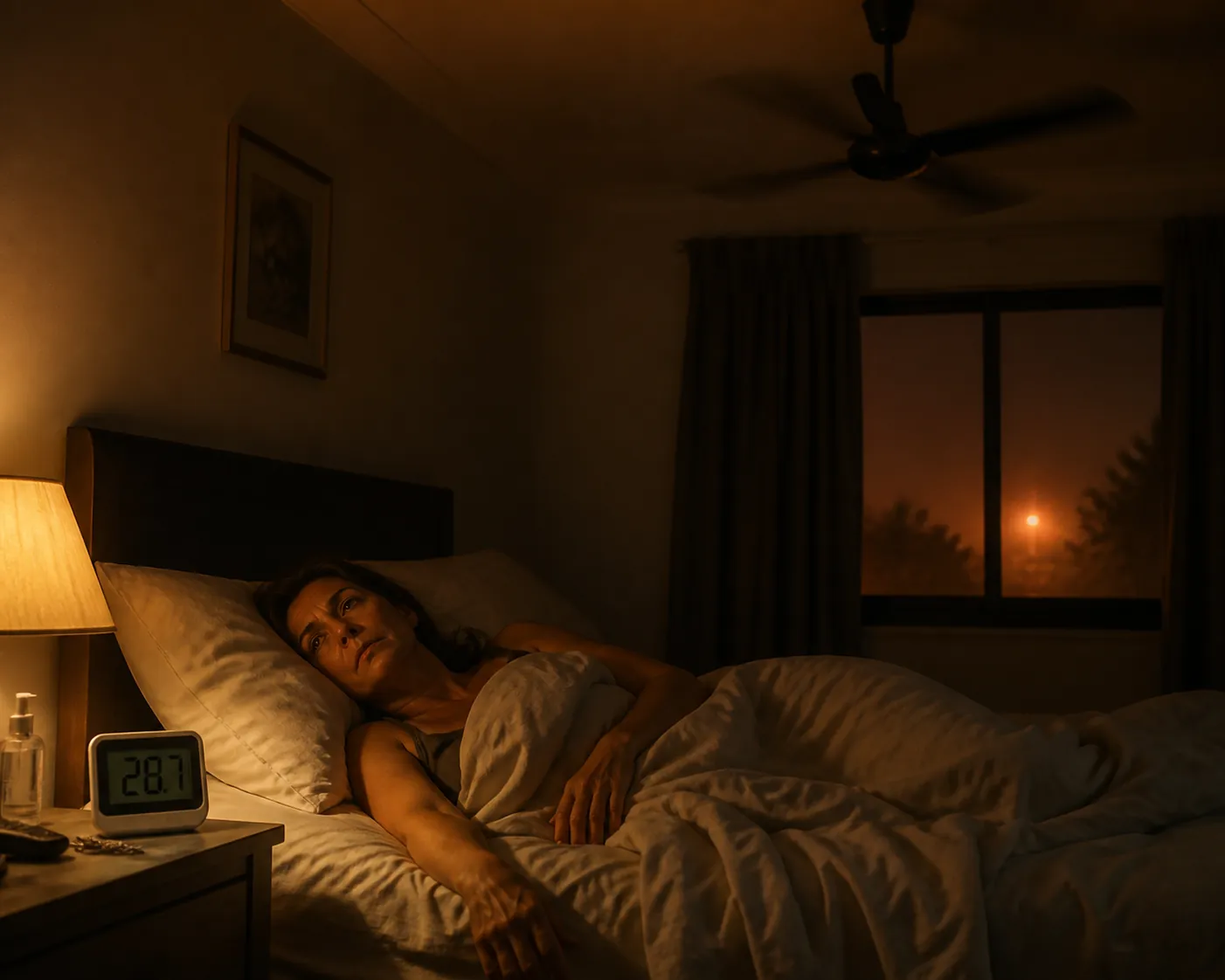
What Changes When Hot Flashes Meet a Heat Dome
A normal hot flash already asks the body to manage a sudden heat event, sweat, cool down, and return to sleep. On a better night, the room helps. The pillow cools again. The damp shirt comes off. The skin meets cooler air. You may not feel restored, but there is at least a path back.
A heat dome interferes with that sequence. The mattress retains warmth. The hallway is no better than the bedroom. The open window may bring in more heat, smoke, humidity, or noise. A fan may feel comforting but fail to lower body temperature if the indoor air is already too hot. The work shifts from “make the room pleasant” to “reduce the number of times a hot flash becomes a full awakening.”
That distinction matters because sleep loss is not only about minutes shaved off the night. A hot flash can wake you; the frustration afterward can keep you awake; the next night you may start monitoring your body before anything happens. After several nights, the room can cool down and the wake-up pattern can remain.
The larger climate-sleep literature points in the same direction, though with the usual dataset caveats. Climate Central’s 2026 analysis of 1,338 cities found that warmer nighttime temperatures have a larger sleep effect for women globally.[3] Li et al. analyzed 23 million wearable sleep records in China and found stronger temperature-sleep associations among women and people with higher BMI.[4] Those studies do not prove what will happen in one bedroom, and wearable datasets can skew by income, device use, country, and access to air conditioning. They do make it harder to dismiss women’s heat-disrupted sleep as merely anecdotal.
Start 24 to 48 Hours Before the First Bad Night
Preparation has to begin before bedtime because the worst decisions happen when you are hot, wet with sweat, irritated, and awake at 2 a.m. The goal is not perfection. It is to remove the small failures that stack up: the unreachable towel, the empty water glass, the overheated pillow, the fan pointed at your face but doing nothing useful, the late-night water binge that solves one problem and creates another.
| When | What to Set Up | Why It Matters for Perimenopause Sleep |
|---|---|---|
| 24–48 hours before | Watch the overnight forecast, not just the daytime high; identify the coolest room or backup sleeping spot. | The relief window after a hot flash depends on nighttime conditions, not afternoon headlines. |
| Morning of the hot day | Close blinds or curtains on sun-facing windows; limit heat-producing appliances when possible. | A cooler room at bedtime starts with less stored heat in walls, floors, and bedding. |
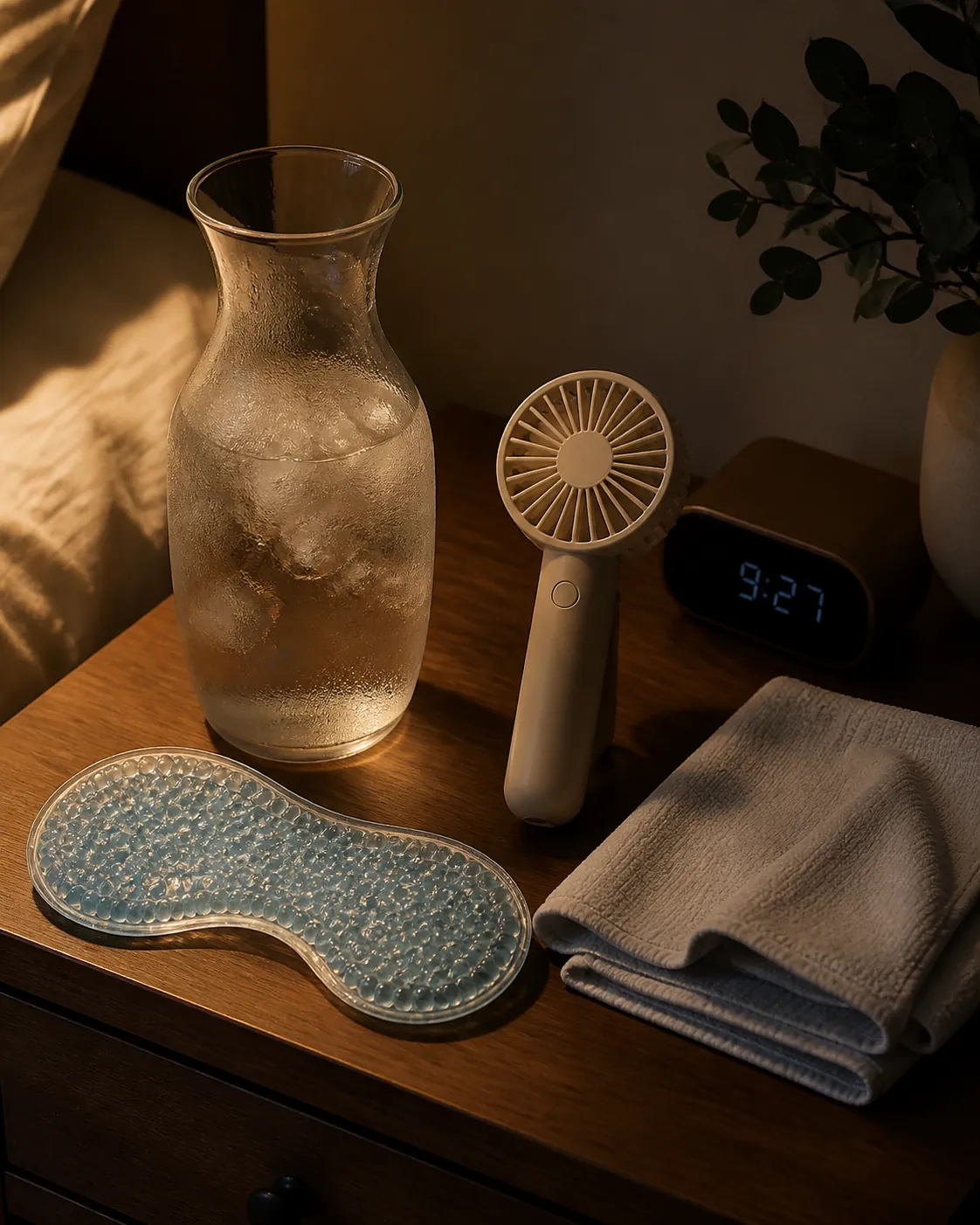
| Late afternoon | Pre-cool the bedroom if you have safe AC access; chill a towel, gel pack, or eye mask. | Cooling tools work best when they are ready before the first wake-up. |
| Dinner through early evening | Move most fluids earlier; keep sips available later rather than drinking heavily at bedtime. | Hydration helps heat tolerance, but a full bladder can turn one awakening into two. |
| Bedtime | Place cooling items, a dry sleep shirt, water, and a low-light path within reach. | The less you stand up, search, and fully wake, the easier it is to return to sleep. |
If you can control indoor temperature, use that control early. Waiting until bedtime asks the air conditioner to cool the air, the furniture, the bedding, and you at the same time. Pre-cooling the bedroom and sleep surface is especially useful when hot flashes are part of the night because the mattress and pillow can otherwise become heat reservoirs.
If you cannot reliably cool the whole bedroom, choose the smallest useful target. Cool the side of the bed where your torso rests. Put a spare pillowcase in a sealed bag in the refrigerator. Keep a folded cooling towel or damp washcloth ready. Move to a lower floor or a shaded room if it is meaningfully cooler. This is not the glossy version of sleep hygiene, but it is often the version people can actually do.
Build the Room Around Recovery, Not Just Coolness
For someone without hot flashes, a cooler room may be the whole project. For someone with vasomotor symptoms, the room has a second job: it must help you recover quickly after a heat surge. That means the bed should not trap sweat, the air should move only if it is safe to move it, and the tools you need after waking should be reachable without turning the room into a bright little emergency.
- Strip the bed down before the first hot night. Use layers you can remove one at a time instead of one heavy cover you will kick off and retrieve repeatedly.
- Keep a dry top or towel close enough to reach without leaving bed. Damp fabric against cooling skin can become the next reason you wake.
- Use breathable sheets if you have them, but do not treat fabric choice as the main intervention. The flash still has to pass through your body.
- Reduce light and friction around wake-ups. A dim nightlight, clear path, and prepared supplies matter more than a perfect bedroom aesthetic.
Fans deserve a little suspicion during extreme heat. They can help sweat evaporate and make moderate warmth more tolerable, but they are not cooling machines. The National Weather Service advises using air conditioning when possible during a heat wave and spending time in air-conditioned places if home cooling is not available.[5] The World Health Organization warns that heat can overwhelm the body’s ability to regulate temperature, especially when exposure is prolonged.[6] If the indoor air is very hot, a fan may increase fluid loss without solving the underlying heat load.
A practical fan rule: use it to move cooler air toward you or push hot air out when the outside air is actually cooler. Do not rely on it as protection when the room itself feels unsafe. If your home stays dangerously hot, the sleep plan becomes a safety plan: identify a cooling center, library, mall, community space, friend’s home, or another air-conditioned place before the first night, not after the second sleepless one.
Hydrate Earlier, Then Stop Flooding the Night
Heat advice often says “drink water,” which is true and still incomplete. For a night-sweat sleeper, the timing matters. If you underdrink all day and try to catch up right before bed, you may trade thirst for a 3 a.m. bathroom trip. If you avoid fluids because you fear waking, heat and sweating can leave you feeling worse.
The more useful pattern is front-loaded hydration: drink steadily from morning through early evening, especially if you have been sweating, commuting, exercising, caring for others, or spending time outdoors. Near bedtime, switch to small sips. Keep water at the bedside, but do not make the bedside glass your main hydration strategy.
Alcohol is worth treating as a heat-dome problem, not just a general sleep problem. It can fragment sleep, worsen temperature discomfort for some people, and lower the odds that you respond clearly when you wake overheated. Caffeine is similar: the issue is not that one afternoon coffee explains every hot flash, but that stimulation and heat are poor companions when you are already expecting a difficult night.
Cool the Body Without Provoking a Rebound
The dramatic cold shower is tempting. It feels decisive. It can also wake you up and, for some people, feel followed by a rebound of warmth once they are back under covers. A gentler cooling routine usually fits sleep better: lukewarm shower, cool cloth on pulse points, chilled eye mask, or a brief foot soak earlier in the evening.
The point is to lower the load without turning bedtime into a performance. You want your body to move toward sleep, not marvel at how heroic you were with ice water. If a cooling gel pack helps, wrap it in cloth and use it briefly on the neck, upper chest, or under the pillowcase rather than pressing intense cold against skin for long stretches.
- Before bed: take a lukewarm shower or use a cool cloth, then get into a pre-cooled bed rather than a heat-soaked one.
- At the first warm surge: uncover the torso first, use the prepared cloth or gel mask, and keep breathing slow enough that panic does not join the flash.
- After sweating: swap the damp layer or towel without turning on bright lights or checking the time repeatedly.
- If you are fully awake: leave the bed briefly for a quiet, dim, cooler spot, then return when sleepy rather than fighting the mattress.
What to Do After a Hot Flash Wakes You
The first minute after waking is where a heat-dome night often goes wrong. You are hot, annoyed, maybe wet with sweat, and the brain begins its inventory: how many hours are left, what tomorrow requires, whether this will happen again. That inventory is understandable. It is also activating.
Make the response boring on purpose. Uncover. Cool the neck or chest. Sip if thirsty. Change the damp layer if needed. Avoid clock-checking if you can; it rarely cools anyone down. If the room is too hot to recover, move to the prepared cooler location rather than waiting in bed to prove a point.
This is also where sleep conditioning starts to matter. A few bad heat-dome nights can teach the brain that bed is a place for monitoring, bracing, and calculating. If the weather breaks but the awakenings continue, the next problem may no longer be the room. Readers dealing with that pattern may want the more targeted discussion in Heat Dome Night Sweats? Why CBT-I Helps Perimenopause Sleep, because CBT-I is aimed at the conditioned-insomnia loop rather than the outdoor temperature.
A Word About Evidence, Because Women Are Often Asked to Prove the Obvious
The best available studies still have limits. The Liao et al. U.S. sample was 68.3% female, 81.5% White, and included a relatively high-income group, with about 42% reporting household income above $100,000.[1] The Li et al. wearable study used Huawei data from Chinese participants, so its measured effects cannot be dropped unchanged into U.S. bedrooms with different housing, climate baselines, and air-conditioning access.[4] Climate Central’s analysis applies a temperature-sleep response function from prior work that drew more heavily from higher-income-country populations, which may underestimate sleep loss in lower-resource settings.[3]
Those caveats do not erase the practical conclusion. They simply keep it honest. The available research supports a narrower, useful claim: women appear more vulnerable to heat-related sleep loss in multiple datasets, menopausal physiology can make heat regulation harder, and heat-dome nights remove some of the environmental relief that normally helps after a hot flash.
If You Cannot Make the Bedroom Cool
Not everyone can set a bedroom to an ideal sleep temperature during a heat dome. Renters may have weak AC, upper-floor bedrooms, sealed windows, high utility costs, caregiving duties, shared sleeping spaces, or no safe way to leave home at night. Advice that assumes total control over the room can become another small insult.
In that case, shrink the plan to what changes the night most. Block sun early. Sleep in the lowest, coolest safe room. Cool the sleep surface instead of the whole room. Prepare one reachable cooling kit. Move fluids earlier. Know where you can spend part of the day in air conditioning so your body is not carrying heat stress into bedtime. The National Weather Service specifically recommends spending time in air-conditioned places during heat waves when home cooling is limited.[5]
For a shorter reference that covers other household members too, How to Stay Cool at Night in Extreme Heat — by Life Stage can sit beside this more perimenopause-specific plan. The needs are not identical, but the logistics often overlap when one home is trying to get several people through the same hot nights.
The Night-Before Checklist
- Check the overnight low and indoor heat risk, not only the daytime high.
- Pre-cool the room, bed, pillow, or backup sleeping spot before bedtime.
- Set out a cooling cloth, gel mask, dry top, water for sipping, and a dim light.
- Drink steadily earlier in the day; avoid making bedtime the main hydration window.
- Use fans only when they move tolerably cool air or improve ventilation; do not treat them as protection in unsafe indoor heat.
- Decide in advance where you will go if the bed is too hot for recovery.
The useful standard is modest: fewer full awakenings, fewer frantic fixes, fewer nights where a hot flash becomes an insomnia rehearsal. If a heat dome is forecast, perimenopause sleep prep belongs before the first hot night. The goal is not merely to make the bedroom cooler. It is to give your body a faster way back down before the brain learns to stay awake.
References
- Impact of heat exposure on sleep health and its population vulnerability in the United States — Liao et al., PMC, 2025
- Keep your cool – and stay healthy – with these hot-weather sleep tips — American Heart Association, 2025
- Climate Change is Costing People Sleep — Climate Central, 2026
- Climate warming may undermine sleep duration and quality — Nature Communications, 2025
- During a Heat Wave — National Weather Service
- Heat and health — World Health Organization
Explore the mechanism
Next step
Spot an error or have clinical feedback?
Because this article covers clinical, medication, or safety information, we use a moderated correction channel instead of open public comments. Let us know if something about “Perimenopause Sleep Prep for Heat Dome Nights” needs a closer look.
Send feedback on this article