
Why Meniere's sleep disruption may need a sleep apnea remedy
If your Meniere's disease isn't improving with standard treatment, undiagnosed sleep apnea may be the culprit. Learn how CPAP therapy can reduce vertigo attacks and improve hearing in the subset of Meniere's patients with concurrent sleep apnea.
The patient who worries me is not the person having a first vertigo spell. It is the person with diagnosed Meniere's disease who has done the ordinary work: lowered salt, taken the diuretic or betahistine, kept rescue medication nearby, canceled plans after attacks, and perhaps been told that the next step may be intratympanic gentamicin or surgery. For that person, remedies for sleep disruption in Meniere's disease should not stop at better pillows or a stricter bedtime. If snoring, gasping, morning headaches, or heavy daytime sleepiness are in the background, an undiagnosed breathing disorder may be keeping the inner ear under stress.
A 2021 case report makes the miss easy to recognize: a patient with Meniere's disease did not improve until obstructive sleep apnea was identified and treated. The value of that report is not that one case proves a rule. It is that it shows a familiar clinical path bending in the wrong direction because the sleep problem was outside the usual ENT treatment ladder [1].
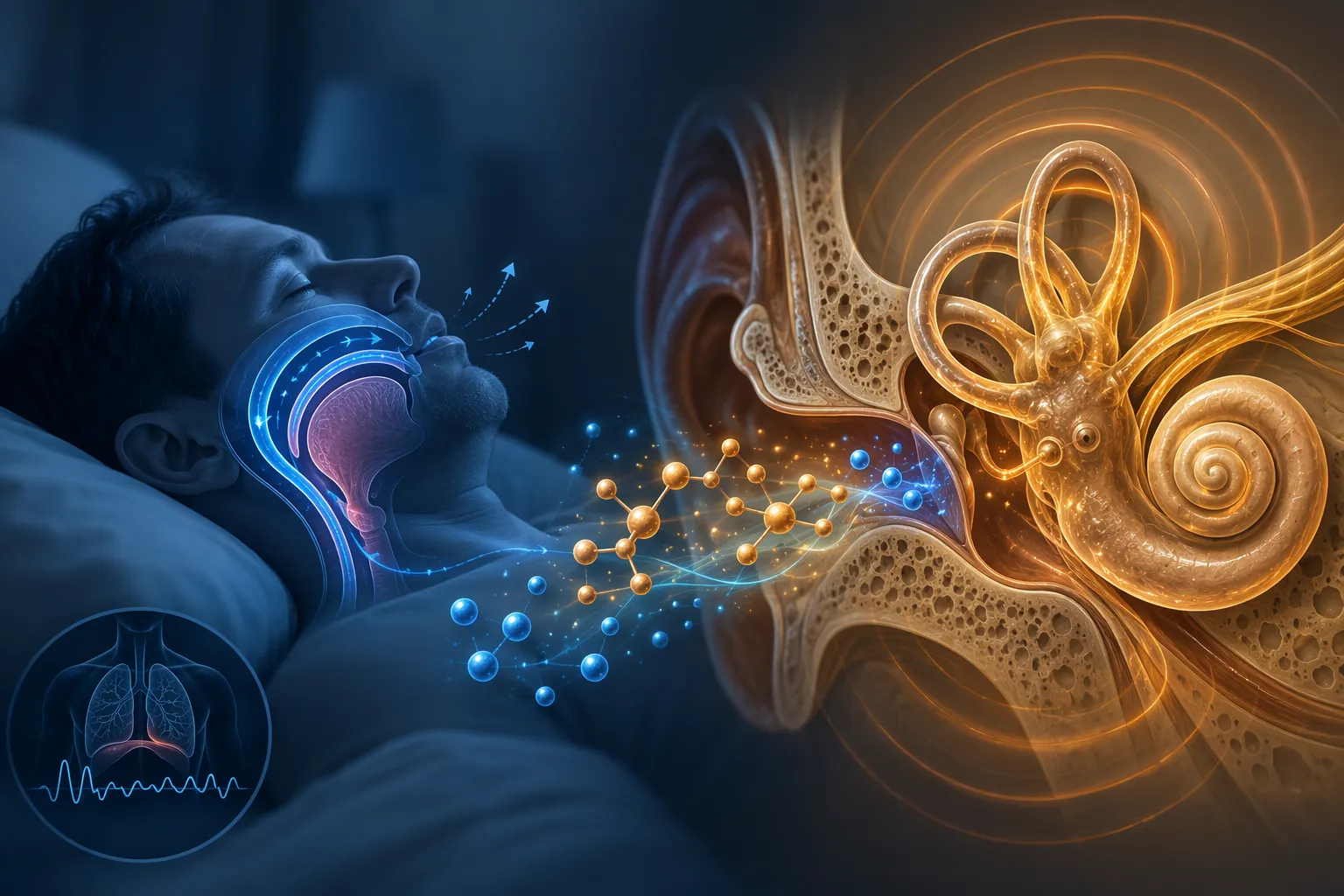
When standard Meniere's care fails, sleep deserves a closer look
Meniere's disease is usually discussed through the inner ear: vertigo attacks, fluctuating hearing loss, tinnitus, aural fullness, and the suspected role of endolymphatic hydrops. Standard care often tries to reduce fluid stress and control attacks. That framework is still useful. The problem is that it can become too narrow when vertigo remains active despite reasonable treatment.
Obstructive sleep apnea is not just snoring. During sleep, the upper airway repeatedly narrows or collapses, causing intermittent oxygen drops and brief arousals. The bed partner may see pauses, choking, restless sleep, or the person sleeping upright. The patient may only report fatigue, morning headache, poor concentration, or a sense that the night never restores them.
That distinction matters because refractory Meniere's can make everyone focus on the ear while the nights keep applying pressure to the system. A person can be “managed” on paper and still have a physiological amplifier running every night.
The Nakayama studies identify the overlooked subset
The most useful evidence here comes from studies that looked specifically at difficult Meniere's patients rather than at sleep apnea in the general population. In a 2010 Japanese cohort of 35 patients with refractory unilateral Meniere's disease, researchers found markedly abnormal sleep architecture: patients averaged 2.8% deep sleep, compared with 10% in controls. Up to 15% had concurrent obstructive sleep apnea, and many were normal-weight and not suspected of having a sleep disorder before testing [2].
That is the finding that should change the clinical conversation. These were not the stereotypical sleep apnea patients whose diagnosis was obvious from the doorway. They were people whose vertigo had already declared itself hard to control. If sleep apnea is missed in that group, the next treatment discussion may move toward destructive vestibular interventions before a reversible nightly stressor has been checked.
| Evidence | What it found | How to use it clinically |
|---|---|---|
| Nakayama 2010 | In 35 refractory unilateral Meniere's patients, average deep sleep was 2.8% versus 10% in controls; up to 15% had concurrent OSA. | Raises suspicion that sleep-disordered breathing can be missed in refractory Meniere's, even when patients are not obese or obviously sleepy. |
| Nakayama 2015 | In 20 Meniere's patients with OSA, CPAP was associated with improved dizziness handicap and better low-frequency hearing thresholds. | Supports CPAP as a targeted treatment for the subset with confirmed OSA, not as a universal Meniere's remedy. |
| Kim 2019 | Overall OSA was not significantly associated with later Meniere's disease, but female and middle-aged OSA subgroups showed about a twofold higher risk. | Useful for pattern recognition, but too limited to claim OSA generally causes Meniere's. |
The follow-up question is whether treating the apnea changes the Meniere's course. In a 2015 pilot study of 20 patients with Meniere's disease and obstructive sleep apnea, CPAP alone was associated with a large improvement in Dizziness Handicap Inventory scores, from 42.3 to 19. Low-frequency hearing thresholds also improved, including 49.5 to 37.7 dB HL at 0.5 kHz [3].
Those are concrete outcomes: less dizziness-related disability and measurable hearing change. They are also pilot-study outcomes. The study did not include a sham CPAP control; the authors reported that withholding CPAP from patients with identified obstructive sleep apnea was considered unethical [3]. That limits how strongly the result can be generalized. It does not erase the practical point: when OSA is actually present, treating it may change symptoms that had been treated as purely inner-ear disease.
Why apnea could make the inner ear harder to stabilize
The proposed mechanism is plausible, but it should be kept in the right category: not fully proven, not imaginary. Obstructive sleep apnea creates repeated episodes of intermittent hypoxia, sympathetic activation, sleep fragmentation, and oxidative stress. Meniere's disease is already a disorder in which fluid pressure and inner-ear homeostasis appear unstable. A nightly pattern of oxygen stress and arousal may make that system less resilient.

Stress physiology is one bridge between the two. A 2004 case-crossover study found that stress increased the risk of Meniere's attacks within 1 to 3 hours, with the authors discussing ACTH-mediated cortisol and aldosterone pathways as relevant mechanisms [4]. That does not prove apnea directly causes every vertigo attack. It does make it easier to understand why a disorder that repeatedly activates stress pathways overnight might contribute to attack vulnerability in some patients.
The hearing findings in the CPAP pilot are especially interesting because low-frequency hearing fluctuation is not just a quality-of-life complaint; it is part of the disease pattern many patients track anxiously. If airway treatment improves oxygenation and reduces sympathetic stress, one possible downstream effect is less pressure on the fluid-regulation system of the inner ear. The existing studies do not let us draw a straight causal line through every step. They do, however, make sleep apnea a testable contributor rather than a vague lifestyle suspicion.
What the larger cohort adds — and what it does not
A Korean nationwide cohort study is useful, but it should not be over-read. In the full cohort analysis, obstructive sleep apnea was not significantly associated with later development of Meniere's disease. In subgroup analysis, however, female patients and middle-aged patients aged 45 to 64 with OSA had about a twofold higher risk of developing Meniere's disease [5].
That is pattern-recognition evidence, not a universal causation claim. It fits the clinical group most likely to be reading this — adults in midlife whose vertigo remains active — but it does not justify telling every person with sleep apnea that Meniere's is coming, or every person with Meniere's that apnea caused it.
The medication problem that can hide in plain sight
Vertigo is frightening, and short-term sedating medication can be appropriate for acute distress. But in a patient with possible sleep apnea, benzodiazepines deserve a careful clinician conversation. They can suppress slow-wave sleep and relax upper-airway muscles, which may worsen upper-airway collapse in someone whose apnea has not yet been diagnosed.
This is not an instruction to abruptly stop prescribed medication. It is a reason to ask whether the medication plan, the sleep symptoms, and the refractory vertigo have been considered together. A patient who is more sedated at night, still gasping, and still waking unrefreshed may be caught in a loop that the chart describes as “Meniere's symptoms” without naming the sleep physiology underneath.
Who should ask about sleep testing?
The case for sleep testing is strongest when Meniere's is refractory and there are clues that breathing during sleep is not normal. The clue may come from the patient, but often it comes from the bed partner.
- Loud habitual snoring, especially if it has worsened with age or weight change
- Witnessed pauses in breathing, choking, gasping, or abrupt awakenings
- Morning headaches, dry mouth, or waking with a pounding sensation
- Daytime sleepiness, heavy fatigue, or concentration problems that are being attributed entirely to Meniere's
- Sleeping upright after vertigo or because breathing feels easier
- Persistent vertigo attacks despite reasonable standard Meniere's treatment
- Use of sedating vestibular medications in a person who may already have sleep-disordered breathing
Normal weight should not be reassuring by itself. In the refractory Meniere's cohort described by Nakayama and colleagues, many patients with concurrent OSA were not obese and had not been suspected of having a sleep disorder [2]. That is exactly why symptom history from the household matters.
What to bring to the ENT, primary care clinician, or sleep specialist
The next step is not to buy a CPAP machine without a diagnosis. It is to ask for obstructive sleep apnea screening or a sleep study when the pattern fits. A useful visit is specific: bring a record of vertigo frequency, current Meniere's treatments, sedating medications, sleep symptoms, and anything a bed partner has observed.
- “My vertigo is still active despite standard Meniere's treatment. Could sleep apnea be contributing?”
- “My partner has noticed snoring, gasping, or pauses. Should I have a sleep study before escalating Meniere's treatment?”
- “I use sedating medication for vertigo. If I might have OSA, should my medication plan be reviewed?”
- “If OSA is confirmed and treated, how will we track changes in vertigo frequency, dizziness handicap, and hearing?”
Tracking matters because CPAP is not a generic Meniere's cure. It is a treatment for confirmed sleep apnea. The hoped-for Meniere's benefit belongs to the subset in whom apnea is acting as a hidden physiological amplifier.
A bounded reason for hope
No major practice guideline currently requires OSA screening for every person with Meniere's disease, and the available studies are too small to make that kind of rule. The strongest data come from selected refractory patients and from a CPAP pilot without sham control. That caution should remain visible.
Still, the clinical consequence is too important to ignore. If vertigo remains poorly controlled and the sleep history contains snoring, witnessed pauses, morning headaches, daytime sleepiness, or unexplained exhaustion, a sleep study is a reasonable conversation before moving further up the invasive Meniere's ladder. For the subset with undiagnosed obstructive sleep apnea, treating the breathing disorder may reduce attacks, improve hearing, and prevent a patient from being escalated before the nights have been examined.
References
- Obstructive sleep apnea and Meniere's disease: A case report. PMC. 2021.
- Sleep disorder in patients with Meniere's disease. PMC. 2010.
- Treatment of obstructive sleep apnea syndrome with nasal continuous positive airway pressure in patients with Meniere's disease. PMC. 2015.
- Stress as a trigger of attacks in Meniere's disease. A case-crossover study. PubMed. 2004.
- Association between obstructive sleep apnea and the risk of Meniere's disease: A nationwide population-based cohort study. PMC. 2019.
Explore the mechanism
Next step
Spot an error or have clinical feedback?
Because this article covers clinical, medication, or safety information, we use a moderated correction channel instead of open public comments. Let us know if something about “Why Meniere's sleep disruption may need a sleep apnea remedy” needs a closer look.
Send feedback on this article