
Why your sleep suffers when your partner has Parkinson's
Parkinson's nighttime symptoms like REM sleep behavior disorder, difficulty turning, and nocturia don't just disrupt the person with Parkinson's—they cascade into caregiver sleep loss, increased burden, and reduced life satisfaction. This article explains the documented cycle and what partners can do to break it.
The night often changes before anyone names it. Your partner jerks an arm during a dream and you wake ready to protect your own face. They need help turning because their body will not roll easily under the sheets. They get up to urinate, again, and you listen for the bathroom door, the walker, the small sounds that tell you whether they are steady. Or their breathing becomes irregular enough that you stop sleeping and start monitoring.
By morning, the medical chart still belongs to the person with Parkinson’s. The partner’s night is harder to enter into that chart: the half-wakings, the scanning for danger, the resentment followed by guilt, the way you can be exhausted without having been the one with the diagnosis. But the research is clear enough on the main point: Parkinson’s sleep problems affect the partner through a chain of disruptions that can become measurable caregiver burden, not just a bad night here and there.

The nighttime cascade is real
A useful way to understand the problem comes from a multinational study of 253 Parkinson’s caregivers that tested a directional pathway: patient sleep problems were associated with caregiver sleep disruption, caregiver sleep disruption was associated with caregiver burden, and caregiver burden was associated with lower life satisfaction.[1] The study’s sleep composite measures had low reliability values, so it should not be treated as a precise instrument for measuring every sleep symptom. Its value is in the direction of the pattern: the patient’s night spills into the caregiver’s night, and the caregiver’s lost sleep is part of the burden pathway.[1]
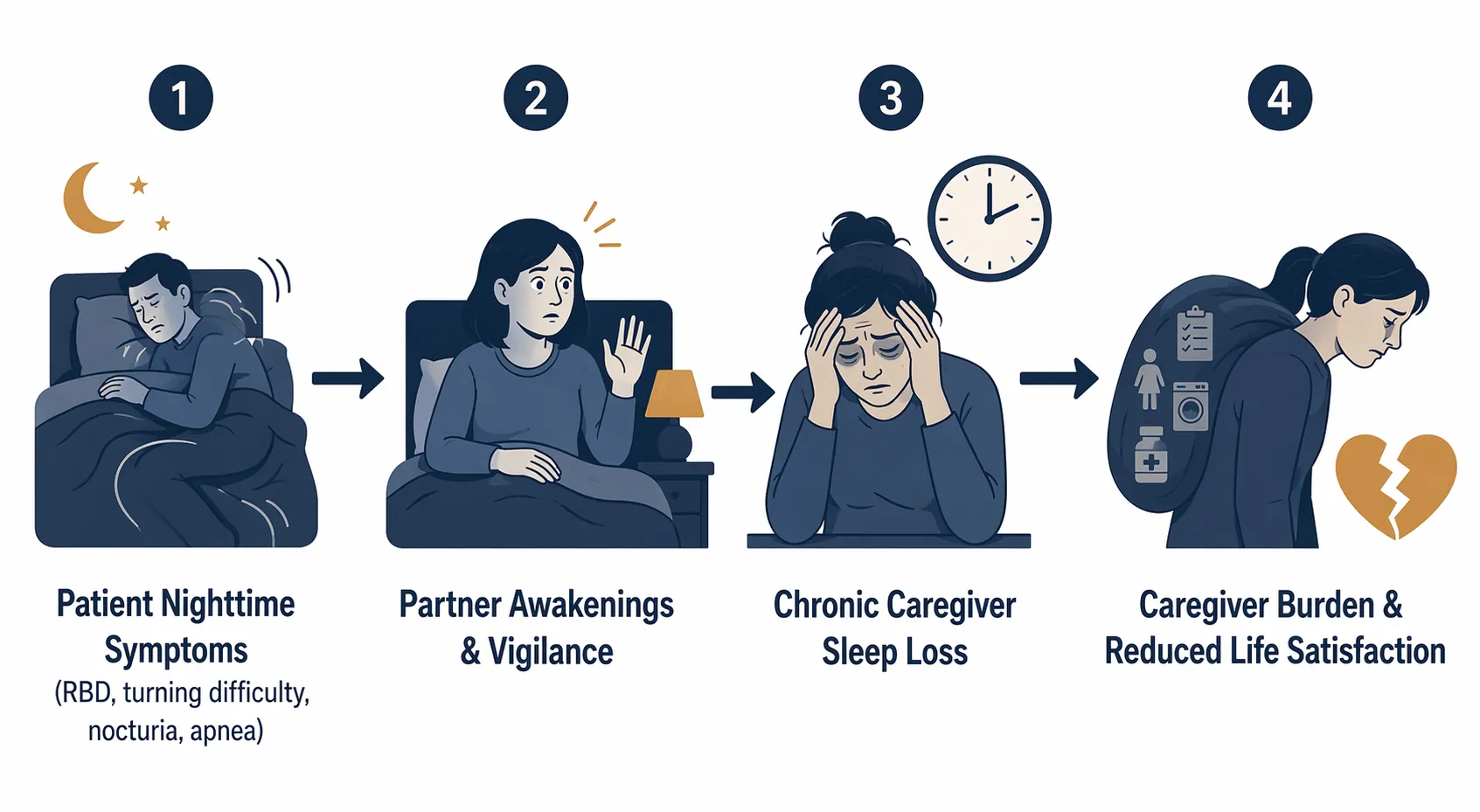
That sequence matters because partners are often told, directly or indirectly, to solve their own sleep with ordinary self-care. Keep a schedule. Avoid late caffeine. Make the bedroom dark. Those things may support a tired body at the margins, and for some older adults they are worth doing carefully. But they do not stop dream enactment. They do not make a stiff body turn over. They do not treat nocturia, fall risk, or breathing-related arousals. If you want a fuller look at why generic advice often misses older-adult sleep problems, see Why Sleep Hygiene Advice Often Fails Older Adults.
Large studies and reviews line up with what many partners describe. In the 2024 SLEEP Survey reported by Practical Neurology, which included 1,248 people with Parkinson’s and 286 caregivers across 27 countries, 88% of caregivers reported sleep disturbances.[2] That survey was associated with AbbVie and PD Avengers, so it deserves the usual caution around industry-adjacent work, especially where treatment implications are concerned. Still, the finding does not stand alone: an earlier study by Pal and colleagues found that more than 90% of caregivers reported some sleep disturbance, while Happe and Berger reported frequent sleep disturbance in 27% of male spouses and 48% of female spouses.[3][4]
A 2022 BMJ Open systematic review also concluded that sleep disturbance among Parkinson’s caregivers is a widespread and measurable phenomenon.[5] Across this body of work, the partner is not simply an observer of symptoms. The partner becomes part of the nighttime system: waking, assisting, anticipating, recovering poorly, and then trying to function the next day.
What feeds the cascade at night
Parkinson’s can disturb sleep in many ways, but a few mechanisms are especially likely to pull the partner awake. They differ in urgency. A dream-enactment episode can feel dangerous in seconds. A turning problem may be quiet but repeated. Nocturia may break both people’s sleep several times a night. Sleep apnea may be missed because it does not always look like the stereotype people have in mind.
REM sleep behavior disorder: when the dream enters the room
REM sleep behavior disorder, or RBD, is one of the clearest examples of a symptom that belongs to one nervous system but happens to two people. In RBD, the usual muscle paralysis of dreaming sleep is reduced or absent, so a person may talk, shout, punch, kick, grab, sit up, or fall while acting out a dream. For the partner, the issue is not only being awakened. It is deciding, instantly and in the dark, whether to intervene, move away, protect the person with Parkinson’s, or protect yourself.

A 2025 study from the Netherlands PRIME-NL cohort, involving people with mild-to-moderate Parkinson’s with a mean disease duration of 7.6 years, found that 47% of people with Parkinson’s who had RBD and 34% of partners were afraid of injuries.[6] The same study reported that 37% of people with Parkinson’s and 30% of partners said RBD affected their relationship.[6] Those are not abstract sleep-quality scores. They describe a bedroom where one person may be asleep while the other is on alert.
The information gap is just as important. In that same study, 40% of people with diagnosed RBD said they had never received information about it, and 62% of people without a formal diagnosis but with RBD symptoms also lacked information.[6] That leaves many couples trying to interpret frightening events as nightmares, aggression, medication effects, or “just Parkinson’s,” when the pattern may be recognizable and clinically discussable.
RBD is a reason to involve the Parkinson’s clinician or a sleep specialist, not a reason to improvise sedating medication at home. Treatments such as melatonin or clonazepam may be discussed in clinical practice, but older adults need careful review for falls, confusion, interactions, and next-day impairment. If medication safety is part of the conversation, especially after age 65, it is worth reading Which Sleep Aids Are Safe for People Over 65? before assuming that a stronger sleep aid is the answer.
Difficulty turning: the quiet interruption that repeats
Difficulty turning in bed can look less dramatic than RBD, but it can wear down a partner by repetition. Parkinsonian rigidity, bradykinesia, pain, stiffness, and “off” periods can make rolling over difficult. The person with Parkinson’s may wake because they are uncomfortable or stuck; the partner may wake to tug a sheet loose, help reposition a shoulder, steady the person at the edge of the mattress, or answer repeated requests for help.
In the SLEEP Survey, difficulty turning in bed was reported by 65% overall and by 84% of those with advanced Parkinson’s.[2] That kind of symptom does not always create a single memorable event. Instead, it fractures the night into small tasks. A partner may never be fully awake for long, but also never sleep deeply enough to recover.
This is where practical problem-solving often belongs before moral endurance. A clinician may need to review nighttime medication timing, pain, stiffness, bedding, mattress height, transfer safety, physical therapy input, or whether an assistive device would reduce how often the partner must physically help. The point is not to make the person with Parkinson’s independent at all costs. It is to reduce the number of times the partner’s body is recruited as the nighttime mobility device.
Nocturia: the bathroom trip that wakes two people
Nocturia means waking at night to urinate. In Parkinson’s, urinary urgency and nighttime urination are common, with some sources describing nocturia in up to 80% of people with Parkinson’s.[7][8] For the partner, the disruption depends on more than the bladder. It depends on fall risk, distance to the bathroom, lighting, freezing, balance, whether the person can manage clothing, and whether the partner can tolerate lying still while hearing someone unsteady move through the room.
Partners often underreport this because each trip feels ordinary. But ordinary events become physiologic stress when they happen repeatedly. You may wake to the first movement, wait through the bathroom trip, listen for safe return, then lie awake long after your partner has fallen back asleep. Over time, that pattern belongs in the same conversation as the patient’s urinary symptoms.
Nocturia should not be reduced to “drink less water at night” without a medical review. The clinician may need to consider urinary urgency, medications, blood pressure patterns, constipation, diabetes or other non-Parkinson’s contributors, sleep apnea, and fall safety. A bedside commode, motion lighting, urinal, absorbent products, or a safer route to the bathroom can be relationship-preserving tools, not signs that the household has given up.
Sleep apnea may not match the stereotype
Sleep apnea is easy to miss in Parkinson’s because many people picture a loud, obese snorer. Parkinson’s-related sleep-disordered breathing may appear in people who do not fit that image, and sleep apnea has been reported in up to 40% of people with Parkinson’s.[9] A partner may notice pauses, gasping, restless sleep, morning headaches, dry mouth, daytime sleepiness, or a pattern of both people waking without knowing exactly why.
This is one of the more important treatable contributors to look for because untreated breathing disruption can fragment the patient’s sleep and keep the partner in monitoring mode. It can also worsen nocturia for some people, which means a breathing problem may be hiding behind repeated bathroom trips. A sleep evaluation is more useful here than another round of general sleep tips.
The partner’s lost sleep becomes its own health problem
Caregiver sleep loss is sometimes treated as the emotional price of loyalty. Clinically, that is a poor bargain. Chronic sleep disruption changes attention, mood, pain tolerance, immune and cardiovascular strain, and the ability to make safe decisions the next day. If you are the person who manages medication timing, drives to appointments, watches for falls, handles finances, or helps with transfers, your sleep debt is not private. It changes the safety margin for both people.
The caregiver literature supports this distinction. Sleep problems in Parkinson’s caregivers are not just a side effect of feeling burdened; caregiver sleep disturbance itself is associated with caregiver burden.[1][5] For a broader explanation of what repeated caregiver sleep deprivation can do to the body and mind, see What caregiver sleep deprivation does to your body and mind.
Relationship strain also deserves direct language. In the SLEEP Survey, 44% of people with Parkinson’s felt their nighttime symptoms affected their caregiver emotionally.[2] In the RBD study, both patients and partners reported relationship effects from dream enactment symptoms.[6] Couples may still love each other and still need separate blankets, a bed rail, a floor mat, a different mattress setup, or at times separate sleeping spaces. A safety decision is not a marital verdict.
What to document before the next appointment
The most useful starting point is not a perfect sleep diary. It is a short, concrete record that makes the invisible parts of the night visible to the clinician. Bring the partner’s sleep into the appointment explicitly. Do not report only that “he sleeps badly” or “she gets up a lot.” Say what wakes you, what you do next, and what you are afraid might happen.
- Dream enactment: shouting, punching, kicking, grabbing, falling out of bed, near-injuries, or the partner moving away to avoid being hit.
- Mobility interruptions: how often the person with Parkinson’s needs help turning, getting up, returning to bed, or untangling from bedding.
- Bathroom trips: approximate number per night, urgency, incontinence, falls or near-falls, and whether the partner must assist or monitor.
- Breathing signs: snoring, pauses, gasping, restless sleep, morning headaches, dry mouth, or unexplained daytime sleepiness.
- Partner effects: how many times you wake, whether you have trouble returning to sleep, whether you nap unintentionally, and whether fatigue affects driving, work, caregiving, mood, or patience.
A phone video can sometimes help with suspected RBD or unusual nighttime movements, as long as it can be captured safely and respectfully. For breathing concerns, a clinician may recommend formal sleep testing rather than relying on partner observation alone. For urinary symptoms, a brief bladder diary may be more useful than a general complaint about “bad nights.”
The care plan should include both sleepers
Once the cascade is visible, the intervention targets become more specific. Ask the Parkinson’s clinician or sleep specialist about RBD safety and treatment, nighttime mobility and medication timing, nocturia and fall risk, and whether sleep apnea screening is appropriate. If the symptoms overlap with cognitive fluctuations, hallucinations, or a Lewy body dementia diagnosis, readers may also find Every sleep disorder linked to Lewy body dementia useful.
Environmental changes are often the least glamorous and the most immediate. Depending on the pattern, that may mean padding sharp edges, lowering the bed, placing a mat beside the bed, using separate blankets, improving night lighting, clearing the bathroom path, changing the side of the bed, using a bed rail only when appropriate and safe, or sleeping separately during periods of active dream enactment or severe caregiver sleep debt. These choices should be discussed as safety and sleep-preservation measures, not as evidence that the relationship has failed.
There is no honest promise of perfect sleep here. Parkinson’s changes nights, and some symptoms require ongoing adjustment. But the partner’s sleep is not collateral damage. It is part of the care plan. Protecting it is not selfish and not generic wellness advice; it is one of the practical ways to interrupt the nighttime burden cycle for both people.
References
- Caregiver burden and life satisfaction in Parkinson’s disease: the role of patient and caregiver sleep problems, PubMed Central, 2020.
- SLEEP Survey Reveals Sleep Disturbances and Emotional Burden in Parkinson Disease, Practical Neurology, 2024.
- A study of sleep disturbance and its clinical significance in Parkinson's disease, PubMed, 2004.
- The association between caregiver burden and sleep disturbances in partners of patients with Parkinson's disease, PubMed, 2002.
- Sleep disturbances in caregivers of patients with Parkinson's disease: a systematic review and meta-analysis, BMJ Open, 2022.
- REM sleep behavior disorder in Parkinson’s disease: burden on patients and partners, PubMed Central, 2025.
- Sleep Disorders, Parkinson’s Foundation.
- Sleep Problems in Parkinson’s Disease, American Parkinson Disease Association.
- Parkinson’s Disease and Sleep, Sleep Foundation.
Safety & eligibility read
Cross-check against other interventionsExplore the mechanism
Next step
Spot an error or have clinical feedback?
Because this article covers clinical, medication, or safety information, we use a moderated correction channel instead of open public comments. Let us know if something about “Why your sleep suffers when your partner has Parkinson's” needs a closer look.
Send feedback on this article