How to Sleep When You're Afraid of Aftershocks
A practical, evidence-informed guide for sleeping during an aftershock sequence. Learn a four-layer framework that balances physical safety with sleep restoration, including a pre-bed safety audit, a hyperarousal-lowering routine, modified stimulus control, and clear red flags for when to seek professional help.
The hard part of coping with sleep disruption from aftershocks is not that you forgot how to sleep. It is that your brain is trying to keep you alive while your body is pleading for rest. The question usually sounds like this: I am exhausted, but if I fall asleep, what if an aftershock hits?
Start with the safest useful answer: sleeping is not abandoning safety if the bed has been made into the safest available place and the response has already been decided. The CDC says that if you are in bed during an aftershock, you should stay there and cover your head and neck with a pillow rather than getting up and running through a dark room.[1]
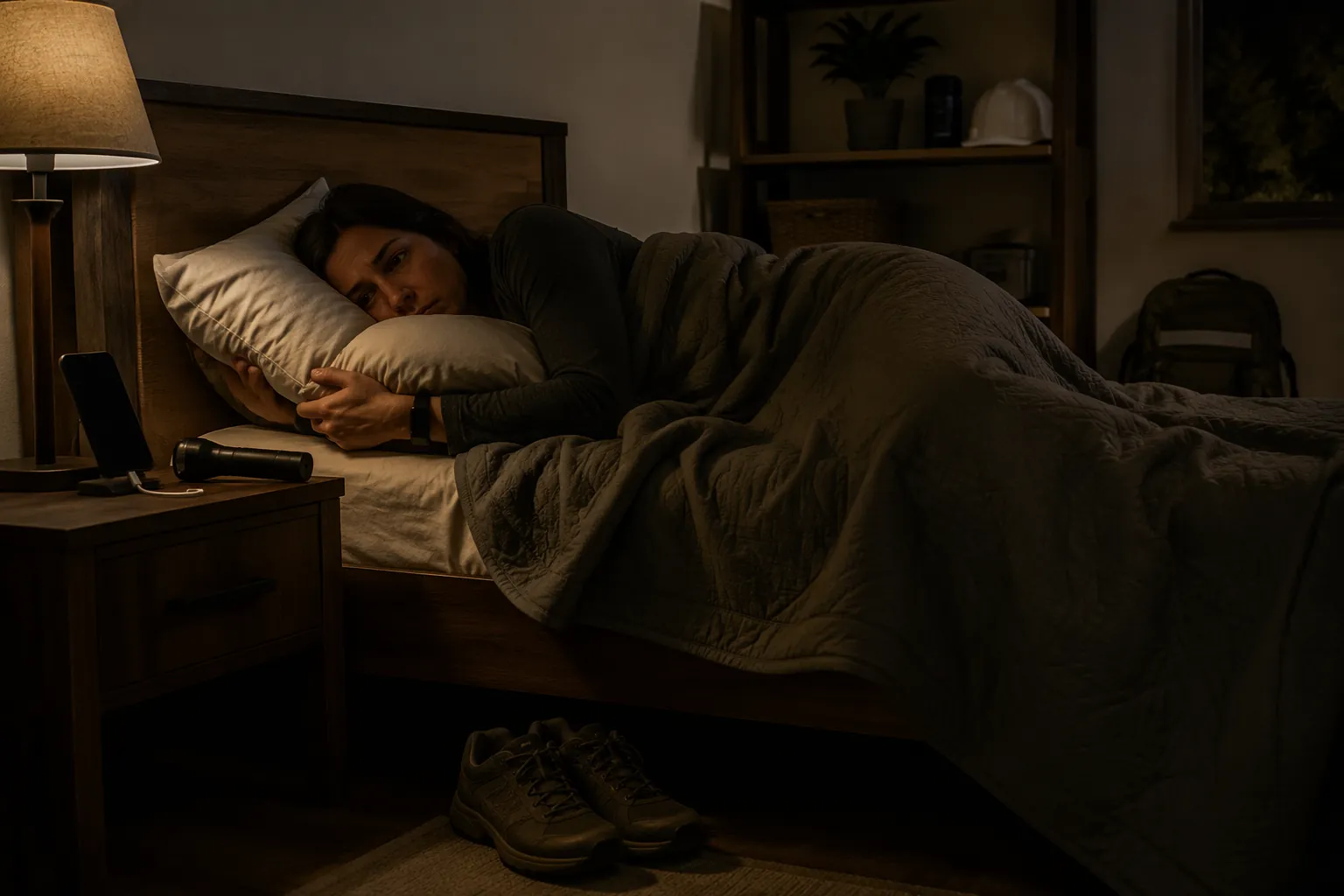
That one instruction changes the job of the night. The bed is not the place where you are helpless. It is part of the safety plan. Your work before sleep is to make that plan credible enough that your nervous system can stop running inspections every few minutes.
The four-layer plan for tonight
Do not start with a perfect bedtime routine. Start with the actual conflict: physical danger first, then sleep. A useful plan has four layers.
| Layer | What it does | Tonight's action |
|---|---|---|
| Bedroom safety audit | Reduces real risk without turning the night into endless checking | Clear hazards, prepare essentials, decide the aftershock response before getting in bed |
| Downshift routine | Tells the body the emergency scan is complete for now | Use a short, repeatable routine and 5:7 breathing |
| Modified stimulus control | Keeps CBT-I logic without ignoring earthquake safety | Treat bed as the planned safe location unless the building is unsafe |
| Escalation rules | Identifies when self-management is no longer enough | Seek care for persistent insomnia, panic, nightmares, avoidance, or unsafe coping |
This is not a promise that you will sleep normally tonight. It is a way to stop making a terrified brain choose between vigilance and collapse.
Make the room safe enough before you ask your body to sleep
A pre-bed safety audit should be short, boring, and final. If it becomes a ritual you repeat every time the house creaks, it has stopped helping. The point is to remove obvious hazards and make the next action clear.
- Move heavy, sharp, or breakable objects away from the bed if they could fall on you.
- Keep shoes within reach so you are not walking through debris barefoot if you need to evacuate later.
- Charge your phone near the bed, but do not keep checking alerts unless an official warning requires action.
- Place a flashlight where you can reach it without standing up.
- Choose the safest sleeping spot available, away from windows and unsecured furniture when possible.
- Say the plan once: if shaking starts while I am in bed, I stay in bed and cover my head and neck with a pillow.
If you are responsible for a child, an older adult, a disabled family member, or a pet, decide the first response before lights-out. Not a whole disaster movie in your head; just the first response. Who stays put? Who needs help after the shaking stops? Where are shoes, glasses, medication, mobility aids, or a leash?
Then stop auditing. One clean pass is safety preparation. Five more passes are usually anxiety bargaining. If something truly changes, handle it. If nothing has changed except the feeling in your chest, move to the downshift routine.
Use a routine that lowers alertness without pretending nothing happened
Generic sleep hygiene can sound insulting after an earthquake. You do not need a lecture about herbal tea while the walls are still making suspicious noises. What helps is a sequence short enough to repeat when you are tired and rattled.
- Finish the safety audit.
- Dim the room and reduce unnecessary sound or light alerts.
- Do one low-effort body cue: wash your face, change clothes, stretch your jaw and shoulders, or sit on the bed with both feet on the floor.
- Use 5:7 breathing for several rounds: inhale for a count of 5, then exhale slowly for a count of 7.
- Get into the safest sleeping position you can manage and keep the pillow within easy reach.
The 5:7 breathing pattern is simple for a reason. A longer, slower exhale can help lower heart rate and calm fight-or-flight activation, which makes it useful before sleep and again if a tremor wakes you.[2] Do not turn it into a performance. If counting makes you tense, shorten the numbers and keep the exhale longer than the inhale.
The routine should end before it becomes another monitoring system. You are not trying to prove that the night is safe. You are giving your body enough repeated cues to understand that the next planned action is rest.
Modify stimulus control instead of fighting it
Standard CBT-I advice often says that if you cannot sleep, you should get out of bed and return only when sleepy. In ordinary insomnia, that can help break the link between bed and wakeful frustration. During an aftershock sequence, blindly following that rule can be a bad fit.
If your building is considered safe enough to remain in and your safest available location at night is the bed, do not force yourself to wander around in the dark just to obey a sleep rule. In this context, bed can stay associated with two things: sleep and the planned aftershock response.
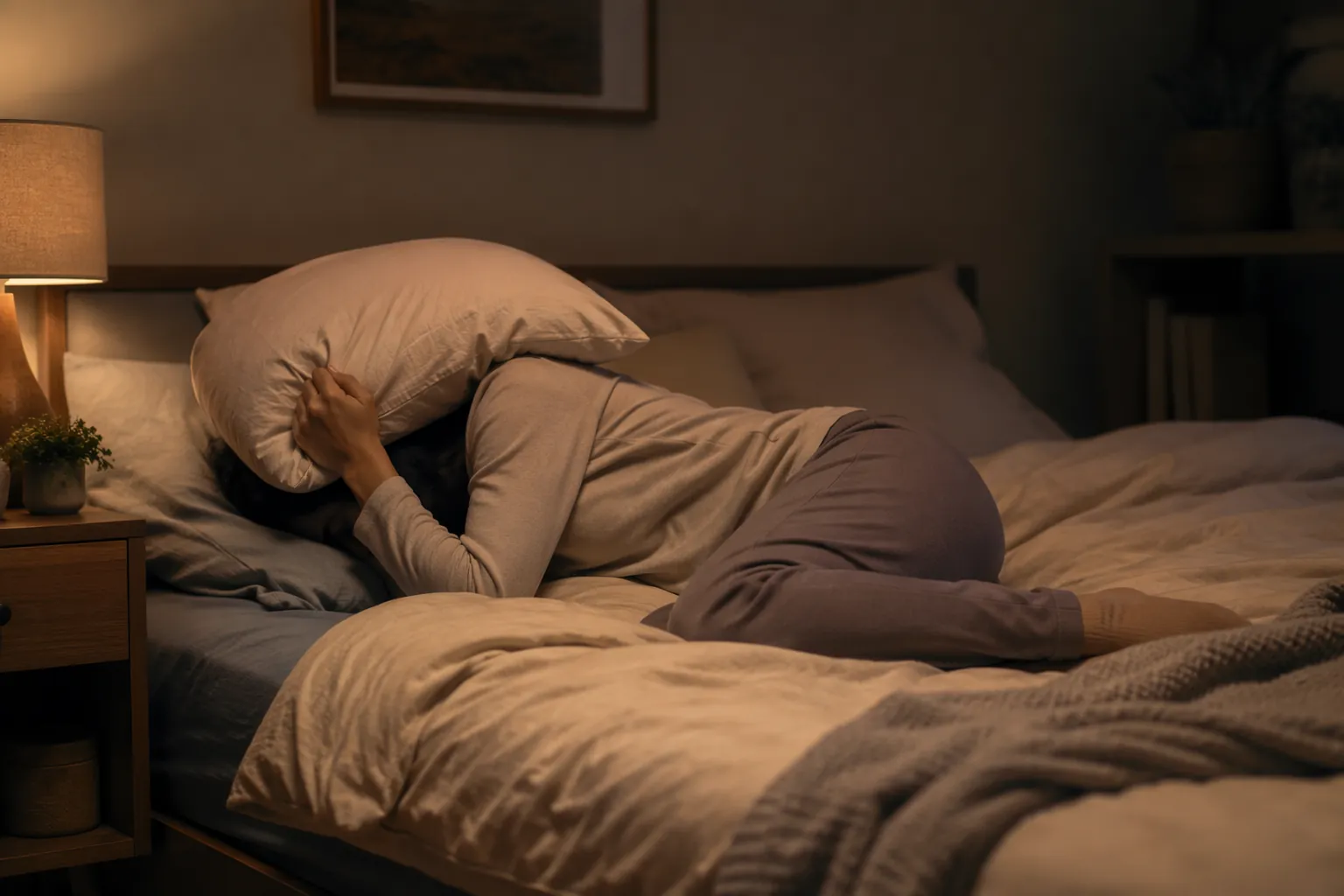
A modified version looks like this: stay in bed, keep the lights low, and avoid turning the bed into a command center. No scrolling damage footage. No refreshing maps every two minutes. No mental replay of every crack in the plaster. If you are awake and activated, sit up or lie on your side, repeat the breathing protocol, and use a quiet anchor such as counting breaths, naming neutral objects in the room, or listening to a calm audio track at low volume.
If you need to check official information, make it bounded: one reliable source, one check, then back to the plan unless there is an instruction that changes what you should do. The goal is not to eliminate uncertainty. It is to stop feeding the loop where uncertainty demands another check, and another, and another.
If a tremor wakes you
Do the already-decided thing. Stay in bed and cover your head and neck with a pillow if shaking starts while you are there.[1] When the shaking stops, pause before jumping up unless there is an immediate danger that requires movement. Check yourself, listen for urgent hazards, then decide whether anything actually needs action.
Afterward, expect your body to be loud. A racing heart, trembling, nausea, heat, or a sudden need to cry can be normal threat physiology. Use the same 5:7 breathing pattern for a few rounds, then return to the smallest next step: pillow reachable, shoes nearby, phone charged, body horizontal again.
Your reaction is common, but the numbers are not a script
Earthquake-related sleep disruption can be severe. In one study of 165 Haiti earthquake survivors, 94% reported clinically significant insomnia symptoms.[3] In a 2025 study of 428 earthquake survivors in Türkiye, the mean Pittsburgh Sleep Quality Index score was 11.10 across age groups; a score above 5 indicates poor sleep quality.[4]
Those findings validate the basic point: bad sleep after earthquakes is not weakness. Still, they should not be used as fortune-telling. The evidence comes largely from major earthquakes and post-disaster conditions in places including Haiti, Türkiye, Japan, and Italy. A person living through frequent low-grade aftershocks in an intact home may not face the same sleep risks as someone displaced after a high-magnitude disaster.
For parents and caregivers, the child data deserve attention without panic. In a Türkiye adolescent study conducted 9 to 12 months after an earthquake, 65.7% of adolescents slept fewer than 7 hours per night, and high earthquake anxiety was associated with much higher odds of poor sleep quality.[5] That study reflected young people living in container or tent housing months after the event, so it does not automatically describe every child who felt an aftershock at home. It does suggest that ongoing fear plus disrupted living conditions can keep sleep problems alive long after the first emergency phase.
Special situations need adaptation, not guesswork
The earthquake-specific sleep studies do not directly answer every question for perimenopause, pregnancy, ADHD, older adulthood, disability, or chronic illness. The general plan still applies: prepare the room, decide the aftershock response, lower hyperarousal, and seek help when symptoms persist. The details may need a clinician.
- If you are pregnant, ask your clinician about safe sleep positioning, medication options, and when anxiety or insomnia needs urgent care.
- If you are an older adult, be especially cautious with sedating medications because falls, confusion, tolerance, and dependence can become part of the danger.
- If you have ADHD, make the safety audit visible and finite: a written checklist can reduce the urge to keep restarting the scan.
- If aftershock fear is colliding with night sweats, cycle changes, or hormonal insomnia, Restful Ground's perimenopause guide to sleeping with earthquake anxiety may fit that overlap more closely.
When self-management is no longer enough
A rough night or several rough nights after shaking is not automatically a disorder. But there is a point where white-knuckling it becomes the wrong plan. Get professional help if insomnia persists, panic attacks make sleep feel impossible, nightmares are frequent, you avoid necessary rooms or routines, you feel detached or constantly on guard, or you cannot function safely at work, while driving, or while caregiving.
CBT-I is worth taking seriously here. The VA National Center for PTSD recommends CBT-I as a first-line treatment for sleep problems related to PTSD, and SleepEducation.org reports that CBT-I works for about 7 out of 10 people who complete it.[6][7] Access can be uneven after disasters, so online or digital CBT-I may be a practical bridge if local clinicians are booked or displaced.
Medication is not a moral failure, and some people do need medical support. But alcohol is a poor sleep tool: it can increase dependence risk and disrupt sleep quality. Benzodiazepines and Z-drugs also deserve caution, especially for long-term trauma-related sleep problems and for older adults, where tolerance, dependence, falls, and confusion are real concerns. If pregnancy, older age, trauma symptoms, other medications, or substance use are part of the picture, do not improvise in the medicine cabinet.
During an aftershock sequence, good sleep is not carefree sleep. It is enough safety preparation to let the brain stand down, enough routine to interrupt hyperarousal, and enough honesty to get help when the night has become too much to manage alone.
References
- Safety Guidelines: After an Earthquake, CDC.
- How to cope with earthquake anxiety, CNN, April 5, 2024.
- Disturbed sleep linked to mental health problems in earthquake survivors, American Academy of Sleep Medicine, 2019.
- The Effects of Earthquake Exposure on Sleep Quality and the Mediating Role of Chronotype: A Cross-Sectional Study, 2025.
- The Effect of Earthquake Anxiety on Sleep Duration and Sleep Quality in Adolescents, 2025.
- Sleep Problems and PTSD, VA National Center for PTSD.
- Sleeping After Trauma, SleepEducation.org.
Safety & eligibility read
Cross-check against other interventionsExplore the mechanism
Next step
Spot an error or have clinical feedback?
Because this article covers clinical, medication, or safety information, we use a moderated correction channel instead of open public comments. Let us know if something about “How to Sleep When You're Afraid of Aftershocks” needs a closer look.
Send feedback on this article