
Why perimenopause makes flood watch sleep anxiety worse
Learn why perimenopause creates a neuro-hormonal 'perfect storm' that amplifies sleep anxiety during flood watches. This article explains the physiological mechanisms behind the reaction and why standard weather anxiety advice may fall short.
A flood watch can look mild on paper: conditions are possible, not confirmed; the water is not at the door; no one has told you to evacuate. And yet at 1:40 a.m., the body may behave as if the emergency has already arrived. You check the alert again. You listen for harder rain. You calculate the route out. You tell yourself you did the reasonable things — charged the phone, checked the forecast, moved what needed moving — and still sleep will not come.
That mismatch is the heart of flood-watch sleep anxiety in perimenopause: the event is uncertain, but the vigilance is sustained. The National Weather Service describes storm stress as a real nervous-system reaction to severe weather information, especially when alerts, memories, and safety decisions keep the brain scanning for danger.[1] A flood watch is especially awkward for sleep because it can hold the body in a waiting state for hours to days. It is not the same as being startled by one clap of thunder and then settling back down.
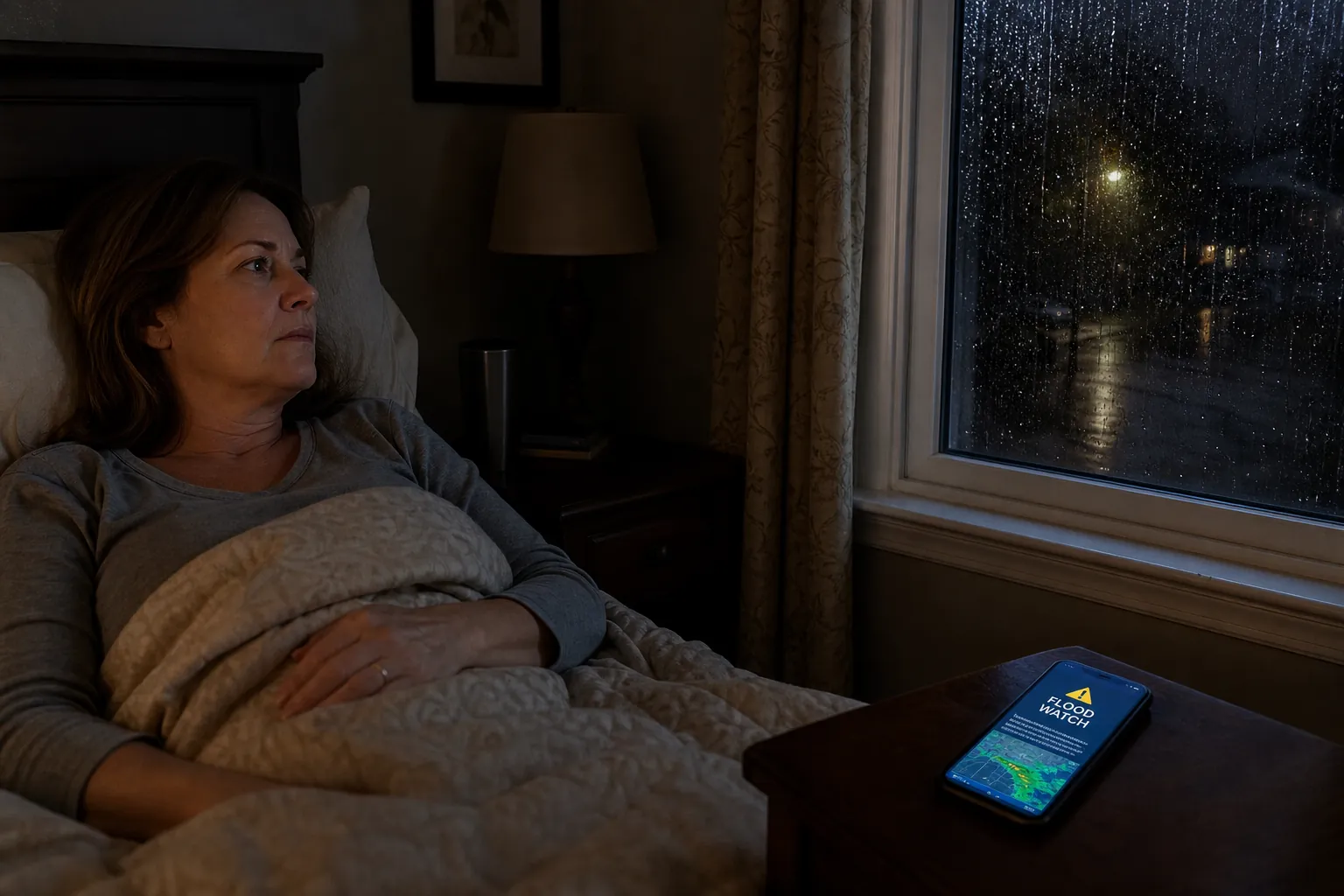
There is not, as of now, a clinical study that directly measures flood-watch alerts and perimenopausal insomnia as one combined phenomenon. The useful explanation comes from putting two evidence streams together carefully: weather alerts can provoke sustained threat-monitoring, and perimenopause can weaken the hormonal systems that normally help the brain stand down.
The watch keeps the threat unfinished
A warning gives the nervous system something concrete to do: shelter, move, call, leave, wait for the immediate cell to pass. A watch is more ambiguous. It asks the brain to keep a channel open. That is useful from a safety standpoint; it is also a terrible sleep condition for someone whose arousal system is already easier to trigger.
This is why the usual “turn off notifications and relax” advice can feel insulting when taken too far. Preparedness matters. So does checking official alerts. The problem is that preparation reduces uncertainty; it does not automatically switch off a body that has entered a high-alert state.
The Anxiety and Depression Association of America’s severe-storm guidance emphasizes practical steps such as making a plan, limiting excessive media exposure, and using calming strategies during hurricane season or storm threats.[2] Those steps are sensible. But in perimenopause, they may be necessary without being sufficient, because the alert is landing on a nervous system whose braking chemistry may be changing.
Perimenopause can weaken the body’s sleep brake
The menopausal transition is not just a reproductive event that happens to occur near midlife stress. Sleep researchers describe it as a period when hormonal variability, vasomotor symptoms, mood vulnerability, and stress-system changes can all converge on sleep.[3] In that context, a flood watch is not creating anxiety out of nowhere. It is testing a sleep system that may already have less margin.
Progesterone is one of the first pieces to notice. Its metabolites interact with GABA-A receptors, part of the brain’s major calming system, and the sleep literature has long treated progesterone as relevant to sedation and respiratory stability.[3] During perimenopause, progesterone can decline and become more erratic. The lived version of that biology is familiar: the mind understands that the forecast is only a watch, while the body cannot find the downshift.
Estrogen adds a second kind of instability. Johns Hopkins Medicine notes that changing estrogen levels can affect serotonin and contribute to new or worsening anxiety during perimenopause; it also reports that about 55% of women experience new anxiety in this transition.[4] That figure should not be read as proof that every anxious night is hormonal. It does show that anxiety emerging in the menopausal transition is common enough to deserve a biological explanation, not a character judgment.
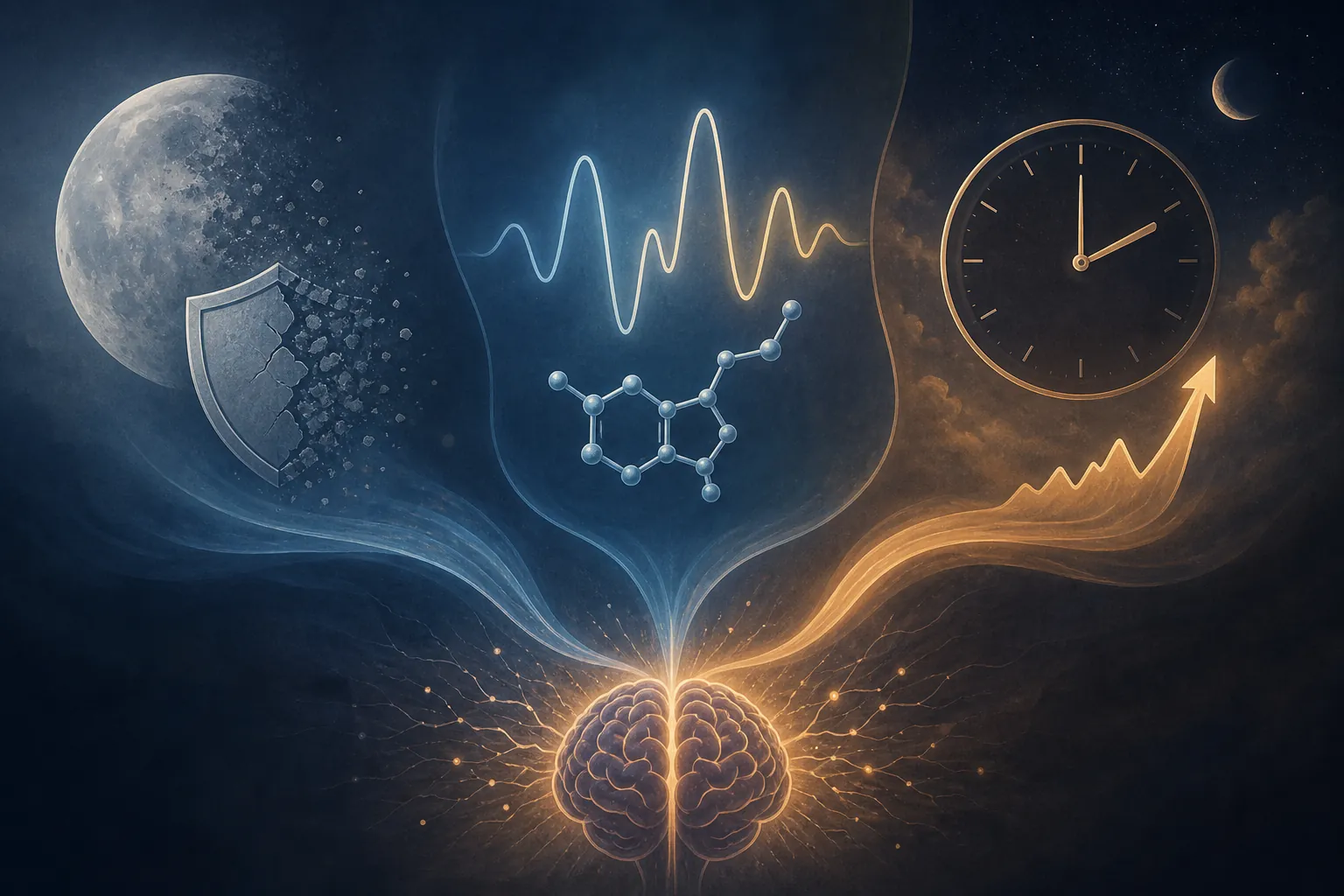
The Baker review gives the broader sleep context: sleep disturbances are reported by roughly 40% to 60% of women during the menopausal transition, and one cited phone-interview study found that 26% met DSM-IV criteria for an insomnia diagnosis.[3] Those numbers measure general menopausal-transition sleep disturbance, not flood-watch nights specifically. Still, they make one thing difficult to dismiss: many women enter midlife with sleep that is already more fragile.
Why the alarm gets louder at 2 or 3 a.m.
Nighttime is when the flood watch becomes most intimate. Daytime checking has distractions and tasks around it. At night, there is less competing information: rain on the window, a phone on the table, the quiet math of “what if the creek rises before morning?”
The stress system matters here. Research on cortisol during the menopausal transition supports the idea that HPA-axis regulation can shift across this life stage, with patterns that include higher cortisol levels during parts of the transition.[5] Cortisol is not “bad”; it is part of waking, mobilizing, and responding. But when it rises at the wrong time, the body may interpret a half-formed cue — heavier rain, a distant siren, a refreshed alert — as something requiring full attention.
This is the same basic threat-reactivity problem discussed in why scary movies keep you up at night during perimenopause: the brain receives a fear cue, and the body takes longer to return to baseline. A flood watch is harder because it does not end with the credits. It keeps refreshing.
For some women, the 3 a.m. wake-up has another layer: cortisol, glucose regulation, and overnight arousal can overlap. That pattern is close to the nighttime cortisol loop discussed in whether a low-carb diet improves sleep in perimenopause. The flood watch may be the conscious object of fear, while the body’s arousal chemistry supplies the volume.
Hot flashes can turn one alert into many awakenings
A flood watch does not have to keep someone awake continuously to ruin the night. It can also attach itself to each normal or symptom-driven awakening. You wake hot, throw off the covers, hear rain, check the phone, and now the nervous system has a reason to stay awake.
Vasomotor symptoms make that loop more likely. In SWAN data discussed in the Baker review, women with moderate-to-severe hot flashes were nearly three times more likely to report frequent nocturnal awakenings.[3] The key point is not that hot flashes cause flood anxiety. It is that they create more openings in the night, and each opening gives the threat-monitoring system another chance to come online.
Environmental stressors often compound this. Heat, humidity, and poor sleep conditions can make the body more reactive before the alert even arrives. That is why the overlap between weather, temperature, and perimenopause sleep in heat dome night sweats and CBT-I for perimenopause sleep belongs next to this conversation, not in a separate mental-health box.
Why being prepared may not make you sleepy
It is possible to do the right safety steps and still have a bad night. That distinction matters. The person who checks the official forecast, knows the evacuation route, charges the phone, and avoids doom-scrolling has reduced chaos. She has not necessarily changed progesterone signaling, estrogen fluctuation, hot-flash awakenings, or a stress system that is over-responding in the dark.
| What preparation can do | What it may not do in perimenopause |
|---|---|
| Clarify whether action is needed | Stop the body from staying in threat-monitoring mode |
| Reduce repeated decision-making | Restore the same calming buffer progesterone once provided |
| Limit unnecessary alert checking | Prevent cortisol-linked awakenings or hot-flash interruptions |
| Make evacuation or sheltering easier if conditions worsen | Make an uncertain, hours-long watch feel emotionally brief |
That is where much storm-anxiety advice runs out of road. The advice is often built for uncertainty management: make a kit, make a plan, choose reliable sources, breathe, limit media. Those are still useful. But sleep anxiety during a flood watch is not only a thinking problem. In perimenopause, it may also be a state-regulation problem: the body has entered alert, and the usual internal signals for safety are weaker or noisier.
The barometric-pressure question is still unsettled
Many women say they feel weather changes in their bodies before or during storms: pressure in the head, mood shifts, joint aches, strange agitation, a sense that sleep will be difficult before the forecast fully explains why. Those reports are common enough in midlife communities to take seriously as experience.
They are not, however, the same as evidence that barometric pressure has a proven perimenopause-specific mechanism for flood-watch insomnia. The stronger evidence remains the more boring and more useful explanation: fluctuating reproductive hormones, altered mood regulation, vasomotor awakenings, and HPA-axis arousal can make a sustained alert harder to tolerate.
Substances and stress can lower the threshold
Some flood-watch nights are worse because the threshold was already lower before the first alert. Alcohol is one example. Parkview Health notes that alcohol can worsen perimenopause sleep by disrupting thermoregulation and increasing nighttime adrenaline, among other effects.[6] On an ordinary night, that may show up as restless sleep. On a flood-watch night, the same physiology may give the brain more wakeful moments to attach to danger.
Chronic stress works in a similar direction. It does not need to be dramatic to matter. A loaded workday, caregiving, grief, a prior flood memory, or weeks of poor sleep can leave the arousal system closer to the surface. The flood watch then becomes the named reason for a reaction that was already physiologically easier to trigger.
A more accurate way to name the night
The most accurate description is not “irrational fear of rain.” It is sustained threat-monitoring during a legitimate weather uncertainty, amplified by a menopausal-transition nervous system that may have fewer calming buffers and more nighttime arousal.
That distinction protects two truths at once. Flood risk deserves respect; anxiety is not solved by pretending alerts do not matter. And a woman who cannot sleep through a flood watch in perimenopause is not failing at perspective. Her body may be processing a real environmental signal with a changed hormonal and stress-response system.
So the answer is bounded but useful: flood-watch sleep anxiety during perimenopause is biologically plausible, even though the exact intersection has not been directly studied. Standard weather-anxiety guidance may still help, but for many women it needs to be paired with perimenopause-aware sleep care rather than treated as a simple reassurance exercise.
References
- Storm Stress and Anxiety, National Weather Service.
- Severe Storms: How to Reduce Your Anxiety, Anxiety and Depression Association of America.
- Sleep and Sleep Disorders in the Menopausal Transition, PMC.
- Perimenopause and Anxiety, Johns Hopkins Medicine.
- Cortisol levels during the menopausal transition, PMC.
- Stronger through perimenopause: The impact of sleep, stress and substances, Parkview Health.
Explore the mechanism
Next step
Spot an error or have clinical feedback?
Because this article covers clinical, medication, or safety information, we use a moderated correction channel instead of open public comments. Let us know if something about “Why perimenopause makes flood watch sleep anxiety worse” needs a closer look.
Send feedback on this article