Which Galaxy Watch Sleep Features Help with Perimenopause?
This guide maps Galaxy Watch sleep tracking features—Bedtime Guidance, skin temperature, sleep apnea screening, and WASO tracking—directly to the physiological drivers of perimenopausal sleep disruption, so you can interpret Samsung Health data for useful trends rather than noise.
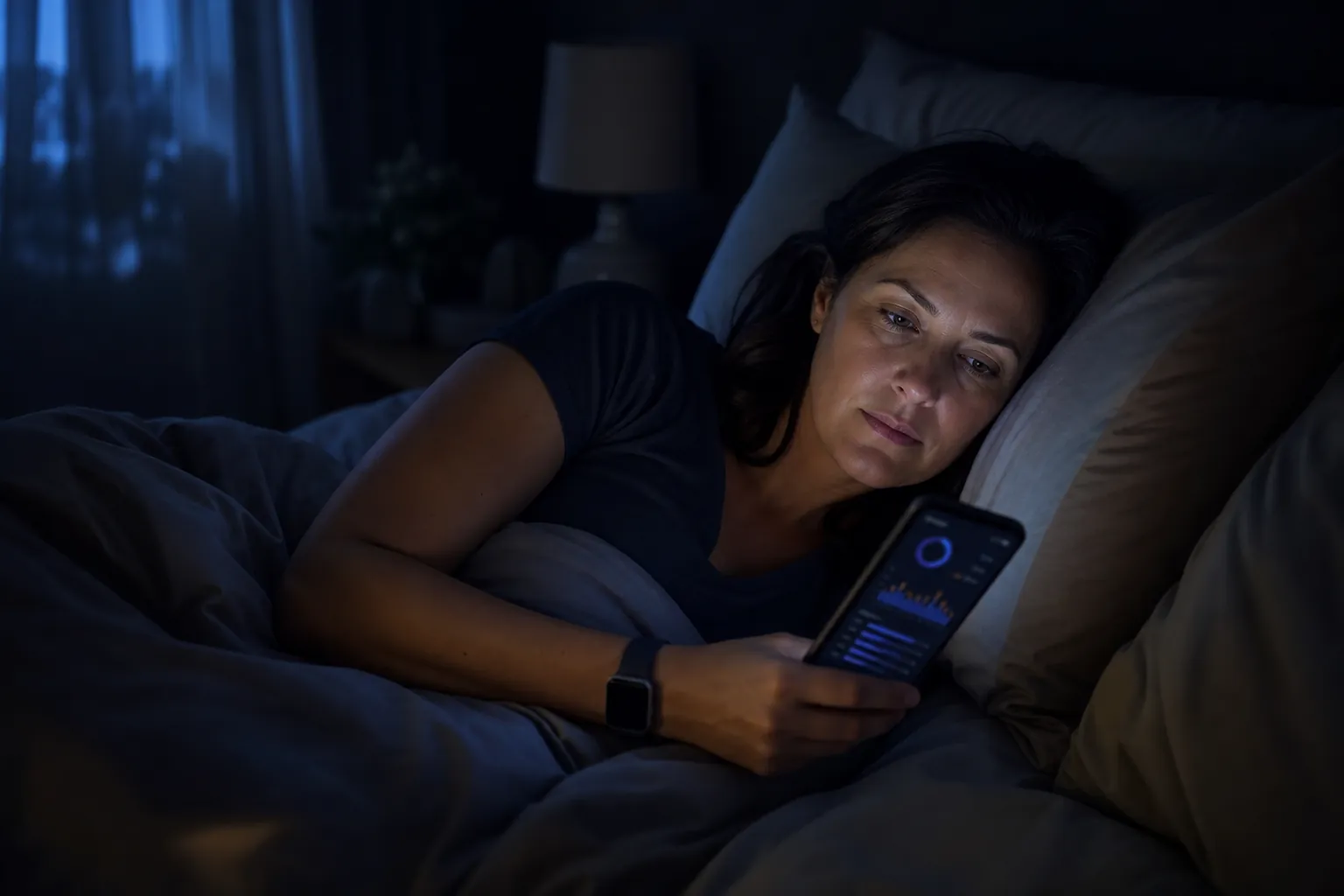
After another broken night, Samsung Health can look both comforting and insulting. There is a score, a graph, a few colored sleep stages, maybe a skin temperature trend, and none of it explains why you were awake at 3:17 a.m. sweating, alert, and annoyed. The useful question is not whether Galaxy Watch sleep tracking is “accurate” in one sweeping way. For perimenopause, it is which parts of the data line up with the ways this transition actually disrupts sleep.
| Galaxy Watch feature | Perimenopause-relevant sleep question | Safest way to read it |
|---|---|---|
| WASO and sleep/wake timing | Am I waking more after I first fall asleep? | Most useful as a week-to-week fragmentation trend, not as a single-night verdict. |
| Bedtime Guidance | Is my sleep window drifting later, becoming irregular, or fighting my body clock? | Useful as a consistency prompt when circadian rhythm feels unstable. |
| Skin temperature trend | Do warmer nights cluster with awakenings or suspected hot flashes? | A pattern clue only; not a validated hot-flash detector. |
| Sleep apnea screening | Could breathing disruption be hiding inside “menopause sleep problems”? | A screening tool for possible moderate-to-severe obstructive sleep apnea, not a diagnosis. |
| Sleep stage breakdown | Am I getting enough REM or deep sleep? | Low-confidence background color; do not build decisions around nightly stage percentages. |
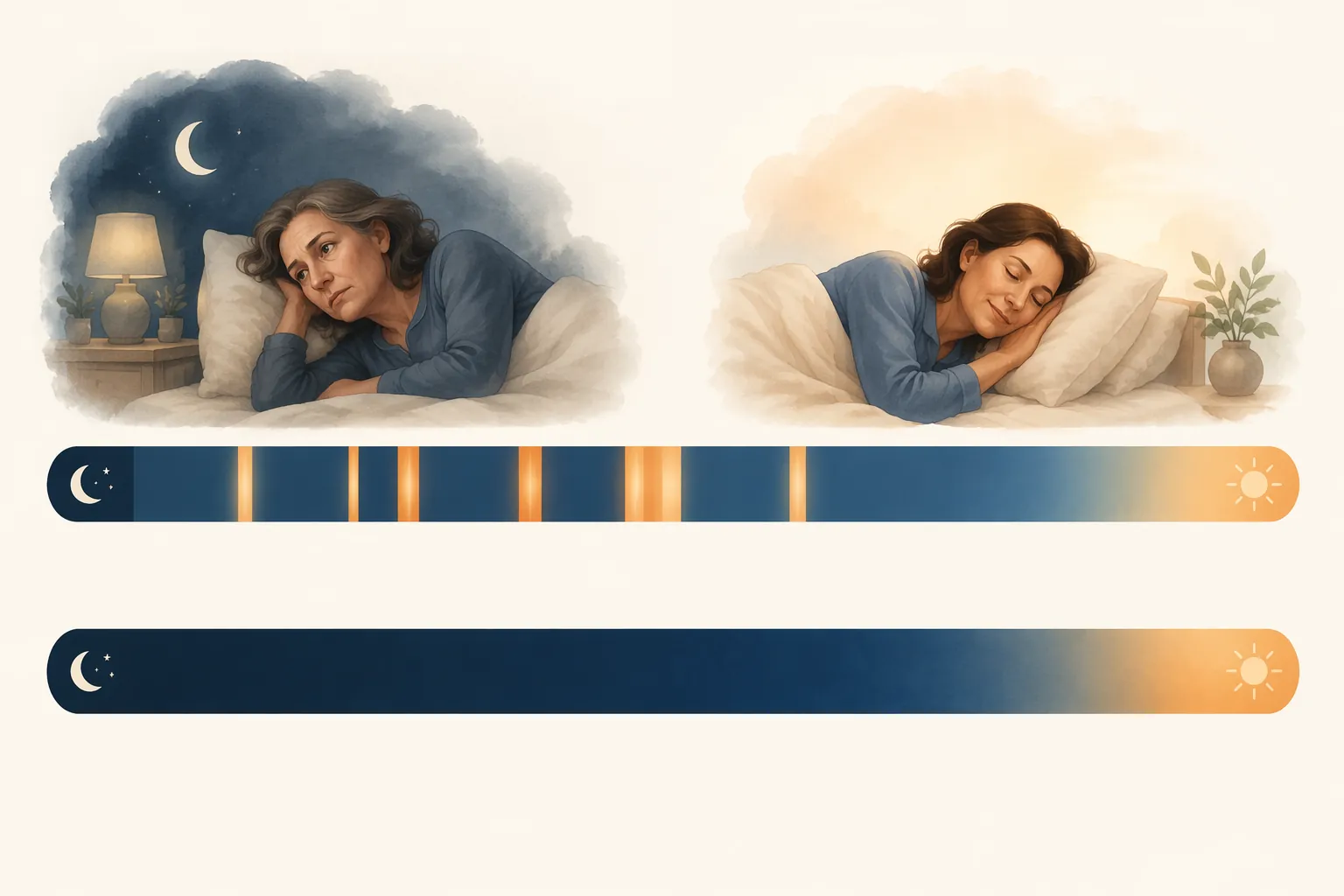
That order matters. The most perimenopause-relevant number on the screen is often not deep sleep. It is wake after sleep onset, or WASO: the time you spend awake after initially falling asleep. In the Harvard Apple Women’s Health Study, 84% of tracked participants reported sleep changes attributed to the menopause transition, and 60% showed increased WASO, with an average 7% increase in the 18 months before their final menstrual period. The study population used Apple Watch, not Galaxy Watch, so this is not a Samsung validation study. Still, the finding gives shape to a familiar complaint: sleep is not just shorter; it is more broken. [1]
Start with fragmentation, not the sleep score
A lower sleep score may be true enough to be irritating, but it is too blended to be very useful. It can reflect a later bedtime, a shorter night, more wake time, stage estimates, movement, or breathing-related signals depending on the model and settings. If perimenopause is the question, separate the score into the parts that have a plausible mechanism.
WASO deserves the first look because it describes the thing many people can feel but cannot quantify: falling asleep, waking again and again, then being told by an app that they technically got enough time in bed. A week with several nights of higher WASO tells a different story from one bad night after a late dinner, travel day, or unusually stressful evening.
This is also where wrist devices are on firmer ground. A 2024 validation study of consumer wrist-worn PPG devices found sleep-wake sensitivity above 95%, while agreement for deep and REM sleep was much weaker, with intraclass correlations reported in the 0.13 to 0.37 range. The study tested Apple Watch Series 8, Fitbit Sense 2, and Oura Ring Gen3, not Galaxy Watch, so it cannot be quoted as direct Galaxy Watch proof. But it is a useful calibration for this whole category of PPG-plus-accelerometer devices: sleep versus wake is a more trustworthy signal than the exact architecture of your REM and deep sleep. [2]
A practical reading routine is simple: look at WASO, total sleep time, sleep midpoint, and how often the night is interrupted. Ignore the temptation to litigate whether one 11-minute wake period was really six minutes. The question is whether your nights are becoming more fragmented over two to four weeks, and whether that fragmentation clusters with heat sensations, cycle irregularity, later bedtimes, alcohol, illness, travel, or possible breathing warnings.
How to review WASO without turning it into another 3 a.m. chore
- Wear the watch consistently for full nights before you compare trends. A missing or half-charged night can make the pattern look more dramatic than it is.
- Compare weeks, not isolated nights. Perimenopause sleep can vary enough that one bad night is usually less informative than a repeated pattern.
- Pair the graph with one plain note when needed: “hot,” “late caffeine,” “travel,” “period started,” “awake and anxious,” or “no obvious trigger.” The note does not need to become a diary.
- Watch for timing. Wakefulness that repeatedly appears in the second half of the night may point you toward different conversations than difficulty falling asleep at the beginning of the night.
- Treat stage percentages as background. If WASO is rising and sleep feels worse, a cheerful-looking REM number should not override your lived experience.
Bedtime Guidance is useful when your sleep window is drifting
Galaxy Watch8’s Bedtime Guidance analyzes circadian rhythm over three nights and suggests an optimal bedtime. That is relevant because perimenopause can involve circadian disruption, and many women notice that their former sleep timing stops behaving predictably. The feature is not a hormone treatment and should not be expected to overpower hot flashes, night waking, or insomnia by itself. Its better role is quieter: it gives you a suggested anchor when your bedtime has started sliding around. [3]
Use it as a consistency tool. If the suggested bedtime is realistic, try holding a steadier sleep window long enough to see whether WASO and wake time improve. If the guidance keeps pushing you toward a bedtime that does not match your life, your work schedule, or your caregiving responsibilities, do not treat that mismatch as a personal failure. The watch can suggest timing; it cannot rearrange the conditions around your sleep.
The most useful configuration choice is not exotic. Charge the watch before evening, wear it snugly enough for sensor contact, and keep your sleep schedule as stable as your actual life allows while you collect data. If you change bedtime, caffeine timing, exercise timing, room temperature, and supplements in the same week, Samsung Health may show a pattern, but you will not know what produced it.
Skin temperature can support a hot-night hypothesis, not prove one
Skin temperature is one of the easier wearable metrics to overinterpret because it feels intimate. Heat is real; waking drenched is real; the graph is right there. But Galaxy Watch skin temperature should be treated as trend-only sleep context, not as confirmed hot-flash detection. The available evidence does not include independent validation showing that Galaxy Watch can identify nocturnal hot flashes.
That does not make it useless. It means the interpretation has to stay modest. If your temperature trend is higher on the same nights your timeline shows repeated awakenings, and your own note says “hot” or “sweaty,” the watch is helping you notice a recurring pattern. If the temperature trend changes but your sleep is fine, or the watch shows no temperature shift on a night you clearly had a hot flash, that is not a contradiction worth arguing with at 6 a.m. Wrist skin temperature is a noisy proxy for a body-wide event.
The safest use is pattern matching over several weeks: temperature elevation plus awakenings plus a remembered heat event. Any one of those by itself is weaker. Together, they may give you better language for a clinician visit: “I’m waking repeatedly, and many of those nights line up with heat symptoms,” rather than “my sleep score is bad.”
The sleep apnea feature deserves more respect than the sleep stages
Breathing-related sleep disruption is easy to misfile under menopause because the daytime aftermath can sound familiar: fatigue, mood changes, and night waking. That overlap is exactly why the Galaxy Watch sleep apnea screening feature matters. In February 2024, Samsung announced FDA authorization for its Galaxy Watch sleep apnea feature as the first over-the-counter obstructive sleep apnea screening tool authorized by the FDA. The feature was validated to detect signs of moderate-to-severe obstructive sleep apnea over two nights of at least four hours of sleep within a 10-day window. [4]
FDA authorization does not mean the watch diagnoses sleep apnea. It means the feature cleared a regulatory pathway for a defined screening purpose under defined conditions. The distinction is not pedantic. A screening alert should move you toward a clinician conversation or formal sleep evaluation; it should not send you into self-treatment, and a non-alert should not be used to dismiss persistent symptoms.
Use the feature the way it was designed: collect the required nights, make sure each qualifying night has enough sleep time, and do not run it only after the single worst night of the month. If the result suggests possible risk, bring the result along with your sleep timeline, WASO trends, and symptom pattern. That combination is more useful than presenting the watch as if it had already made the diagnosis.
This is one of the few places where a wearable can change the next step in a meaningful way. Not because it names the condition with certainty, but because it can keep a breathing problem from being buried inside the large, vague bucket of “menopause sleep.”
Let sleep stages recede into the background
The sleep-stage chart is visually persuasive. It looks like a medical record, with neat bands of light sleep, deep sleep, REM, and wake. For perimenopause decision-making, it should carry the least weight. The available wearable validation evidence is much stronger for sleep-wake detection than for deep or REM staging, and it is not direct Galaxy Watch polysomnography validation. [2]
That means a low deep-sleep percentage should not become the center of the investigation unless the broader pattern supports it. If you feel awful and the watch shows fragmented sleep, focus on the fragmentation. If your REM number bounces around while your sleep feels steady, there may be nothing to solve. The stage chart can stay on the page, but it should not be allowed to run the meeting.
A practical way to read Samsung Health across a month
The most useful setup is boring in the best way: consistent wear, a stable sleep window where possible, and a small number of metrics you actually review. If you are in perimenopause, the point is not to produce a perfect dashboard. It is to sort several plausible drivers that can look identical at 3 a.m.
| Pattern in Samsung Health | What it may suggest | What to do next |
|---|---|---|
| WASO rises across several weeks while bedtime stays fairly stable | Increasing sleep fragmentation | Look for clustering with heat symptoms, cycle changes, stressors, illness, medication changes, or breathing-risk alerts. |
| Sleep midpoint drifts later and wake time becomes inconsistent | Circadian drift or schedule instability | Use Bedtime Guidance as an anchor, then watch whether WASO and total sleep time improve. |
| Temperature trend elevations cluster with awakenings and remembered heat | Possible heat-linked arousals | Track the pattern for a few weeks and describe it as suspected heat-related waking, not watch-confirmed hot flashes. |
| Sleep apnea screening flags possible risk | Possible moderate-to-severe obstructive sleep apnea risk | Discuss the result with a clinician or sleep specialist; do not treat the watch as a diagnosis. |
| Deep or REM percentages fluctuate but sleep-wake timing is stable | Likely stage-estimation noise or normal variation | Avoid chasing stage percentages unless symptoms and other trends point to a real problem. |
If you also use Samsung Health cycle tracking, be careful with expectations in perimenopause. Irregular cycles are part of the transition, and Samsung’s cycle predictions have not been independently validated specifically for perimenopausal users. Cycle context can still be useful as a rough note: sleep worsened before bleeding, after skipped cycles, or during a stretch of vasomotor symptoms. Treat it as context, not a precise endocrine map.
When the watch data should leave the app
The best use of Galaxy Watch sleep data is often not self-optimization. It is making the problem visible enough to discuss clearly. A clinician does not need your worst sleep score. They need to know what has changed, how long it has been happening, whether you are waking after sleep onset, whether heat symptoms are involved, whether breathing risk has been flagged, and how the sleep disruption is affecting the next day.
- Bring up a sleep apnea screening alert rather than waiting to see if it “goes away.”
- Bring up persistent WASO increases when they match worsening daytime fatigue, mood changes, or functioning.
- Bring up repeated awakenings that cluster with suspected hot flashes or night sweats.
- Bring up severe or prolonged sleep disruption even if the watch gives reassuring stage charts or a non-alarming score.
Galaxy Watch can help a perimenopausal reader notice circadian drift, fragmented sleep, possible heat-linked awakenings, and potential apnea risk. It cannot diagnose menopause-related insomnia, hot flashes, or sleep apnea.
References
- Sleep Patterns and Changes in Perimenopause — Harvard T.H. Chan School of Public Health, May 2026.
- Robbins et al. 2024, Sensors (PMC11511193) — PMC, 2024.
- Samsung Galaxy Watch8 Series and Galaxy Watch Ultra: Comfort From Sleep to Workout — Samsung Newsroom, July 2025.
- Samsung Sleep Apnea Feature on Galaxy Watch First of Its Kind Authorized by US FDA — Samsung Newsroom, February 2024.
Explore the mechanism
Next step
Spot an error or have clinical feedback?
Because this article covers clinical, medication, or safety information, we use a moderated correction channel instead of open public comments. Let us know if something about “Which Galaxy Watch Sleep Features Help with Perimenopause?” needs a closer look.
Send feedback on this article