
Why Heatwaves Wreck Perimenopause Sleep More Than They Used To
Understand the biological mechanism behind why heatwaves disrupt perimenopause sleep more severely than before. This article explains how declining estrogen narrows the thermoneutral zone, turning high nighttime temperatures into a more potent trigger for hot flashes and awakenings.
The room may be hot, yes. The insulting part is that it used to be only hot. You would kick off the sheet, turn the pillow, complain in the morning, and move on. Now the same kind of summer night can feel as if it has crossed some private tripwire: heat rises in the chest or face, sweat breaks through, sleep snaps open, and by 3:17 a.m. you are trying to decide whether your body has become dramatic or defective.
That change is the place to start when asking why heatwaves affect perimenopause sleep. The answer is not simply that heat is uncomfortable, or that midlife women become more delicate sleepers. The more useful explanation is narrower and more physical: during the menopausal transition, declining and fluctuating estrogen can narrow the brain's thermoneutral zone, the temperature range in which the body feels it does not need to launch a cooling response. When that zone gets smaller, a hot bedroom has less distance to travel before it sets off a hot flash.
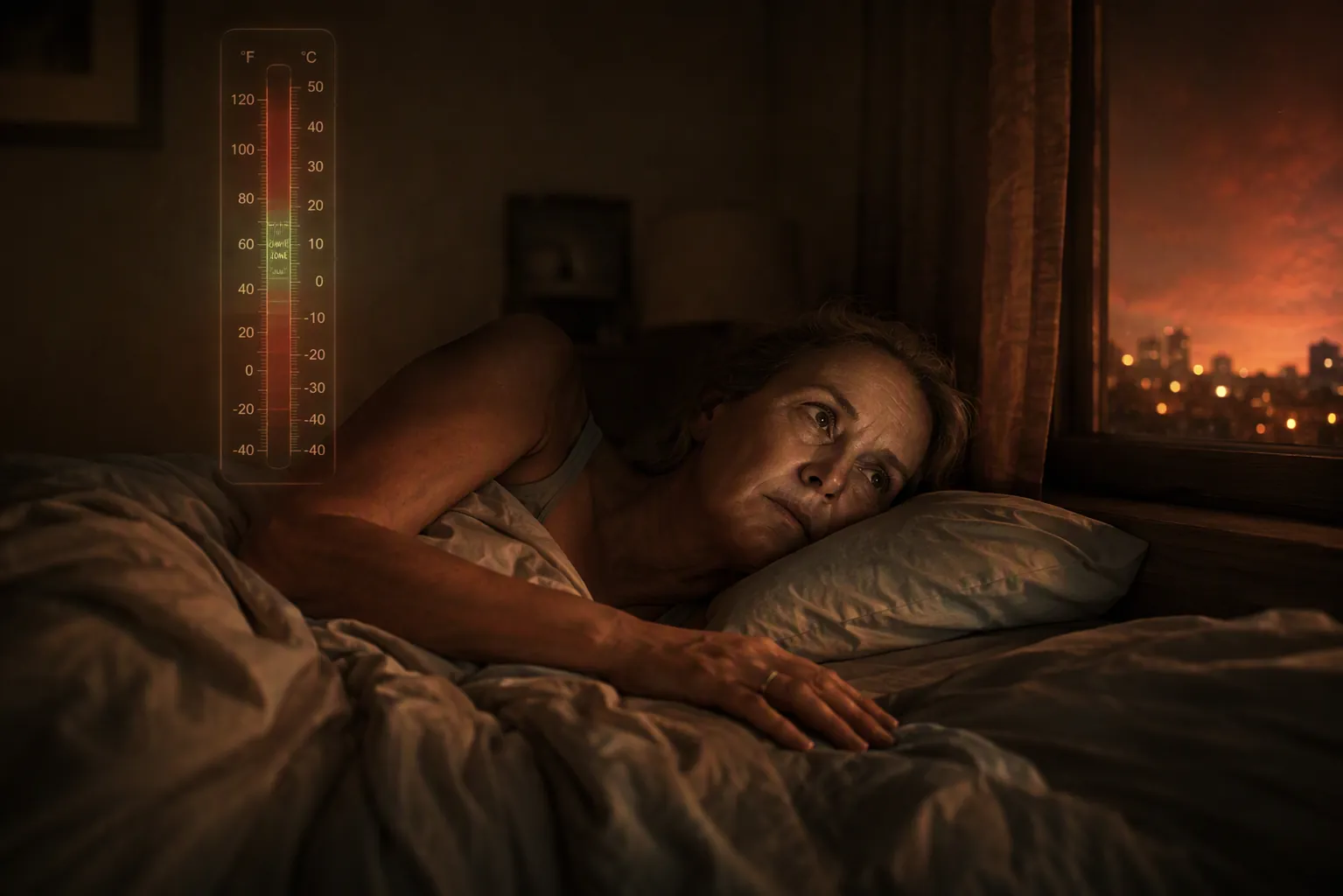
The thermostat did not vanish. Its margin got smaller.
Hot flashes are often described as random surges, but the better model is a nervous system reacting too soon. In the thermoregulatory model associated with Robert Freedman and summarized in menopausal sleep research, vasomotor symptoms are linked to a narrowed thermoneutral zone controlled through the hypothalamus. When core temperature rises above the upper threshold, the body activates heat-loss responses such as skin blood vessel dilation and sweating. In perimenopause, that upper threshold can sit uncomfortably close to ordinary body temperature, so smaller thermal changes can trigger a larger response.[1]
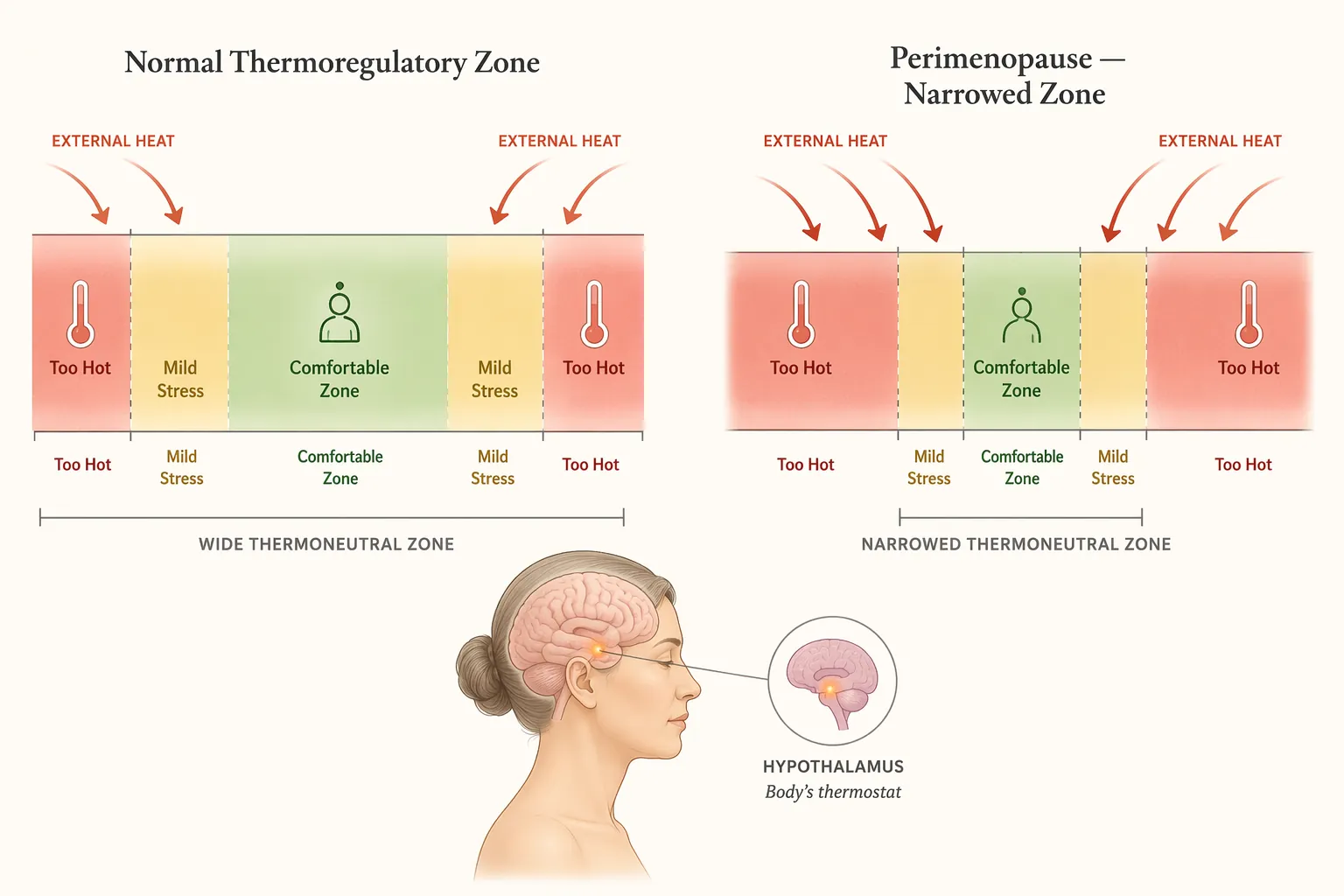
This is why the phrase "I just run hot now" can be both true and incomplete. The issue is not only the temperature you feel on your skin. It is the reduced buffer between normal warmth and an internal alarm. A summer night that once stayed below the alarm line can now cross it repeatedly, especially if the room never cools down enough for the body to return to baseline.
Once that alarm fires, sleep is not being disturbed by heat alone. It is being disturbed by a sequence: the bedroom remains warm, core temperature edges toward the threshold, the body launches a cooling response, sweat and flushing arrive, and the sleeping brain is pulled toward wakefulness. If the sheet is damp, the heart is beating harder, or embarrassment and irritation rush in, the awakening lasts longer than the hot flash itself.
Why the same heatwave can now cause more awakenings
A heatwave adds pressure from the outside. Perimenopause has already reduced tolerance from the inside. Put those together and the night is no longer just warm; it is warm inside a smaller operating range.
That matters most overnight because sleep already depends on temperature regulation. The body normally cools as it moves toward sleep. A bedroom that stays hot makes that cooling harder. In someone with a narrowed thermoneutral zone, the body may also reach the hot-flash threshold more easily. The result can be a repeating pattern rather than a single bad moment: heat, hot flash, sweat, awakening, partial cooling, return to sleep, then another breach.
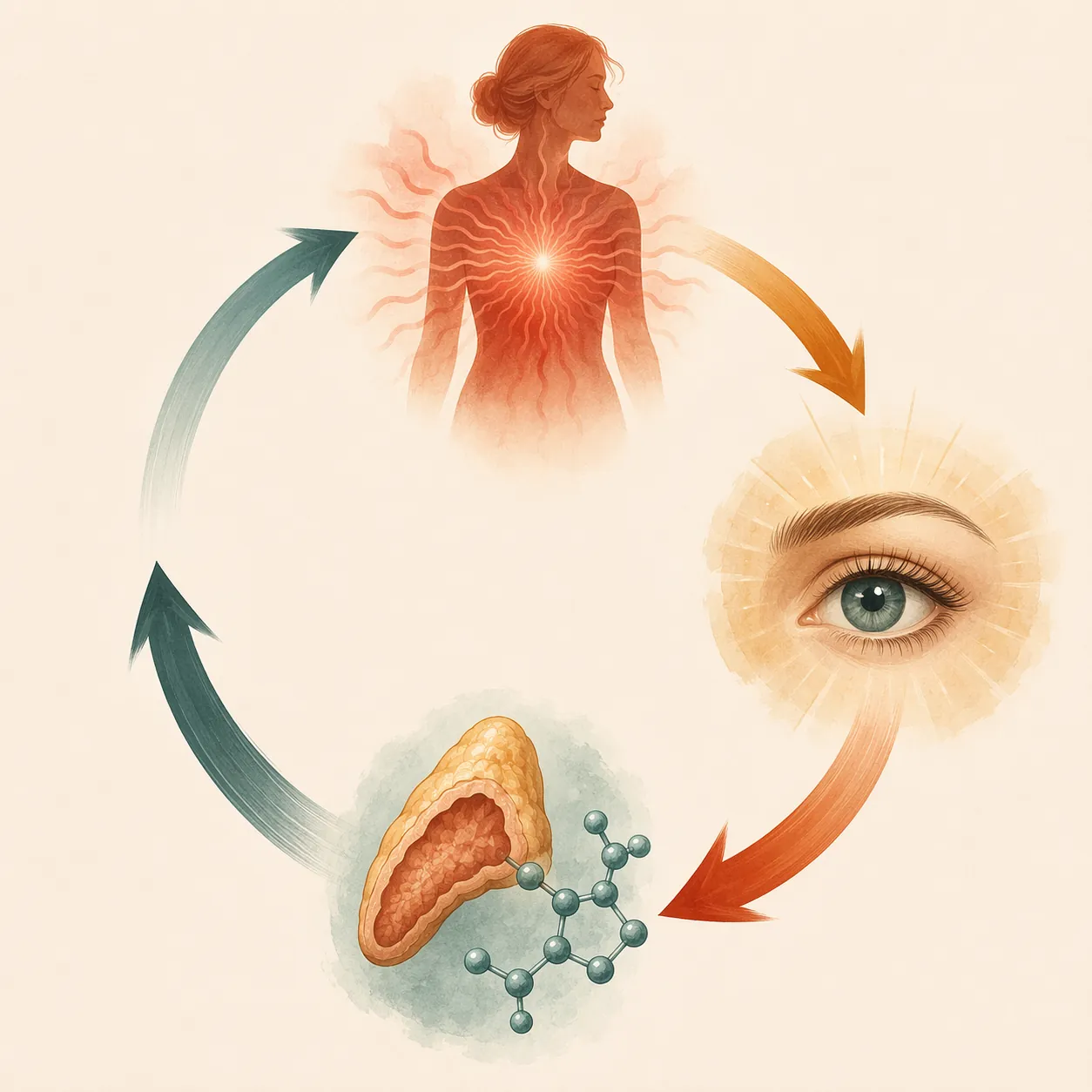
There is also a second loop that is less visible but familiar to anyone who has started dreading bedtime. Disturbed sleep can raise stress-system activity; menopause clinicians often describe a cycle in which poor sleep increases cortisol, cortisol can worsen hot flashes, and the worsening hot flashes further disrupt sleep.[5] This does not mean every 3 a.m. awakening is "stress." It means the body can become more reactive after the first few breaks in sleep.
That distinction matters. If you wake drenched during a heatwave, the practical question is not whether the cause is hormones or heat. It is usually both, acting through the same temperature-control system. Treating them as separate problems can make the experience feel mysterious when it is actually coherent.
The sleep evidence points in the same direction
Sleep disruption during the menopausal transition is common enough that it should not be brushed aside as a personality trait. A review of menopausal sleep research reports that about 40% to 60% of women report sleep difficulties during the transition.[1] That is a broad measure, not a diagnosis for every individual woman, but it sets the right expectation: this is a common biological season for sleep to become more fragile.
The association becomes sharper when hot flashes are included. In SWAN information on sleep problems during menopause, women with moderate-to-severe hot flashes were reported to be nearly three times more likely to have frequent awakenings than women without hot flashes.[2] That does not prove that every awakening is caused by a hot flash. It does show that the women having stronger vasomotor symptoms are also much more likely to experience the kind of broken sleep that makes nights feel untrustworthy.
Objective monitoring makes the link harder to dismiss. In a 2014 study by de Zambotti and colleagues, wake time attributed to hot flashes accounted for about 27% of objective wake-after-sleep-onset, and 69% of objective hot flash events were coincident with an awakening.[3] That 69% figure is not a metaphor. It means that in this study, most measured hot flash events happened together with waking.
For the woman lying awake and wondering whether she is overreacting, that evidence is not merely academic. It gives a physical explanation for why the awakening can feel abrupt and bodily before it becomes emotional. The sequence can begin in thermoregulation, then become worry, frustration, clock-checking, and the miserable arithmetic of how little sleep remains.
What heatwave studies can prove, and what they cannot
The climate-side data are useful, but they need careful handling. A 2025 USC Keck School of Medicine report on All of Us data linked higher nighttime temperatures with reduced sleep in U.S. adults, estimating 2.63 fewer minutes of sleep per 10°C increase in nighttime temperature. The report also said effects were greater among females and projected 8.5 to 24 hours of sleep lost per person per year by 2099 under warming scenarios.[4]
That study does not isolate perimenopausal women, and it does not tell us the exact number of minutes a 49-year-old with night sweats loses during a heatwave. It does support the narrower claim that hotter nights measurably reduce sleep in a general adult population, with a stronger effect reported among females. The perimenopause-specific conclusion comes from placing that external heat pressure beside the established vasomotor mechanism, not from pretending one dataset answered every question.
The synthesis is still clinically sensible: if the internal temperature window is narrowed, the same high nighttime temperature is more likely to breach it. A heatwave does not have to be the sole villain. It can be the extra push that turns an already tight thermoregulatory margin into repeated nocturnal hot flashes and awakenings.
When understanding the mechanism should change the next step
Mechanism is not a substitute for care, but it can prevent the wrong kind of self-blame. If your sleep falls apart mainly on hot nights and the pattern includes flushing, sweating, or sudden heat surges, start by treating the night as a temperature-threshold problem. The useful question becomes: how do I reduce the number of times my body crosses the hot-flash line?
- If the room is the main problem, lower the thermal load before bed: shade the room earlier, move air across skin, use lighter bedding, pre-cool the sleep space if possible, and avoid trapping heat under heavy sleepwear.
- If you do not have air conditioning, prioritize body-level cooling and airflow rather than waiting for the whole home to feel comfortable.
- If night sweats are intense, new, or confusing, separate ordinary vasomotor symptoms from heat illness warning signs, especially during prolonged extreme heat.
- If repeated awakenings have taught your brain to expect wakefulness, treat that as a sleep-conditioning problem, not only a temperature problem.
- If alcohol is part of the evening routine, consider it a heat-aggravating variable rather than a neutral sleep aid.
For the practical side, use the evidence-tiered heat and night-sweats toolkit when you want cooling strategies matched to perimenopause physiology. If you are trying to sleep through heat without air conditioning, the more specific route is how to sleep in a heat wave without AC during perimenopause. For severe heat or symptoms that do not fit your usual hot-flash pattern, use the triage guidance in how to sleep through a heat wave with perimenopause night sweats.
The sleep side deserves its own boundary. If the heatwave passes but the awakenings remain, or if you begin going to bed already braced for 2 a.m., the problem may have shifted from heat-triggered disruption into conditioned insomnia. That is where CBT-I for heat-dome perimenopause sleep becomes relevant. It does not cool the room. It helps retrain the bed-wakefulness association after repeated bad nights.
Heatwaves can wreck perimenopause sleep more severely because outside heat is pressing against a narrower internal temperature tolerance. That makes nocturnal hot flashes, sweating, and awakenings more likely than heat or hormone change alone would predict. Understanding that mechanism will not make a hot night pleasant, but it should make the experience less humiliating: your body is not failing a simple comfort test. It is operating with less thermal margin.
References
- Sleep and Sleep Disorders in the Menopausal Transition, National Center for Biotechnology Information, 2018
- Effects of Sleep Problems During Menopause, SWAN Study
- Objective measures of sleep and hot flashes in midlife women, Fertility and Sterility, 2014
- Study links rising temperatures to reduced sleep in U.S. adults, Keck School of Medicine of USC, 2025
- How to cope in hot weather when you're menopausal, Dr Louise Newson
Explore the mechanism
Next step
Spot an error or have clinical feedback?
Because this article covers clinical, medication, or safety information, we use a moderated correction channel instead of open public comments. Let us know if something about “Why Heatwaves Wreck Perimenopause Sleep More Than They Used To” needs a closer look.
Send feedback on this article