
5 Sleep Changes That May Be Early Warning Signs of Dementia
Learn which five specific sleep disturbances—from declining deep sleep to prolonged sleep duration—have been linked to early Alzheimer's brain changes in recent research, and how to use these patterns as signals for a timely clinical conversation rather than self-diagnosis.
Sleep can change for ordinary reasons after 50: retirement, caregiving, pain, medications, less daylight, a quieter social schedule, or a partner’s snoring. That is why sleep disturbances that raise dementia worries should not be read like a home diagnostic test. The useful question is narrower: has a sleep pattern become new, persistent, measurable, and clustered with other changes?
Recent studies have linked five sleep changes with Alzheimer’s-related biology before obvious cognitive symptoms appear. The links are worth taking seriously, but they are associations. A person who wakes at 3 a.m. for a stressful week is not seeing proof of dementia. A person whose sleep has clearly shifted over months, especially alongside daytime function, mood, memory, medication, or movement changes, has a better reason to bring the pattern to a clinician.
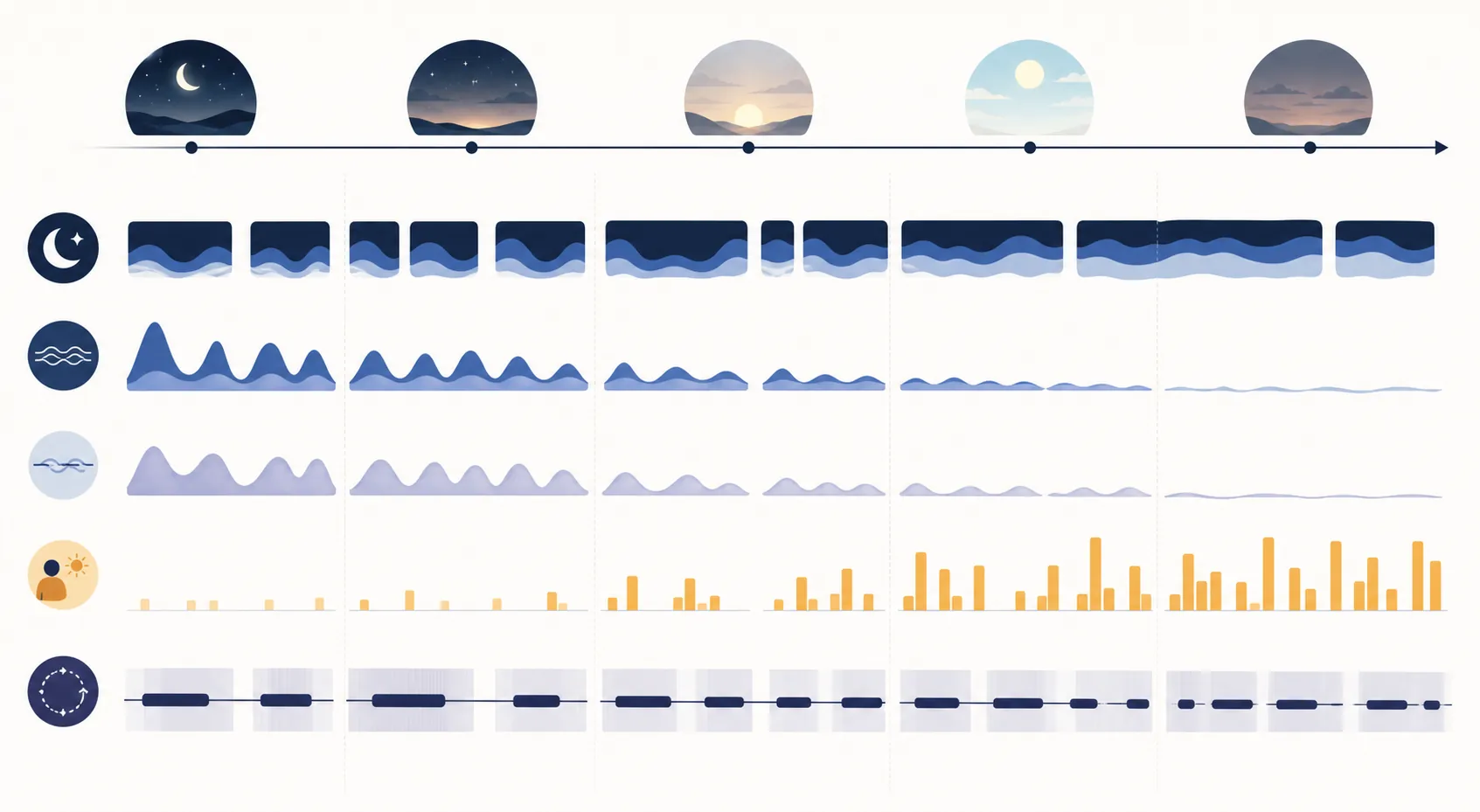
| Sleep change to track | What it may look like at home | Research signal linked to it |
|---|---|---|
| Declining slow-wave sleep | Less restorative deep sleep, often seen on a sleep study or reliable wearable trend | Higher tau protein levels; later brain-volume differences in Alzheimer’s-vulnerable regions |
| Escalating daytime sleepiness | More dozing, unplanned naps, or difficulty staying alert during normal daytime routines | Higher dementia incidence in an older women’s cohort when sleepiness rose over five years |
| Prolonged sleep duration | A new pattern of routinely sleeping about 8.5 hours or more, especially if it keeps increasing | Higher plasma p-tau181 in a Framingham-based study |
| Reduced or delayed REM sleep | Less REM proportion on sleep testing, or delayed REM timing in measured sleep architecture | Reduced brain volume in vulnerable regions years later |
| Fragmented circadian rhythms | Irregular rest-activity timing: napping, pacing, waking, and sleeping scattered across day and night | Amyloid-positive status in cognitively normal adults; locus coeruleus degeneration in another cohort |
The most helpful notes are plain ones: when the change started, whether it is worsening, how often it happens, what else changed at the same time, and whether the person is less able to function during the day. A month of dated observations is usually more useful than a single dramatic night.
1. Declining Deep Sleep
Deep sleep, also called slow-wave sleep, is the heavy, restorative stage that tends to shrink with age. That normal decline makes this signal easy to overread. The concern is not that an older adult has less deep sleep than a younger adult. The concern is a persistent drop from that person’s usual pattern, particularly when it appears with other sleep or daytime changes.
In a WashU Medicine study published in January 2025, researchers followed 119 adults age 60 and older and found that lower slow-wave sleep was associated with higher tau protein levels, independent of total sleep duration. [1] That last phrase matters. The finding was not simply that people who slept less had more tau. It pointed to the quality and architecture of sleep, not just the number of hours in bed.
Tau is one of the proteins involved in Alzheimer’s disease, but an association with tau is not the same as an Alzheimer’s diagnosis. It is a reason to be more precise. If a sleep study, medical-grade tracker, or consistent wearable trend shows deep sleep steadily declining, the note for the doctor is not “I think this is dementia.” It is closer to: “My deep-sleep measure has dropped compared with my usual pattern, and I’m also noticing more daytime sleepiness and missed morning activity.”
For readers who want the biology behind sleep and tau handled in more detail, the companion explanation on how sleep may boost SORLA protein to fight tau tangles is a better place to go deeper. For symptom triage, the key point is simpler: a sustained loss of deep sleep becomes more meaningful when it is new for the person and not explained by pain, alcohol, untreated sleep apnea, a medication change, or a disrupted schedule.
2. Daytime Sleepiness That Keeps Increasing
Daytime sleepiness is not the same thing as enjoying an afternoon rest. The pattern to watch is escalation: a person who used to be alert through breakfast, errands, reading, or conversation now dozes repeatedly, cancels daytime activity, or cannot stay awake during ordinary routines.
A UCSF study reported in Neurology in March 2025 followed 733 women in their 80s. Among women whose sleepiness increased over five years, dementia incidence was 19%, compared with 8% in the stable-sleep group. [2] That is a clinically vivid finding because it describes change over time, not a one-day complaint.
It also has a clear boundary. The study population was women with an average age in the 80s, so the result should not be casually stretched to every man or woman in their 50s, 60s, or 70s. It does not prove that sleepiness causes dementia. It says that, in this group, rising sleepiness tracked with later dementia more often than stable sleep did.
For a family member keeping notes, the most useful observations are behavioral: “She now falls asleep during lunch most days,” “He has stopped taking his morning walk because he says he cannot get going,” or “The naps have changed from one planned rest to several unplanned dozes.” Those details help separate a lifestyle preference from a functional change.
3. A New Pattern of Long Sleep
Long sleep is the easiest warning sign to misunderstand. More sleep is not automatically bad. Recovery after illness, a heavy caregiving stretch, travel, grief, depression, medication changes, and untreated sleep disorders can all lengthen time in bed. Some people have always needed more sleep than average and function well with it.
The signal in the research is more specific: a measurable long-sleep pattern, especially if it is new or increasing. A UT Health San Antonio study published in Alzheimer’s & Dementia in May 2026 included 2,410 Framingham participants and found that sleeping 8.5 to 9 or more hours per night was associated with higher plasma p-tau181, with the association sharpening beyond 10 hours. [3]
P-tau181 is a blood-based marker related to Alzheimer’s pathology, but the long-sleep finding was cross-sectional. That means it cannot answer whether long sleep contributes to brain change, reflects early brain change, or travels alongside another health process. It should not be used to warn an exhausted older adult against rest.
What makes long sleep more clinically relevant is the company it keeps. A new habit of sleeping 9 or 10 hours and still waking unrefreshed is different from a lifelong 9-hour sleeper who remains active and sharp. Long sleep plus rising daytime sleepiness, less deep sleep, mood change, slowed activity, or memory concerns deserves a more timely conversation.
4. Reduced or Delayed REM Sleep
REM sleep is the stage most associated with vivid dreaming. It is part of sleep architecture, so most people will not know their REM proportion without a sleep study or a reasonably consistent tracking device. Even then, consumer estimates can be noisy. The pattern matters more than a single low REM reading.
A March 2025 study highlighted by the American Academy of Sleep Medicine included 270 participants with a median age of 61. Lower proportions of slow-wave sleep and REM sleep were linked to reduced brain volume in Alzheimer’s-vulnerable regions, including the inferior parietal area, measured 13 to 17 years later. [4]
This does not mean a short REM night predicts future dementia. Alcohol, antidepressants, sleep apnea, irregular sleep timing, and many other factors can alter REM. But if a formal sleep evaluation shows reduced or delayed REM alongside other changes, it gives the clinician more to work with than a vague report of “bad sleep.”
5. Fragmented Day-Night Rhythms
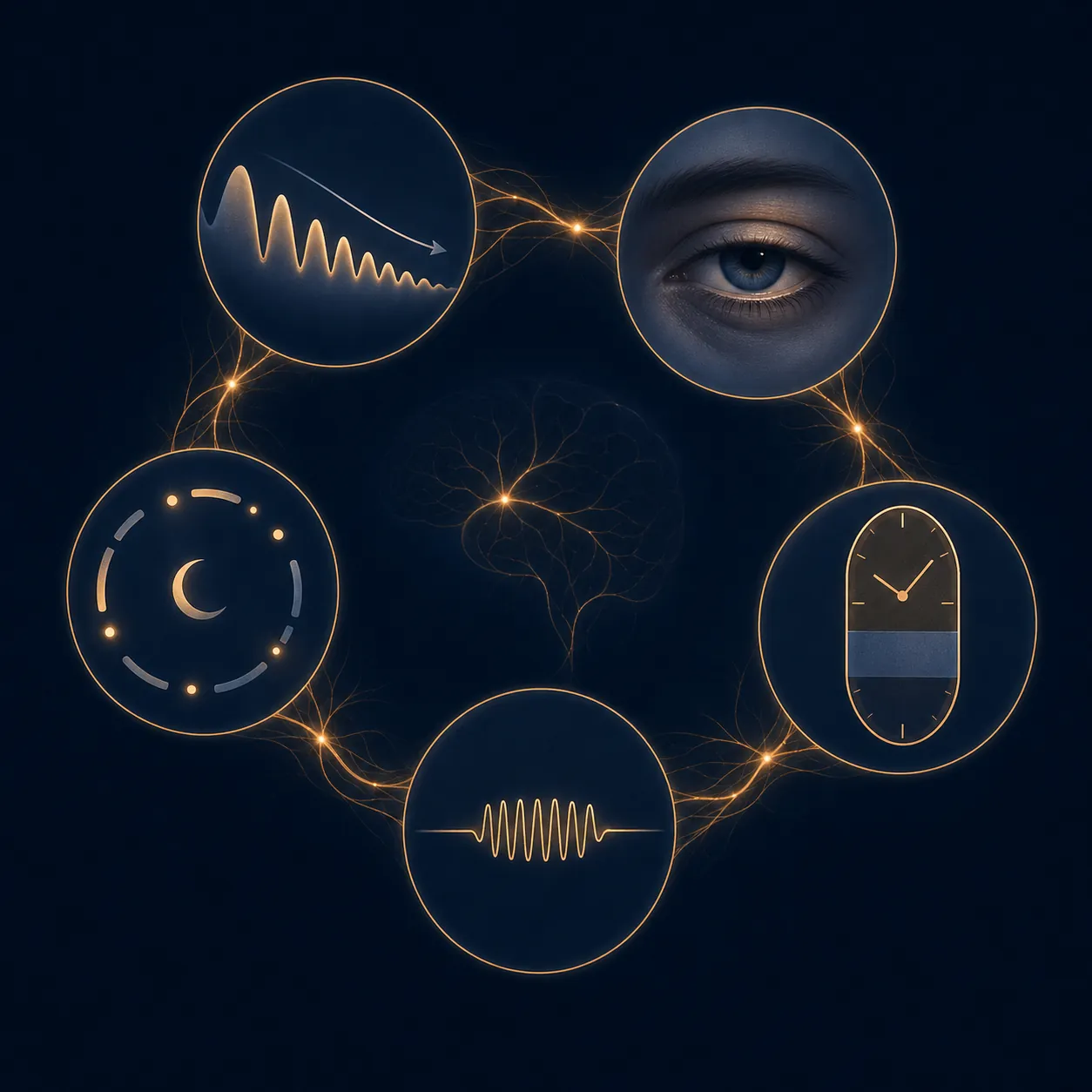
Circadian fragmentation is not just insomnia. It is a rest-activity rhythm that loses its shape. Sleep, naps, wakefulness, movement, and quiet periods become scattered across the 24-hour day instead of forming a fairly stable day-night pattern.
In a WashU study published in JAMA Neurology, researchers studied 189 cognitively normal adults with an average age of 66 and found that amyloid-positive participants showed fragmented rest-activity patterns. [5] Amyloid positivity is not the same as dementia; these participants were cognitively normal. The finding is still important because it places rhythm disruption in the preclinical conversation.
Another line of evidence points to the brain systems that help regulate arousal. A study reported by BrightFocus, based on Rush Memory and Aging Project data from 388 participants, linked locus coeruleus degeneration with fragmented sleep appearing about seven years before death. [6] The locus coeruleus is involved in wakefulness and attention, so this kind of work is biologically plausible. It is not a bedside test.
At home, circadian fragmentation may look like repeated nighttime wandering to the kitchen, long daytime sleep spells, early evening dozing, and wide swings in wake time. The question is whether the rhythm has become less organized than it used to be. A newly retired person may also sleep differently because the workday no longer anchors bedtime and morning light exposure; that is a different starting point, and it is worth separating life-stage disruption from neurological concern. For that distinction, see how retirement affects sleep quality.
Patterns Matter More Than One Bad Night
A single symptom is a weak signal. A cluster is stronger. The concern rises when an adult 50 or older develops several changes together: less deep sleep, more daytime sleepiness, longer sleep duration, reduced or delayed REM, and a more fragmented day-night rhythm.
Larger datasets add background weight but should not turn every sleep complaint into a dementia scare. A May 2025 npj Dementia study of more than 1 million participants across three cohorts found that non-organic sleep disorders carried a 67% increased dementia hazard, largely independent of APOE status. [7] That category is broader than the five specific patterns in this article, and the study population was predominantly European, so it is better used as context than as a personal checklist.
The unresolved question is direction. Sleep disruption may contribute to Alzheimer’s-related processes; early Alzheimer’s biology may disrupt sleep; both may be shaped by other health conditions. Current evidence does not let a person look at sleep alone and determine which pathway is happening.
When to Bring Sleep Changes to a Clinician
The most useful appointment is not built around fear. It is built around a record. Bring a short sleep log, medication list, recent diagnoses, alcohol or cannabis changes, pain symptoms, snoring or breathing pauses, mood changes, and any memory or function concerns noticed by the person or family.
- Make an appointment if a sleep change is new, persistent, and worsening over weeks to months.
- Move sooner if two or more patterns appear together, such as longer sleep plus rising daytime sleepiness.
- Mention any daytime consequences: missed walks, skipped meals, falls, less driving confidence, withdrawal from activities, or trouble managing medications.
- Ask about common treatable causes, including sleep apnea, depression, pain, restless legs, medication effects, and circadian disruption.
- Do not use a wearable sleep-stage score by itself as proof of brain disease; use trends as conversation starters.
The practical threshold is clear enough: if an adult 50 or older develops persistent or worsening deep-sleep loss, rising daytime sleepiness, unusually long sleep duration, reduced or delayed REM patterns, or fragmented day-night rhythms—especially in combination or alongside memory, mood, function, or medication changes—the next step is a timely medical conversation. Not self-diagnosis. Not panic. A conversation with enough detail that the clinician can decide what needs checking.
References
- Decreased deep sleep linked to early signs of Alzheimer’s disease, WashU Medicine, January 2025.
- Increasing Sleepiness May Be Early Sign of Alzheimer’s in the Elderly, Alzheimer’s Information Site, March 2025.
- Sleeping longer may signal early Alzheimer’s-related brain changes, News-Medical, July 15, 2026.
- Study links sleep stages to brain changes in Alzheimer’s disease, American Academy of Sleep Medicine, March 2025.
- Circadian rhythms disrupted in patients with preclinical Alzheimer’s, WashU Medicine.
- Study Links Alzheimer’s Onset to Sleep Disruption and Degeneration in Key Brain Region, BrightFocus Foundation.
- Sleep disorders and dementia risk: a multi-cohort study, npj Dementia, May 2025.
Explore the mechanism
Next step
Spot an error or have clinical feedback?
Because this article covers clinical, medication, or safety information, we use a moderated correction channel instead of open public comments. Let us know if something about “5 Sleep Changes That May Be Early Warning Signs of Dementia” needs a closer look.
Send feedback on this article