
A surprising number of people reach retirement expecting sleep to become easy. No alarm. No commute. No late meeting that runs past dinner. Then, a few months in, they are awake at 2 a.m. or still in bed at 9:30 a.m., wondering why the freedom they wanted has made their nights feel less reliable.
That experience is real, but it is not the whole story. In the French GAZEL cohort, sleep disturbance fell after retirement: prevalence dropped from 24.2% before retirement to 17.8% afterward, and the odds of sleep disturbance were 26% lower on average after retirement.[1] Work stress can be a serious sleep disruptor, and many people do sleep better once that pressure lifts.
The trouble is hidden inside the average. Retirement does not simply remove stress. It also removes a daily timing system: the wake-up alarm, morning light exposure, movement outside the home, meals on a schedule, social contact, and the ordinary fatigue that comes from having to be somewhere. For some retirees, especially those who retire because of health problems or those who naturally prefer later sleep times, losing that structure can make sleep quality worse rather than better.
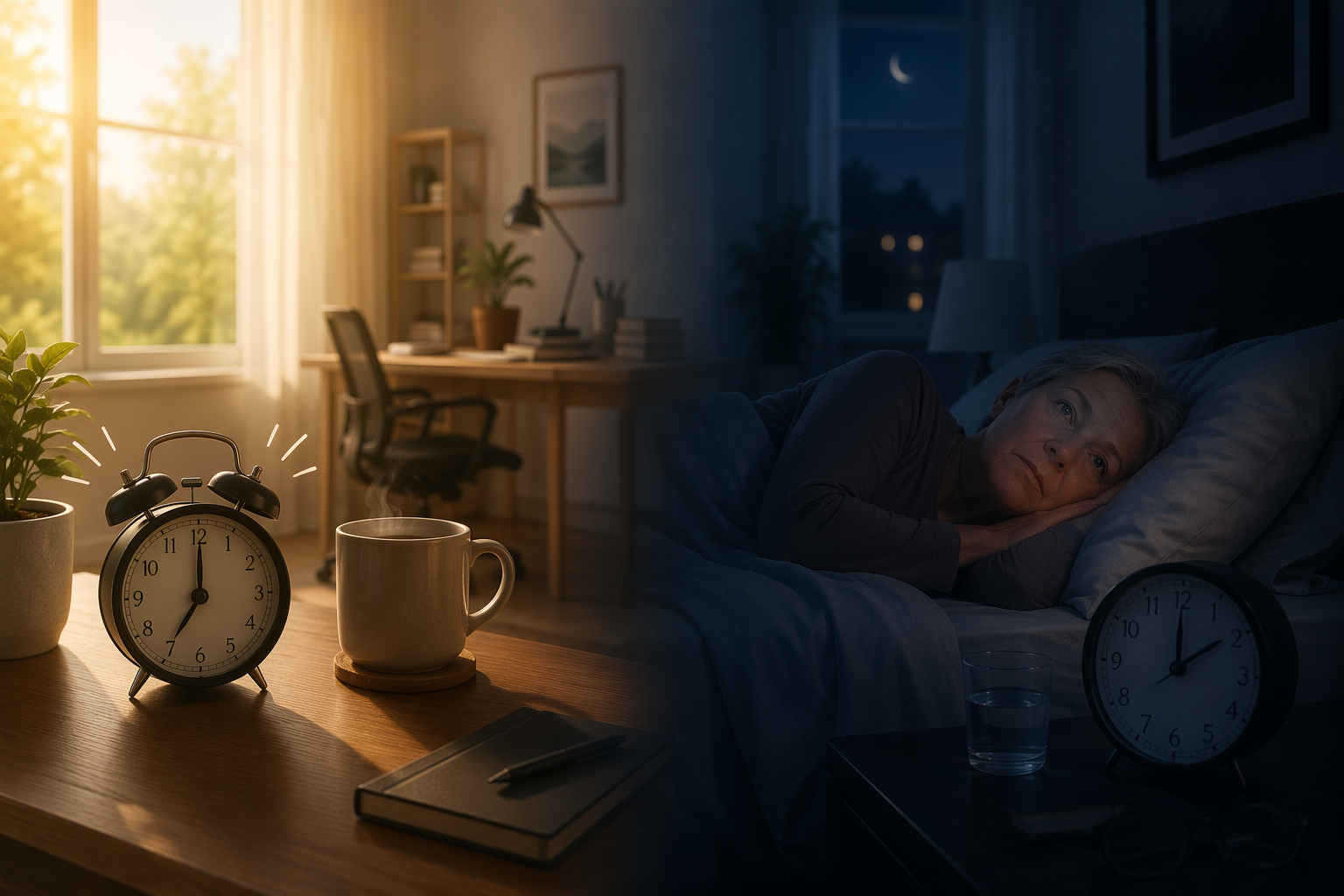
Why retirement can improve sleep and disturb it at the same time
The cleanest way to understand how retirement affects sleep quality is to separate relief from rhythm. Relief is what happens when job demands, workplace conflict, early commuting, and performance pressure fall away. Rhythm is what happens when the body still needs a fairly consistent signal for when the day starts and ends.
The GAZEL findings speak to relief. The group average improved after retirement, but the same research also found that people who retired for health reasons had a 46% increased risk of sleep disturbance.[1] That distinction matters. A person leaving work healthy, financially stable, and ready to choose a new schedule is not in the same position as someone leaving because pain, illness, disability, caregiving strain, or exhaustion made work impossible.
The rhythm side shows up clearly in the Hagen REST study. After retirement, sleep duration increased only modestly, by about 15 to 22 minutes, while bedtimes shifted 30 to 36 minutes later and wake times shifted 63 to 78 minutes later.[2] That is the paradox in clock time: retirees did not simply gain a long, restorative sleep extension. Their entire sleep window moved later, and the wake time moved especially far.
| What changed after retirement | What the evidence showed | Why it matters at home |
|---|---|---|
| Sleep disturbance | Lower on average in the GAZEL cohort | Many people benefit when work stress ends |
| Sleep duration | About 15 to 22 minutes longer in the REST study | More time available does not mean dramatically more sleep |
| Bedtime | About 30 to 36 minutes later in the REST study | Evenings can drift when there is no next-day demand |
| Wake time | About 63 to 78 minutes later in the REST study | The missing morning anchor may be the larger change |
| Health-related retirement | Higher risk of sleep disturbance in GAZEL | Symptoms, pain, mood, or medication issues may need direct care |
This is why “just enjoy sleeping in” can be poor advice. Sleeping later for a short recovery period may feel wonderful. But if wake time keeps drifting, morning light gets delayed, daytime activity gets weaker, naps stretch longer, and the bed becomes a place for long wakeful periods, sleep can become more fragile.
The alarm clock was doing more than waking you up
Most people think of an alarm as an intrusion. It is. But it is also a cue. It tells the body, “This is morning.” Once you are up, more cues follow: bathroom light, breakfast, coffee, outdoor light, a walk to the car or bus, conversation, errands, work tasks, lunch, the trip home, dinner, and evening fatigue. None of these has to be perfect. Together, they keep the internal clock from floating.
That internal clock depends heavily on the suprachiasmatic nucleus, or SCN, a timing center in the brain. Aging is associated with degradation in SCN function and reduced circadian amplitude, meaning the body’s day-night signals can become less forceful with age.[3] This does not mean poor sleep is inevitable after 60. It means the external cues around sleep often matter more, not less.
A similar principle appears when clocks are shifted from the outside, as with Daylight Saving Time. The issue is not only the clock on the wall; it is the mismatch between social time, light exposure, and the body’s timing system. If you want a deeper look at that external-cue problem, see this guide to Daylight Saving Time and sleep effects. Retirement can create a quieter version of the same problem, except the shift may unfold slowly enough that you do not notice it until your nights have changed.
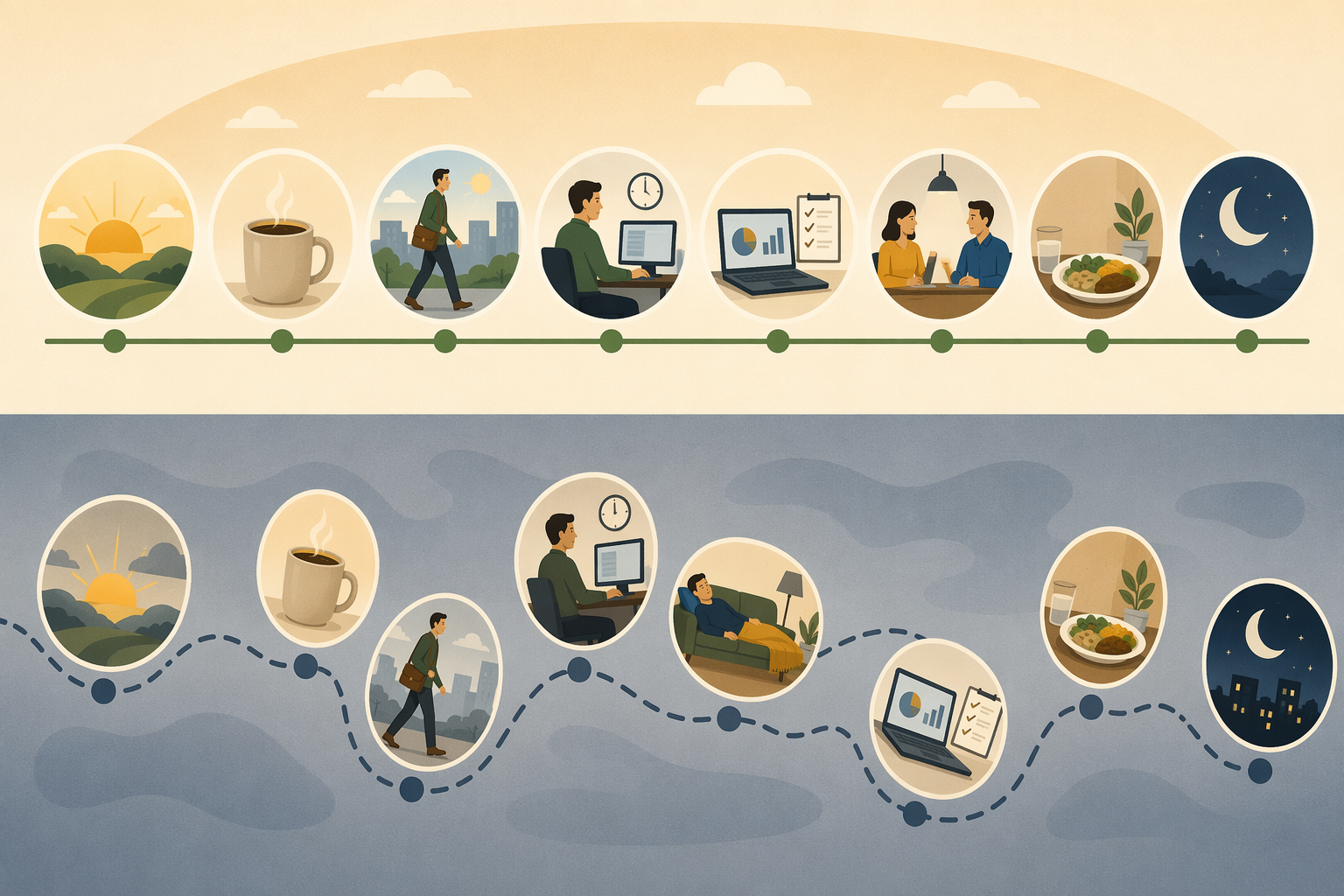
Evening chronotypes deserve special mention. In the REST study, evening types extended wake times more than 40 minutes later than morning types after retirement.[2] For years, work may have forced them into an earlier schedule than their bodies preferred. Retirement removes that pressure. The first feeling may be relief. The later consequence may be a sleep window that keeps sliding until it no longer fits meals, daylight, appointments, family life, or the retiree’s own sense of feeling well.
More time in bed is not the same as better sleep
One of the most common retirement sleep traps is expanding the night from both ends. You go to bed earlier because there is no reason to stay up, or later because there is no reason to stop watching television. You wake during the night, but stay in bed because there is no urgent morning demand. Then you sleep late to compensate. The bed begins to hold more waking time than it used to.
The REST timing data helps explain why this feels so confusing. Sleep duration rose by minutes, while wake time shifted by more than an hour.[2] A retiree may feel as if sleep has become larger in their life, yet not feel more rested. That mismatch can happen when time in bed expands faster than actual sleep.
Over time, this can feed conditioned insomnia. The bed stops being a strong cue for sleep and becomes a place where the brain practices waiting, calculating, worrying, and checking the clock. This is not a character flaw. It is learning. The nervous system learns from repetition, including the repetition of lying awake in the same place night after night.
Naps, activity, and caffeine often change quietly
Retirement also changes the pressure that builds across the day. Sleep drive is partly strengthened by being awake and active. If the day becomes less physically demanding, if naps become longer or later, or if mornings begin with several low-light hours indoors, nighttime sleep may lose some of its force.
Napping is common in later life. Li, Vitiello, and Gooneratne report that about 25% of older adults nap regularly, compared with about 8% of younger adults, and note that improper nap timing can degrade nocturnal sleep drive.[3] A short, early nap may be harmless or helpful for some people. A long nap late in the afternoon can act more like a second sleep period, leaving the night lighter and more broken.
Activity can shift in the same direction. In the FIREA accelerometer study of Finnish municipal-sector workers, sleep increased after retirement while moderate-to-vigorous physical activity decreased.[4] The sample was specific, and it should not be treated as a universal picture of all retirees. Still, the pattern is recognizable: when the workday no longer forces walking, stairs, errands, commuting, or scheduled movement, the body may get more rest opportunity but less daytime activation.
Caffeine habits can also loosen. Someone who once had coffee at 6:30 a.m. and stopped by late morning may now sip it over a longer, later morning, or add an afternoon cup because the day feels open. Caffeine timing matters because its alerting effect can outlast the moment you drink it. If your retirement routine has moved coffee later, this guide to how caffeine disrupts sleep quality is a useful companion to the timing work.
Health-related retirement needs a different lens
If you retired because your health made work difficult, your sleep problem may not be mainly about freedom or loose routines. The GAZEL finding that health-related retirees had a 46% increased risk of sleep disturbance is a warning not to over-simplify this transition.[1] Pain, breathing problems, medication changes, depression, anxiety, neurological symptoms, reduced mobility, and caregiving strain can all make sleep worse, and they deserve direct attention.
This is where standard retirement advice can sound careless. A person who left a satisfying job because of a worsening condition does not need to be told only to get morning sunlight and keep a schedule. Those anchors may still help, but they sit beside medical questions: Is pain waking you? Are you short of breath at night? Has a medication changed? Are you sleeping in a recliner because lying flat is hard? Are you napping because fatigue is severe, not because the day is empty?
The practical point is not to assume every retirement sleep problem is behavioral. If sleep worsened at the same time as a health decline, start there. The rhythm work can support recovery, but it should not be used to ignore symptoms that need care.
A simple way to identify what changed
Before changing everything, compare your current week with a typical workweek from your final year of employment. You are looking for timing changes, not moral failures. The most useful clues are often plain.
- Wake time: Has it moved later by more than an hour, or does it vary widely day to day?
- Morning light: Do you get bright outdoor light soon after waking, or do you spend the first hours indoors?
- Activity: Did commuting, walking, errands, or scheduled tasks disappear without a replacement?
- Naps: Are they longer, later, or more frequent than they used to be?
- Caffeine and alcohol timing: Have either shifted later because mornings and evenings feel less bounded?
- Bed use: Are you spending long awake periods in bed reading, worrying, watching shows, or trying to force sleep?
- Health changes: Did pain, breathing, mood, medications, or mobility change around the same time as retirement?
A one-week sleep diary is often enough to reveal the pattern. Write down when you got into bed, when you estimate you fell asleep, major awakenings, final wake time, nap timing, caffeine timing, alcohol timing, exercise, and whether you got outdoor morning light. Do not aim for perfect measurement. Aim for enough honesty to see whether your sleep has lost its anchors.
Rebuild anchors instead of chasing perfect sleep hygiene
Retirement does not require recreating a job schedule. It does require giving the body enough repeated signals to know when the day begins, when energy should rise, and when sleep should become likely. The goal is not discipline for its own sake. The goal is rhythm that protects freedom rather than letting freedom dissolve into drift.
Choose a wake time you can live with
Start with wake time, not bedtime. Bedtime will be hard to control if your morning keeps moving. Choose a wake time that fits the life you actually want in retirement, including appointments, family obligations, exercise, and daylight. It does not need to be 6 a.m. It does need to be consistent enough that your body can learn it.
If you have drifted very late, move gradually. A sudden large shift can feel like jet lag. A smaller, steady adjustment paired with morning light and activity is usually more tolerable.
Put light and movement near the start of the day
Morning light is one of the clearest timing signals available. Outdoor light is usually stronger than indoor light, even on a cloudy day. Pair it with something ordinary: a short walk, watering plants, sitting outside with breakfast, walking to a nearby errand, or meeting someone in the morning rather than late afternoon.
Movement does not have to be athletic to be useful, but the loss of moderate-to-vigorous activity after retirement in the FIREA findings is a reminder that “being done with work” can accidentally mean being done with built-in exertion.[4] If your workday once supplied movement, retirement has to replace it on purpose.
Keep naps useful, not unlimited
A nap is not automatically a problem. The question is whether it is borrowing too much sleep pressure from the night. If nighttime sleep has become lighter or later, try keeping naps earlier in the day and short enough that you wake refreshed rather than groggy. If you need long daily naps because you cannot function otherwise, treat that as information worth discussing with a clinician rather than simply a retirement habit.
Give the bed one main job again
If you are spending long stretches awake in bed, the bed may have become too flexible a place. Keep reading, television, bills, phone scrolling, and worry sessions out of bed when you can. If you cannot sleep, it is often better to get up briefly and do something quiet in low light until sleepiness returns. This is not punishment. It is a way of teaching the brain that bed is not the place where the night’s struggle happens.
People recovering from other life disruptions often need the same kind of rebuilding. A different example appears in this concussion recovery sleep guide: when the old structure is interrupted, sleep often improves only after new cues become dependable.
What biology explains, and what it does not
Aging changes sleep, but it should not become a wastebasket explanation for every bad night after retirement. The review by Li, Vitiello, and Gooneratne notes age-related circadian weakening, and it also cites evidence that many age-related sleep changes plateau by around age 60.[3] That matters for a recent retiree in their 60s or early 70s: if sleep worsened sharply after leaving work, the timing of the change itself points toward social and behavioral disruption as part of the story.
The broader retirement sleep literature points in the same mixed direction. Reviews of sleep before and after retirement describe both improvement and disruption, depending on health, work history, lifestyle, and measurement.[5] The evidence base also has limits. Much of the longitudinal research comes from Nordic countries and France, where pension systems and health care contexts differ from those in the United States. GAZEL used a broad yes-or-no question about trouble sleeping, and FIREA followed a specific group of Finnish municipal-sector workers.[1][4]
Those limits should keep the conclusions modest, not useless. The practical pattern is still strong enough to act on: when work stops supplying time cues, many retirees need to rebuild them deliberately.
When to seek help
Self-management is reasonable when the problem is mild, recent, and clearly tied to a drifting schedule. A consistent wake time, morning light, daytime movement, nap boundaries, earlier caffeine cutoff, and less wakeful time in bed are sensible first steps.
Do not wait indefinitely if sleep is persistently poor, distressing, or impairing your daytime function. Seek professional guidance sooner if you have loud snoring, gasping, restless legs, severe daytime sleepiness, worsening mood, significant pain, medication concerns, or a major health change around retirement. If you are unsure whether this is normal adjustment or clinical insomnia, use this insomnia triage framework to sort the next step.
Retirement removes an imposed schedule. That can be a gift. It can also reveal how much your sleep depended on cues you never had to choose. Better sleep after retirement often begins by choosing them now: a wake time, morning light, movement, well-timed rest, and a bed that belongs mostly to sleep.
References
- Study shows that sleep disturbances improve after retirement, American Academy of Sleep Medicine, 2009.
- Changes in Sleep Duration and Sleep Timing Associated with Retirement Transitions, Sleep, 2016.
- Sleep in Normal Aging, Sleep Medicine Clinics, 2018.
- How Retiring Changes Sleep, Sleep Review, 2022.
- Sleep before and after retirement, Current Sleep Medicine Reports, 2018.




Comments
Join the discussion with an anonymous comment.