
The phrase “sleep and SORLA protein tau tangles” sounds as if three pieces of Alzheimer’s biology have already been wired into one clean circuit. They have not. What has changed in 2026 is narrower, and more interesting: SORLA, the protein encoded by the SORL1 gene, has been shown in a tauopathy mouse model to act directly on tau pathology, reducing tau hyperphosphorylation and limiting tau seeding. In the same work, mice given extra SORLA had less brain atrophy, less tau accumulation, and healthier synaptic connections, while mice lacking Sorl1 had worse tauopathy damage.[1]
That is not a sleep study. It is not a human prevention trial. It does not prove that better sleep “boosts SORLA.” But it gives sleep research a more concrete target to sit beside. If SORLA is one of the brain’s brakes on tau pathology, then the practical question becomes: what can a person do now to reduce the amount of tau stress that brake has to manage?

What the new SORLA finding actually shows
Tau is not automatically bad. In healthy neurons, tau helps stabilize microtubules, the internal tracks that help cells maintain structure and move cargo. The problem begins when tau is chemically altered in ways that make it detach, misfold, accumulate, and spread abnormal shapes from one region to another.
Hyperphosphorylation is one of those chemical changes. Phosphate groups are added to tau at many sites; when this process becomes excessive or poorly controlled, tau is more likely to lose its normal role and participate in pathological aggregates. “Tau tangles” are the late, visible version of a process that begins earlier and more subtly, with abnormal tau forms gaining the ability to recruit more tau into the same misfolded pattern.
Tau seeding is the spreading part of the story. A seed is not a full tangle. It is a small pathological form of tau that can encourage other tau molecules to misfold. This matters because Alzheimer’s and related tauopathies are not only about how much abnormal tau exists in one place. They are also about whether pathology can move through vulnerable neural circuits.
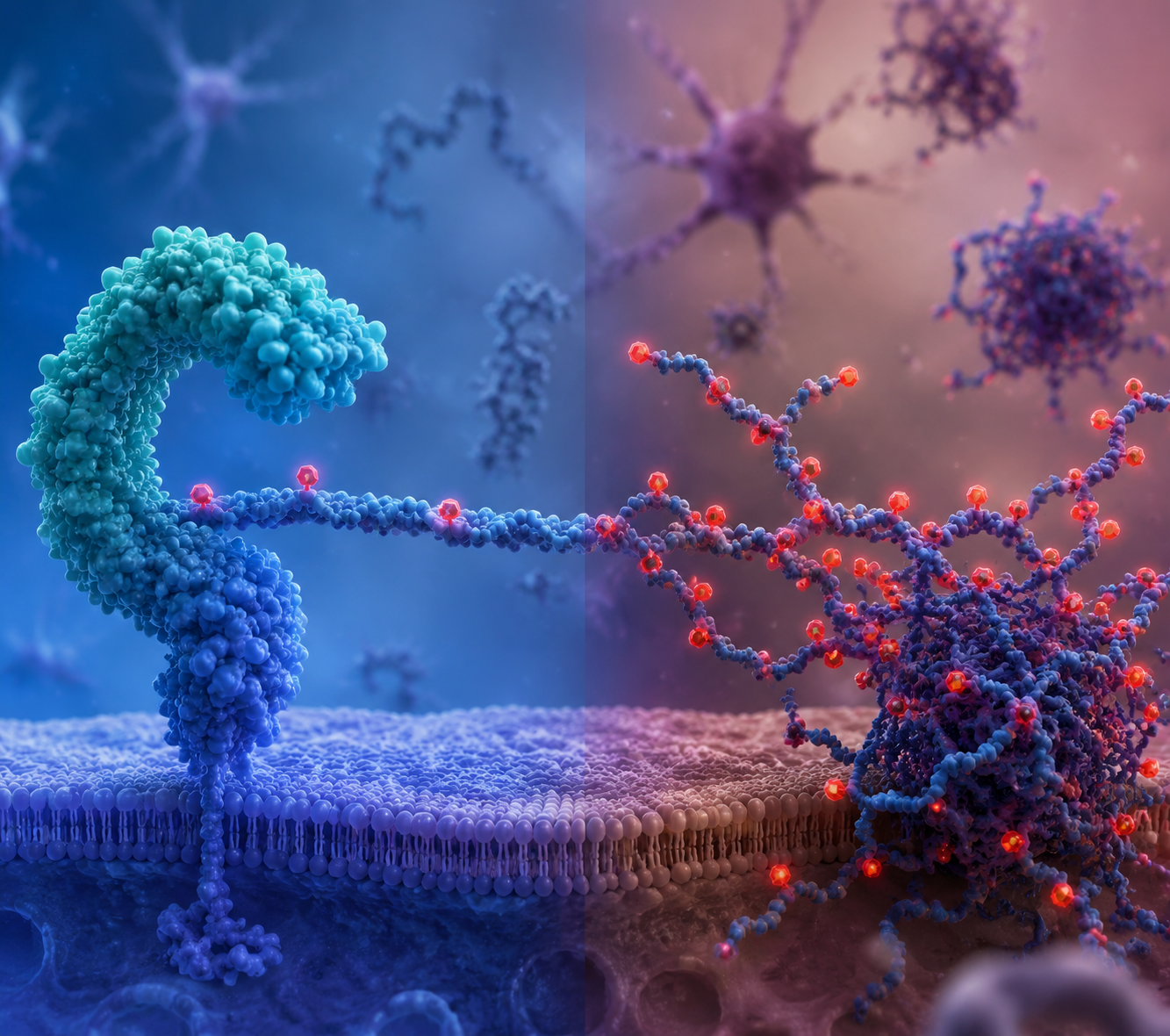
The July 2026 SORLA study is valuable because it did not merely place SORLA near Alzheimer’s risk on a genetic map. In aged PS19 P301S tauopathy mice, raising SORLA suppressed pathological effects, including tau hyperphosphorylation and seeding; removing Sorl1 made the damage worse.[1] That contrast gives the finding its force. More SORLA was linked with less tau injury. Missing Sorl1 pushed the system in the wrong direction.
Why “less seeding” is not a small detail
It is tempting to read a protein finding as another item on a long list of molecular associations. This one deserves more attention because seeding sits close to the mechanics of disease progression. If abnormal tau can seed new abnormal tau, then a protein that limits seeding is not just changing a biomarker in isolation. It may be interfering with a process by which pathology expands.
The same is true for hyperphosphorylation. A reduction there suggests that SORLA may affect an upstream pressure that makes tau more likely to behave pathologically. The study does not mean SORLA is the only tau regulator, or that tau tangles can be switched off by turning one protein upward. Brains are not that obliging. But it does place SORLA closer to the disease mechanism than a vague “associated with Alzheimer’s risk” label would.
The genetic context helps explain why researchers were looking here in the first place. SORL1, the gene that encodes SORLA, is a known genetic risk factor for late-onset Alzheimer’s disease, and loss-of-function variants are associated with increased risk.[2] That does not mean everyone with a family history should rush to interpret a single gene as destiny. Late-onset Alzheimer’s risk is not usually one-gene arithmetic. But SORL1 has been serious enough in the field that a direct SORLA-tau mechanism is not coming out of nowhere.
Where sleep enters the tau story
Sleep enters this article later than a sleep headline might prefer because the evidence has to be kept in the right order. First: SORLA can suppress tau pathology in a mouse model. Second: tau is sensitive to sleep and wake states in separate animal and human studies. Third: sleep may therefore be one realistic way to reduce tau pressure, even though no one has shown that sleep raises SORLA expression or activity in people.
The strongest human signal comes from sleep-deprivation studies measuring tau in cerebrospinal fluid. In a 2019 Science study, one night of total sleep deprivation raised CSF tau by approximately 50% in healthy adults; the human sample was small, with eight participants.[3] A related 2020 Annals of Neurology study found that sleep deprivation increased CSF pT217, a phosphorylated tau site linked to tau pathology, by roughly 60–80%, with seven participants per group and substantial individual variability.[4]
Those numbers should be taken seriously and kept in proportion. They do not prove that one bad night causes Alzheimer’s disease. They do show that the human tau system can respond measurably to acute sleep loss. For a reader worried about tau tangles, that is more relevant than generic reassurance about sleep being “good for the brain.”
The same 2019 line of work also reported a more dramatic animal finding: in tauopathy mice, 28 days of sleep restriction caused tau tangles to spread through twice as much brain area compared with rested controls.[3] This is still mouse work, and tauopathy mice are engineered models rather than miniature humans with late-onset Alzheimer’s. But the direction is hard to ignore. Sustained sleep restriction did not merely change wakefulness; it changed the apparent spread of tau pathology in brain tissue.
| Evidence stream | What it supports | What it does not prove |
|---|---|---|
| SORLA-tau mouse study | SORLA can reduce tau hyperphosphorylation and limit tau seeding in PS19 P301S tauopathy mice. | That sleep raises SORLA in humans. |
| Human sleep-deprivation studies | Acute sleep loss can increase CSF tau and phosphorylated tau measures in small healthy adult samples. | That one poor night causes dementia. |
| Mouse sleep-restriction study | Repeated sleep restriction can worsen tau spread in a tauopathy model. | That the same magnitude applies to people. |
| Glymphatic tau-clearance work | Sleep-state physiology can affect extracellular tau clearance in animal models. | That human tau clearance during sleep has been fully quantified. |
The cleanup pathway: glymphatic clearance
A useful way to think about sleep and tau is not as magic repair, but as traffic control. During wakefulness, neurons are active, metabolism is high, and soluble proteins are being released into the spaces around cells. During sleep, animal studies suggest that the brain’s fluid-clearance system becomes more effective at moving certain waste products, including extracellular tau, out of those spaces.
This is where the glymphatic system matters. In animal models, glymphatic clearance removes extracellular tau more efficiently during sleep, while clearance is substantially reduced during wakefulness.[5] That finding fits with the sleep-deprivation tau studies without being the same evidence. One line measures tau rising after lost sleep. Another studies a clearance route that can remove extracellular tau. Together they suggest why sleep could reduce tau burden, but they do not create a direct SORLA claim.
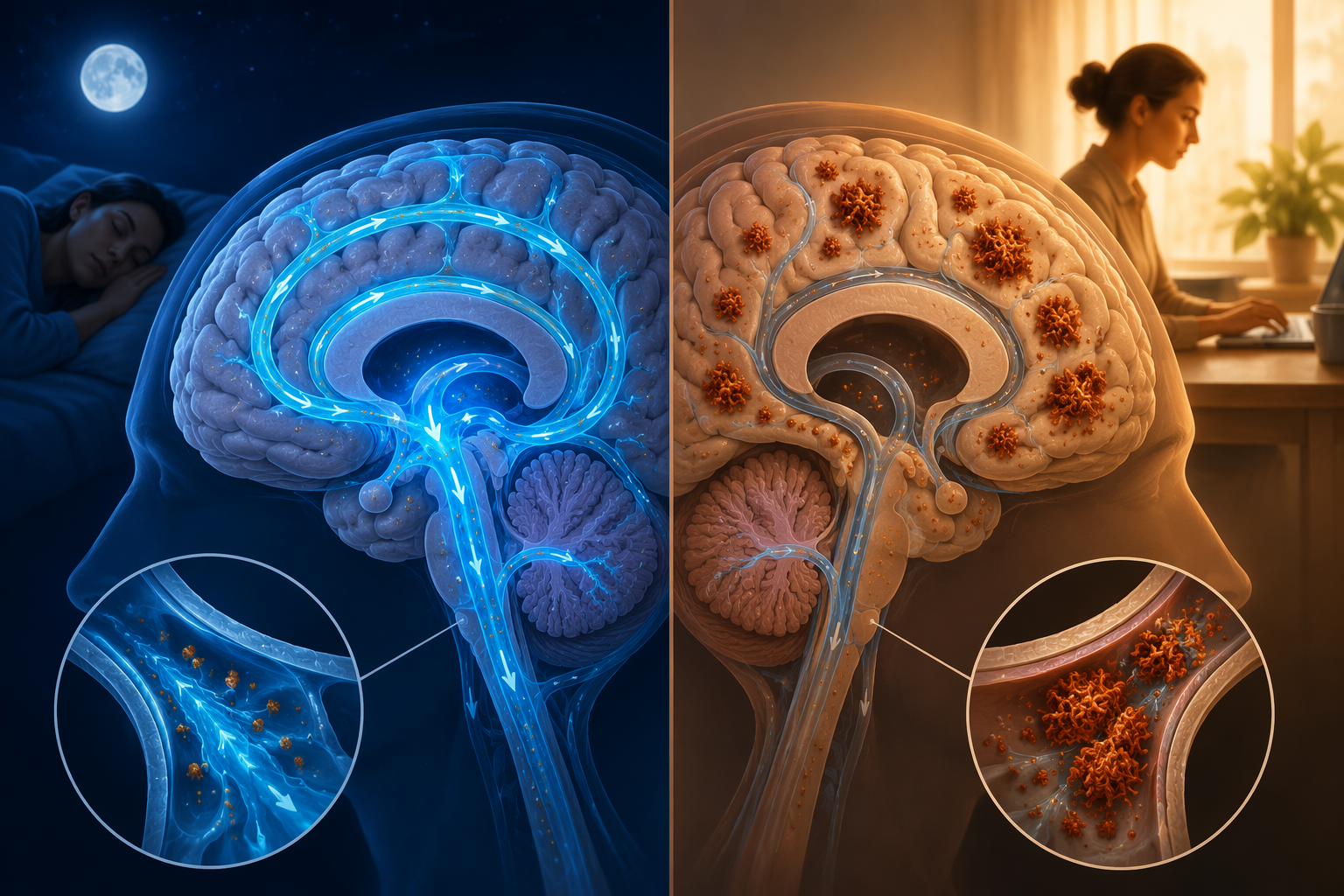
The distinction is important because “clearance” and “protection” are not identical jobs. Glymphatic flow may help reduce extracellular tau available to spread. SORLA, in the 2026 mouse work, appears to suppress pathological tau effects inside the tauopathy system itself.[1][5] If both are operating in the same biological neighborhood, they may matter together. But the studies have not yet shown that sleep activates SORLA, that glymphatic clearance depends on SORLA, or that improving sleep changes SORLA levels in human brain tissue.
The honest gap: sleep has not been shown to boost SORLA
This is the place where the story can easily become too smooth. A new protein suppresses tau pathology. Sleep affects tau. Therefore sleep boosts the protein. That last step has not been demonstrated.
There is currently no direct study showing that sleep changes SORLA expression or activity in humans. There is also no approved drug, supplement, or behavioral protocol known to raise SORLA in people. Therapeutic SORLA upregulation remains preclinical. The 2026 study is exciting because it identifies a protective mechanism in mice, not because it gives people a lever they can pull on SORLA tomorrow.
That does not make sleep irrelevant. It changes the claim. Sleep quality is not a proven SORLA-boosting treatment; it is a plausible way to reduce tau-related stress on a system in which SORLA appears to be protective. A brake matters more when the hill is steep. Sleep may be one way to make the hill less steep.
What “supporting the system” can mean in real life
For someone with a parent who had late-onset Alzheimer’s, this is not an abstract distinction. The desire is often for something specific: a test, a supplement, a molecule to increase. SORLA is satisfying because it is specific. But specificity in the lab does not automatically become a consumer instruction.
The useful action is more ordinary and less trivial than it sounds: protect the sleep conditions that keep tau from being pushed in the wrong direction. That means treating chronic sleep restriction, fragmented sleep, untreated sleep apnea symptoms, irregular sleep timing, and repeated all-nighters as biologically relevant rather than merely inconvenient. The evidence does not require pretending that perfect sleep prevents Alzheimer’s. It does justify taking persistent poor sleep seriously as a tau-relevant pressure.
A practical hierarchy follows from the evidence, even without a SORLA protocol:
- First, reduce repeated sleep loss. The human CSF studies examined acute total deprivation, and the mouse work suggests repeated restriction can worsen tau spread.
- Second, pay attention to sleep continuity, not only time in bed. A brain that is repeatedly pulled out of stable sleep may not get the same physiological conditions as one that sleeps through.
- Third, take possible sleep disorders seriously. Loud snoring, witnessed breathing pauses, severe daytime sleepiness, and restless nights are medical clues, not character flaws.
- Fourth, be wary of SORLA-boosting claims. At present, no human intervention has been shown to raise SORLA as a treatment strategy.
None of this asks sleep to do more than the evidence allows. The sleep-tau studies show sensitivity of tau biology to sleep and wake states. The glymphatic work shows a plausible cleanup route in animal models. The SORLA study shows a protective tau mechanism in mice. The overlap is meaningful, but it is still an overlap, not a completed clinical pathway.
A calibrated reason to care about sleep
The best reason to care about sleep in this story is not that bedtime has become an Alzheimer’s treatment. It has not. The better reason is that tau biology is becoming less vague. We can now point to a protective protein that reduces tau hyperphosphorylation and seeding in a mouse model, and we can point to separate sleep studies showing that tau levels, tau phosphorylation, tau spread, and extracellular tau clearance are sensitive to sleep-wake biology.[1][3][4][5]
That is enough to move sleep out of the soft-advice category. It is not enough to say sleep boosts SORLA in humans. The careful middle ground is still useful: if SORLA is one protective brake on tau pathology, then good sleep may be one of the few available behaviors that lowers the tau burden placed on that brake. For now, that is the honest promise — not a cure, not a guarantee, but a concrete reason to treat sleep as part of brain maintenance rather than background noise.
References
- SORLA up-regulation suppresses pathological effects in aged tauopathy mouse brain, Science Advances, July 2026.
- SORLA/SORL1, Alzforum.
- The sleep-wake cycle regulates brain interstitial fluid tau in mice and CSF tau in humans, Science, 2019.
- Sleep deprivation affects tau phosphorylation in human cerebrospinal fluid, Annals of Neurology, 2020.
- Glymphatic system clears extracellular tau and protects from tauopathy, Journal of Experimental Medicine, 2022.
Comments
Join the discussion with an anonymous comment.