
Sleeping Safely in Your Vehicle During Wildfire Road Closures
Learn the three-part strategy for safe vehicle sleep when wildfire road closures strand you: air management to limit smoke exposure, anxiety protocols to get rest, and threat monitoring to know when to evacuate.
If a wildfire road closure has stopped you and you may need to sleep in your vehicle, treat sleep as a safety procedure, not a comfort project. The immediate job is to reduce smoke entering the cabin, make rest possible without going completely offline, and keep enough threat monitoring active that you can move when conditions or officials require it.
Start with three decisions in this order: where the vehicle sits, how the air moves, and who is awake next. That order matters because anxiety gets louder when the basics are vague. Once the car is positioned, the windows are sealed, the vents are set, and the next alarm is scheduled, your brain has fewer reasons to keep running the same danger loop.
- Position first: park only where it is legal or directed, out of traffic, away from dry grass, brush, or anything that could ignite.
- Manage air next: keep windows up, close outside vents, and use air conditioning on recirculate if you need cabin cooling or filtration.
- Sleep in shifts if you are not alone: one person rests while another watches for official updates, smoke changes, traffic movement, symptoms, or instructions to relocate.
- Use phone alarms if you are alone: schedule short check-ins instead of trying to remain half-awake all night.
- End the sleep plan immediately if officials tell you to move, fire behavior changes nearby, smoke enters the vehicle heavily, you develop concerning symptoms, or the parking spot becomes unsafe.
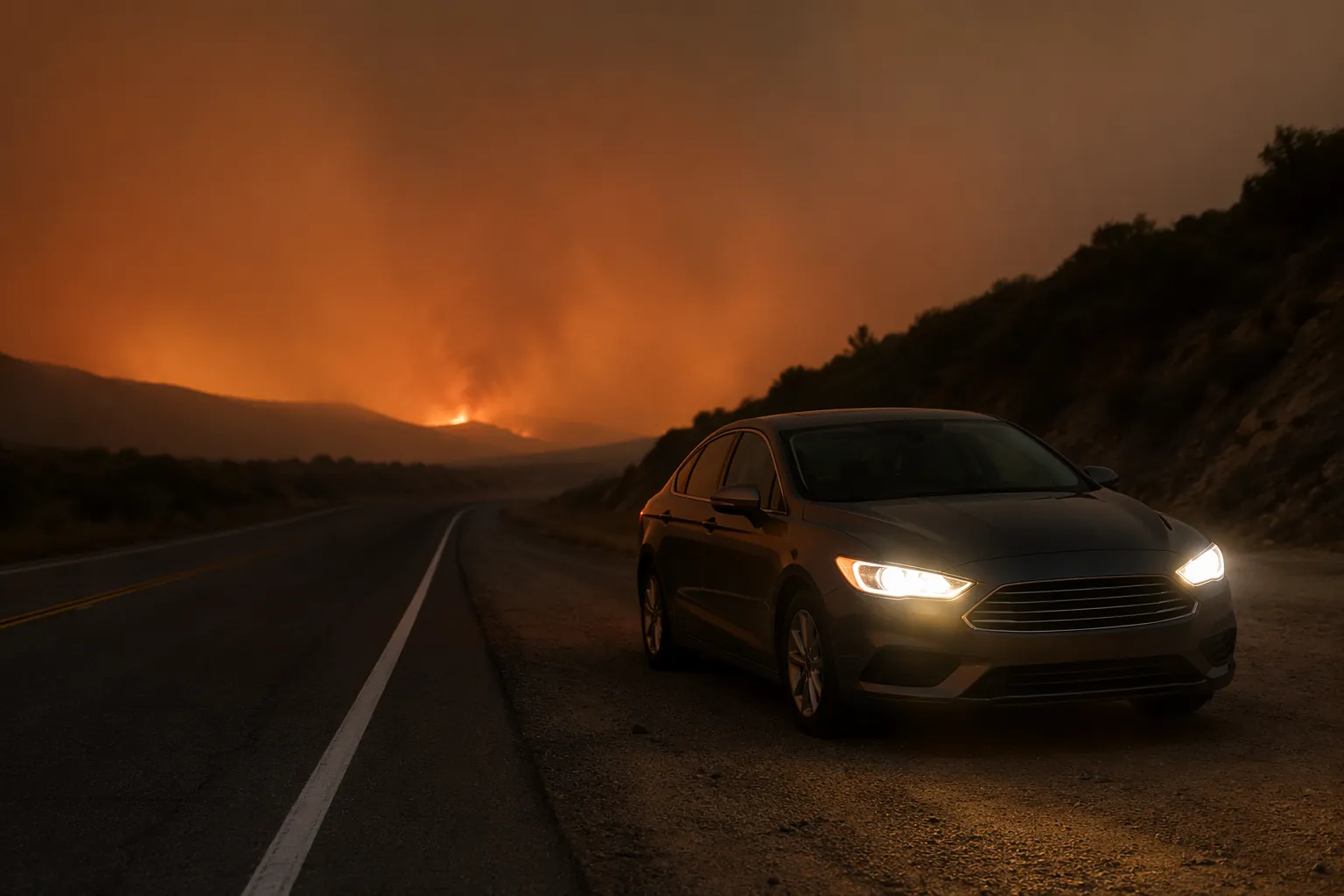
Set Up the Vehicle Before You Try to Sleep
Do the physical setup before negotiating with your fear. The Centers for Disease Control and Prevention advises people in vehicles during wildfire smoke to keep windows and vents closed and run the air conditioner on recirculate; it also warns not to idle or park over dry grass because hot vehicle parts can ignite vegetation.[1] Those instructions are not sleep advice, but they are the most concrete starting point for vehicle sleep during a closure.
Move only if moving is allowed and safer than staying put. If traffic is stopped by responders, do not create a second hazard by driving around cones, parking in a travel lane, or blocking emergency vehicles. If you have a choice among safe stopping places, choose pavement, gravel, or cleared ground over shoulder grass. Keep the vehicle visible. Leave room for other vehicles and emergency access. If the wind is pushing smoke directly into your location and officials have not told you to remain there, a safer nearby position may matter more than a flatter place to recline.
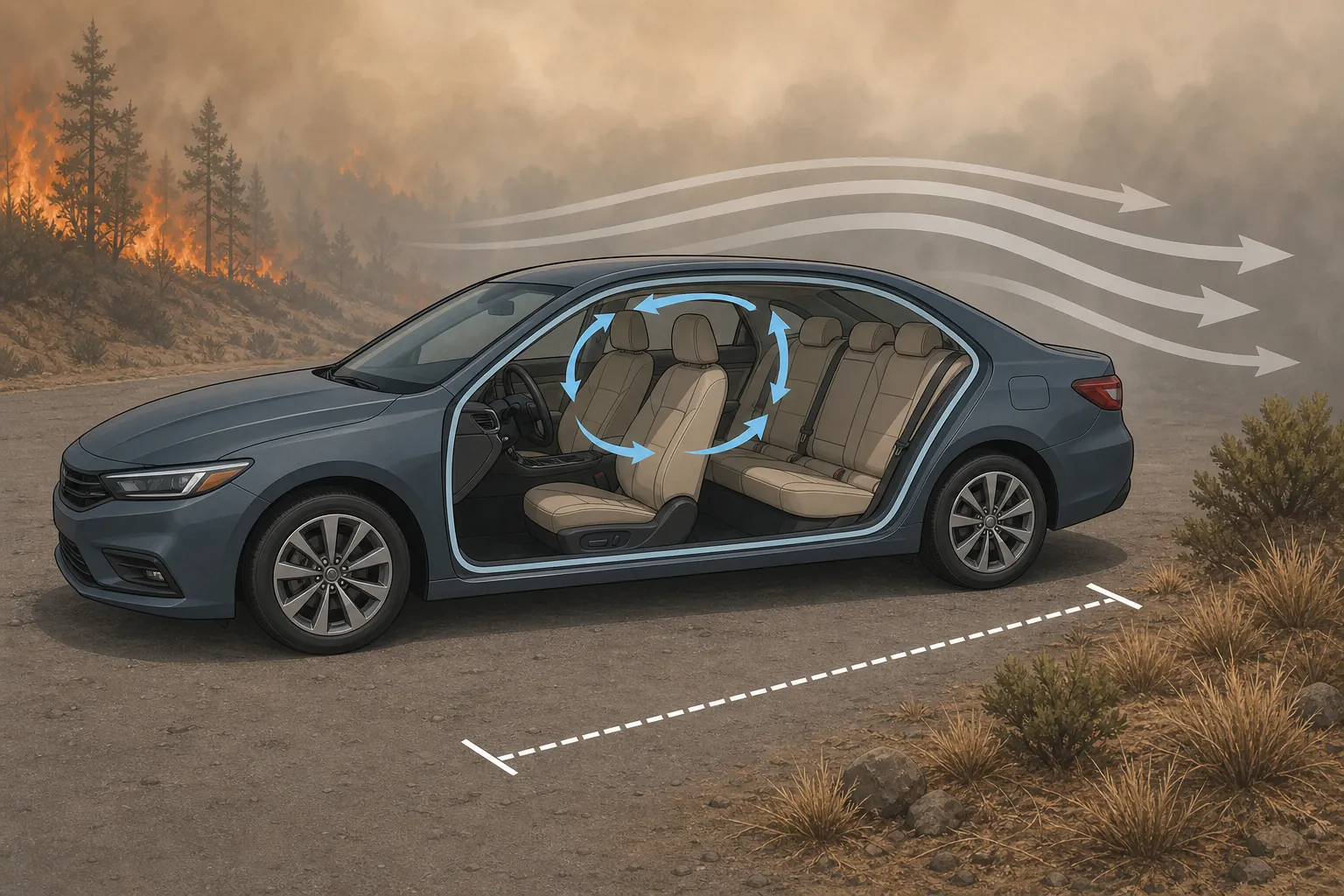
Inside the cabin, close every window fully. Turn off fresh-air intake if your controls allow it. Set the system to recirculate. If you need to run air conditioning, use it in short, deliberate intervals rather than letting the engine idle thoughtlessly, especially if you are near dry vegetation. If the engine must run for heat, cooling, defogging, or battery preservation, check that the tailpipe is not blocked and that exhaust is not being pulled into the cabin.
Recirculation is not a magic seal. People open doors, vents leak, smoke conditions change, and vehicle filters vary. But it reduces the amount of outside smoky air you are deliberately drawing in, and that is the level of control available in a stranded-car situation. If you have an N95 respirator or better and the cabin smells smoky or you need to step outside briefly, use it. Do not use masks as a reason to ignore official movement instructions or remain in a deteriorating area.
| Vehicle action | Why it matters tonight |
|---|---|
| Windows fully closed | Reduces direct smoke entry into the cabin. |
| Vents closed or outside-air intake off | Limits smoky outdoor air being pulled through the ventilation system. |
| AC on recirculate when used | Cycles cabin air instead of continuously bringing in outside smoke. |
| Park away from dry grass and brush | Reduces ignition risk from hot vehicle parts or nearby fire spread. |
| Keep access clear | Allows emergency vehicles, traffic release, or relocation when conditions change. |
Give Yourself Permission to Sleep in a Controlled Way
A parked car near a wildfire closure is a bad place to demand calm. Your body may be doing exactly what it is built to do: scanning, listening, calculating exits, and refusing to drop into sleep. The Sleep Health Foundation’s bushfire guidance recommends planning watch shifts across the sleep period and setting phone alarms for updates so people can get deeper sleep between checks.[2] That is the key distinction: you are not ignoring danger; you are replacing continuous hypervigilance with scheduled attention.
If there are two or more adults in the vehicle, decide the first watch before everyone is exhausted. The awake person watches for official alerts, traffic movement, changing smoke, nearby flame or ember activity, worsening symptoms, and instructions from responders. The resting person sleeps with shoes nearby, phone reachable, keys in a known place, and seatbelt or exit path managed so they can move quickly if awakened.
If you are alone, use alarms instead of willpower. Set a short interval you can tolerate based on the situation and official update timing. Put the phone where the alarm will wake you, but protect the battery: dim the screen, close unnecessary apps, and keep a power bank connected if you have one. Write the next check time on paper or in a note if your mind keeps doubting it. The point is to make the next decision visible.
A simple check can be enough: official alert source, road status if available, visible smoke or glow, smell inside the cabin, symptoms in passengers, fuel or battery status, and whether the parking spot is still safe. Do not turn every check into an endless news search. Patchy information can make fear worse without improving your decision.
Use a short reset before closing your eyes
Once the next watch or alarm is set, give your body a downshift cue. Put both feet flat if you can. Loosen your jaw. Unclench your hands. Take a slower exhale than inhale for several breaths. Name the next action out loud: “The windows are closed. The vent is recirculating. The alarm is set. I will check again when it rings.” This does not make the situation safe by itself. It tells your nervous system that someone is still in charge.
The sleep problem here is not ordinary insomnia. Wildfire evacuation and smoke exposure can combine smoke irritation, hyperarousal, and an unfamiliar sleeping environment; a broader guide to three threats to sleep during a wildfire evacuation covers that wider pattern. In the vehicle, the same threats are compressed into a smaller space with fewer options, which is why the watch-and-alarm rhythm matters.
Why Your Body May Refuse to Sleep
The fear may feel embarrassing after the immediate sirens have passed. It should not. In one online survey after severe smoke and bushfire exposure in the Australian Capital Territory, 37% of respondents reported disrupted sleep and 80% reported anxiety; the study’s authors also noted a 6.4% response rate, so the figures should be read as evidence of a real problem rather than a precise estimate for every wildfire population.[3]
A systematic review of wildfire-related sleep disturbance found high reported insomnia prevalence among wildfire survivors, including 63% to 72.5% by self-report and 43.6% by clinical diagnosis in the studies it reviewed.[4] Those numbers come from survivor populations, not from a study of people sleeping in vehicles at road closures. Still, they help explain why “just get some rest” can be useless advice when the air smells wrong and the route ahead is blocked.
Smoke may also affect sleep through more than coughing or eye irritation. Sleep Foundation summarizes research suggesting fine smoke particles may reach brain regions through the olfactory nerve, a plausible pathway for nervous-system effects, though this should be treated cautiously when applying it to a single night in a car.[5] The practical takeaway is narrower and stronger: keep smoke out of the cabin as much as you can, because smoke exposure and alarm physiology are pulling in the same bad direction.
For readers who are already safe enough to read more deeply, why wildfire smoke keeps your brain on high alert at night and how Code Purple air quality affects sleep explain the smoke and arousal pathways in more detail. If you are still stranded, stay with the checklist first.
Know What Interrupts the Sleep Plan
Vehicle sleep during a wildfire closure lasts only while sheltering in place remains the safer option or the only option. The American Red Cross advises people to follow evacuation instructions from local officials and to leave immediately when ordered; it also emphasizes monitoring alerts and knowing where to go.[6] In a road-closure situation, that means your sleep plan answers the next hour, not the whole night.
- Official instruction: if responders, emergency alerts, or road authorities tell you to move, the sleep shift ends.
- Smoke change: if smoke thickens, enters the cabin strongly, or visibility drops around moving traffic, reassess instead of trying to sleep through it.
- Fire cues: visible flame, embers, rapidly increasing glow, falling ash, or heat near the vehicle requires immediate attention.
- Unsafe parking: traffic patterns, blocked shoulders, nearby vegetation, or other vehicles can turn a reasonable stop into a hazard.
- Health symptoms: trouble breathing, chest pain, confusion, severe headache, faintness, or carbon monoxide concerns should override the rest plan.
If you brought a portable air cleaner or battery-powered filtration device, use it only if it is designed for the space and power source you have. The EPA’s home air-cleaner guidance is not vehicle-specific, but it does emphasize that air cleaners and filters are only part of indoor air quality management and that effectiveness depends on the device and conditions.[7] In a car, no gadget replaces closed windows, recirculation, safe positioning, and official instructions.
If Fear Is the Main Thing Keeping You Awake
Fear itself can be the sleep barrier, even when the flames are not visible from your windshield. In a study of people affected by wildfires, fear of imminent death was significantly associated with insomnia and PTSD symptoms one month later; the reported association for fear of imminent death was p = 0.005.[8] That finding does not mean your fear predicts trauma. It means perceived danger is powerful enough to disturb sleep on its own.
Another wildfire survivor study found smoke exposure was a significant predictor of insomnia, and insomnia predicted both PTSD and nightmare severity.[9] Again, that is not a vehicle-sleep study. But it supports the reason for treating smoke management and anxiety management as linked tasks instead of separate problems.
When panic spikes, do one physical task before checking the news again. Reconfirm the vent setting. Touch the window switch and verify it is closed. Check the alarm time. Put shoes where your feet can find them. Sip water if you have it. Then use a short phrase that matches the plan: “I am resting until the alarm unless something changes.” The wording is less important than the handoff from fear to procedure.
If you are with children, an older adult, or someone with asthma, heart disease, disability, pregnancy, or high anxiety, make the plan visible to them in plain language. Tell them who is watching, when the next alarm will sound, and what would make everyone move. People rest better when they know they will not be surprised by a silent decision.
What Not to Spend Energy On
Do not try to make the vehicle bedroom-like before it is safety-ready. Reclining the seat, arranging a pillow, or finding a better sleeping angle comes after air, alerts, access, and alarms. Comfort helps only if it does not slow evacuation, block visibility, drain the phone, or make the driver too groggy to respond.
Do not argue yourself into staying awake forever. Exhaustion can make the next decision worse. The safer compromise is limited rest bracketed by checks. If you want a broader plan for evacuation nights before, during, and after displacement, use how to protect your sleep during a wildfire evacuation when you are no longer making immediate road-side decisions.
And do not treat the car as a safe shelter once the reason for stopping changes. If the road reopens, officials direct relocation, smoke worsens, symptoms appear, or the parking location becomes unsafe, the sleep protocol is over. At that point, the responsible sleep decision is to stop sleeping and move according to official guidance.
References
- How to Safely Stay Safe During a Wildfire, Centers for Disease Control and Prevention.
- Bushfire Threat and Sleep Health: Coping with Uncertainty and Anxiety, Sleep Health Foundation.
- Physical and Mental Health Effects of Bushfire and Smoke in the Australian Capital Territory 2019-20, Frontiers in Public Health, 2021.
- Systematic Review of the Impact of Wildfires on Sleep Disturbances, 2021.
- How Wildfire Smoke Pollution Can Impact Your Sleep, Sleep Foundation.
- Wildfire Safety, American Red Cross.
- Air Cleaners and Air Filters in the Home, U.S. Environmental Protection Agency.
- Insomnia and PTSD One Month After Wildfires: 'Fear of Imminent Death'.
- Prevalence and Predictors of Sleep and Trauma Symptoms in Wildfire Survivors, Sleep Epidemiology, 2023.
Explore the mechanism
Next step
Spot an error or have clinical feedback?
Because this article covers clinical, medication, or safety information, we use a moderated correction channel instead of open public comments. Let us know if something about “Sleeping Safely in Your Vehicle During Wildfire Road Closures” needs a closer look.
Send feedback on this article