
A Code Purple air quality alert is the kind of warning that can feel abstract until bedtime. The windows are shut, the room is dim, and the problem seems to have moved indoors with you: more congestion, more mouth breathing, more awakenings, or a partner noticing louder snoring than usual. In regional U.S. alert systems that use the term, Code Purple refers to very unhealthy air in the AQI 201–300 range. The sleep science is narrower than the alert label, though: researchers have not isolated “Code Purple nights” as their own sleep-exposure category. The evidence comes mostly from studies of PM2.5, nitrogen dioxide, ozone, and other pollutants across broader exposure ranges.
That distinction matters for anyone searching for Code Purple air quality and sleep tips. The practical question is often “what should I do tonight?” But the biological question comes first: what exactly is the polluted air interrupting? A 2020 systematic review found that 21 of 22 studies reported a positive association between air pollution and adverse sleep outcomes, which is strong enough to take the signal seriously while still asking which pathway is doing the work in a given sleeper.[1]

The first tissue to complain is often the airway
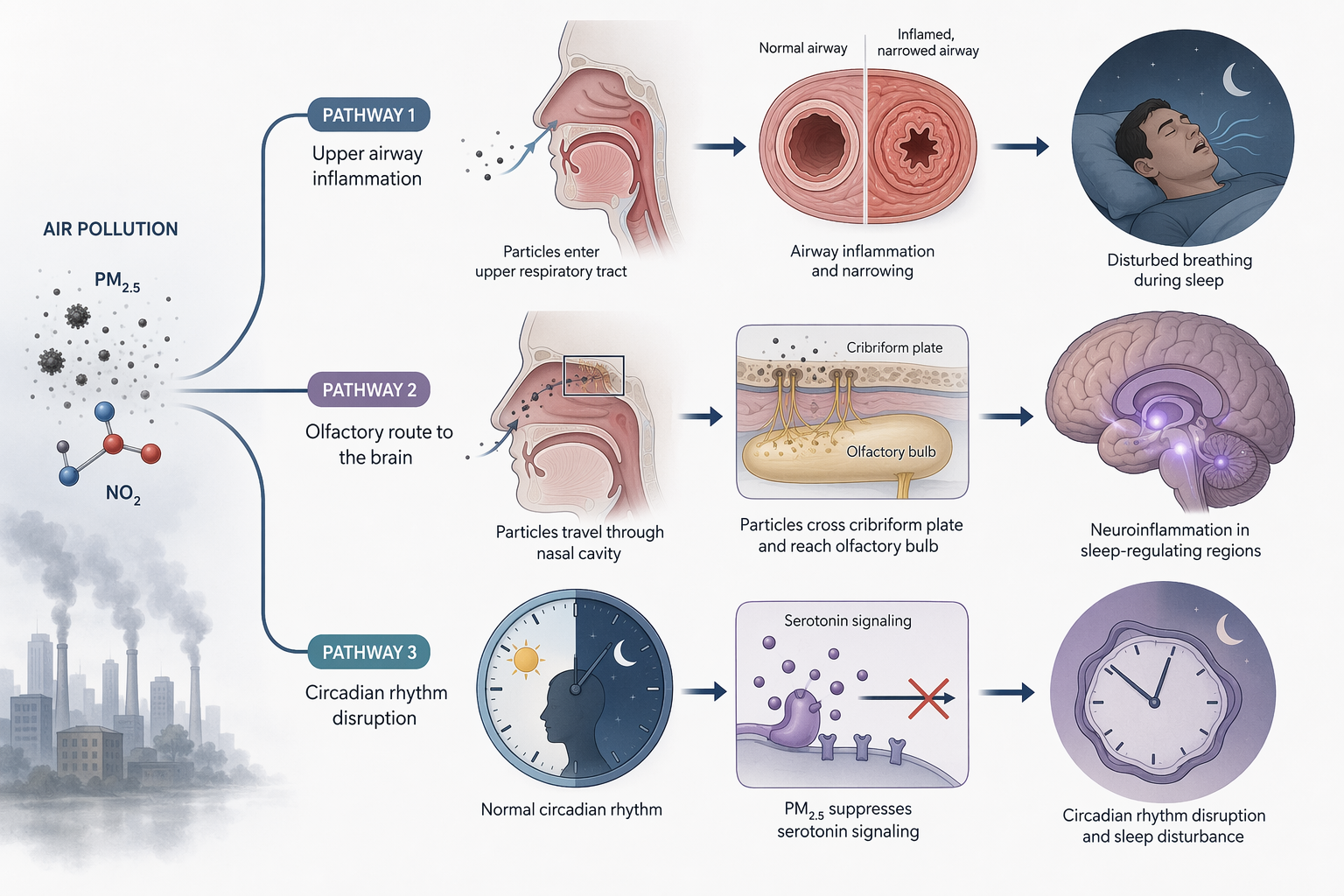
Fine particles do not need to create a dramatic asthma attack to affect sleep. They can irritate the nose, throat, and upper airway enough to change the mechanics of breathing during the hours when airway tone is already reduced. At night, the muscles that help hold the airway open relax. If the nasal passages and throat are also inflamed, swollen, or producing more mucus, the sleeper may shift into mouth breathing, snore more, or experience more partial obstructions.
This is why the respiratory pathway is the most concrete sleep pathway. It has a clear sequence: polluted air contacts the upper airway, local tissues become irritated, the breathing passage narrows, and the sleeper becomes more vulnerable to fragmented breathing. That fragmentation does not have to fully wake a person each time. It can appear as lighter sleep, repeated arousals, morning headache, dry mouth, or the sense of having slept for enough hours without feeling restored.
The Multi-Ethnic Study of Atherosclerosis gives this pathway one of its strongest bridges into sleep-disordered breathing. In that analysis of 1,974 participants, higher PM2.5 and nitrogen dioxide exposure was associated with increased sleep apnea risk.[2] That does not prove that one smoky or stagnant evening causes apnea in a person who would otherwise have none. It does support a more plausible and clinically important reading: polluted air may worsen the breathing instability of people who are already near the edge—because of congestion, snoring, obesity risk, alcohol use near bedtime, anatomical narrowing, or existing sleep apnea.
The body position of sleep makes the same irritation more consequential. A mildly inflamed airway during the day can be annoying; the same airway at night has to stay open while the person is lying down, swallowing less often, and cycling through sleep stages that alter muscle tone. For someone using a CPAP machine, a pollution-heavy night can also make the practical side harder: nasal stuffiness, mask discomfort, and mouth leak can all turn a respiratory exposure into a sleep-continuity problem.
This is also where the advice in a practical hazardous-air guide belongs. Keeping polluted air out of the sleeping space, improving filtration, and reducing airway irritation make sense because they interrupt this chain near the beginning. The longer action checklist belongs in the companion guide on how to sleep when air quality is hazardous; the mechanistic point here is that those actions are not generic comfort rituals. They are aimed at keeping the airway from becoming the weak link in sleep.
Particles may also reach sleep-regulating brain circuits
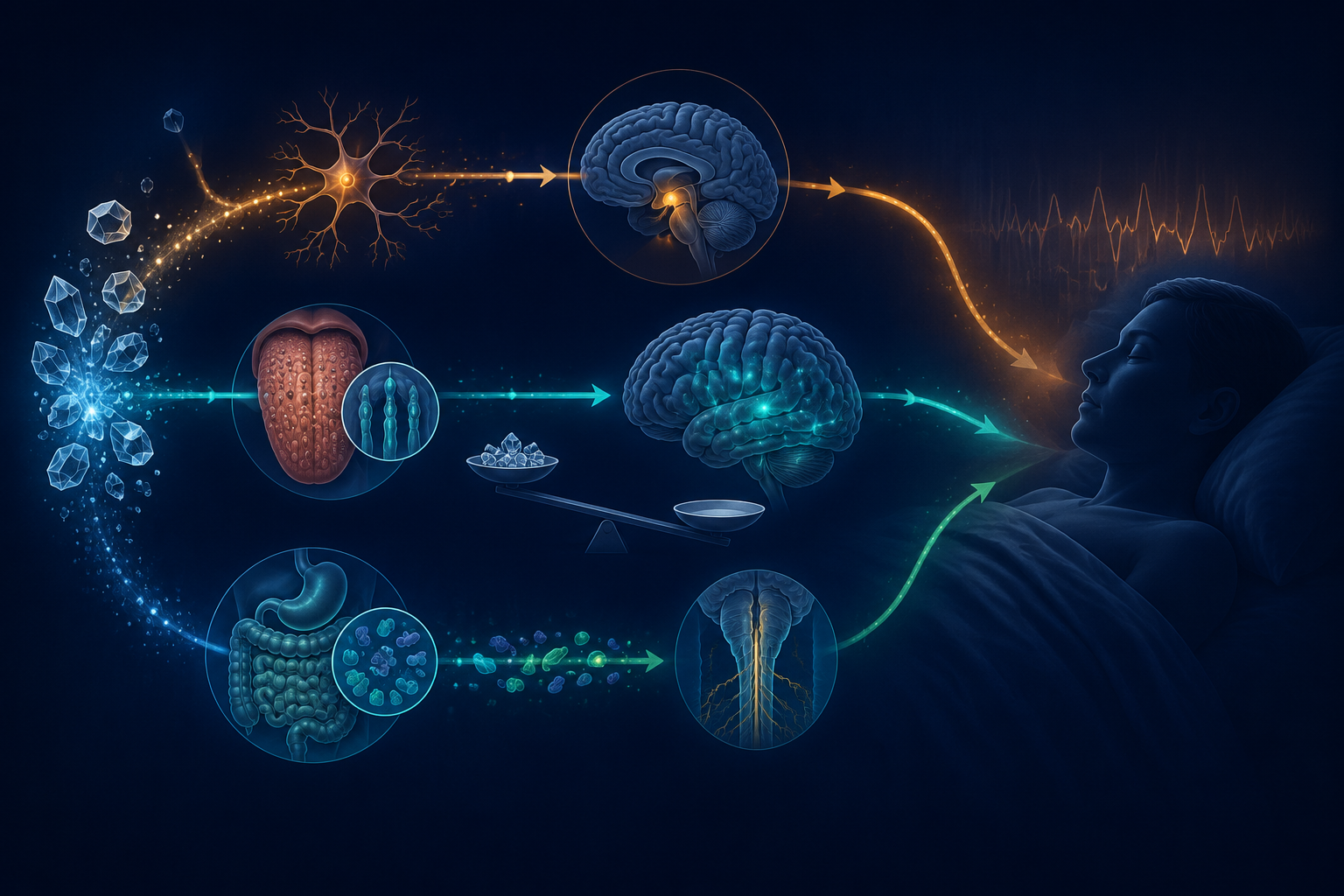
The second pathway is less visible from the bed but biologically serious: neurotoxicity. Fine particulate matter and traffic-related pollutants such as nitrogen dioxide are studied not only as lung exposures, but as exposures that may influence the nervous system. One proposed route runs through the nose, across the cribriform plate, and into the olfactory bulb—the brain structure involved in smell. From there, inflammatory signaling may affect wider brain regions involved in arousal, breathing control, and sleep regulation.
The cribriform plate matters because it gives the nasal cavity an unusually direct anatomical relationship with the brain. It is not a magic doorway through which every particle travels intact, and the evidence should not be exaggerated into a single guaranteed route. But it helps explain why inhaled pollution is not only a chest problem. The nose is both an airway filter and a sensory interface with the nervous system.
Once neuroinflammation enters the picture, sleep disruption can look different from simple congestion. The person may not remember gasping or snoring. Instead, the night may feel restless, shallow, or oddly alert. Sleep depends on timed shifts in brain-state control: arousal networks need to quiet, sleep-promoting systems need to hold, and respiratory control has to remain stable enough that the brain is not repeatedly pulled back toward wakefulness.
This pathway is one reason large association studies are useful but incomplete. A sleep questionnaire or diagnosis code can show that polluted-air exposure tracks with worse sleep outcomes, but it cannot always tell whether the dominant route was a stuffy airway, a direct nervous-system effect, stress from the event itself, heat, noise, or some combination. The Liu review’s broad pattern supports an association between air pollution and adverse sleep, but the mechanism still has to be inferred from more specific biological and epidemiological evidence.[1]
Why the effect can show up right at bedtime
Sleep complaints during severe pollution events are sometimes dismissed as next-day fatigue being misread as bad sleep. Timing makes that too simple. PM2.5 levels have been reported to peak globally between 9 PM and 11 PM, a window that overlaps with the period when many people are trying to fall asleep.[3] That does not mean every city peaks at exactly the same hour or that every Code Purple alert follows the same pattern. It does mean the exposure can plausibly arrive when the body is attempting one of its most delicate transitions: moving from wakefulness into sustained sleep.
At that point, small physiological disturbances carry more weight. Nasal resistance rises. A person notices the need to clear the throat. The brain remains slightly more vigilant because breathing is uncomfortable. If the bedroom is warm because windows are closed, or noisy because an air conditioner or filtration unit is running, the pollution event can stack several sleep disruptors into the same hour.
The same timing issue is one reason wildfire smoke often feels different from a routine bad-air day. Smoke events can change outdoor air, indoor air, odor, anxiety, and bedroom ventilation decisions at once. The wildfire-specific sleep discussion is covered separately in the wildfire smoke and sleep quality guide, but the shared biology is the same: inhaled pollutants can affect sleep before the next morning arrives.
The serotonin-circadian route is plausible, but less settled
The third pathway is circadian. PM2.5 exposure has been linked in the literature to serotonin suppression, and serotonin is part of the biochemical system that helps shape circadian timing and sleep-wake regulation. If that chain holds in humans under real-world exposure conditions, air pollution could affect sleep not only by making breathing harder or inflaming neural tissue, but by shifting the signals that help the body know when to sleep.
This is the pathway that deserves the most caution. It is biologically interesting, but it is not as well established as the airway pathway or the broader neuroinflammation pathway. Serotonin is involved in many systems, circadian regulation is distributed across multiple signals, and real-world pollution exposure rarely arrives alone. Light exposure, stress, room temperature, illness, medications, and schedule irregularity can all affect the same sleep-wake machinery.
So the circadian route should not be used as a tidy explanation for every bad night during a pollution alert. It is better treated as a possible contributor, especially when the complaint is not mainly snoring or congestion but an inability to fall asleep at the usual time. The evidence gives a reason to watch the pathway; it does not yet give the same confidence as the respiratory sequence.
Large datasets support the signal, but they do not erase the caveats
The association is not confined to small lab samples. A UK Biobank analysis comparing 5,976 patients with sleep disorders and 97,160 controls identified PM2.5 as a sleep disorder risk factor.[4] In Ningbo, China, a study of 395,561 adults aged 60 and older found a positive association between short-term air pollutant exposure and hospital admissions for sleep problems.[5] Those studies help keep the topic from being reduced to anecdote: the sleep signal appears in large populations, not only in people who already track every environmental exposure.
Scale, however, does not make the evidence more specific than it is. Many sleep studies rely on self-reported sleep, diagnosis codes, or hospital admissions rather than polysomnography. Those measures matter, but they do not capture the same thing. A hospital admission for a sleep problem is not the same outcome as a lower percentage of slow-wave sleep. A questionnaire about insomnia is not the same as a measured oxygen desaturation. A long-term exposure estimate is not the same as one Code Purple night.
That is the main calibration: the sleep effect is credible, but the Code Purple-specific evidence gap remains real. Code Purple is an alert category used in some regions, not a biological exposure unit. The body is responding to pollutants, dose, timing, ventilation, and individual vulnerability—not to the color label itself.
How to rank the three pathways
| Pathway | What happens biologically | How confident to be |
|---|---|---|
| Upper respiratory inflammation | Pollutants irritate the nose and upper airway, narrowing breathing passages and worsening snoring or sleep-disordered breathing. | Strongest practical sleep link, especially for people with congestion, snoring, or sleep apnea risk. |
| Direct neurotoxicity and neuroinflammation | Fine particles and nitrogen dioxide may affect the nervous system through nasal-brain routes including the cribriform plate and olfactory bulb. | Biologically plausible and important, with less direct night-by-night sleep specificity than the airway pathway. |
| Circadian-serotonin disruption | PM2.5-linked serotonin suppression may interfere with circadian and sleep-wake signaling. | Suggestive, but less established than the first two pathways. |
For a person lying awake during a severe pollution alert, the most likely first-order explanation is usually not mysterious: the airway is irritated, breathing is less stable, and sleep becomes easier to fragment. The nervous-system pathway gives the problem a second route that does not depend entirely on snoring or congestion. The circadian-serotonin pathway may help explain some timing and sleep-onset complaints, but it should stay in the “plausible, still developing” category.
For a broader explanation of how air quality affects sleep outside Code Purple conditions, see the related guide to air quality and sleep effects and the shorter mechanistic overview of air quality sleep pathways. The practical sleep-tips article can handle what to do with the room, filtration, and bedtime routine. The mechanistic answer is more restrained: severe air pollution can plausibly disrupt sleep through multiple routes, with the strongest support behind respiratory inflammation and neurotoxicity, and a more tentative case for circadian-serotonin disruption.
References
- The Effects of Air Pollution on Sleep: A Systematic Review and Meta-Analysis, PMC, 2020.
- The Association of Ambient Air Pollution with Sleep Apnea: The Multi-Ethnic Study of Atherosclerosis, PMC, 2019.
- Global PM2.5 peak timing analysis, PMC.
- UK Biobank analysis of PM2.5 and sleep disorder risk, UK Biobank.
- Short-term air pollutant exposure and hospital admissions for sleep problems in Ningbo, China, PMC.
Comments
Join the discussion with an anonymous comment.