
How to Get Some Sleep After an Earthquake
This guide provides a concrete, step-by-step protocol for the first night after an earthquake, prioritizing physical safety preparations before addressing the acute hypervigilance that prevents sleep. You'll learn the essential bedtime safety checklist, breathing and relaxation techniques adapted for trauma, and how to know when to seek further help.
If you are searching for how to sleep after an earthquake tonight, the first answer is not “try to relax.” Your body may be listening for aftershocks because aftershocks are a real possibility. That alertness is inconvenient, frightening, and often exhausting, but it is not a character flaw.
Sleep disruption after a major earthquake is common enough that it should remove some shame from the room. In a 2019 study of Haiti earthquake survivors, 94% reported insomnia symptoms after the disaster.[1] Studies after earthquakes in Japan and Turkey also found substantial sleep disturbance, including nearly doubled insomnia prevalence in Tokyo after the Great East Japan Earthquake and poor sleep scores among surveyed survivors after the 2023 Turkey earthquake.[2][3] Those studies do not tell you exactly what will happen in your bedroom tonight. They do tell you that being wired after shaking is a normal human response.
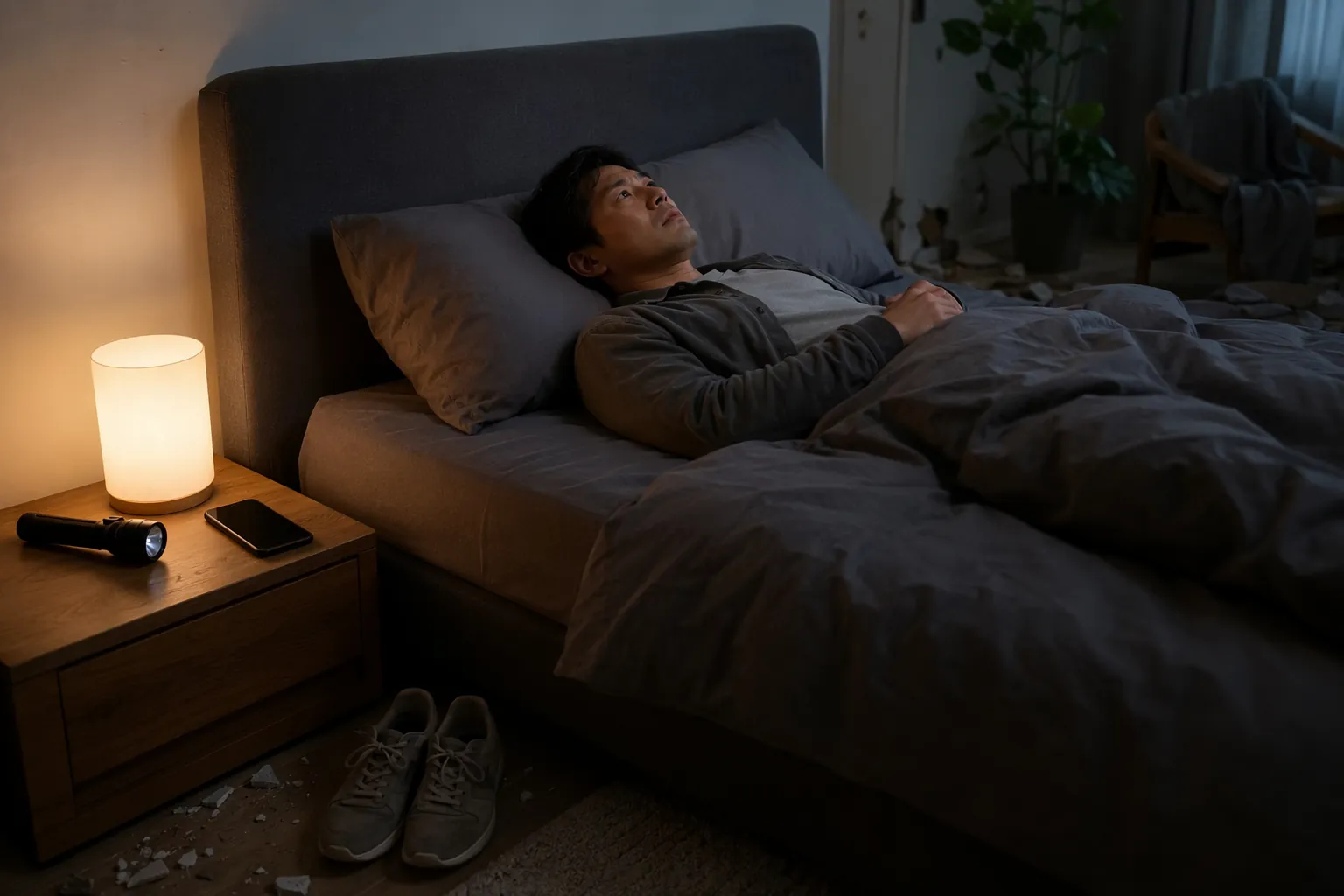
For the first night, the useful question is narrower than “How do I calm down?” It is: what has to be true before your body can safely stand down enough to rest? Start there. Breathing exercises work better after your shoes are where your feet can find them.
First, Decide Where You Can Safely Rest
Do not make the bed sacred tonight. If your usual bedroom has broken glass, a damaged ceiling, a tall bookcase leaning toward the bed, a heavy mirror above your head, or a blocked exit, choose another place. A couch away from windows may be better. A mattress on the floor may be better. A hallway interior to the home may be better if it keeps you away from falling objects and gives you a clearer route out.
If local officials have told you to evacuate, or if you smell gas, see major structural damage, hear shifting or cracking, or cannot safely move through the building, the sleep plan changes: leave if you can do so safely and follow local emergency instructions. Rest in a safer place before you try to sleep in a dangerous one.
Once you have chosen the least risky available sleeping spot, do a short, practical scan. Look above you, beside you, and along the route out. The CDC advises clearing heavy objects from above the bed, sleeping in safe clothing with shoes nearby, and keeping a flashlight and whistle within reach after an earthquake.[4] If you want a fuller room-by-room version later, use a dedicated guide to bedroom earthquake safety during sleep. Tonight, keep the scan tight enough that you actually finish it.
Set Up the Bedside Safety Check Before You Try to Sleep
This is the part that often does more for sleep than a calming script. Your brain is asking a reasonable question: if shaking starts again, what happens next? Answer it with objects, placement, and a route.
- Put sturdy shoes where your bare feet will land, not across the room.
- Sleep in clothing you could leave in, including something warm enough for waiting outside.
- Place a flashlight, whistle, phone, glasses, keys, medications, and water within reach.
- Charge your phone if power is available, then stop using it as an aftershock monitor.
- Move breakables, lamps, framed pictures, books, and heavy objects away from the bed or sleep area.
- Clear the path from your sleeping place to the safest exit or shelter area.
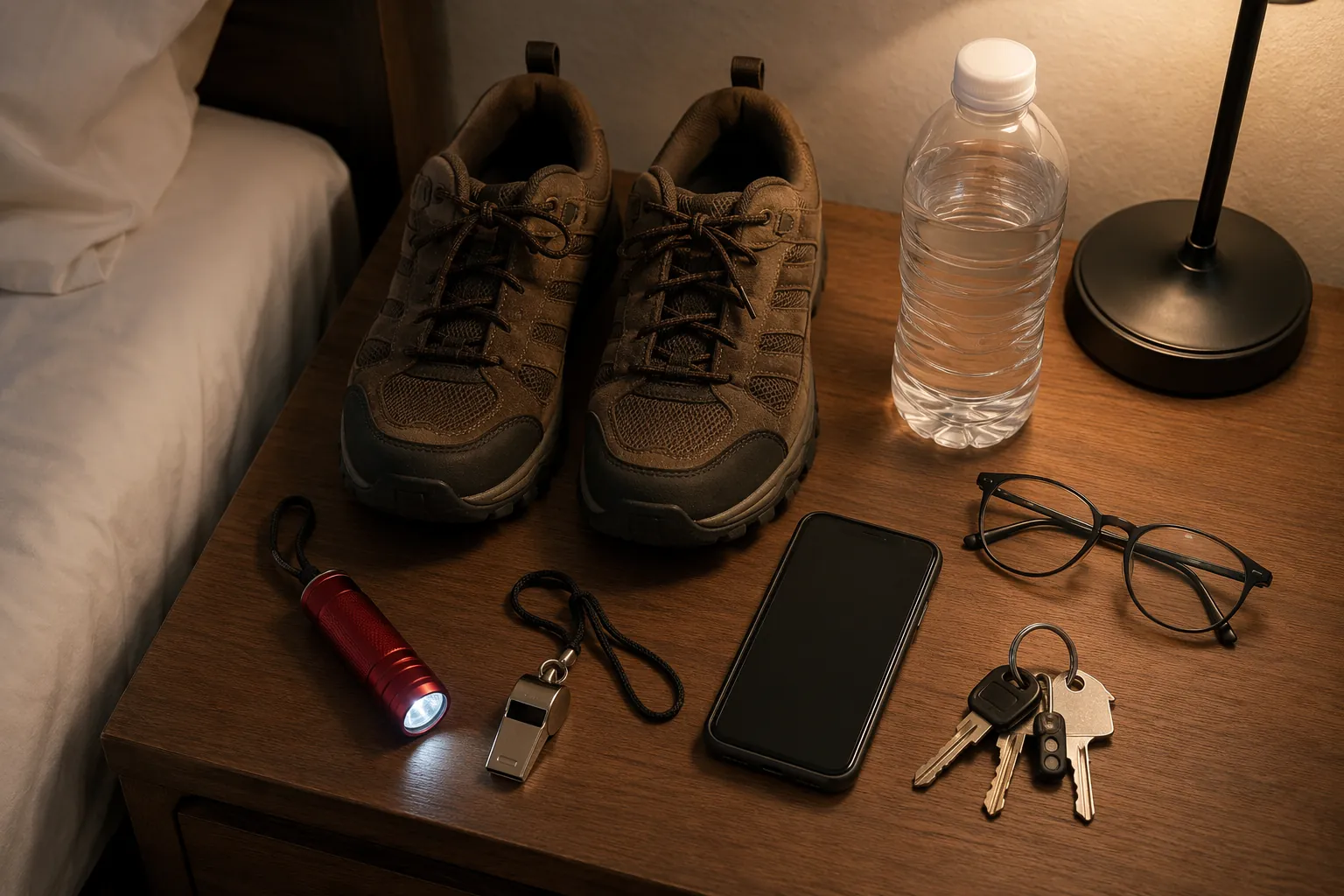
The CDC’s guidance to keep shoes, a flashlight, and a whistle close is not decorative preparedness; it reduces the number of decisions you have to make while scared, half-asleep, or in the dark.[4] A more detailed earthquake bedside kit can wait until tomorrow if needed. Tonight’s kit is the minimum you can reach without standing up.
Then choose your aftershock action before you lie down. The USGS advises that if shaking starts while you are in bed, you should stay there, lie face down, and cover your head and neck with a pillow unless you are under a heavy light fixture or another hazard that makes the bed unsafe.[5] If your chosen sleep spot is not a bed, decide the closest equivalent: protect your head and neck, stay low, and avoid running through falling objects.
Say the plan plainly once: “If shaking starts, I cover my head and neck. My shoes are here. My light is here. My exit path is clear.” You do not need to make it poetic. You need your half-awake brain to recognize the instructions.
Make One Deliberate Attempt at Rest
After the safety check, stop improving the room unless you find a real hazard. This matters. Preparedness can reduce uncertainty, but repeated checking can become its own alarm system. Concrete action helps hypervigilance when it creates a credible plan; it stops helping when it turns into another loop. For a deeper look at that line, see how earthquake preparedness relieves sleep anxiety.
Now make one deliberate attempt to rest. Lower the lights if you can do so safely. Keep emergency alerts available, but do not refresh aftershock maps, social feeds, or damage videos from bed. The point is not perfect sleep hygiene. The point is to stop feeding the exact threat-scanning system that is keeping you awake.
Do not use alcohol as your sleep tool tonight. It may feel sedating at first, but it can fragment sleep, interfere with recovery sleep, and leave you less clear if you need to respond later in the night. After an earthquake, impaired judgment is not a small side effect.
If Your Body Still Feels Wired, Start With the Exhale
Even after you have done everything sensible, your chest may stay tight. Your legs may feel ready to move. Your hearing may keep stretching toward every truck, pipe, and settling wall. That does not mean the checklist failed. It means the nervous system is slower than the hands.
There are no earthquake-specific randomized trials proving that a particular breathing pattern or relaxation exercise will put survivors to sleep. The tools below come from general insomnia care, acute stress management, and expert opinion. That is a limitation, but it does not make them useless. Use them as low-risk ways to reduce physical arousal after you have made the room safer.
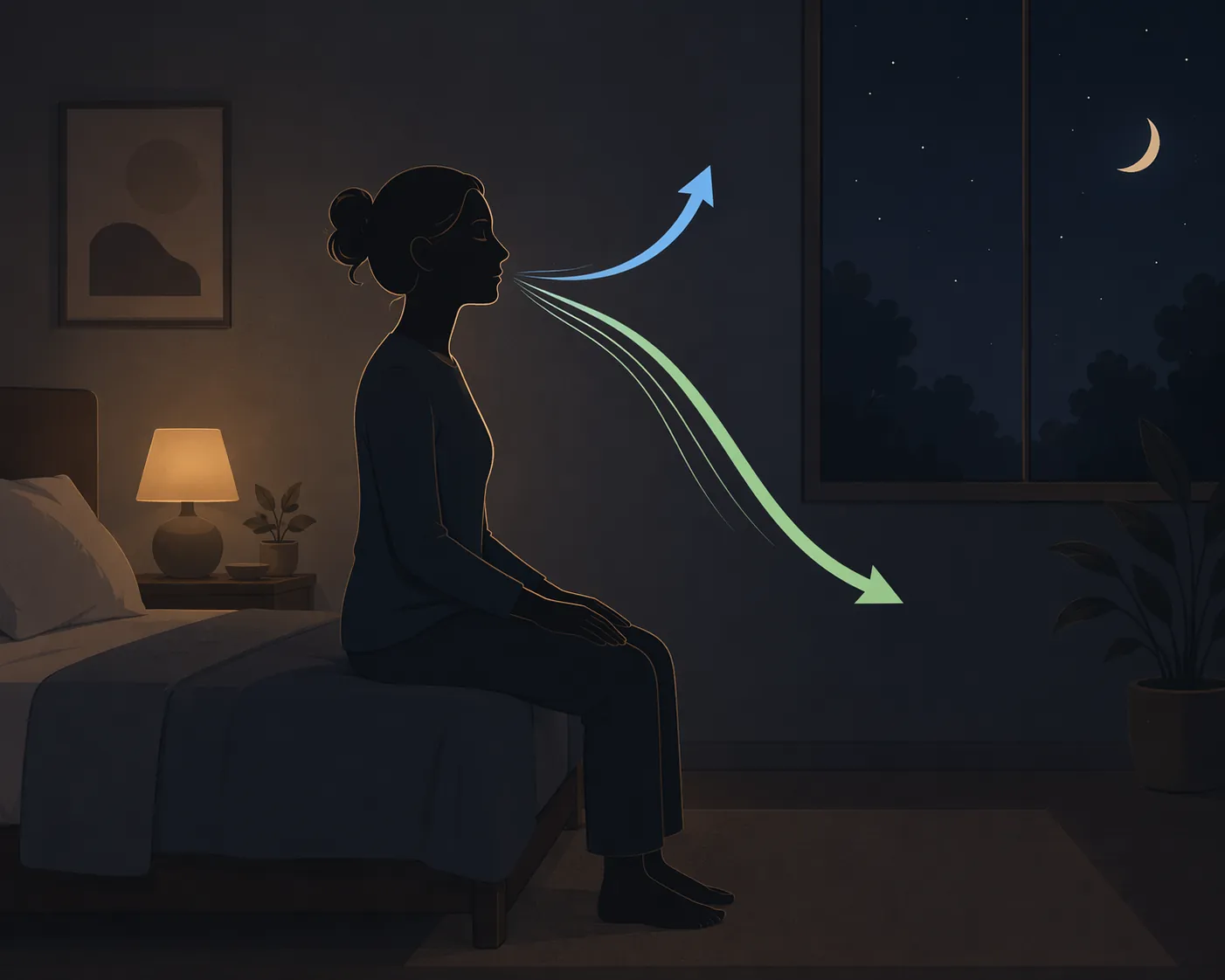
Try a prolonged-exhale pattern for a few minutes:
- Inhale gently through your nose for a count of 5.
- Exhale slowly for a count of 7.
- Keep the breath comfortable; do not strain to make the numbers perfect.
- If counting makes you more alert, use “shorter in, longer out” instead.
The longer exhale is the useful part. It gives the body a repeated signal that it does not have to stay at full emergency speed. If you feel dizzy, stop and breathe normally.
Use Progressive Muscle Relaxation Without Forcing Calm
Progressive muscle relaxation is a good fit when fear has moved into the body: clenched jaw, lifted shoulders, tight calves, hands gripping the blanket. Psychiatrist Dr. Gail Saltz recommended progressive muscle relaxation for earthquake anxiety, describing a pattern of squeezing each muscle group for 5 counts and then releasing, moving from the feet upward.[6]
Keep it simple tonight:
- Curl your toes and tense your feet for about 5 counts, then release.
- Tense your calves and thighs, then release.
- Tense your hands, arms, and shoulders, then release.
- Tense your face gently, then release your jaw, tongue, and forehead.
- After each release, notice the difference between bracing and letting go.
Skip any area that hurts or feels injured. This is not exercise. It is a way to show your muscles that they do not need to hold the whole night at once.
If You Are Awake and Escalating, Leave the Bed Carefully
In ordinary insomnia treatment, people are often told to get out of bed if they cannot sleep after about 20 minutes. After an earthquake, use that rule carefully. Do not turn it into pacing, checking, scrolling, or repeatedly opening the front door to listen.
If lying there is making your alarm climb, sit up slowly. Put on your shoes if the floor may have debris. Move to the safest quiet place you identified earlier. Keep the lights low if possible. Do something grounding and dull: hold a warm drink without caffeine, read a familiar page, name five objects you can see, or repeat your aftershock plan once. When your body drops even slightly from panic to watchful tiredness, return to the sleeping place on purpose.
The goal is not to win a contest against wakefulness. The goal is to avoid teaching your bed that it is where you rehearse disaster footage for hours.
What Counts as Success Tonight
A full, smooth night may not be available. Some broken rest still counts. Lying safely with your body supported counts. Breathing with a longer exhale counts. Keeping your phone from becoming an aftershock slot machine counts. Not drinking to knock yourself out counts.
If you need a longer routine for the coming nights, build from this first-night sequence rather than replacing it with generic sleep advice. A more complete earthquake safety sleep routine can help once the immediate hazards are handled. The same safety-first logic also applies in other disasters, including tropical storm landfall and nights disrupted by wildfire anxiety and smoke.
For tonight, safety preparation is not the prelude to the sleep advice. It is the sleep advice. Once your body believes there is a plan for shaking, darkness, shoes, light, and exit, relaxation techniques have something solid to stand on.
This guide is no longer enough if nightmares persist, daytime flashbacks keep interrupting you, you begin avoiding bed because it feels unsafe even after the environment is secure, or acute insomnia continues beyond two to three weeks. At that point, contact a clinician or a mental health professional familiar with trauma and sleep.
References
- AASM study of Haiti earthquake survivors, AASM, 2019.
- Prevalence of Insomnia Among Residents of Tokyo and Osaka After the Great East Japan Earthquake, PMC/PubMed.
- Sleep and Trauma Effects of the Earthquake: A Cross‐Sectional Study, PMC/PubMed, 2023.
- Safety Guidelines: After an Earthquake, CDC.gov.
- USGS earthquake safety protocols, USGS.
- What to do if you have earthquake anxiety, according to an expert, CNN.com.
Explore the mechanism
Next step
Spot an error or have clinical feedback?
Because this article covers clinical, medication, or safety information, we use a moderated correction channel instead of open public comments. Let us know if something about “How to Get Some Sleep After an Earthquake” needs a closer look.
Send feedback on this article