
Sleep Tips for Monsoon Heat and Storms in Perimenopause
Monsoon humidity, storms, and perimenopause night sweats create a triple assault on sleep. This guide offers a three-front strategy—micro-climate cooling, storm-night anxiety protocol, and evening hormone-support routine—to restore rest without requiring central air conditioning.
The hard part about monsoon heat and storms in perimenopause is that the usual answer — keep the bedroom cool — is too thin for the night you are actually having. The room may not be scorching. The thermostat may not look alarming. But the air is wet before the rain, your skin cannot dry after a sweat, thunder keeps pulling you toward alertness, and the fan that helped last week may stop helping when the power flickers.
That pattern is not a character flaw or a failure to relax. It is a collision between three systems: a body in perimenopause that has less thermal wiggle room, humid air that interferes with evaporative cooling, and storm cues that can push an already reactive nervous system into watch mode.
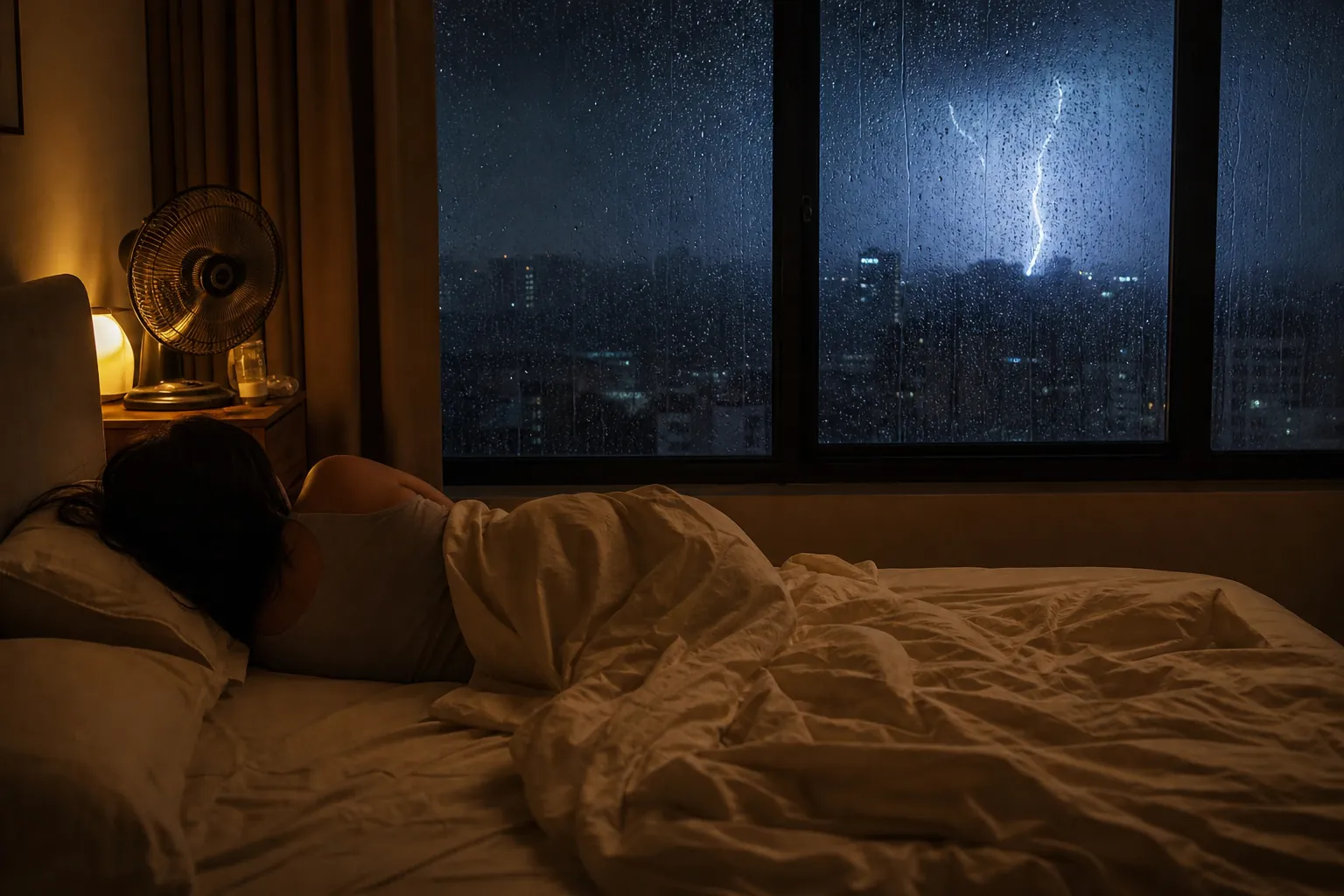
Why Monsoon Nights Feel Worse in Perimenopause
Perimenopause can make small environmental changes feel much larger at night. Stanford Lifestyle Medicine describes estrogen and progesterone shifts as part of the sleep problem in this life stage, including changes in thermoregulation and a narrower comfort range for temperature stability; its guidance also notes a cool bedroom target of about 60–67°F, a useful benchmark that is often unrealistic in humid regions without reliable air conditioning.[1] Johns Hopkins Medicine similarly explains that falling estrogen affects the body's ability to regulate temperature and can contribute to hot flashes and night sweats.[2]
Humidity is the missing piece in many bedroom-cooling lists. Sweat cools you when it evaporates. In monsoon or coastal air, especially when humidity stays high, evaporation slows down, so sweat lingers on skin and fabric instead of carrying heat away. Menoveda, a wellness brand source that should be treated as practical and physiology-based rather than independent clinical trial evidence, describes midlife nights as especially vulnerable when humidity exceeds 70% and recommends aiming for indoor humidity below 50% when possible.[3] The Sleep Foundation also includes humidity control among sleep-environment factors for menopause-related sleep disruption.[4]
This is why turning the thermostat lower, when that option exists, may not be enough. A cool, damp room can still leave sheets clammy after a hot flash. A fan can move air across the body but cannot remove much moisture from the room. A thin blanket can help until the next sweat episode soaks it. Monsoon sleep needs a micro-climate plan, not just a cooler number on a wall.
Storms add a second pathway. Johns Hopkins reports that about 4 in 10 women experience mood symptoms during perimenopause that resemble PMS, including anxiety and irritability, and explains that hormone shifts can affect mood regulation.[5] Weather-sleep sources describe pressure changes and storm conditions as potential sleep disruptors, though this has not been proven as a perimenopause-specific mechanism.[6] The cautious takeaway is enough: if thunder, wind, pressure changes, or outage worry reliably wake you, the storm itself deserves a place in the sleep plan.
Work the Room Before You Work on Willpower
The first front is the bedroom. Not because environment solves every perimenopause symptom, but because the room is the part of the night you can alter before your body is already sweating and startled.
| Problem on a monsoon night | What helps most | Why it matters |
|---|---|---|
| Air feels heavy before rain | Dehumidifier or dry mode if available | Lower humidity lets sweat evaporate more effectively |
| Sweat lingers after a hot flash | Wicking sheets, breathable sleepwear, spare dry layer | Dry fabric reduces the clammy wake-up loop |
| Room is not hot but still uncomfortable | Fan plus humidity control, not fan alone | Air movement helps only when moisture has somewhere to go |
| Power may fail | Battery fan, cooling towel, water, small light | The backup is easier to use when it is already within reach |
If there is one upgrade to prioritize, make it humidity control. A compact dehumidifier in the bedroom, or a dry setting on a mini-split or portable unit, changes the physics of the room. It does not have to turn the bedroom into a cold, sealed hotel room. The goal is to make sweat useful again.
Place the dehumidifier where air can circulate around it, keep the door mostly closed for the first part of the evening if that is safe and comfortable, and empty the reservoir before bed so it does not shut off in the worst part of the night. If the machine has a humidity setting, the practical target is below 50% when achievable; if that is not realistic during heavy rain, even moving the room from swampy to less damp can change how long sweat stays on skin and sheets.[3]
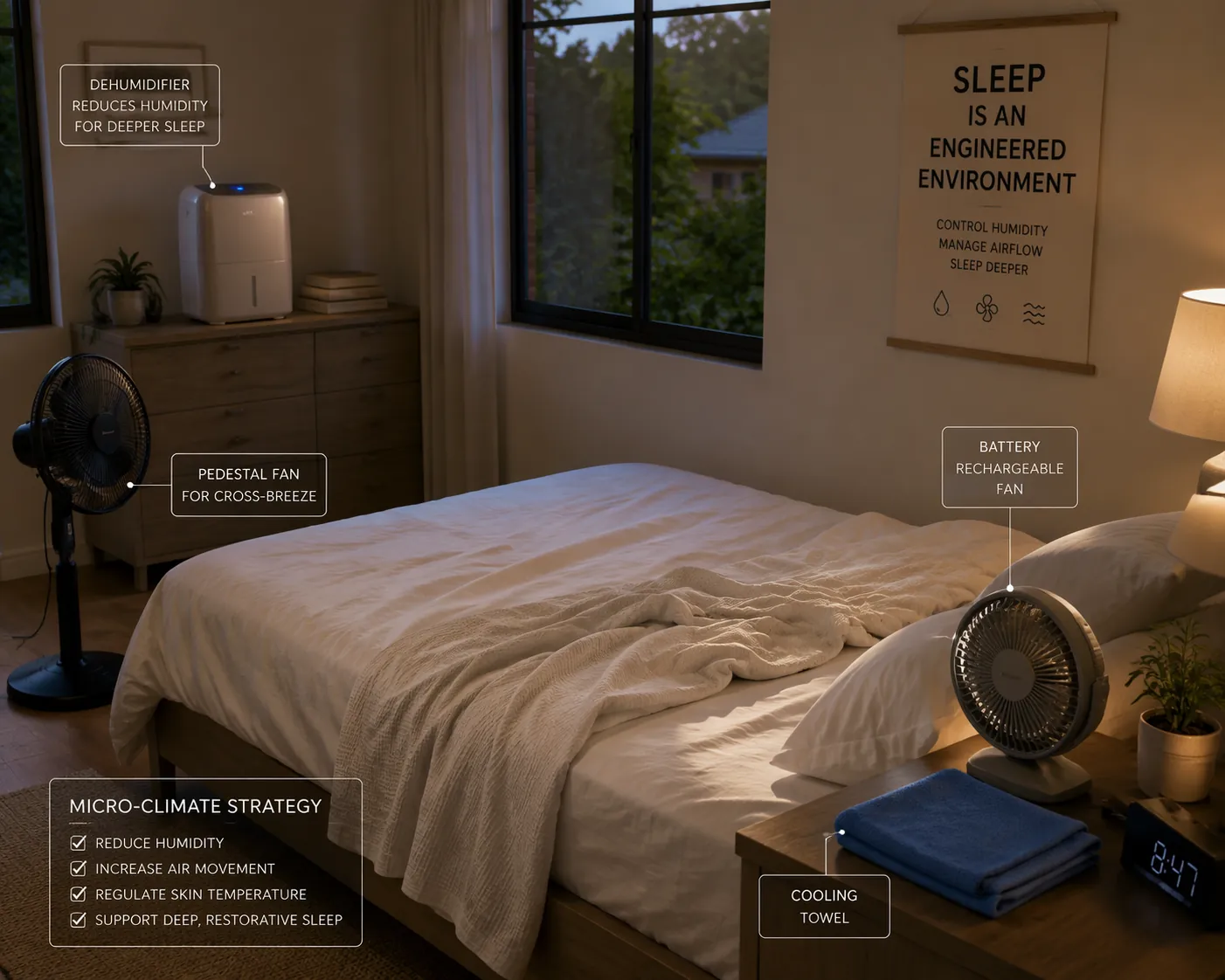
Fans still matter, but they need a job. A pedestal fan across the room can create gentle crossflow. A small bedside fan can be angled toward the torso rather than the face if direct air dries the eyes or irritates sinuses. In very humid air, the fan may feel less effective because evaporation is already impaired; paired with dehumidification, it becomes more useful.
Bedding is the next unglamorous fix. Menoveda reports that bamboo and Tencel sheets wick perspiration about 50% faster than high-thread-count cotton when ambient humidity is above 60%.[3] That specific figure comes from a commercial wellness source, so it should not be treated like a large independent clinical trial. But the practical principle is sound: after a hot flash, the best fabric is not the one that feels most luxurious at bedtime; it is the one that stops holding wet heat against you at 2 a.m.
High-thread-count cotton can trap warmth and moisture. A lighter cotton percale, bamboo, Tencel, linen blend, or other breathable weave is often more useful than a dense, polished sheet. Keep the top layer simple: one light cover that can be kicked off and pulled back without wrestling with a heavy comforter. If night sweats are frequent, keep a dry pillowcase or thin towel near the bed so changing the contact surface takes seconds rather than turning into a full bedding operation.
A Power-Outage Cooling Kit Is Not Overreacting
Storm sleep plans often fail at the exact moment they are needed: the room is finally tolerable, then the power cuts out. A backup kit will not reproduce air conditioning. It can keep the night from becoming a long, wet negotiation with panic.
- Charge a small battery-operated fan before storm season nights, not after the lights flicker.
- Keep a cooling towel by the bed; wet it, wring it well, and place it on the neck, chest, or behind the knees.
- Freeze a soft gel pack or a water bottle wrapped in cloth for brief pillow or pulse-point cooling.
- Place water and a dim battery light within reach so you do not have to search the room while half-awake.
- If you use medical devices or have heat-sensitive health conditions, treat power planning as a safety issue, not a comfort upgrade.
The point is not to build a perfect emergency system. It is to remove decisions from the storm hour. When the air goes still, you already know where the fan is, where the towel is, and what to do first.
Set the Storm Protocol Before the Thunder Starts
Storm anxiety at night is not always dramatic. Sometimes it is the body refusing to drop its guard. The first thunderclap lands, the mind starts tracking the next one, and every small noise becomes information. In perimenopause, when anxiety and sleep disruption are already more common, that alertness can have less distance to travel.[5]
This combined storm-and-perimenopause pattern has not been directly studied as its own condition. It is better understood as an overlap: perimenopause can increase vulnerability to anxiety and night waking, while weather changes and storm noise can disturb sleep in some individuals.[5][6] That distinction matters because it keeps the plan honest. You are not trying to prove that every pressure drop causes insomnia. You are reducing predictable arousal on nights when storms repeatedly disturb you.
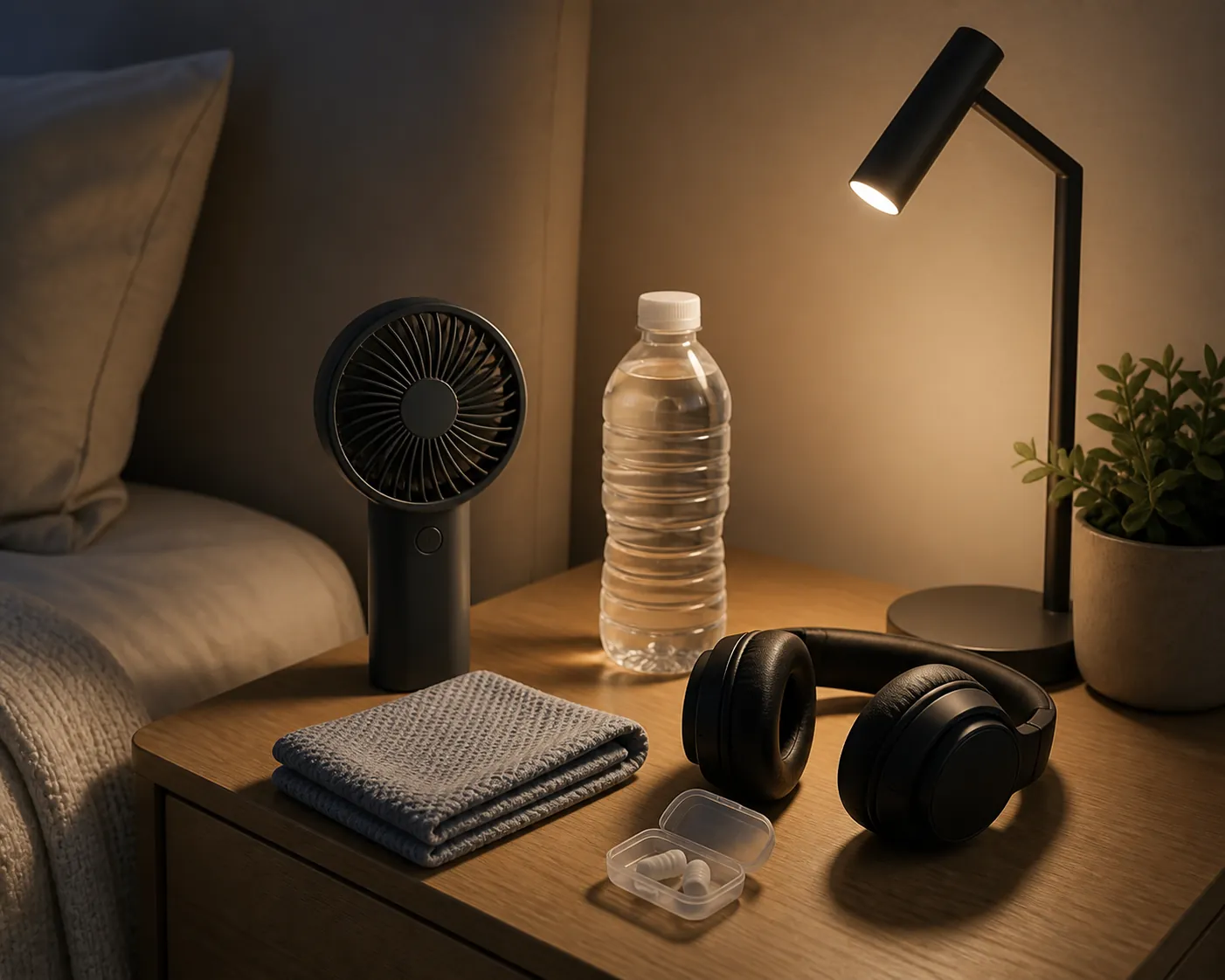
Pre-commitment is the useful part. Before the storm arrives, choose the sound, the light level, the cooling backup, and the rule for checking weather alerts. If you wait until thunder wakes you, the protocol becomes another task for an activated brain.
- Check the forecast once in the evening and set any necessary alerts loud enough to hear but not so broad that every update wakes you.
- Start sound masking before sleep, especially if distant thunder makes you brace for the next rumble.
- Use a low, warm light only for safety; bright light during a wake-up can make returning to sleep harder.
- Put the cooling towel, water, and battery fan on the same side of the bed every time.
- If you wake, repeat one short sequence: cool the body, check safety only if needed, restart sound, return to bed.
For sound, low-frequency masking is often more helpful than a bright hiss. Brown noise has more low-end weight than white noise, which can make it better suited to covering thunder rumbles that travel through walls and floors. This is a practical acoustic choice, not a guaranteed anxiety treatment. If headphones bother you, try a speaker across the room at a steady volume; if sound makes you more vigilant, skip it and use earplugs or a quieter fan instead.
The weather-alert rule deserves special attention. Safety comes first, especially in regions with flooding, lightning, or severe wind. But repeated radar checking can keep the nervous system in a loop of scanning. Set the alert system you trust, decide what kind of warning requires action, and let ordinary rain be ordinary rain.
Use the Evening Routine as a Stabilizer, Not a Second Job
The evening routine comes after the room and storm setup because it cannot compensate for a wet bedroom. Still, it can lower the heat load you carry into bed and reduce the number of avoidable wake-ups.
A cooling shower about 90 minutes before bed can help some people enter the night less overheated; Modern OBGYN Care includes this timing among perimenopause sleep strategies.[7] The shower should be cool or comfortably lukewarm, not icy enough to leave you shivering and rebounding into warmth. Dry fully before bed, especially in humid air, so the shower does not simply add another layer of dampness.
Dinner is less about perfection than heat load. A very heavy, spicy, or alcohol-centered evening can make some women hotter at night. A lighter supper with enough protein, steady carbohydrates, and less late alcohol is a more boring recommendation, but boring is useful here. The goal is to avoid adding digestive heat and sleep fragmentation to a night already shaped by humidity and storms.
Hydration also needs a middle path. Night sweats can leave you thirsty, and electrolyte-containing fluids may be useful when sweating is heavy, but drinking large amounts right before bed can trade heat waking for bathroom waking. Front-load fluids earlier in the evening, then keep a small bottle at the bedside for wake-ups.
Magnesium glycinate is often discussed for perimenopause sleep, and Modern OBGYN Care suggests taking it about 90 minutes before bed.[7] Keep the framing modest. Magnesium is not a storm-season cure, and it is not appropriate for everyone, especially people with kidney disease, those on interacting medications, or anyone already taking multiple supplements. If you try it, treat it as one small stabilizer and clear it with a clinician when your medical situation is not straightforward.
What to Do During a 2 A.M. Hot Flash in a Storm
The middle-of-the-night plan should be short enough to remember while irritated. This is not the moment for a full relaxation routine, a bedding overhaul, or a debate about whether the room is objectively hot.
- Uncover first and let air reach the torso, neck, and back.
- Use the cooling towel or wrapped cold pack for a few minutes rather than soaking the bed.
- Switch to the dry side of the pillow or replace the pillowcase if it is damp.
- Restart the fan or battery fan at a tolerable angle.
- Avoid checking the time unless you need it for safety or medication.
- Return to the same low sound or quiet setting you chose before bed.
Changing dry contact surfaces is underrated. A damp pillowcase or wet sheet can keep the body in a feedback loop: sweat, chill, re-cover, overheat, wake again. A spare pillowcase, towel, or light sleep shirt within reach can interrupt that loop without turning on bright lights or stripping the bed.
When the Problem Needs Medical Attention
Environmental fixes are worthwhile, but they should not be used to explain away severe symptoms. Talk with a clinician if night sweats are soaking and persistent, if bleeding patterns are concerning, if anxiety is escalating, if insomnia lasts for weeks despite changes, if you have chest pain, fainting, unexplained weight loss, fever, or symptoms that feel unlike your usual perimenopause pattern.
It is also worth seeking help if storm nights trigger panic, if fear of sleep starts shaping your day, or if you are relying on alcohol or sedating medications to get through the season. Perimenopause is common; suffering through every humid storm night without support should not be treated as the entry fee.
A workable monsoon sleep plan does not require a perfect bedroom or central air. It requires separating humidity from temperature, preparing for storm arousal before it starts, and keeping the evening routine simple enough to repeat. On a wet, loud night, that is often the difference between fighting the room until dawn and giving the body a real chance to settle.
References
- Sleep and Perimenopause, Stanford Lifestyle Medicine, link
- How Does Menopause Affect My Sleep?, Johns Hopkins Medicine, link
- Humidity & Sleep: Why Midlife Nights Feel Worse Before the Rains, Menoveda, link
- Menopause and Sleep, Sleep Foundation, link
- Perimenopause and Anxiety, Johns Hopkins Medicine, link
- Understanding the Impact of Weather Changes on Sleep, South Shore Sleep Diagnostics, link
- How to Sleep Better Through Perimenopause, Modern OBGYN Care, link
Safety & eligibility read
Cross-check against other interventionsExplore the mechanism
Next step
Spot an error or have clinical feedback?
Because this article covers clinical, medication, or safety information, we use a moderated correction channel instead of open public comments. Let us know if something about “Sleep Tips for Monsoon Heat and Storms in Perimenopause” needs a closer look.
Send feedback on this article