
Heat Wave Sleep Tips for the Super El Niño by Life Stage
This guide provides life-stage-specific sleep strategies for pregnant people, perimenopausal women, older adults, and adults with ADHD during the record-breaking 2026 Super El Niño heat wave, grounded in the physiology of heat-disrupted sleep and with clear safety boundaries.
At 2:00 a.m., “keep the bedroom cool” is not a plan. It is a wish, especially when the room never really cooled after sunset, the fan is just pushing warm air around, and the usual sleep advice has started to feel written for someone else’s body.
As of July 2026, forecasters and climate analysts were describing an unusually strong Super El Niño pattern, with Yale Climate Connections and Carbon Brief reporting a consensus Niño3.4 anomaly near 3.6°C and Carbon Brief tracking 2026 as the second-warmest year to date in its analysis window.[1][2] The Bulletin of the Atomic Scientists had already warned in May 2026 about a reinforcing ocean-heatwave and El Niño feedback loop.[3] That context matters because nighttime heat is no longer a minor comfort problem for many households. It changes the body’s work during sleep.
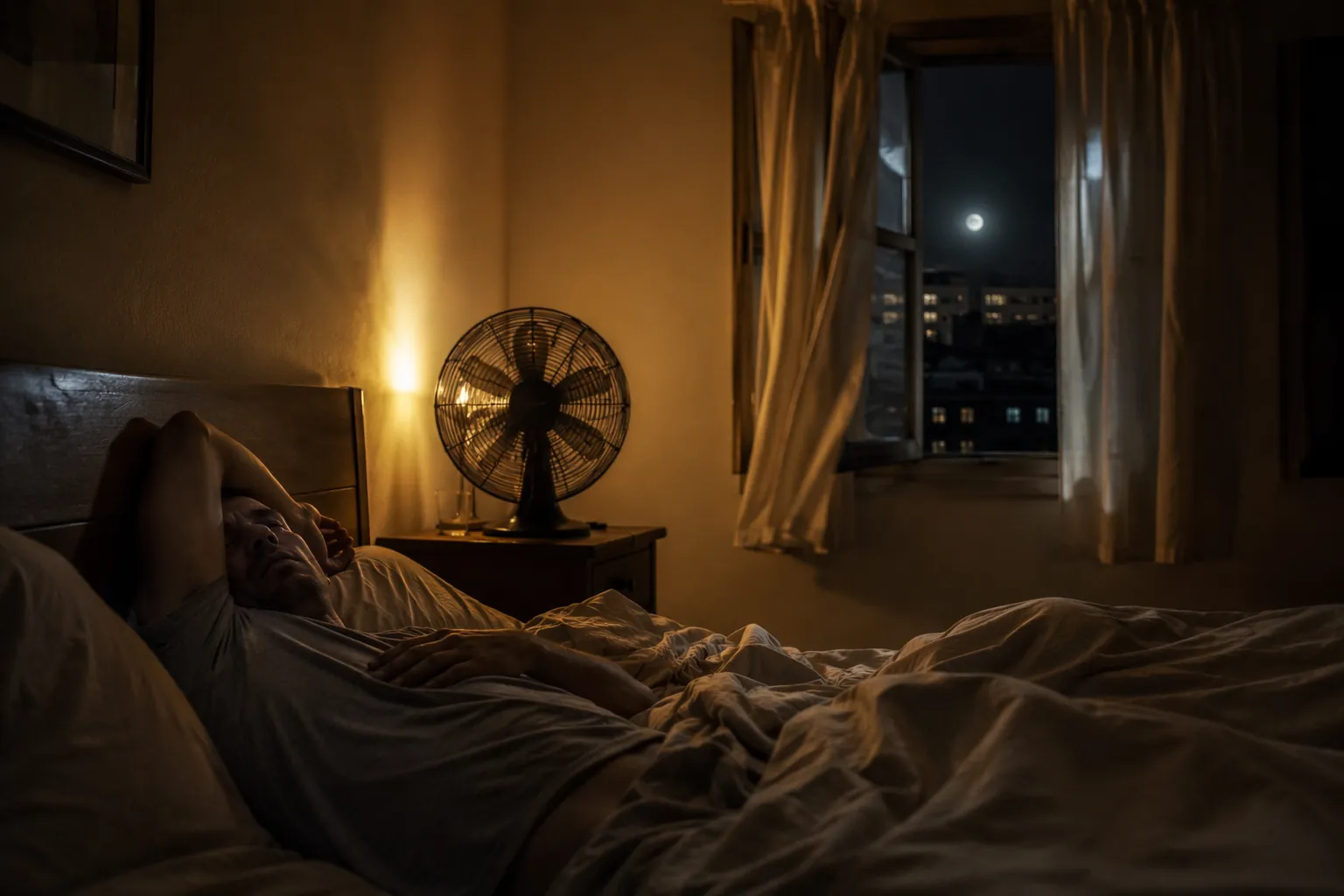
The common mechanism is simple enough: sleep asks the body to shed heat. A hot room makes that harder. The safe response, however, is not common at all. Pregnancy, perimenopause, older adulthood, and ADHD can each change what “cooling down” means, what becomes risky, and when the problem has moved beyond self-management.
Start With the Body in the Room
If you are trying to choose a sleep strategy tonight, start by locating the constraint that matters most. This is not a ranking of who suffers more. It is a way to avoid applying the wrong advice to the wrong body.
| If this is you tonight | The heat-related sleep problem to respect first | Be more careful with |
|---|---|---|
| Pregnant person | Higher baseline heat load and heat-wave pregnancy risks | Overheating, dehydration, and assuming fan use is always enough |
| Perimenopausal woman | Ambient heat layered on top of vasomotor symptoms such as night sweats | Heavy bedding, late hot showers, and sleepwear that traps heat |
| Older adult or caregiver | Reduced heat tolerance, medication effects, dehydration, and fall risk | Very hot fan use, cold shock, nighttime bathroom trips, and sedating medications |
| Adult with ADHD | Sensory overload, routine breakdown, and possible heat-related worsening of symptoms | Complicated cooling plans, irritating fabrics or sounds, and medication-timing questions without clinician input |
Large sleep-temperature datasets help explain why this summer feels so punishing. A 2025 Nature Communications study using 23 million sleep records found that each 10°C temperature increase was associated with 20.1% higher odds of sleep insufficiency, 9.67 fewer minutes of total sleep, and a 2.82% decline in deep sleep.[4] A separate 2025 Environment International analysis of 12 million U.S. nights reported that West Coast residents lost nearly three times as much sleep per degree as some other groups in the study.[5] These findings do not prove every individual will respond the same way, and the China and U.S. settings matter for generalizability. They do show that heat-disrupted sleep is measurable, not imaginary.
Pregnancy: Keep Cooling Simple, But Do Not Treat Overheating as Ordinary Insomnia
Pregnancy already asks the body to manage a higher internal heat burden. Add a Super El Niño heat wave and the usual light advice — open a window, run a fan, drink some water — may still be useful, but it needs firmer edges. The goal is not heroic sleep hygiene. The goal is avoiding sustained overheating while making the bed safe enough to rest.
A fan can be reasonable when the indoor air is below 95°F/35°C, according to Tommy’s pregnancy heat guidance, which treats that threshold as a practical safety boundary for fan use in pregnancy.[6] That does not mean a fan fixes the room. It means moving air may help sweat evaporate when the air is not dangerously hot. Above that point, a fan can feel comforting while doing too little to lower heat strain, and local public-health guidance should take priority.
- Use a fan to move air across the room or past damp skin rather than blasting it directly at the face all night.
- Choose loose, breathable sleepwear and remove heat-trapping layers before trying more elaborate interventions.
- Use cool cloths on the neck, chest, or wrists if they feel soothing; replace them before they become warm and clammy.
- Keep water reachable, but also respect any fluid guidance you have been given for your pregnancy.
- If the coolest safe place is not the bedroom, move earlier in the evening rather than waiting until exhaustion makes decisions harder.
Heat waves have also been linked with preterm birth risk in pregnancy research.[6] That does not mean one hot night causes preterm labor. It does mean pregnancy deserves a lower threshold for asking for help when heat exposure is prolonged, indoor temperatures stay high, or symptoms feel different from ordinary discomfort.
Call your maternity care team or local urgent guidance line if heat is accompanied by dizziness, faintness, confusion, persistent vomiting, signs of dehydration, contractions, reduced fetal movement, chest pain, or a sense that you cannot cool down. During a heat wave, those are not sleep problems with a pregnancy attached. They are pregnancy problems happening at night.
Perimenopause: Separate the Room Heat From the Internal Heat Surge
Perimenopause can make the body’s thermal control feel jumpy even before the weather gets involved. Declining estrogen is associated with vasomotor symptoms such as hot flashes and night sweats, and ambient heat can stack on top of that. The result is not just “being too warm.” It is waking in a wet shirt, throwing off covers, chilling, pulling covers back on, and repeating the cycle.
The most useful cooling here is often modular. A single heavy comforter gives the body one bad choice: trapped heat or no cover. Layered bedding gives smaller choices. A light sheet, a thin blanket within reach, and a separate towel or washable layer for sweat can reduce the amount of fully waking up required after a hot flash.
- Take a cool or lukewarm shower earlier in the evening, not so close to bed that wet hair or chilled skin becomes its own sleep disruption.
- Keep a dry shirt or sleep top at bedside so changing does not require turning on bright lights or searching drawers.
- Use bedding that can be peeled back in small increments instead of one heavy layer.
- Aim the fan to create gentle airflow across bedding rather than a harsh stream that becomes irritating after the sweat cools.
- If night sweats are new, drenching, or accompanied by unexplained weight loss, fever, chest symptoms, or other systemic changes, treat them as a medical symptom rather than assuming perimenopause explains everything.
A cool cloth can be useful during a hot flash because it gives the nervous system a specific cooling signal without requiring a full reset of the room. But the cloth should be part of a low-friction plan: within reach, easy to replace, and not so cold that it startles you fully awake.
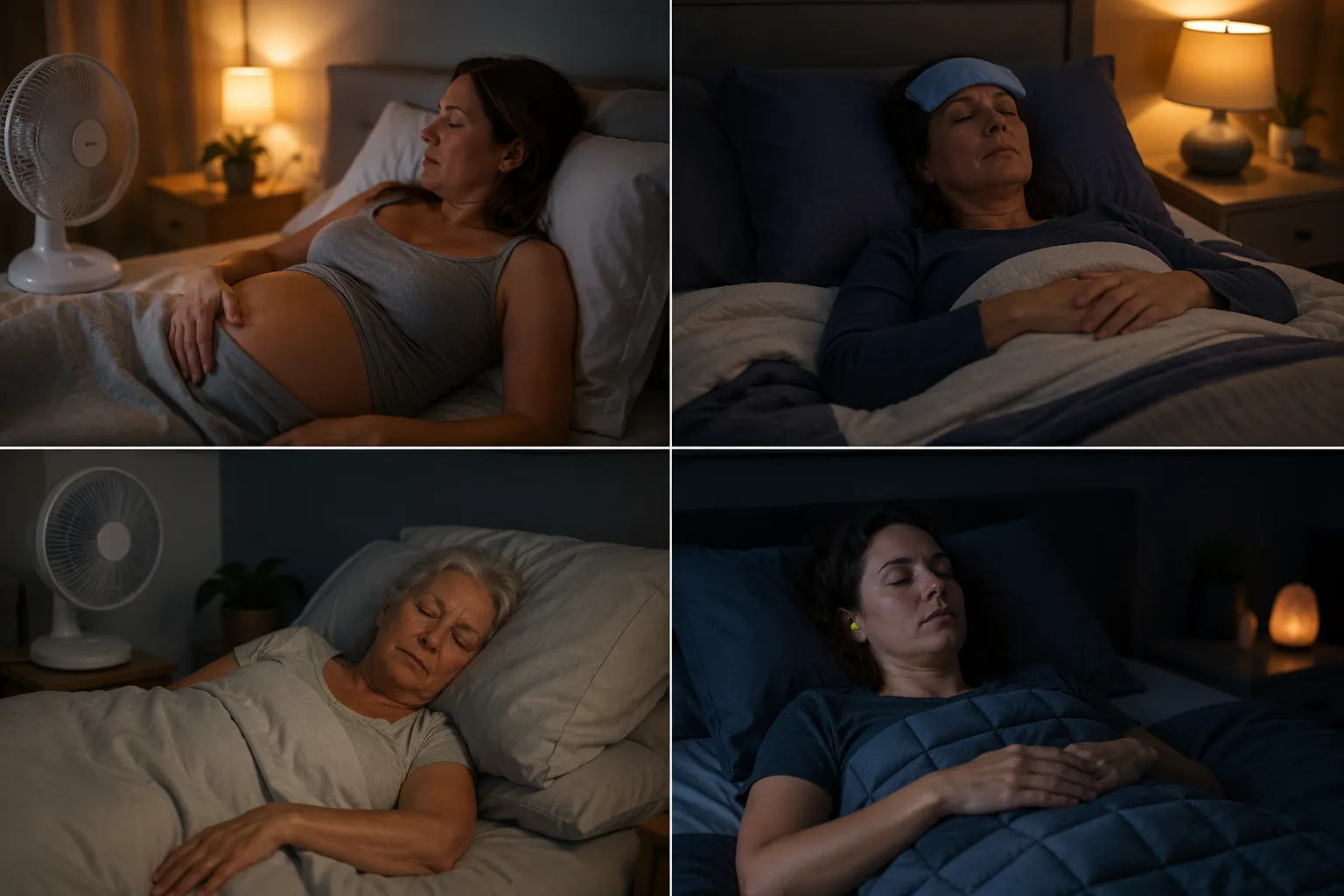
Older Adults: Heat Advice Has to Include Medications, Balance, and Sweating
For older adults, the danger in generic heat-wave sleep tips is that they often assume the body can sweat, sense thirst, stand up safely at night, and recover quickly from a poor choice. Aging can make all of those assumptions less reliable. Medications can narrow the margin further.
A 2023 Science of the Total Environment study identified an ideal sleep temperature range for older adults of 68°F to 77°F and found sleep efficiency dropped by 5% to 10% above 77°F.[7] That range is not always achievable in a heat wave, especially without air conditioning. It is still clinically useful because it tells caregivers when “warm but tolerable” may already be costing sleep quality.
Medication review belongs inside the cooling plan. The AGS Beers Criteria and clinical summaries such as Cleveland Clinic’s overview flag several medication classes that can matter in heat, including benzodiazepines, zolpidem, anticholinergics, diuretics, and beta-blockers.[8][9] The issue is not that every person taking one of these drugs is unsafe at home. The issue is that sedation, impaired sweating, blood-pressure changes, dehydration, urinary urgency, and nighttime confusion can turn a simple cooling tactic into a fall or heat-illness risk.
Fans deserve more caution here than they often get. Moving air can help when the room is warm but not dangerously hot and the person can sweat. If sweating is impaired, hydration is poor, or the room itself is very hot, a fan may provide a false sense of safety. A caregiver should be more interested in the person’s actual condition — alertness, skin, dizziness, fluid intake, urine output, and ability to get up safely — than in whether a fan is running.
- Clear the path from bed to bathroom before the night starts; heat plus sedating medication plus darkness is a fall setup.
- Place water within reach, but follow any heart, kidney, or fluid-restriction instructions already given by a clinician.
- Use light bedding and breathable clothing before adding devices or complicated routines.
- Avoid very cold showers or sudden ice-cold cooling unless a clinician has specifically advised it; abrupt cold exposure can be poorly tolerated in frail adults.
- Check in earlier than bedtime during heat waves, because waiting until midnight can leave fewer safe options.
The long-term risk is also moving in the wrong direction. Gavi has projected that by 2050, more than 23% of the global population aged 69 and older will face routine temperature peaks above 99.5°F.[10] That is not a reason to panic at bedtime. It is a reason to treat older-adult cooling as infrastructure: medication review, safe rooms, backup cooling locations, and caregiver check-ins rather than a last-minute fan decision.
Seek urgent help if an older adult becomes confused, faint, unusually weak, stops sweating despite heat, has hot dry skin, cannot keep fluids down, has chest pain, or cannot safely stand or walk. In that moment, the question is no longer how to sleep through the heat wave.
ADHD: Make the Cooling Plan Sensory-Safe and Easy to Start
The ADHD heat-sleep evidence is thinner than the pregnancy, aging, and population sleep-temperature evidence. The most practical material comes from clinical sources and adjacent research rather than large ADHD-specific sleep trials. That uncertainty matters. It also should not leave adults with ADHD stuck with advice that depends on calm sequencing, low sensory load, and perfect evening follow-through.
Clinical sources cited in the brief, including Mindful Health and BrainTrainMe in June 2026, describe heat as worsening sensory overload, draining cognitive reserves, and complicating stimulant-medication routines.[11][12] A 2024 pediatric study with 179,846 participants linked heat exposure with worsened ADHD symptoms, though pediatric symptom findings should not be stretched into a precise adult sleep rule.[13] The safer conclusion is narrower: heat can make ADHD nights harder, and cooling plans should reduce friction rather than add another demanding routine.
For ADHD, the best heat-wave sleep tip may be the one that can be started while irritated, overheated, and already late. That usually means fewer steps and fewer sensations to negotiate.
- Pick one acceptable cooling texture before bedtime: a cooling pad, damp cloth, light sheet, or breathable shirt that does not become a sensory problem after ten minutes.
- Use a fan setting and sound profile you can tolerate; louder airflow is not better if it keeps your nervous system on alert.
- Pre-place the items you will need in one visible spot: water, charger, medication reminder if used, cloth, earplugs, and sleep mask.
- Lower decision load by choosing the cooling order in advance: change shirt, drink water, fan on low, cloth on neck, lights out.
- Ask the prescribing clinician about stimulant timing, missed doses, appetite suppression, hydration, or heat sensitivity rather than improvising medication changes during a heat wave.
The same principle belongs in broader neurodivergent sleep planning. Sensory-safe cooling is not decoration for ADHD. If the fabric, sound, light, or wetness is intolerable, the strategy will not survive contact with the actual night.
What to Do When the Room Will Not Cool
When a heat wave keeps indoor temperatures high after dark, the best move is often not one more sleep trick. It is changing the cooling environment earlier, while judgment is still good. That may mean sleeping in the lowest, coolest room; moving away from a sun-exposed wall; using cross-ventilation only when outdoor air is cooler than indoor air; or spending part of the evening in a cooled public or shared space if one is safely available.
The life-stage distinction still holds in these ordinary choices. A pregnant person may need a lower threshold for leaving an overheated room. An older adult may need help getting to a cooler room without falling. A perimenopausal woman may need bedding that handles both heat and post-sweat chilling. An adult with ADHD may need the plan made visible and simple before the night gets away from them.
During the 2026 Super El Niño heat wave, the right sleep tip is the one that fits the person using it: their body, medications, sensory limits, balance, pregnancy status, and ability to cool safely. If heat brings confusion, faintness, chest pain, persistent vomiting, signs of dehydration, inability to cool down, reduced fetal movement, unsafe weakness, or concern that something is medically wrong, stop managing it as a sleep problem and seek urgent guidance.
References
- Yale Climate Connections July 2026 Super El Niño forecast coverage, Yale Climate Connections, July 2026.
- Carbon Brief 2026 temperature and El Niño tracking analysis, Carbon Brief, July 2026.
- Bulletin of the Atomic Scientists May 2026 ocean heatwave and El Niño analysis, Bulletin of the Atomic Scientists, May 2026.
- Nature Communications 2025 sleep-temperature study by Li et al., Nature Communications, 2025.
- Environment International 2025 sleep-temperature study by Liao et al., Environment International, 2025.
- Tommy’s pregnancy heat guidance, Tommy’s.
- Science of the Total Environment 2023 older-adult sleep temperature study, Science of the Total Environment, 2023.
- American Geriatrics Society 2023 updated AGS Beers Criteria® for potentially inappropriate medication use in older adults, American Geriatrics Society, 2023.
- Beers Criteria — Potentially Inappropriate Medication Use in Older Adults, Cleveland Clinic.
- Gavi projection on older adults and future heat exposure, Gavi.
- Mindful Health June 2026 ADHD and heat guidance, Mindful Health, June 2026.
- BrainTrainMe June 2026 ADHD and heat guidance, BrainTrainMe, June 2026.
- 2024 pediatric study linking heat exposure with worsened ADHD symptoms, 2024.
Explore the mechanism
Next step
Spot an error or have clinical feedback?
Because this article covers clinical, medication, or safety information, we use a moderated correction channel instead of open public comments. Let us know if something about “Heat Wave Sleep Tips for the Super El Niño by Life Stage” needs a closer look.
Send feedback on this article