
Trip Trading as a Sleep Strategy for Flight Attendants
Flight attendants face severe sleep disruption from irregular schedules and early starts. This guide explains how evaluating trip trades through a circadian lens — direction of travel, departure times, sector count, and layover quality — can reduce cumulative sleep debt more effectively than trading for pay or destination preferences alone.
The trade that looks clean on the screen is not always clean in the body. One pairing pays a little better, drops you into a favorite layover city, and preserves the day off you wanted. The other is less pretty but avoids a 0520 report, keeps the last inbound out of the 0400-0759 window, and gives you one real night at home before the next sequence. On paper, both trips may be legal and workable. By the second night after, they may feel completely different.
That is the part of flight attendant sleep disruption trip trading can actually touch. It cannot make aviation a stable-bedtime job. It cannot erase time zones, van waits, noisy airport hotels, minimum rest, commuting, or the odd cruelty of getting home exhausted when everyone else is starting the day. But it can change which fatigue you choose to stack, and which fatigue you refuse to carry into the next pairing.

The numbers justify taking that trade screen seriously. In a cross-sectional study of 4,011 flight attendants, sleep disorder prevalence was estimated at 5.7 times that of the general population.[1] In another cabin crew study, 68% screened positive for shift work disorder.[2] Workday sleep has also been reported at an average of 4.6 hours against a perceived need of 8.1 hours, which matches what many crews already know without needing a journal article: the deficit is not a bad week here and there. It is built into the way the work is arranged.[2]
So the practical question is not whether a flight attendant should care about sleep. The better question is: if two trips both look acceptable, which one is less likely to compound sleep debt by the end of the sequence and the day after?
Read the pairing like a sleep document
A pairing already tells a sleep story before you fly it. The problem is that most trade decisions start with the obvious fields: credit, days off, layover city, commutability, sit time, equipment, maybe whether the crew meals are likely to be survivable. Those matter. But for sleep, the fields that deserve first pass are usually these:
- Direction of travel, especially whether the trip pushes eastward across time zones.
- Report times before 0630, when sleep loss is more likely to be baked in before sign-in.
- Inbound arrivals between 0400 and 0759, particularly if you still have to commute or drive home.
- Number of sectors in the duty period, because each leg adds workload and recovery demand.
- Layover sleep opportunity, including hotel timing, transportation delay, noise, and the local clock.
- Recovery compression: what the trip does to the next two nights, not just the legal rest immediately after.
The trap is evaluating these as separate annoyances. A four-sector day with a normal report is not the same sleep problem as a four-sector day after a short layover. An early report after an at-home night is not the same as an early report after a late van, a thin hotel wall, and a body still reading another time zone. The circadian cost shows up in the combination.
Start with the clock, not the layover city
Early starts deserve more suspicion than crews sometimes give them, especially when a trip looks otherwise easy. Evidence cited in cabin crew sleep research found that starts before 0630 reduced total sleep by about two hours and cut into REM and stage 2 sleep.[2] That matters because a 0520 report does not only mean waking early. It often means trying to fall asleep at a time when your body is not ready, sleeping lightly because you are afraid of missing the alarm, then showing up already short before boarding even starts.
When comparing trades, mark every report before 0630 as a sleep event, not just a schedule event. Then look at what came before it. If the early report follows a real at-home night and leads into a short duty day, it may be manageable. If it follows a late arrival, a hotel transport delay, or an eastward move, the same report time becomes much more expensive.
Treat eastbound movement as a multiplier
Eastward travel is generally more disruptive to sleep than westward travel because it asks the body to advance its timing rather than delay it, a direction most people tolerate less easily.[2] That does not mean every eastbound trip is a bad trade or every westbound trip is protective. It means eastbound movement should raise the price you mentally assign to early starts, short layovers, and quick turns.
A westbound layover that lands late may still leave you with enough biological night to sleep. An eastbound layover can look long in block time but land at a local hour that chops the useful sleep window into pieces. The hotel may be fine. The bed may be fine. The problem is that the pairing is asking sleep to happen at the wrong time, then judging the trip legal because enough hours exist on the page.
Do not ignore the last inbound
The last leg is where a lot of trade decisions get too optimistic. A pairing can be survivable until the inbound arrives in the early morning, when the cabin is done but the day is not. In a cabin crew study, inbound flights arriving between 0400 and 0759 produced the highest commute-home fatigue scores.[2] That window is not just ugly because it feels bad. It is ugly because the person who has been working now has to clear the aircraft, get to the lot or crash pad or commuter gate, drive or deadhead, answer the messages that came in overnight, and make choices while the body is near its circadian low.
This is where the day-after question belongs. If a trade gets you home technically earlier but drops you into that 0400-0759 arrival window, ask what the next six hours actually look like. A short drive, no family obligations, and a protected sleep opportunity may be one answer. A long commute, school drop-off, daytime noise, and another sequence coming up may be another.
Count sectors as workload, not just legs
Sector count can look harmless when the flights are short. Crews know better. Each turn brings boarding, service decisions, passenger management, security awareness, lav checks, trash, delays, turbulence, deplaning, and another reset. Research on aviation crew fatigue found that each additional sector in a duty period increased reaction time.[2] That finding should change how a trade is read: a four-sector day is not merely a different route pattern from a two-sector day. It is a different cognitive load.
A multi-sector day followed by a strong layover may be worth taking. A multi-sector day followed by an early report, a short hotel night, or a high-fatigue inbound is the kind of stacking that does damage quietly. It may not feel dramatic enough to reject when you are trying to improve days off. It is exactly the kind of trade that can make the next pairing feel worse before it even starts.
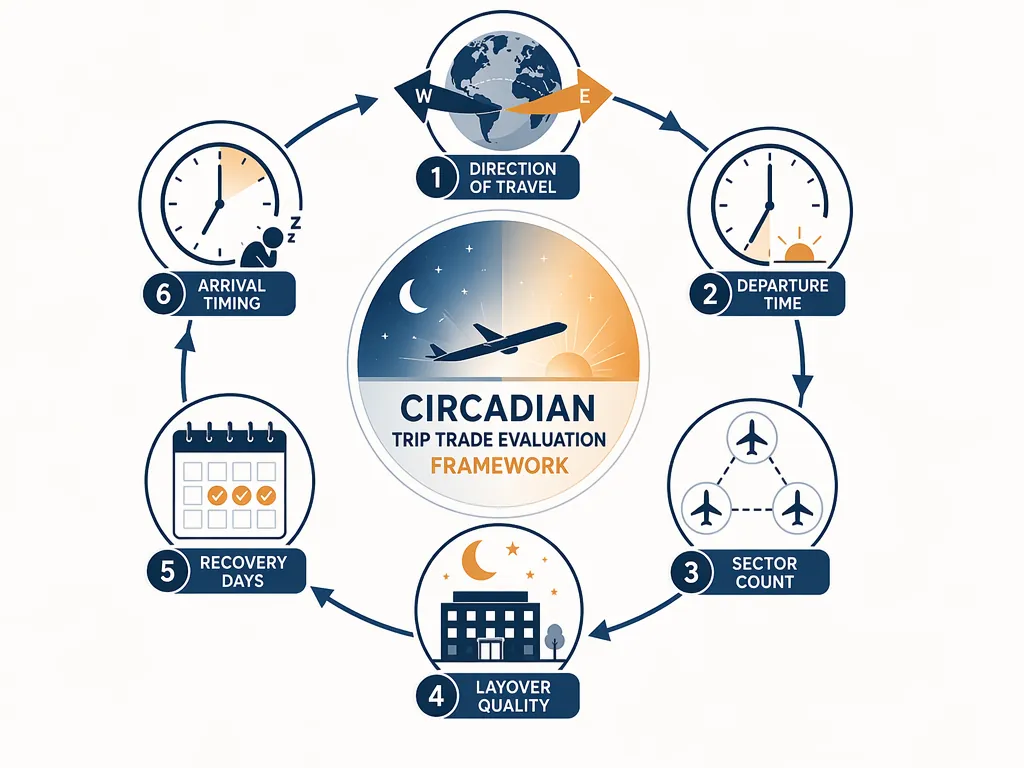
A circadian workflow for the trade screen
A useful trade review does not need to be complicated. It needs to happen before the destination, credit, and convenience arguments take over. The following workflow is meant for comparing two acceptable options, not for pretending there is always a perfect one available.
| Trade feature | What to ask before accepting | Why it matters for sleep |
|---|---|---|
| Direction | Does the trip push east, west, or stay mostly local? | Eastward movement is generally harder on sleep timing. |
| Early report | Is any report before 0630, and what sleep opportunity comes before it? | Early starts are linked with shorter sleep and reduced REM/stage 2 sleep. |
| Inbound window | Does the final arrival land between 0400 and 0759? | This window is associated with higher commute-home fatigue. |
| Sector count | How many legs are worked in the heaviest duty period? | More sectors add operational and reaction-time burden. |
| Layover sleep | How much of the layover is actually sleepable after van, food, noise, and local time? | Legal rest is not the same as usable sleep. |
| Recovery | What happens to the next two nights after the pairing? | Compressed recovery can carry sleep debt into the next sequence. |
The first pass is directional. If the trade moves east, give extra scrutiny to the next report time and the layover sleep window. An eastbound trip with generous recovery can still be reasonable. An eastbound trip with a short hotel night and an early van is asking for sleep at the wrong biological time and then cutting the opportunity short.
The second pass is the front end of each duty day. Circle every report before 0630. Then work backward. What time would you need to be asleep to protect even a modest sleep opportunity? What time will you realistically get to bed after commute, packing, family needs, or hotel arrival? If the answer depends on falling asleep instantly at an hour your body usually resists, the trade is more fragile than it looks.
The third pass is the back end. Final arrivals between 0400 and 0759 deserve a separate mark because they are easy to misread as convenient. Yes, you may be done early. But if the arrival pushes the most dangerous fatigue into the commute home, the pairing may be borrowing from safety and recovery to create the appearance of a freed-up day.
The fourth pass is sector load. Compare the heaviest duty days, not just the average feel of the trip. A three-day pairing with one brutal day can leave more residue than a longer pairing with steadier duty. If the trade adds sectors on the same day it shortens sleep opportunity, consider that a combined penalty.
The fifth pass is the layover. Do not count the full scheduled layover as sleep opportunity. Subtract deplaning, customs if relevant, waiting for transportation, the ride, food, shower, decompression, wake-up buffer, van time, and the local clock problem. Then ask whether what remains is a sleep window or only a legal interval.
The sixth pass is recovery at home. This is where a trade that looks smart by days off can still fail. If the pairing ends in a way that ruins the first night home, and the next day is already claimed by commuting, caregiving, errands, or another report, the trip may not truly create recovery. It may only move fatigue into unpaid time.
Where contract rules enter the sleep decision
Trip trading lives inside a contract, not inside a wellness article. The rules that decide what you can trade, when you can trade it, and whether the system will accept it vary by airline and agreement. A United AFA C9 resource, for example, describes specific mechanics for two-person trades, trading time windows, Bad Day/Worse Day rules, and carryover pairings.[3] That is a useful concrete example of how detailed trade logic can become, but it should not be treated as a universal map for every carrier.
From a sleep standpoint, contract mechanics matter because they decide whether the better circadian choice is actually available. A trade may be sleep-protective but blocked by legality, staffing, reserve coverage, credit rules, days of availability, or a contractual restriction. A two-person trade may solve one person's sleep problem while creating a worse sequence for the other. A carryover pairing may look attractive in one bid month while quietly damaging recovery in the next.
That is why the workflow should sit next to the contract, not above it. First, identify the sleep cost. Then see whether the trade system, open time, seniority position, reserve status, and local rules leave room to act. If they do not, the sleep analysis has still done something useful: it tells you where the risk is, which parts of the trip need protection, and whether the next trade should be used to repair rather than optimize.
What trading cannot fix
Trip trading is powerful because it changes exposure. It is limited because it does not change the job's underlying circadian structure. A better trade can reduce stacked early starts, avoid a punishing inbound, or protect a recovery night. It cannot make repeated time-zone shifts biologically neutral, turn a noisy layover hotel into restorative sleep, or remove the workload of a hypobaric cabin environment.
The secondary controls still matter, but they are not the main lever. Caffeine timing, alcohol, light exposure, naps, and melatonin can all affect how a sequence feels. In the cabin crew study cited earlier, 91% reported daily caffeine consumption and 41.4% reported using alcohol to facilitate sleep.[2] Those figures are not moral failures. They are signs of workers trying to force alertness and sleep into a schedule that often fights both.
If symptoms are persistent, severe, or affecting safety, it is worth treating them as more than a scheduling puzzle. Restful Ground's guide to shift work sleep disorder treatment lays out a stepped-care approach, and the jet lag prevention guide is useful when a route change, time-zone crossing, or new pattern keeps repeating. For some crews, melatonin matching may be relevant, but timing and context matter; it should not be treated as a way to rescue every badly built pairing.
The trade worth taking
A sleep-protective trade is not always the prettiest trip. Sometimes it gives up a favorite layover. Sometimes it pays less. Sometimes it keeps the same number of days away but removes the one feature that would have made the sequence bleed into the next two nights: the too-early report, the eastbound compression, the extra sectors, the short hotel night, or the inbound that leaves you driving home at your worst hour.
The decision rule is disciplined rather than absolute: use trip trading to reduce cumulative sleep disruption when the contract and your real life allow it, but judge the trade by sleep architecture and recovery consequences as carefully as by pay, destination, or convenience. On the trade screen, the better trip is not only the one that looks good when you pick it up. It is the one that leaves you less damaged when you put the suitcase down.
References
- Estimating the Health Consequences of Flight Attendant Work: Comparing Flight Attendant Health to the General Population in a Cross-Sectional Study. McNeely et al., 2014.
- Sleep, Fatigue, and Well-Being among Commercial Airline Cabin Crew. Wen et al., 2021.
- Trip Trades Explained. United AFA C9 InfoLinks.
Explore the mechanism
Next step
Spot an error or have clinical feedback?
Because this article covers clinical, medication, or safety information, we use a moderated correction channel instead of open public comments. Let us know if something about “Trip Trading as a Sleep Strategy for Flight Attendants” needs a closer look.
Send feedback on this article