
Thyroid Medication Recalled? Sorting Sleep Problems in Perimenopause
Perimenopausal women on levothyroxine face confusing sleep symptom overlap when a recall hits. This guide provides a framework to distinguish recall-related sleep changes from perimenopause-driven ones, and explains when to test TSH versus adjust sleep hygiene.
If your levothyroxine is on the July 2026 recall list and your sleep has suddenly become worse, the first move is not to stop the medication. It is to verify whether your exact product and lot are affected, keep thyroid treatment continuous while a replacement is arranged, and then decide whether the sleep change needs a thyroid lab check rather than another round of sleep-hygiene troubleshooting.
That order matters. Levothyroxine is a narrow-therapeutic-index medication; small changes in delivered dose can matter clinically, and stopping abruptly can create overt under-treatment while you are trying to avoid a possible recall-related problem. The July 17, 2026 Class II recall has been reported as covering Major Pharmaceuticals / Cardinal Health unit-dose blister products across multiple strengths, with 12 product lines in the 25–150 mcg range. The publicly available recall coverage did not quantify the exact potency shortfall, and recall notices can be amended, so the safest question is not “Does my pill look familiar?” but “Does my pharmacy confirm that my dispensed lot is affected?” [1][2]

The problem is not just the recall. It is the symptom overlap.
A perimenopausal woman who wakes at 3 a.m. drenched, exhausted, irritable, and unable to fall back asleep may already have a believable explanation: hormones. When a levothyroxine recall arrives in the middle of that pattern, the story becomes harder. Too little thyroid hormone can also change sleep, energy, temperature regulation, and mood. Sleep literature describes hypothyroidism as being associated with symptoms such as fatigue, sleepiness, and disrupted sleep, while thyroid hormone excess can push in the other direction, toward insomnia and nighttime palpitations or a “wired” feeling. [3][4]
A subpotent tablet would not usually behave like a switch flipping overnight. The concern is more gradual: less hormone delivered over time, followed by returning hypothyroid symptoms. A replacement fill can also create confusion in the opposite direction if the effective dose changes after the switch. That is why timing helps, but timing alone does not diagnose the problem.
The practical question is narrower than “Is this thyroid or perimenopause?” It is: “Has something changed from my usual perimenopause pattern in a way that fits under-replacement, over-replacement, or neither clearly enough that I need labs?”
Start with medication continuity
Before sorting symptoms, close the medication loop. Recall anxiety can make people do the most understandable and least helpful thing: skip doses while waiting for a call back. For levothyroxine, that can make the symptom picture noisier and may worsen hypothyroid symptoms.
- Call the dispensing pharmacy and ask whether your exact manufacturer, National Drug Code if available, strength, package type, and lot are included in the current recall notice.
- Ask how they will replace the affected supply and whether the replacement is the same dose, same formulation, and same manufacturer or a switch.
- Keep taking levothyroxine as directed until your prescriber or pharmacist gives you a replacement plan, unless you have been told otherwise for your specific situation.
- Save the bottle, blister pack, photos of labels, refill date, and any recall notice so your clinician is not guessing from memory.
This is medication safety work, not sleep optimization yet. Sleep changes are important, but they sit downstream from whether you are receiving the intended thyroid dose.
Use direction of change, not just symptom names
The same word can hide different physiology. “Tired” after four hot-flash awakenings is not the same as feeling heavy, slowed, and sleepy despite enough time in bed. “Temperature problems” can mean waking sweaty and flushed, or it can mean being unusually cold in a room that used to feel comfortable. “Bad sleep” can mean restless insomnia, or it can mean sleeping longer and still feeling unrefreshed.
| What changed? | More suggestive of perimenopause pattern | More suggestive of thyroid dose problem | What to do with the clue |
|---|---|---|---|
| Night waking | Waking with heat, sweating, or a surge that resembles prior hot flashes | Waking more often with heavy fatigue, sluggish mornings, or a clear change after a recalled fill | Compare with your baseline pattern and note the refill or recall timing |
| Temperature | Heat episodes, sweats, flushing, bedding changes | New cold intolerance, lower daytime energy, feeling chilled when others are comfortable | Do not assume all temperature symptoms are hormonal |
| Fatigue | Tired because sleep is repeatedly interrupted | Broader slowing, sleepiness, low motivation, constipation or other returning hypothyroid-type symptoms if present | Ask whether the fatigue extends beyond the bad night itself |
| Insomnia | Difficulty returning to sleep after a hot flash or stress surge | Wired insomnia, racing heart, or nighttime shakiness after a replacement or dose change | Consider whether the issue appeared after the medication supply changed |
| Mood | Irritability or emotional reactivity tracking poor sleep and cycle changes | Mood change paired with broader hypothyroid return or possible over-replacement symptoms | Treat mood as part of the pattern, not a stand-alone diagnosis |
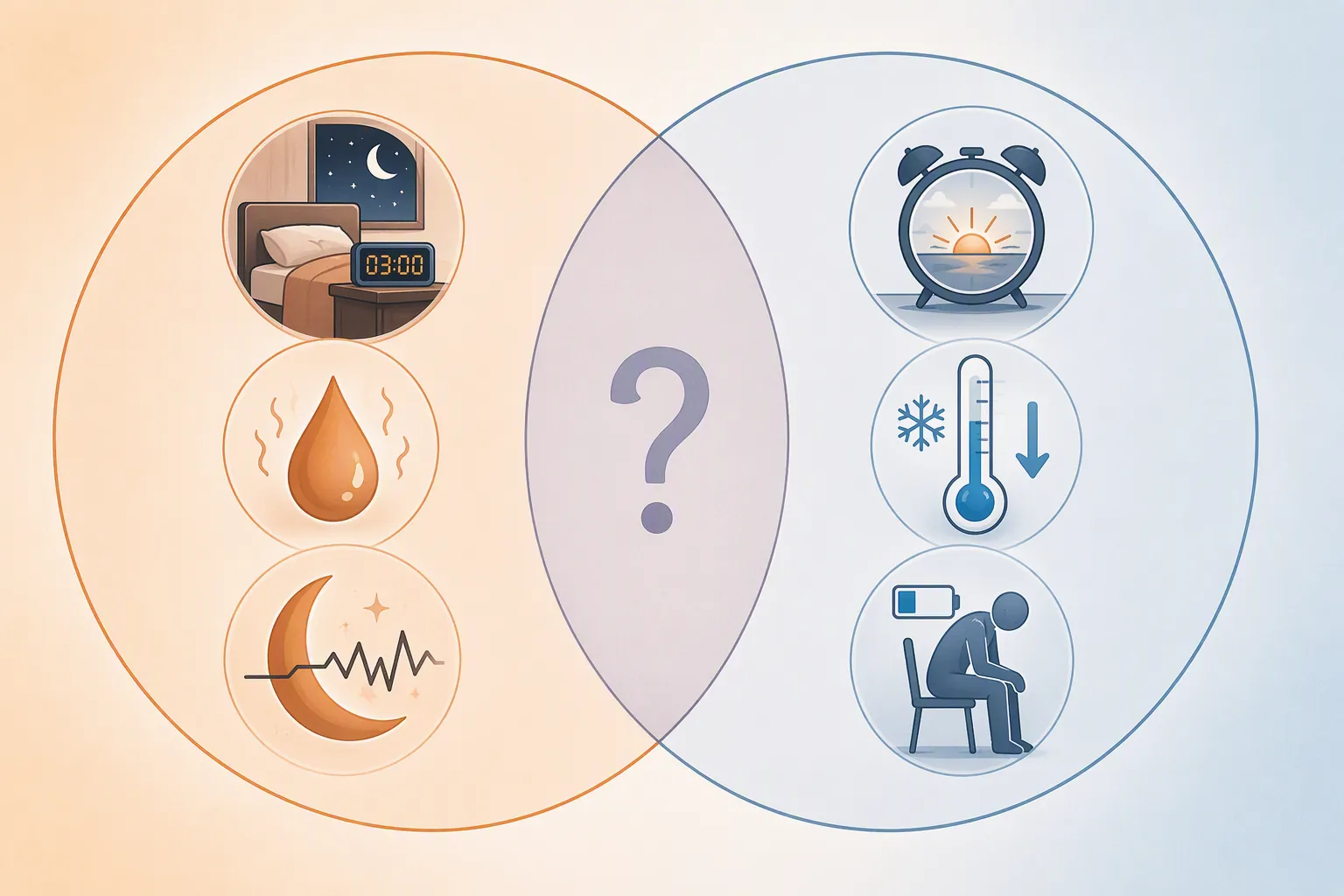
This kind of sorting does not prove the cause. It keeps you from collapsing everything into one bucket. Perimenopause and thyroid dysfunction can both affect thermoregulation, sleep, mood, and energy; midlife is exactly when the overlap becomes common enough to mislead patients and clinicians alike. [5][6]
Build a short symptom diary that a clinician can actually use
A diary is not a home diagnostic tool. Its value is that it gives your clinician a clean timeline: when the recalled supply may have been used, when a replacement occurred, and whether symptoms moved toward under-replacement, over-replacement, or the familiar perimenopause pattern.
- Medication: dose, manufacturer if listed, blister or bottle format, refill date, lot information if available, missed doses, and replacement date.
- Sleep: bedtime, wake time, number of awakenings, whether waking involved sweat, cold, racing heart, anxiety, or no clear trigger.
- Daytime direction: unusually sleepy and slowed, tired only after disrupted sleep, or wired and unable to settle.
- Temperature pattern: hot flashes or night sweats, new cold intolerance, or both at different times.
- Other changes: constipation, menstrual-cycle changes, weight change, mood changes, new supplements, calcium or iron timing, and any change in how you take levothyroxine.
The last item matters because absorption and routine changes can blur the recall story. A woman who starts taking calcium closer to her thyroid pill, changes breakfast timing, receives a different manufacturer, and enters a worse hot-flash month may have more than one reason for sleep to deteriorate. The diary does not need to be elegant. It needs dates.
When to ask for TSH and free T4
If sleep worsens after a recalled levothyroxine supply, especially with new daytime sluggishness, cold intolerance, or a return of symptoms you remember from before treatment, asking about thyroid labs is reasonable. If sleep worsens after the replacement and the pattern is wired insomnia, nighttime tachycardia, or feeling overactivated, labs may also be appropriate. The point is not that every bad night needs bloodwork. The point is that ambiguous midlife sleep symptoms should not be managed for weeks as “just perimenopause” when thyroid dosing has also been disrupted.
After a levothyroxine dose adjustment or manufacturer switch, thyroid guidance commonly uses a 6–8 week window to recheck TSH and free T4, because TSH needs time to reflect the new steady state. [7] That window is useful after a planned switch. It does not mean you must quietly wait 6–8 weeks if symptoms are severe, escalating, or unsafe; it means your clinician may use both immediate clinical judgment and appropriately timed follow-up labs.
A practical message to the office can be brief: “My levothyroxine supply may be affected by the July 2026 recall. I am perimenopausal, but since this refill I have had new or worsening sleep disruption plus [your specific symptoms]. Should we check TSH and free T4 now, and should we repeat them 6–8 weeks after the replacement or manufacturer switch?”
What not to overread
A recall notice does not prove that your current insomnia, sweats, or fatigue are caused by the medication. The public recall information available in late July 2026 identifies affected products and subpotency concerns, but it does not provide a patient-level symptom prediction or a quantified potency shortfall for you to translate into a dose effect. [1]
Perimenopause also remains a real explanation. Hormonal fluctuation can fragment sleep, intensify night sweats, and make mood and energy less predictable. Thyroid testing is not a dismissal of perimenopause; it is a way to avoid missing a treatable medication-continuity problem inside a noisy life-stage transition.
The evidence here is also stitched from separate sources: recall information, thyroid dosing guidance, and sleep literature on thyroid dysfunction and perimenopause. There is not a single study showing exactly how the July 2026 recalled levothyroxine lots changed sleep in perimenopausal women. That uncertainty is precisely why the safest approach is verification, continuity, symptom direction, and labs when the story is muddy.
Where sleep hygiene fits
Keep the basics in place: consistent wake time, alcohol caution, a cooler bedroom, light management, and a plan for hot-flash awakenings. But if your thyroid medication may be recalled and symptoms have changed, sleep hygiene is not the first diagnostic lever. It can make a hard night less punishing; it cannot confirm whether you are under-replaced.
Once the medication status is verified and thyroid under- or over-replacement is not being ignored, then perimenopause-specific sleep care becomes the right conversation: vasomotor symptom treatment, cognitive behavioral therapy for insomnia, medication review, mental health support, and other options that fit your medical history. Those decisions are cleaner when everyone knows whether the thyroid dose changed underneath them.
A calm order of operations
- Verify the recall through your pharmacy using your exact dispensed product and lot information.
- Do not stop levothyroxine on your own; arrange a replacement plan first.
- Write down the refill date, replacement date, missed doses, and when sleep or daytime symptoms changed.
- Sort symptoms by direction: sleepy and slowed, wired and overactivated, hot and sweaty, cold and sluggish, or your usual perimenopause pattern.
- Ask about TSH and free T4 if symptoms are new, worsening, unclear, or appear after a recalled fill, replacement, manufacturer switch, or dose change.
- Return to perimenopause-focused sleep supports after the thyroid medication question is being handled, not instead of handling it.
References
- Thyroid medication recall July 2026, USA Today, July 27, 2026.
- Levothyroxine Recall 2026, Passion Health Physicians.
- Thyroid Issues and Sleep, Sleep Foundation.
- Thyroid and Insomnia, WebMD.
- Perimenopause and Thyroid Problems—Common and Confusing, Centre for Menstrual Cycle and Ovulation Research.
- The Thyroid Hormone Axis and Female Reproduction, Frontiers in Endocrinology.
- FDA Alert on Levothyroxine, American Thyroid Association.
Safety & eligibility read
Cross-check against other interventionsExplore the mechanism
Next step
Spot an error or have clinical feedback?
Because this article covers clinical, medication, or safety information, we use a moderated correction channel instead of open public comments. Let us know if something about “Thyroid Medication Recalled? Sorting Sleep Problems in Perimenopause” needs a closer look.
Send feedback on this article