
Why extreme heat ruins sleep in perimenopause
Learn why the same warm night that was merely annoying before perimenopause now reliably destroys your sleep — through a double thermostat failure where the body's need to cool down to sleep collides with a dramatically narrowed thermoneutral zone that turns any heat into a flash trigger.
The unnerving part is the comparison. A warm bedroom used to mean lighter sleep, a kicked-off sheet, maybe a cranky morning. In perimenopause, the same room can feel as if it trips an alarm: heat rushes up, sweat starts, the heart speeds, sleep breaks, and then there is the quiet labor afterward — changing clothes, cooling the skin, waiting for the body to believe it is safe again.
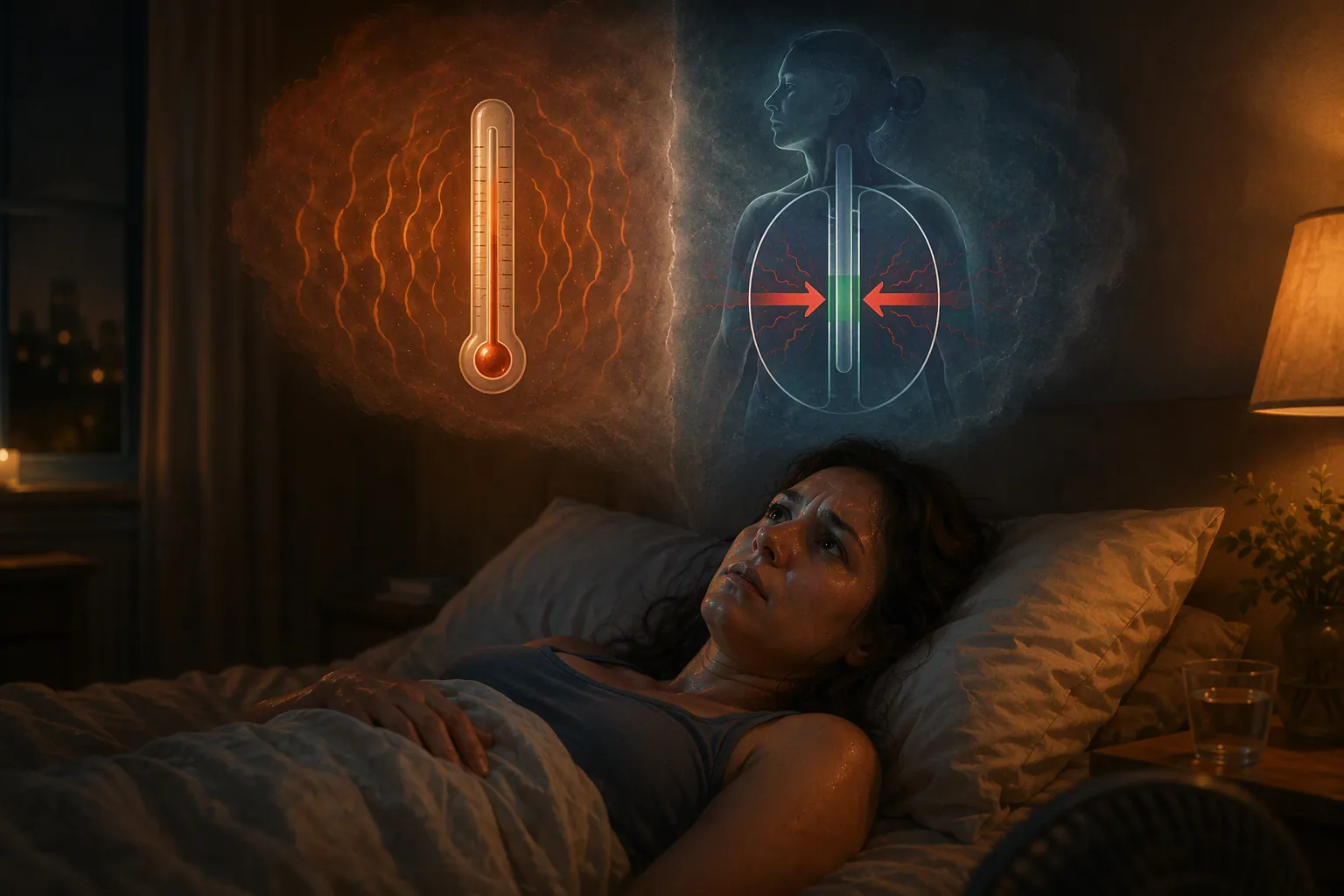
That shift is not just a lower tolerance for summer. Extreme heat ruins sleep in perimenopause because two temperature systems collide. Sleep always depends on the body’s ability to cool down. Perimenopause can also narrow the internal temperature buffer that normally keeps a small rise from becoming a full heat-loss response. Put those together, and “a little too warm” can become enough to wake the whole system.
Sleep Begins With Cooling
The first thermostat problem is universal. To fall asleep and stay asleep, the body needs to lower its core temperature by about 0.5–1°C. When the surrounding air stays too hot, that drop becomes harder to achieve.
Large-scale wearable data make the broad heat problem difficult to dismiss. A 2025 Nature Communications study analyzed more than 23 million sleep records from Chinese Huawei wearable users and found that each 10°C increase in ambient temperature was associated with 9.67 fewer minutes of sleep and 20.1% higher odds of insufficient sleep. The effect was stronger in women and in adults older than 45.[1]
That study is not a perfect map of every sleeper. The data came from Huawei users in China, and housing, climate, air-conditioning access, building design, and daily routines vary across countries. Still, the basic direction matters: heat does not merely make sleep feel unpleasant. It measurably shortens sleep, and the signal is not evenly distributed across people.
The Second Thermostat Is the Narrowed Buffer
The perimenopause-specific problem is not simply that hormones “make you hot.” The more useful idea is the thermoneutral zone: the small temperature range in which the body does not need to launch a heat-dissipation response. Inside that band, the system can tolerate minor changes. Outside it, the body starts defending itself.
Robert Freedman’s thermoregulatory research gives that idea a number. In postmenopausal women without hot flashes, the thermoneutral zone was about 0.4°C. In postmenopausal women with hot flashes, it was reported as essentially 0.0°C — meaning there was no measurable buffer before a rise in core temperature triggered heat-loss responses.[2]
That finding deserves care. It was measured in postmenopausal women, not as a direct perimenopause-only measurement. But it is still one of the clearest physiological explanations for the lived experience many women describe in the menopause transition: the margin for error seems to disappear before the periods have fully stopped.
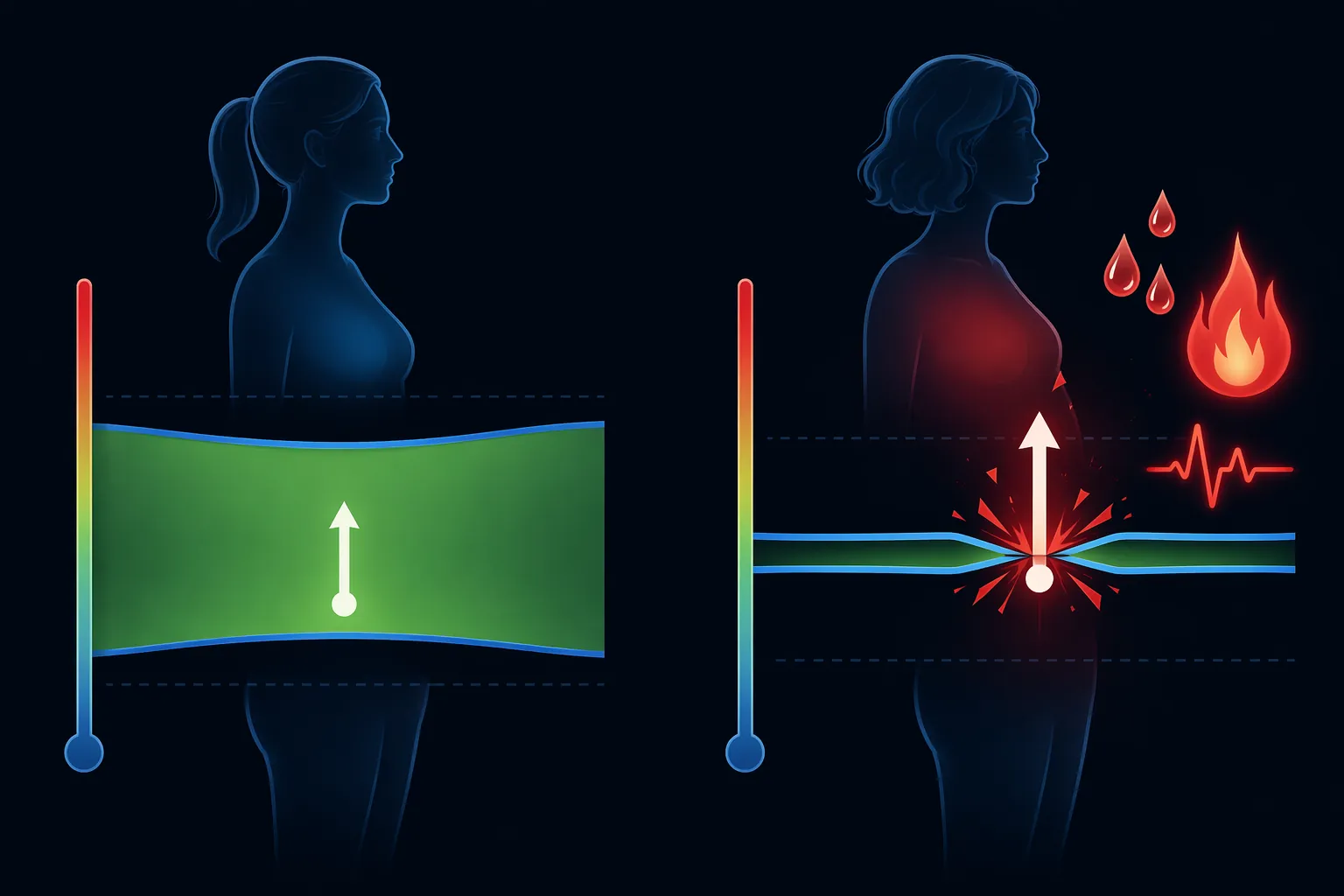
Once that buffer narrows, the bedroom does not have to be dangerously hot to become physiologically disruptive. A small upward drift in core temperature can be interpreted as a problem requiring immediate heat loss. Blood vessels dilate. Sweating begins. Heart rate may rise. The brain is no longer quietly maintaining sleep; it is managing an emergency cooling operation.
How the Two Thermostats Stack at Night
On an ordinary cool night, the sleep system gets help from the environment. Heat moves away from the body. Core temperature can fall. The brain can move through sleep stages without repeatedly solving a temperature problem.
On a hot night, the room pushes the other way. The mattress holds heat. Humid air makes sweat less useful. The body keeps trying to shed warmth into an environment that is not accepting it efficiently. That is already enough to fragment sleep in many people.
In perimenopause, the same external heat can land on a more reactive internal system. The body still needs the normal nighttime cooling drop, but the thermoneutral zone may be narrower. A room that blocks cooling also raises the chance that the internal temperature crosses the flash threshold. The result is not one problem but two: the body cannot cool smoothly into sleep, and then a small rise may trigger a disproportionate cooling response.
This is why the experience can feel so abrupt. The room may not feel unbearable when you first lie down. The failure may arrive later, after heat has accumulated under bedding, after the sleep-related cooling curve has been blunted, or after the body has made several small adjustments without quite succeeding. Then one small additional rise pushes the system past its narrowed threshold.
A Hot Flash Is Often a Sleep-Breaking Event
The phrase “night sweats” can make the problem sound surface-level, as if the main issue were damp pajamas. But a nighttime hot flash is often tied to awakening itself. In a 2014 Fertility and Sterility study of 34 perimenopausal women using objective EEG sleep measurement, roughly 70% of nighttime hot flashes were associated with awakenings.[3]
That was a modest sample, so it should not be inflated into a universal law. Its value is more precise: it shows why a woman may not simply “sleep through” vasomotor symptoms. Many flashes are not background sensations occurring under sleep. They are sleep-breaking events.
The awakening has consequences beyond the flash itself. Once awake, the sleeper has to cool the skin, manage wet clothing or bedding, settle the heart rate, and return to sleep while knowing the same sequence may repeat. After enough nights, the bed can start to feel less like a cue for sleep and more like the place where the next heat alarm is waiting.
Why Heatwaves Can Feel Like a Stress Test
The body has several routes for getting rid of heat: widening blood vessels near the skin, sweating, changing breathing and heart-rate patterns, and altering behavior. A heatwave asks those systems to work harder for longer. In midlife, that demand may be arriving at the same time as more frequent vasomotor instability, more fragmented sleep, and more cardiovascular arousal during the night.
This does not mean every bad summer night is caused by perimenopause. Room temperature, humidity, medications, alcohol, sleep apnea, anxiety, thyroid disease, infection, and other medical issues can all affect sweating and sleep. The point is narrower and more useful: when perimenopausal temperature regulation is already more easily provoked, extreme heat can expose the vulnerability.
The Triggers That Lower the Threshold
Some triggers matter because they make the narrowed buffer easier to cross. Integrative Menopause MD describes a clinical “stacked triggers” framing in which alcohol, dehydration, late meals, and humidity can combine with heat to lower the flash threshold.[4]
That framing is expert clinical opinion rather than peer-reviewed proof. It is still useful if it is treated as a way to observe patterns, not as a moral inventory. The question is not “What did I do wrong?” It is “What pushed a system with less thermal margin over the line tonight?”
- Alcohol can widen blood vessels and may make temperature swings more noticeable.
- Dehydration can make sweating and heat regulation harder.
- A late heavy meal can add digestive heat and arousal close to bedtime.
- Humidity can make sweating less effective, so the body works harder to cool.
For some women, none of these are the deciding factor on their own. The problem is accumulation. A warm room plus a humid night plus wine plus an already narrowed thermoneutral zone can behave differently than any one of those conditions would by itself.
What Understanding the Mechanism Changes
The mechanism does not magically cool the room. It does change the interpretation of what is happening. A heat-triggered perimenopausal awakening is not a character flaw, poor discipline, or an exaggerated response to summer. It is the predictable result of a sleep system that needs cooling and a temperature-defense system with less room for error.
That distinction matters because repeated heat awakenings can train the brain to expect wakefulness. After enough nights, the original trigger may be heat, but the continuing problem may also include conditioned insomnia: scanning for symptoms, bracing for the next flash, watching the clock after cleanup, and losing confidence that the bed is safe. Restful Ground’s related article on CBT-I for heat-dome night sweats and perimenopause sleep goes further into that treatment-focused side.
The useful practical move is not to pretend a fan and a lighter sheet can solve every extreme-heat night. It is to separate the problems. Reduce heat load where possible. Notice threshold-lowering patterns without blaming yourself. Treat repeated wakefulness as a sleep-conditioning problem if it begins to persist beyond the hottest nights. And take heavy sweating, palpitations, chest symptoms, faintness, or new severe night sweats seriously enough to discuss with a clinician.
Perimenopausal heat-related insomnia is not an overreaction to summer. It is a collision between the biology sleep has always required and a thermostat system that has lost much of its margin for error.
References
- Li et al., Nature Communications 2025 study on ambient temperature and sleep records. Nature Communications, 2025.
- Freedman, Thermoregulatory aspects of menopausal hot flashes. American Journal of Obstetrics and Gynecology, 1999.
- de Zambotti/Baker, Magnitude of the impact of hot flashes on sleep in perimenopausal women. SRI International / Fertility and Sterility, 2014.
- Integrative Menopause MD, clinical article on stacked hot-flash triggers including alcohol, dehydration, late meals, and humidity.
Explore the mechanism
Next step
Spot an error or have clinical feedback?
Because this article covers clinical, medication, or safety information, we use a moderated correction channel instead of open public comments. Let us know if something about “Why extreme heat ruins sleep in perimenopause” needs a closer look.
Send feedback on this article