
The best airline for sleeping on long flights is not the one with the softest adjective attached to its cabin. It is the one that gives your body the most room to stop bracing: enough width to keep your shoulders from fighting the armrest, enough pitch to let your knees and hips relax, enough recline or bed length to reduce the upright-chair problem, and a cabin environment that does not work against sleep through pressure and lighting.
That matters because travel sleep loss is not a niche complaint. Airport Dimensions and Sleepover research found that 8 in 10 travelers report sleep debt from travel, with an average loss of 4 hours and 42 minutes per journey.[1] Meanwhile, the seat itself has become less forgiving: The Points Guy reports that pitch has fallen from about 35 inches in the 1960s to 30–33 inches today, while width has dropped from 18.5 inches to about 17 inches, a 15% loss of personal space.[2]
So the useful question is not simply which airline has the prettiest long-haul cabin. It is which airline, in the cabin you can actually afford, gives you the strongest measurable chance of sleep.
Start With the Cabin, Not the Brand
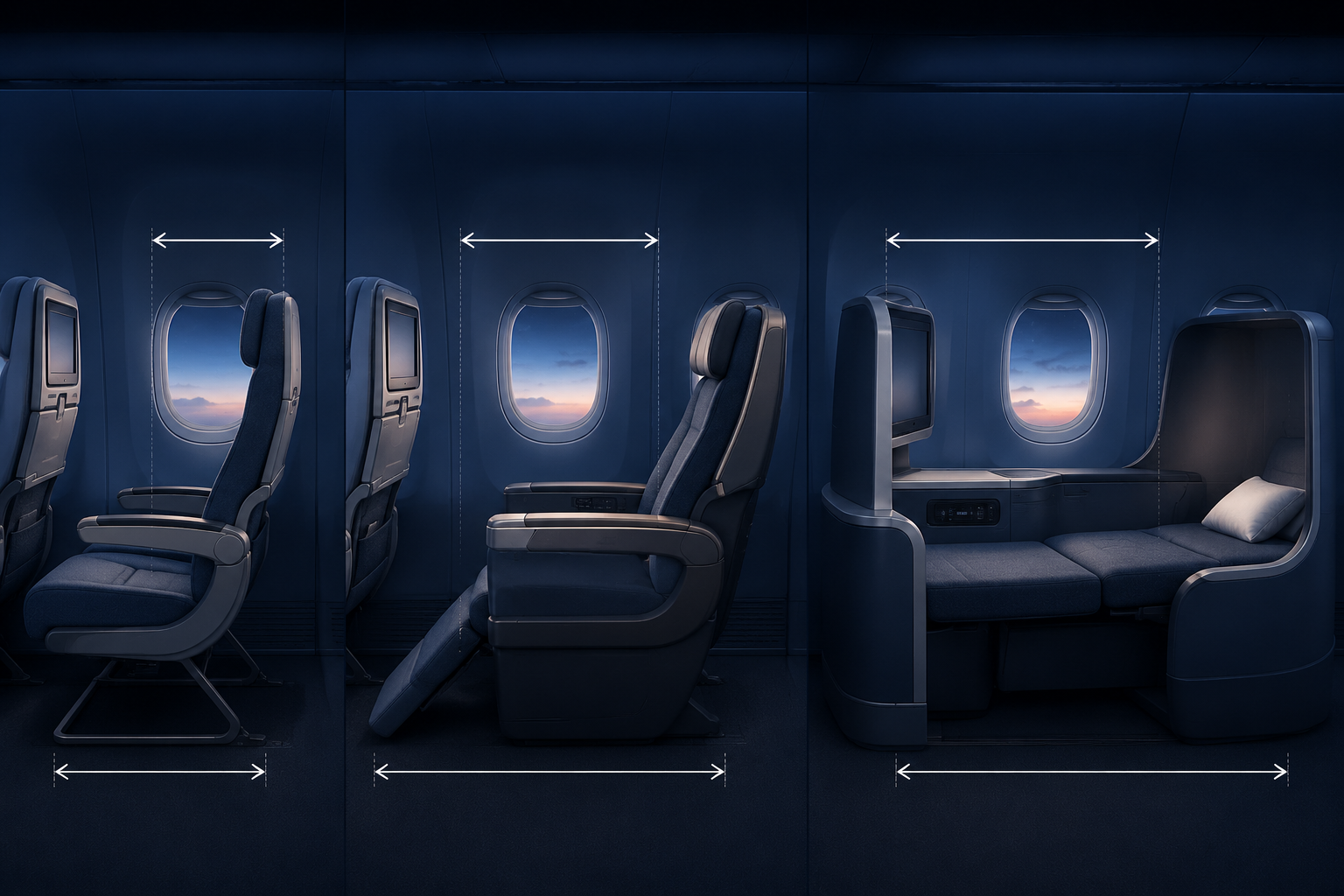
A ranking can be useful, but only after the dimensions are on the table. The 2025 Airline Sleep Score Index, reported by Irish Star, is worth considering because it weights seat pitch at 30%, seat width at 30%, cabin lighting at 20%, and passenger sentiment at 20%.[3] That is a more sleep-relevant mix than the usual pile of lounge photos and champagne service notes.
There is a caveat. The primary Sleepagotchi page was not directly recoverable, and the index has to be treated as a secondary-source data point rather than a fully inspectable primary methodology. The criteria are plausible; the score should not be treated as laboratory proof.
| Cabin choice | What changes for sleep | Best-supported examples |
|---|---|---|
| Economy | Small differences matter: 18–19 inches of width, 32–34 inches of pitch, footrests, or rentable sleeper rows can separate tolerable from miserable. | Japan Airlines 787 economy, ANA long-haul economy, Singapore Airlines economy, Cathay Pacific economy, Air New Zealand Skycouch |
| Premium economy | Usually the strongest value-for-sleep cabin: wider seats, 33–42 inches of pitch across carriers, deeper recline, and better leg support without business-class pricing. | Singapore Airlines premium economy; other long-haul premium economy products with verified pitch, width, and recline |
| Business class | The sleep question becomes bed length, privacy, surface width, and whether the seat is truly lie-flat rather than just dressed up. | Qatar Qsuite, ANA The Room, Delta One Suite, United Polaris, Air France La Première |
| Aircraft type | The plane can lift or cap the cabin: cabin altitude, humidity, lighting, and layout can matter as much as the airline name. | Airbus A350 strongest in the cited aircraft-comfort index; dense 777-300ER 3-4-3 layouts are weak for sleep |
Economy: The Few Inches That Decide the Night
Economy is where airline sleep claims usually collapse first. A standard long-haul economy seat around 17 inches wide with 30–32 inches of pitch may be survivable for a daytime flight. On an overnight flight longer than 8 hours, it asks the body to sleep while staying narrow, upright, and guarded.
Japan Airlines is the economy outlier that deserves attention because the difference is physical, not poetic. Condé Nast Traveler reports that JAL configures its Boeing 787 economy cabin at 8-abreast, giving passengers 18.5-inch-wide seats and 34 inches of pitch, while the industry standard on the 787 is commonly 9-abreast at about 17 inches wide.[4] That is the kind of specification that changes a night: less shoulder compression, more knee room, and more freedom to shift positions without negotiating with both neighbors.
ANA is another economy cabin worth separating from the pack. The same Condé Nast Traveler roundup notes ANA’s 34-inch pitch and footrest in economy.[4] A footrest sounds minor until the third hour of an overnight flight, when unsupported legs start pulling the lower back and hips into the argument. It does not make economy flat, but it gives the body another way to distribute pressure.
Singapore Airlines also has a measurable economy case. Simple Flying lists Singapore’s standard economy seat at 32 inches of pitch, 19 inches of width, and 6 inches of recline, calling it the widest standard economy seat among major carriers in its 2026 comparison.[5] Cathay Pacific is less wide in that cited comparison but still notable for 32 inches of pitch and 6 inches of recline, tied with Singapore on recline depth.[5]
For a traveler trying to sleep in economy, those differences are not cosmetic. Width protects the shoulders and rib cage. Pitch protects the knees and makes it easier to change position. Recline changes how much neck and lower-back work is required to remain asleep. None of this guarantees a good night, but it is a better predictor than whether the airline has a refined safety video.
When Economy Turns Into a Sleeper Row
The most interesting economy sleep products are not normal seats with nicer stitching. They are products that admit the obvious: a human sleeps better when horizontal.
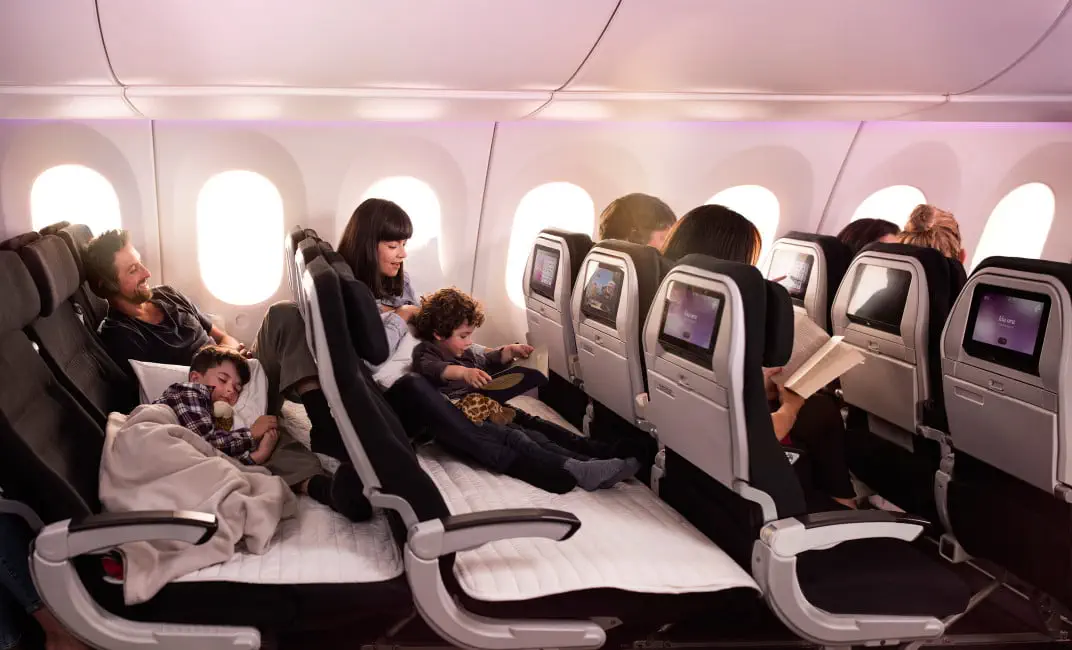
Air New Zealand’s Skycouch converts a row of three economy seats into a 29-by-61-inch flat surface. Condé Nast Traveler and AFAR report pricing in the range of $750–$1,400 per row, roughly one-quarter of a business-class ticket in the cited comparison.[6][7] It is not a business-class bed: 61 inches is short for many adults, and a shared row can be awkward depending on who is traveling. But for a solo traveler who can curl up, a parent with a child, or a couple willing to trade width for cost, it changes the category from “seat” to “surface.”
ANA’s Couchii follows a similar idea, offering a 32-inch-wide bed surface in economy, with Forbes reporting prices from $130 to $2,580 depending on route.[8] Lufthansa’s Sleeper’s Row is more straightforward: a rentable economy row on routes longer than 11 hours, priced at $179–$249 in the same Forbes report.[8] These are not glamour products. That is their virtue. They solve the sleep problem more directly than a “premium” headrest on a cramped seat.
Two newer ideas deserve a flag rather than a coronation. Air New Zealand’s Skynest is planned as economy-passenger bunk beds on Auckland–New York from November 2026, with 4-hour sessions starting at $495, according to Forbes.[8] United’s Relax Row, reported from the 2026 Aircraft Interiors Expo, is planned for up to 12 rows per aircraft across 200 Boeing 787 and 777 widebodies by 2030.[8] Both are promising because they acknowledge fatigue instead of decorating it, but the practical verdict should wait for deployed routes, booking rules, and real cabin placement.
Premium Economy Is Often the Sensible Sleep Upgrade
Premium economy is the cabin I would look at first when the goal is sleep but the budget will not tolerate business class. It usually does not give you a bed. What it often gives you is the set of compromises economy withholds: wider seating, more pitch, a better recline angle, and leg support that reduces the constant search for a tolerable position.
The Sleep Score Index supports that instinct. Singapore Airlines scored 96.8 out of 100, with reporting attributing its performance to 19-inch-wide premium economy seats and circadian-aware lighting; the same coverage identifies 33–42 inches of pitch across premium economy carriers as a major reason the cabin can be the best value-for-sleep proposition.[3]
That range matters because pitch does more than give tall passengers bragging rights. It changes the angle of the hip and knee, the ability to slide forward without trapping the legs, and the chance of sleeping without waking every time the person ahead reclines. Once the pitch moves into the mid-30s or beyond, the seat has room to behave like a rest platform rather than a waiting-room chair.
Singapore Airlines is the cleanest premium economy pick from the available data because the score, width, and lighting claims line up. But the broader rule is more useful than a single badge: when choosing between premium economy products, look for verified width near or above 19 inches, pitch in the upper end of the 33–42-inch band, meaningful recline, and a footrest or legrest that supports the lower body. A cheap premium economy seat with marginal pitch is not automatically a sleep upgrade; a well-specified one can be the difference between dozing and recovering.
Lighting is the one premium-economy feature that often sounds soft until it is done well. Circadian-aware lighting cannot force sleep, but it can stop the cabin from behaving like a shopping mall at midnight. In the Sleep Score Index, cabin lighting accounts for 20% of the score, which is a reasonable weighting: less important than the seat dimensions, but not irrelevant when the cabin is trying to move several hundred bodies across time zones.[3]
Business Class: Pay for the Bed, Not the Theater
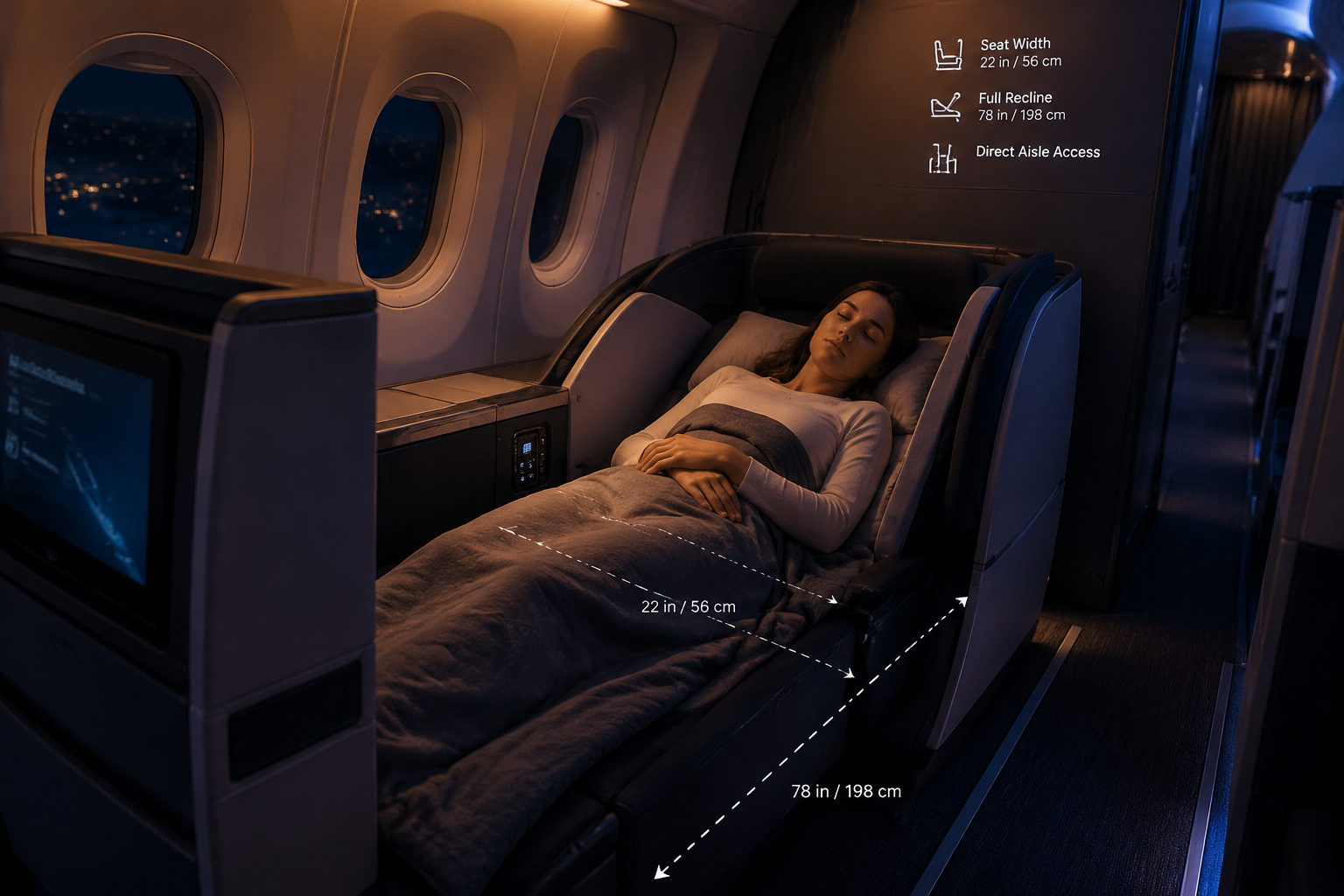
Business class should be the easy answer, and sometimes it is. A true lie-flat seat removes the central sleep insult of economy: having to remain upright. But business class still needs to be judged by bed length, seat width, privacy, and how much of the sleeping surface is actually usable once the seat is flat.
Qatar Airways Qsuite is one of the strongest supported examples: the Sleep Score reporting lists a 21.5-inch-wide seat, 79-inch bed, sliding door, and a 96.8 score.[3] The sliding door is not just theater if it reduces aisle disturbance and light intrusion. The 79-inch bed is the more important fact.
ANA’s The Room is impressive for a different reason: width. Forbes reports a 35-inch-wide seat and 72-inch bed, and notes that the product won a 2025 Crystal Cabin Award.[8] A 72-inch bed may not be enough for every tall traveler to fully stretch out, but 35 inches of width is a serious amount of lateral freedom in the air. That can matter more than a longer but tighter sleeping tunnel.
Delta One Suite and United Polaris also clear the basic sleep threshold because they are built around lie-flat beds rather than enhanced recliners. NerdWallet describes Delta One Suite as offering a bed longer than 6.5 feet with Missoni bedding, while United Polaris offers a 6-foot-6-inch bed with Saks Fifth Avenue bedding.[9] Bedding is pleasant; bed geometry is the real reason these products belong in the sleep conversation.
Air France La Première sits in a different price universe, with Forbes describing a separate seat and full-length bed enclosed by floor-to-ceiling curtains.[8] That can be excellent for sleep, but it is not a useful benchmark for most travelers deciding whether to move from economy to premium economy. It proves the same point at the extreme end: sleep improves when the product gives the body a real surface, darkness, and separation.
The Aircraft Can Beat the Airline Name
The aircraft-type angle is where glossy airline rankings often become too blunt. A good airline can put you on a dense configuration. A less celebrated carrier can put you on a better airframe with a more forgiving cabin. The ticket may show the brand in large letters, but the body sleeps inside a specific aircraft and layout.
AirTraveler Club’s 2025 comfort ranking gives the Airbus A350 a score of 87 out of 100, citing a 6,000-foot cabin altitude and 20% humidity, and connects those conditions with 15–20% less fatigue on flights longer than 12 hours based on Aerospace Medical Association research.[10] The same ranking puts the Boeing 777-300ER in a 3-4-3 configuration at 68 out of 100, with 17-inch seats in its “avoid” tier.[10]
This source also has a boundary: the ATC comfort score is proprietary and not peer-reviewed. Its inputs are still worth looking at because they are the right kind of inputs—seat configuration, pressure, humidity, and layout—but the final score should be treated as a structured travel-comfort model, not an independent medical finding.
Even with that caveat, the direction is hard to ignore. AirTraveler Club reports that aircraft type predicted comfort with 87% accuracy versus 34% for airline brand in its analysis of 80 aircraft configurations.[10] That does not mean the airline is irrelevant. It means “Singapore” or “Qatar” or “United” is incomplete information until you know the aircraft, cabin, and seat map.
So Which Airline Gives You the Best Chance of Sleep?
If you are staying in economy, Japan Airlines is the most compelling conventional economy pick from the available evidence because its 787 layout gives you 18.5-inch width and 34-inch pitch instead of the tighter 9-abreast standard.[4] ANA deserves a close look where its 34-inch pitch and footrest are available.[4] Singapore Airlines and Cathay Pacific are strong economy contenders when their published seat width, pitch, and recline match the aircraft you are booking.[5]
If you can pay for an economy sleep product, Air New Zealand Skycouch is the clearest current example of a seat becoming a sleep surface, with ANA Couchii and Lufthansa Sleeper’s Row also worth pricing against premium economy on the same route.[6][7][8] These products are especially interesting when business class is absurdly expensive and the flight is long enough for horizontal rest to matter.
If premium economy is within reach, Singapore Airlines has the strongest cited case because its Sleep Score Index result, 19-inch-wide premium economy seat, and circadian-aware lighting all point in the same direction.[3] More broadly, premium economy is the cabin most likely to make financial sense for sleep when it gives you verified pitch in the 33–42-inch range, real recline, and leg support.
If business class is realistic, Qatar Qsuite and ANA The Room are the standout products in the cited material because their dimensions translate directly into sleep: a 79-inch bed and door for Qatar, unusual width for ANA.[3][8] Delta One Suite and United Polaris are also legitimate sleep products when the aircraft has the true lie-flat version you expect.[9]
The safest answer is not a timeless crown. The best airline for sleeping on long flights is the one that gives you the best configuration for your budget: the most width, the most usable pitch, the deepest recline or truest bed, the lowest cabin altitude, and the least hostile lighting on the actual aircraft operating your route. Brand reputation can help you build a shortlist. The seat map and specifications decide whether you sleep.
References
- Sleepover Research, Airport Dimensions.
- Tips and strategies for sleeping better on a plane, The Points Guy.
- Sleepagotchi 2025 Sleep Score Index, Irish Star.
- 13 Airlines With the Best Economy Cabins for International Flights, Condé Nast Traveler.
- The Airlines With The World's Most Superior Economy Class Seats In 2026, Simple Flying.
- These 3 Airlines Let Passengers Turn a Row of Economy Seats into Beds, Condé Nast Traveler.
- Air New Zealand Skycouch review, AFAR.
- The Best Ways To Sleep On Planes: Seats To Suites And 'Nests', Forbes, Apr 2026.
- Where to Fly Business Class in Lie-Flat Seats, NerdWallet.
- Best aircraft for long flights. Comfort rankings (2025), AirTraveler Club, 2025.
Comments
Join the discussion with an anonymous comment.