Blood Moon Tonight? Sleep Disruption and Quick Tips
No — there is no blood moon tonight, July 30, 2026. A true blood moon means a total lunar eclipse, not just a bright, low, orange, or unsettling-looking moon. The last total lunar eclipse was March 3, 2026, and the next one is not until December 31, 2028. The upcoming August 27–28, 2026 lunar event is a very deep partial eclipse — 96.2% covered — which is why some astronomy coverage calls it an “almost blood moon,” but it is not tonight and it is not a total eclipse.[1]
That answer matters if you are awake right now and trying to decide whether the sky is doing something dramatic to your sleep. Tonight’s more useful explanation is simpler: the full moon was last night, July 29, the Buck Moon. The few nights around a full moon are the period where sleep studies have found small but measurable changes. Small is doing real work here. This is not evidence that the moon can ruin your entire night by itself.
Why Your Sleep May Feel Off Anyway
The cleanest study to keep in mind is not an eclipse study. It is a full-moon study. In 2013, researchers analyzed sleep in 33 healthy adults in a windowless laboratory and found that around the full moon, deep-sleep delta activity dropped by 30%, total sleep time fell by 20 minutes, and people took about 5 minutes longer to fall asleep.[2]
The windowless part is the interesting wrinkle. The participants were not lying under moonlight, scrolling eclipse photos, or checking the sky through the blinds. That does not prove a mystical lunar force. It does mean light alone may not explain every pattern researchers have observed, and it keeps the question from being quite as tidy as “just close the curtains.”
A larger 2021 study tracked sleep across the lunar cycle in 562 people and found sleep duration varied by 46–58 minutes, with bedtimes shifting by about 30 minutes across the cycle. The pattern appeared in Indigenous Toba-Qom communities and in college students in Seattle, though the write-up does not break out the exact magnitude separately for every group.[3]
So yes, if you are sleeping lightly, falling asleep later than usual, or waking after a short stretch, the full-moon window is a plausible contributor. It is not the only plausible contributor. Heat, alcohol, stress, late light exposure, hormones, pain, caregiving wake-ups, pregnancy discomfort, perimenopause, medication timing, and tomorrow-morning anxiety can all be louder than the moon.
This distinction is especially useful if your sleep is already sensitive. A full-moon week may feel more noticeable when you are also dealing with hot flashes, night sweats, early-morning cortisol spikes, or restless wake-ups. If that is your pattern, the more specific guide on why the full moon disrupts perimenopause sleep more may be more useful than another astronomy search.
A Lunar Eclipse Is Not a Separate Sleep Diagnosis
There is no direct evidence that a lunar eclipse has its own special biological sleep effect separate from the full-moon phase. The more likely eclipse problem is behavioral: you stay up later to watch it, stand outside in alert mode, check your phone for timing updates, take photos, come back in cold or wired, and then ask your nervous system to shut down on command.
That is why the August 27–28 partial eclipse deserves a practical note, not panic. If you plan to watch it, treat it like any other late-night sky event: protect the morning after if you can, keep your phone brightness low, and consider a 20–30 minute nap 1–2 hours before the partial phase begins. For a fuller recovery plan, the same logic used for sleeping after late-night aurora viewing applies: the sky may be worth seeing, but the wind-down still needs a landing strip.
For tonight, the useful move is to stop treating “blood moon” as an active emergency. If the moon is bright outside your window, block the light. If the search itself has become the stimulant, end the search.
What to Do in the Next 10 Minutes
You do not need a full sleep makeover at 1:40 a.m. You need to reduce input, give your body fewer reasons to stay alert, and avoid turning one wakeful patch into a monitored event.
- Block the light you can block. Close blackout curtains if you have them. If not, shift the curtain overlap, move your pillow away from the window beam, use a sleep mask, or drape a spare dark shirt where light is leaking in, as long as it is safe. Harvard Health notes longer sleep latency and less total sleep in the days before a full moon, and dim light is one plausible part of the story.[4]
- Stop adding brighter light. Put the phone down now, not after one more lunar calendar check. Cleveland Clinic notes that even dim lunar light has been discussed as a possible melatonin suppressor, with moonlight estimated around 0.1–0.3 lux; your phone is the easier light source to control.[5]
- Do one calming technique, slowly enough to be boring. The goal is not to force sleep. It is to lower arousal so sleep has somewhere to land.
- Do not keep checking the clock. Clock-checking turns the night into a countdown and gives your brain fresh math to do.
If you are fully awake and have been awake for a while, use the same rule you would use on any other bad night: make the bed less of a problem-solving desk. The guide to what to do when you wake up at 3 a.m. and can’t sleep goes deeper, but the short version is to keep lights low, do something quiet and unstimulating if you need to get up, and return when you feel sleepy rather than defeated.
Try 4-7-8 Breathing Without Making It a Test
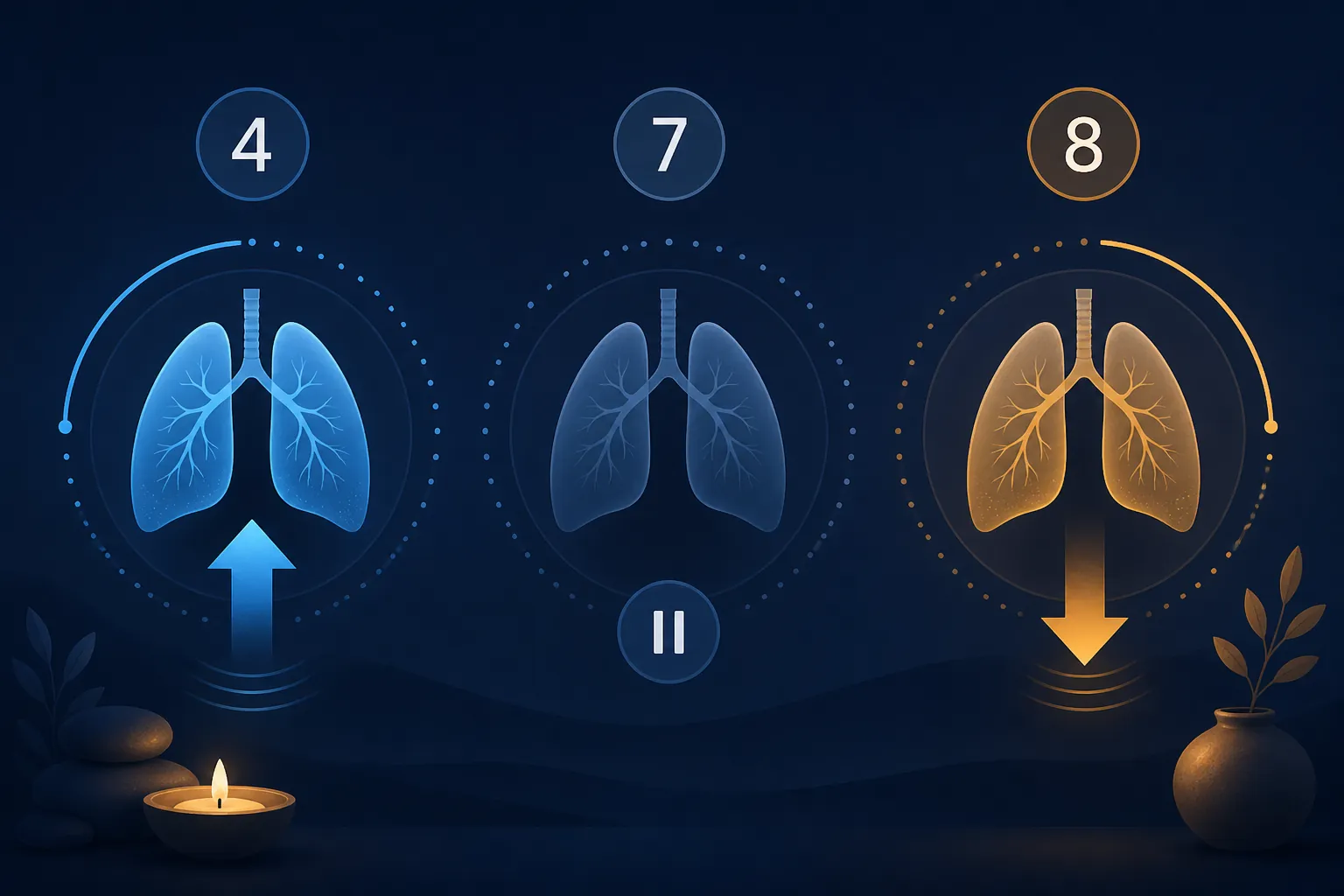
- Inhale gently through your nose for a count of 4.
- Hold for a count of 7, or shorten the hold if that feels strained.
- Exhale slowly for a count of 8.
- Repeat for a few rounds, then let your breathing return to normal.
If the counts make you tense, use the shape instead: shorter inhale, tiny pause, longer exhale. A long exhale is often the part that helps most when the body is alert.
How Much Sleep Loss Are We Actually Talking About?
The number to carry into the night is about 20–25 minutes, not “the moon stole my sleep.” The controlled lab study found 20 minutes less total sleep around the full moon.[2] The broader field evidence found lunar-cycle variation and later bedtimes, but it still points to a shift, not a guaranteed all-night disruption.[3]
Harvard Health’s summary is somewhat wider, reporting 30–80 minutes longer to fall asleep and 20–90 minutes less total sleep in the days before a full moon.[4] That range is worth respecting if you are someone who feels lunar weeks strongly, but tonight’s better explanation is still a recent full moon, a wakeful brain, and probably at least one controllable input in the room.
If tomorrow is important, aim for damage control rather than perfect sleep. Reduce light. End the investigation. Use one calming technique. Stop checking the time. A tired morning is manageable; it is not proof that the moon ruined the night.
References
- August 2026 lunar eclipse — Everything you need to know about the 96% 'blood moon', Space.com.
- Evidence that the Lunar Cycle Influences Human Sleep, Current Biology, 2013.
- Moonstruck sleep, Science Advances, 2021.
- Moonlight may affect sleep cycles, Harvard Health Publishing, 2021.
- Does The Moon Affect Humans?, Cleveland Clinic, 2022.
Read the full guide: How to Manage Full Moon Sleep Disruption During Aquarius 2026