Does the full moon affect sleep during perimenopause?
Perimenopause and the full moon each independently disrupt sleep through different biological pathways. This FAQ explains how they interact, what the research says, and what you can do on full-moon nights.
If you are asking whether the full moon affects sleep during perimenopause because your already-fragile nights seem to fall apart around the full moon, the careful answer is: it might be a real added stressor, but it has not been directly tested as a full moon × perimenopause interaction. The evidence is stronger for two separate facts: sleep often worsens during the menopause transition, and several studies have found measurable sleep changes around the full moon. Putting those together is plausible; treating it as proven is not.
That distinction matters. A woman in perimenopause does not need another vague reassurance that “sleep changes happen.” She also does not need a moon-phase rule that promises certainty from thin evidence. The useful question is narrower: when a light-sensitive, melatonin-linked sleep disruption lands on top of a hormonally unstable sleep system, what might happen, and what can you do without overreading the science?
What full-moon sleep studies actually show
The full-moon sleep signal is not just folklore, though it is also not perfectly consistent across every study. In a controlled sleep-lab analysis published in Current Biology, participants slept about 20 minutes less, took about 5 minutes longer to fall asleep, had up to a 30% reduction in deep sleep, and showed lower evening melatonin around the full moon compared with other lunar phases.[1] A later Sleep Medicine analysis also reported reduced sleep quality around the full moon and described the association as seeming more pronounced in women than in men, but that sample came from a clinical sleep-lab population rather than a general perimenopausal cohort.[2]
A larger field study adds a different kind of evidence. Casiraghi and colleagues found that sleep tended to start later and last less in the nights before the full moon, with sleep duration reduced by about 11 to 25 minutes across study populations; in outdoor settings, sleep onset was delayed by 30 to 80 minutes.[3] That does not prove the full moon ruins sleep for everyone. It does show that lunar timing can correspond with changes large enough for a sensitive sleeper to notice.
The most clinically useful part of this research is not the romance of the full moon. It is the melatonin clue. Melatonin is one of the body’s major darkness signals. If moonlit evenings, brighter nights, later outdoor activity, or simply more light exposure around the full moon delay or blunt that signal, the first consequence is often not dramatic insomnia. It is a later sleep onset, lighter sleep, or waking up feeling as if the night never became fully restorative.
What perimenopause adds before the moon enters the room
Perimenopause can make sleep less resilient before any lunar effect is involved. In a May 2026 Apple Women’s Health Study update from Harvard, 60% of women showed increased wake-after-sleep-onset in the 18 months before menopause, with an average 7% increase in wake time after sleep began.[4] That measure is important because many women do not describe their problem as simply “I cannot fall asleep.” They fall asleep, then wake at 2:40 a.m., or 3:15 a.m., or again and again until morning.
Perimenopausal sleep disruption is not one mechanism wearing different outfits. Fluctuating estrogen can disturb temperature regulation and circadian timing. Declining progesterone may reduce some of the calming, GABA-supporting effects that made sleep easier earlier in life. Hot flashes can produce abrupt awakenings, followed by the secondary problem: once awake, the nervous system may not step back down quickly.
So the baseline changes. A younger sleeper may absorb a slightly brighter night or a later bedtime with little consequence. A perimenopausal sleeper may be operating with less margin: more temperature volatility, more nighttime awakenings, less hormonal support for consolidated sleep, and possibly a circadian system that is easier to disturb.
Where the two pathways plausibly pile up
No study in the research record has directly asked: do perimenopausal women sleep worse around the full moon than they do at other lunar phases, after controlling for age, symptoms, light exposure, and menstrual-cycle irregularity? That missing study is the reason the answer cannot be “the full moon causes perimenopausal insomnia.”
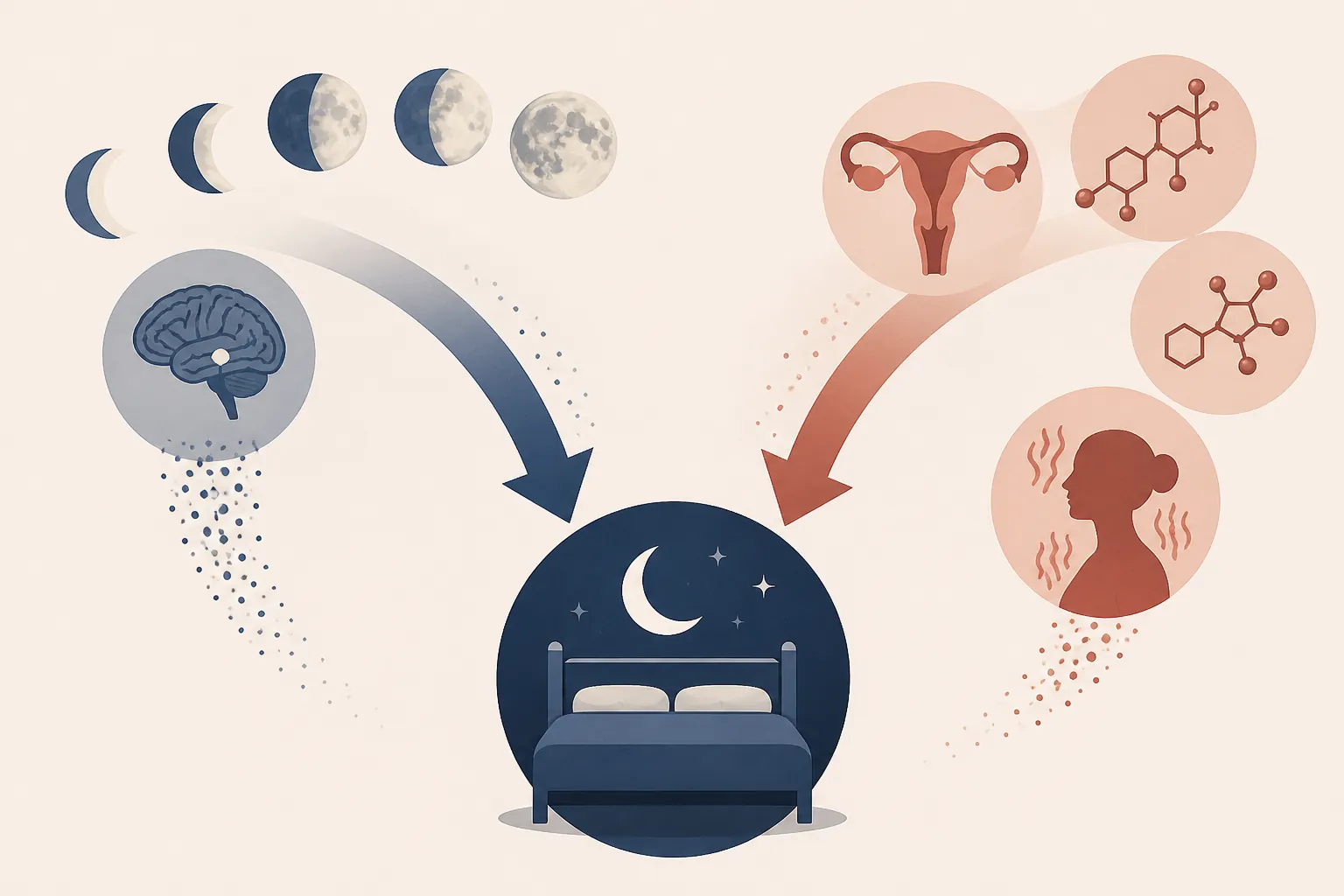
But absence of that exact interaction study does not make the lived pattern meaningless. The plausible overlap is this: the full moon has been associated with lower evening melatonin and delayed or shortened sleep, while perimenopause can make sleep more fragmented and less hormonally buffered. If both are active on the same night, the result may be a longer time to fall asleep, more awakenings after sleep begins, lighter deep sleep, or a morning-after feeling that the night technically happened but did not restore you.
| Pressure on sleep | What has been measured | What it may feel like |
|---|---|---|
| Full moon or pre-full-moon nights | Less total sleep, later sleep onset, reduced deep sleep, and lower evening melatonin in some studies | Taking longer to fall asleep, sleeping lightly, waking less refreshed |
| Perimenopause | More wake-after-sleep-onset in the 18 months before menopause in wearable data | Falling asleep but waking repeatedly, especially in the second half of the night |
| Hot flashes and temperature instability | A recognized menopause-related sleep disruptor | Abrupt waking, sweating, throwing off covers, difficulty settling again |
| Lower progesterone/GABA support | A plausible hormonal pathway rather than a moon-specific finding | More nighttime alertness, less “sleep pressure,” more sensitivity to stressors |
Melatonin is the cleanest point of convergence. Around the full moon, the issue may be environmental light and circadian timing. During perimenopause, the issue may be internal rhythm stability and hormone-linked sleep regulation. Those are not identical pathways, but they meet in the same practical place: the brain’s decision about whether evening has truly become night.
This is also why the effect, if you have one, may be uneven. You may sleep acceptably through one full moon and badly through the next. The moon phase is only one input. Alcohol, a late meal, a warm bedroom, a stressful day, a skipped workout, a hot-flash cluster, or a shifting period can make the same lunar phase land very differently.
The menstrual-cycle moon evidence is interesting, but it does not prove this case
There is related evidence that lunar, hormonal, and sleep rhythms can intersect. Helfrich-Förster and colleagues reported that women’s menstrual cycles intermittently synchronized with lunar luminance and gravimetric cycles, with synchrony declining after age 35 and under artificial light.[5] That is biologically interesting for this question because it keeps lunar-hormonal timing within the realm of plausible physiology rather than pure myth.
It is not direct evidence for a woman in late perimenopause waking after a full moon. Synchrony studies generally do not answer whether full-moon nights worsen insomnia in women aged 40 to 55, and a menstrual-cycle pattern in younger or cycling women cannot simply be carried over to irregular perimenopausal cycles. It belongs in the background, not in the driver’s seat.
What to do on full-moon nights if perimenopause already disrupts your sleep
The goal is not to become a lunar detective at the expense of sleep. The goal is to reduce the parts of the overlap you can control, especially evening light, heat, and the spiral that can follow one bad night.
Treat the full moon as a light-management night
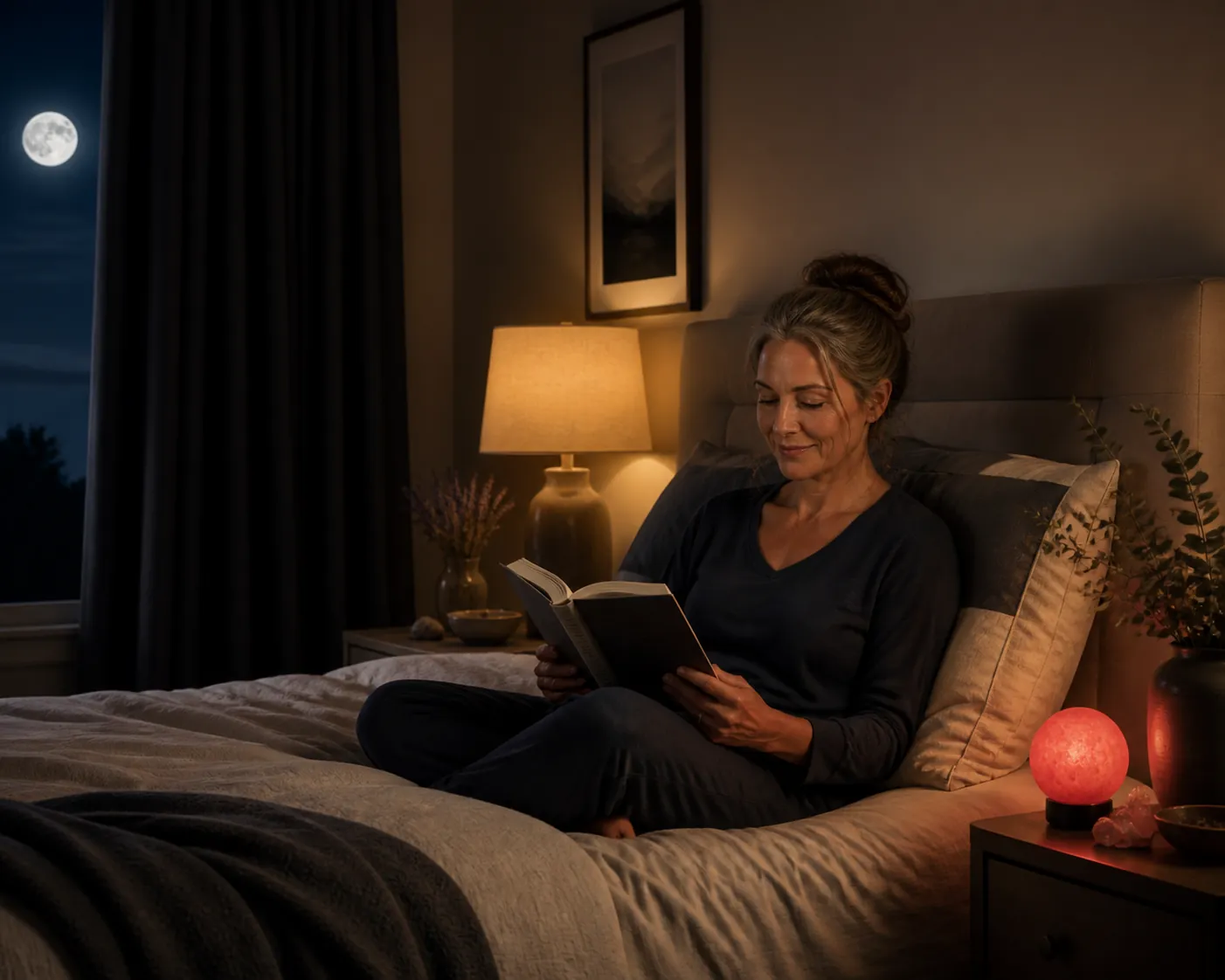
If the most plausible lunar pathway is melatonin suppression, then the first response is boring and useful: make the evening darker. Close curtains before the room fills with moonlight. Use warm, low light after dusk. Avoid bright overhead lighting during bathroom trips. If you read in bed, use the dimmest light that still lets you read comfortably. This is not because moonlight is magically dangerous; it is because a perimenopausal sleep system may have less tolerance for extra circadian noise.
Protect the hot-flash routine you already know works
Full-moon nights are not the time to experiment with a warmer duvet, a late glass of wine, or a heavy meal close to bed if those already worsen your symptoms. Keep the room cool. Layer bedding so you can remove one layer without fully waking yourself. Put water, a dry sleep shirt, or a fan control within reach if night sweats are part of your pattern. The less decision-making you do at 3 a.m., the less likely one awakening becomes a long wake period.
Do not turn one bad moon night into three anxious nights
The full moon is easy to blame because it is visible. That visibility can become its own problem. If you go to bed expecting a bad night, you may add performance anxiety to a night that was already physiologically vulnerable. A steadier approach is to plan modestly: dim the light, cool the room, keep the wake-up time reasonably consistent, and do not spend the next day treating the night as proof that your sleep is permanently broken.
Track patterns only if the data will change what you do
A simple log can help if you keep it small. For two or three months, note the moon phase, bedtime, estimated time to fall asleep, awakenings, hot flashes or night sweats, alcohol, late meals, unusual stress, and whether your period or spotting occurred. Do not grade yourself. Look for repeated clustering: worse sleep in the three or four nights before the full moon, worse sleep only when hot flashes are active, or no reliable lunar pattern once other factors are visible.
- If the pattern appears lunar, focus on light control and schedule consistency around those nights.
- If the pattern follows hot flashes, prioritize menopause symptom treatment rather than finer moon tracking.
- If the pattern follows alcohol, late meals, or stress, the moon may be a bystander.
- If sleep is poor most nights, the problem has outgrown moon-phase troubleshooting.
When not to blame the moon
A lunar pattern should not distract from treatable sleep disorders. Sleep apnea becomes more relevant as women move through menopause; Johns Hopkins Medicine reports that postmenopausal women are 2 to 3 times more likely to have sleep apnea than premenopausal women.[6] Snoring, gasping, witnessed pauses in breathing, morning headaches, dry mouth, high blood pressure, or severe daytime sleepiness deserve clinical attention even if the timing seems to cluster around the full moon.
The same is true if insomnia is escalating, mood symptoms are worsening, hot flashes are frequent, or you are routinely functioning on too little sleep. Perimenopause may be the background vulnerability, and the full moon may be an added stressor, but neither should become a reason to wait out a problem that is affecting health, safety, or daily function.
So the restrained answer is the most useful one: the full moon may worsen sleep for some perimenopausal women, especially through light exposure and melatonin timing, but perimenopause remains the larger sleep vulnerability. If full-moon nights are the only problem, adjust light, cooling, and expectations. If sleep is broadly deteriorating or breathing symptoms are present, the next step is evaluation, not a more elaborate lunar calendar.
References
- Evidence that the Lunar Cycle Influences Human Sleep, Current Biology, 2013.
- Lunar cycle and sleep: Is it a myth?, Sleep Medicine, 2014.
- People go to bed later and sleep fewer hours before a full moon, University of Washington News, January 27, 2021.
- Sleep Patterns and Changes in Perimenopause, Apple Women’s Health Study, Harvard T.H. Chan School of Public Health, May 2026.
- Women temporarily synchronize their menstrual cycles with the luminance and gravimetric cycles of the Moon, Science Advances, 2021.
- How Does Menopause Affect My Sleep?, Johns Hopkins Medicine.
Explore the mechanism
Next step
Spot an error or have clinical feedback?
Because this article covers clinical, medication, or safety information, we use a moderated correction channel instead of open public comments. Let us know if something about “Does the full moon affect sleep during perimenopause?” needs a closer look.
Send feedback on this article