
What are the FMCSA sleep apnea and fatigue requirements for CDL?
For CDL sleep requirements and fatigue management, there are two separate tracks to keep straight. FMCSA directly enforces Hours of Service rules: most property-carrying drivers may drive up to 11 hours only after 10 consecutive hours off duty, must stay within a 14-hour on-duty window, must take a 30-minute break after 8 cumulative hours of driving without at least a 30-minute interruption, and must follow the 60/70-hour weekly limits with the 34-hour restart option where applicable.[1] Sleep apnea is handled differently. There is no universal federal rule that says every CDL holder must take a sleep apnea test, but a DOT medical examiner can require evaluation when clinical risk indicators suggest the driver may not be medically safe to operate.[2]
The CPAP number drivers hear most often is also worth stating carefully: medical examiners commonly look for CPAP use of at least 4 hours per night on at least 70% of nights when judging whether treatment is effective, but that benchmark is an applied medical-certification standard, not a stand-alone FMCSA statute that automatically applies to every driver.[3] A driver with documented treatment is often certified for one year rather than the standard two-year medical card.[4]

The sleep rule and the sleep apnea question are not the same rule
Hours of Service rules answer the scheduling question: when may a driver legally drive, stop, restart, or use a sleeper berth? They apply whether or not the driver has sleep apnea. The medical-certification process answers a different question: does this driver have a condition that may interfere with safe operation of a commercial motor vehicle?
That distinction matters because a clean logbook does not cancel a medical concern, and a sleep apnea diagnosis does not erase the Hours of Service limits. A driver can be fully compliant with the 10-hour off-duty rule and still be referred for a sleep study during a DOT physical. A driver can also be treated for sleep apnea and still violate HOS if the driving window, break, or weekly limits are exceeded.
| Issue | Who applies it | What it usually means for the driver |
|---|---|---|
| Hours of Service rest and driving limits | FMCSA and enforcement officials | You must structure driving, breaks, off-duty time, and weekly hours within the federal limits. |
| Sleep apnea risk during a DOT physical | Certified medical examiner | You may be asked for testing or treatment documentation if risk indicators are present. |
| CPAP compliance after diagnosis | Medical examiner reviewing treatment effectiveness | You may need a machine-generated compliance report before certification or recertification. |
The enforceable fatigue-management rules
For most property-carrying CDL drivers, the core federal Hours of Service numbers are straightforward on paper. A driver may drive a maximum of 11 hours after 10 consecutive hours off duty. That driving must fit inside a 14-consecutive-hour window after coming on duty. A driver also needs a 30-minute interruption after 8 cumulative hours of driving if there has not already been a qualifying break.[1]
The weekly cap is separate from the daily driving limit. FMCSA’s summary describes 60 hours on duty in 7 consecutive days or 70 hours on duty in 8 consecutive days, depending on the carrier’s operating schedule, with a 34-hour restart available to reset the calculation.[1] Sleeper berth rules can allow qualifying split rest periods, including 7/3 and 8/2 combinations, but those are still Hours of Service calculations rather than medical sleep-apnea clearance.[1]
Those rules do not promise that a driver is well-rested. They set enforceable minimums and maximums. FMCSA’s driver-fatigue safety material says 13% of commercial motor vehicle drivers were considered fatigued at the time of a crash in the agency’s cited crash study, which is enough to explain why fatigue keeps appearing in enforcement, training, and medical-certification conversations.[5]
When a DOT physical turns into a sleep apnea referral
A DOT physical is not supposed to be a sleep study for every driver who walks through the door. The examiner is looking for medical conditions that may interfere with safe driving. Sleep apnea becomes part of the exam when the driver’s history, symptoms, or measurements raise concern.
Common screening indicators include BMI greater than 40, neck circumference greater than 17 inches for men or greater than 16 inches for women, a STOP-BANG score of 3 or higher, and reported daytime sleepiness.[2] Those indicators do not diagnose obstructive sleep apnea by themselves. They tell the examiner that the risk is high enough to justify asking for more information, which may include a sleep study.
Symptoms still matter. Loud snoring, witnessed pauses in breathing, gasping awake, morning headaches, and unplanned daytime dozing are not interchangeable, and snoring alone is not a diagnosis. Drivers trying to sort out what is worth mentioning can start with the difference between snoring and sleep apnea, then bring the actual symptom history to the examiner rather than trying to guess the outcome.
This is also where old rumors create real stress. FMCSA withdrew its 2016 obstructive sleep apnea rulemaking activity in 2017, and no universal federal screening rule replaced it.[2] As of Q3 2026, the practical authority sits with the medical examiner’s duty to determine medical fitness under existing standards, not with a separate blanket rule requiring every CDL driver to be tested.
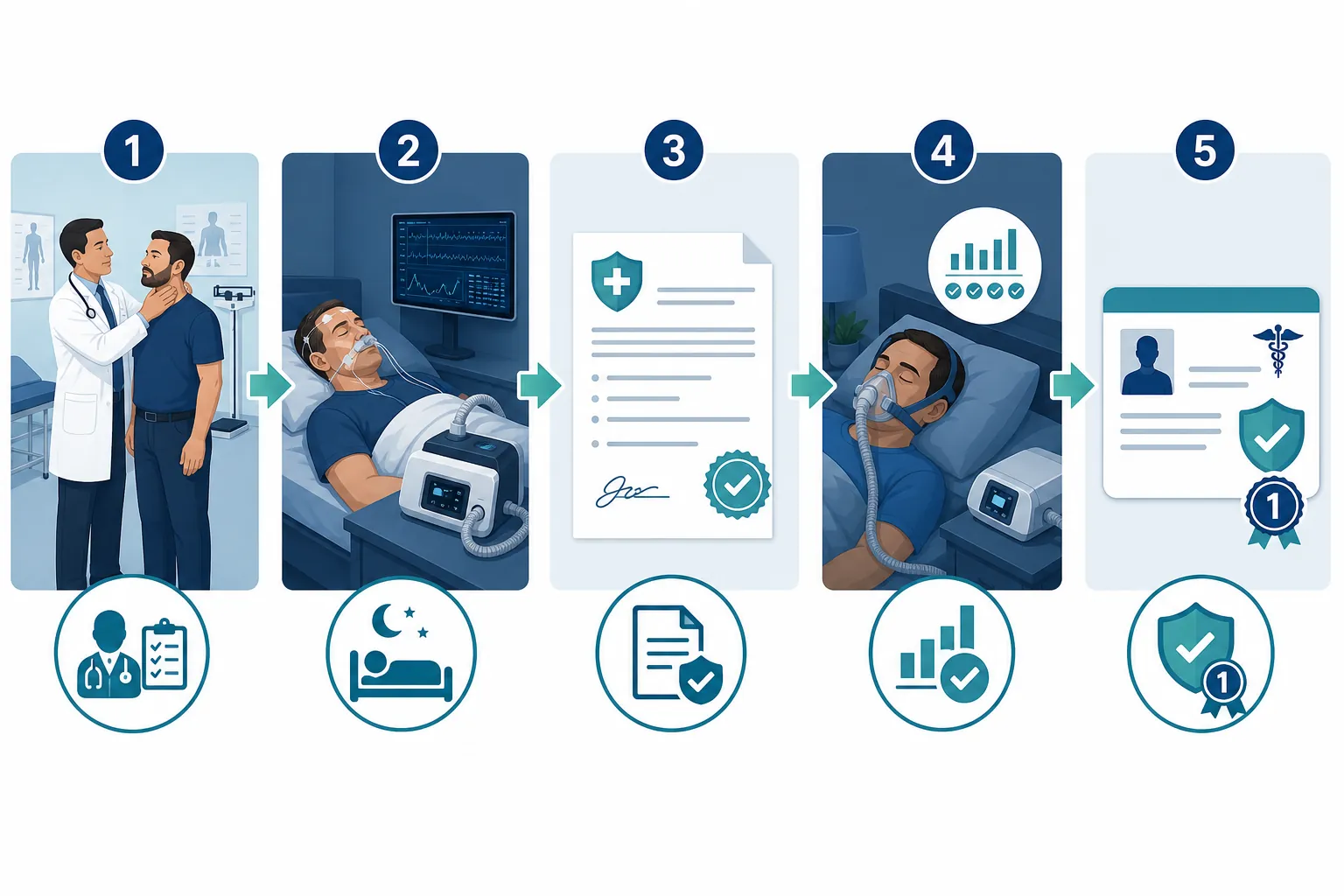
The usual pathway after a driver is flagged
The pathway is less mysterious when it is laid out in order. The examiner identifies risk during the DOT physical. The driver is referred for testing. If sleep apnea is diagnosed, treatment starts. The driver brings objective treatment documentation back to the examiner. Certification is then based on whether the condition is controlled well enough for safe driving.
- Risk is flagged during the DOT physical through measurements, questionnaire results, symptoms, medical history, or examiner judgment.
- The driver completes an accepted sleep evaluation, which may be a lab study or a home sleep apnea test when clinically appropriate and accepted by the reviewing provider.
- If obstructive sleep apnea is diagnosed, the driver begins treatment, most commonly CPAP therapy.
- The driver returns with a CPAP compliance report or other treatment documentation requested by the examiner.
- The examiner may issue a shorter medical card, commonly one year, when treatment is documented and the driver is considered safe to operate.
Some drivers are issued a short conditional card while testing or early treatment is being completed. WorkSTEPS describes a conditional-certification ladder that can include a 3-month card followed by longer certification once compliance is documented.[2] The exact card length depends on the examiner’s findings, the severity of the condition, and the documentation available at the visit.
Testing logistics can vary. A driver comparing a home test with an in-lab study may care about scheduling, insurance, and out-of-pocket cost; those tradeoffs are covered more directly in home sleep test versus lab study cost. For DOT purposes, the important point is that the result has to be a clinical sleep evaluation the examiner and treating provider can rely on, not a phone app trend or watch estimate.
A diagnosis is not usually the career-ending event drivers fear
The condition that creates the certification problem is untreated or inadequately controlled moderate-to-severe obstructive sleep apnea, not the mere fact that a driver has been diagnosed.[6] That difference is not a technicality. A driver who avoids testing because of fear may arrive at recertification with an unresolved safety concern. A driver who completes testing and brings treatment documentation gives the examiner something concrete to review.
For CPAP users, the document that usually matters is the machine-generated compliance report. Occupational medicine and sleep-clinic sources commonly describe the benchmark as at least 4 hours of CPAP use per night on at least 70% of nights.[3][4] Some examiners also want a recent 30-day report, especially when a driver is newly treated or returning after a conditional card.[3]
That report is different from a driver saying the mask is being used. It is also different from a consumer sleep score. Wearables may help someone notice patterns, but a sleep tracker is not a sleep study, and it is not the same as CPAP adherence data pulled from a treatment device.
The usual tradeoff is card length. Sleep Care Online describes the common distinction this way: drivers with untreated or unresolved concerns may not receive full certification, while drivers who document effective CPAP treatment are often limited to a one-year card instead of a two-year card.[4] That annual review can be inconvenient, but it is also the route many treated drivers use to stay medically certified.
What to bring to recertification
A driver coming back after a sleep apnea referral should assume the examiner needs documentation, not a verbal update. The most useful folder is usually simple: the sleep study result, the diagnosis and treatment note if available, the CPAP compliance report covering the period requested, and any follow-up note showing the driver is tolerating treatment and symptoms such as daytime sleepiness are controlled.
- Bring the CPAP compliance report, not just the machine or mask.
- Check that the report shows dates, nightly usage, and percentage of compliant nights.
- Bring the sleep study result if this is the first DOT visit after diagnosis.
- Expect annual certification to be more likely than a two-year card when ongoing sleep apnea treatment is part of the medical file.
The cleanest answer is the least dramatic one: FMCSA rest rules are mandatory and enforceable; sleep apnea testing is not universal, but it can be required when risk indicators are present; treated sleep apnea with objective compliance documentation is usually manageable for CDL medical certification.
References
- Summary of Hours of Service Regulations, Federal Motor Carrier Safety Administration.
- Trucking Safety and Sleep Apnea, WorkSTEPS.
- DOT Requirements For CPAP Compliance, Jeffrey S. Liva, MD.
- Does DOT Physical Require a Sleep Apnea Test?, Sleep Care Online.
- CMV Driving Tips - Driver Fatigue, Federal Motor Carrier Safety Administration.
- Can You Have a CDL With Sleep Apnea?, Driver Resource Center.
Read the full guide: How a Subpotent Levothyroxine Dose Causes Fatigue and Poor Sleep