
Is Earthquake Sleep Anxiety Normal or a Sign of PTSD?
If you are searching for how to sleep during earthquake anxiety, the question underneath may be harder to say out loud: Is this still a normal reaction, or has it become something I should treat?
In the first days and weeks after an earthquake, poor sleep can be a normal physiological response. Your body has learned that the bed, the dark, the stillness, or a small vibration may not be as safe as they felt before. That does not mean you are weak, dramatic, or permanently damaged. It does mean your nervous system is still trying to sort danger from safety.
The line starts to shift when the sleep problem persists, narrows your life, or changes what you do at night: you avoid bed, you stay alert for aftershocks long after the immediate danger has passed, you have earthquake-specific nightmares, you cannot function during the day, or you need alcohol or another substance to get to sleep. A bad week is not a diagnosis. But a pattern that is still ruling your nights after several weeks deserves a more serious look.
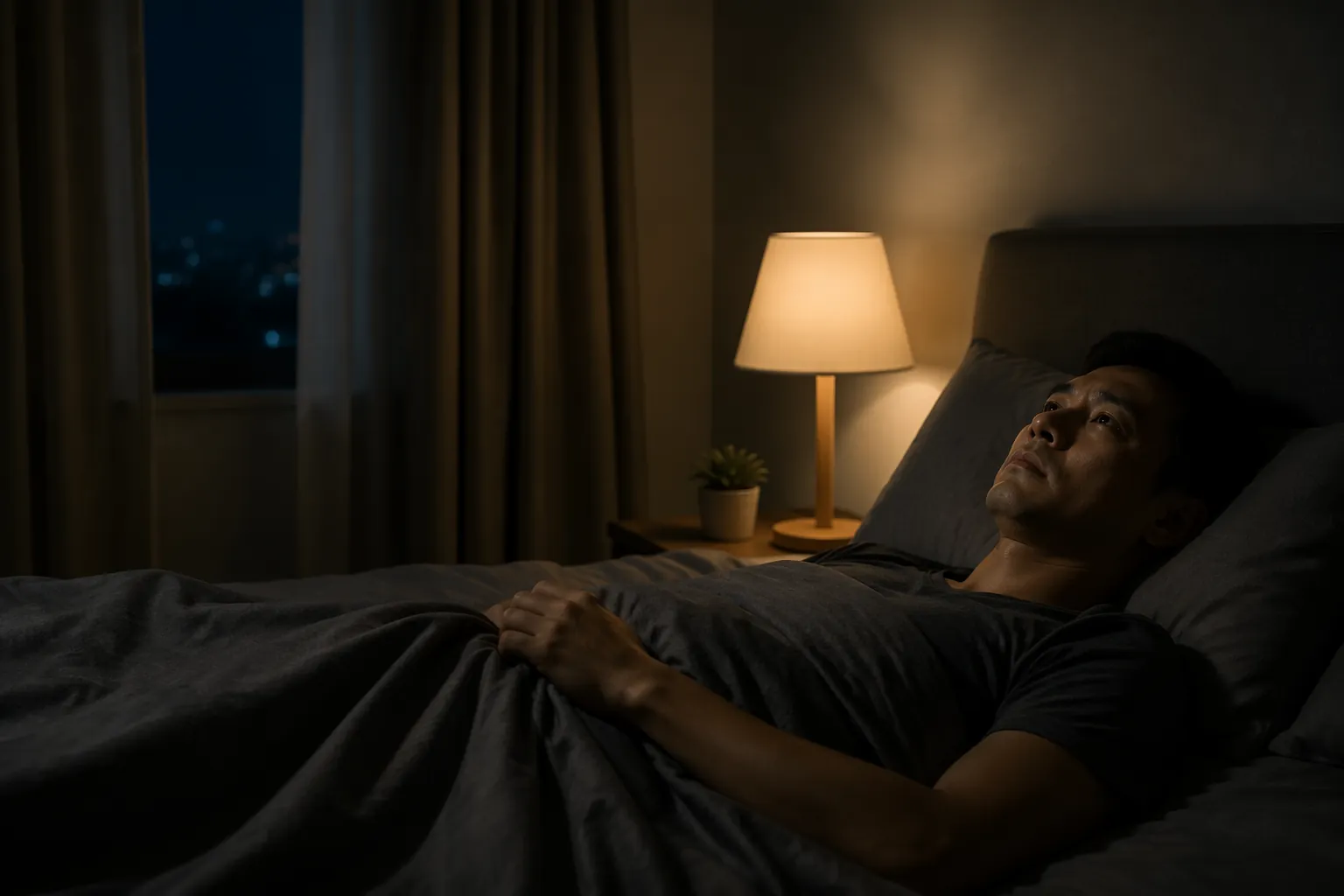
A Quick Triage Check
Use this as an orientation tool, not a self-diagnosis. If any of these are present, especially beyond about a month, it is reasonable to seek a professional evaluation rather than keep trying to push through.
- Nightmares specifically about the earthquake, aftershocks, collapsing buildings, shaking rooms, sirens, escape, or being trapped.
- Active avoidance of going to bed, sleeping only in places that feel safer, delaying bedtime for hours, or staying busy so sleep cannot begin.
- Hypervigilance that does not fade after several weeks: scanning sounds, checking walls, monitoring alerts, or jolting awake to ordinary house noises.
- Daytime dysfunction from fatigue, distraction, irritability, memory problems, or fear of being alone at night.
- Using alcohol, cannabis, sedatives not prescribed for you, or other substances mainly to make sleep possible.
- Sleep disruption that remains high beyond one month, even if you are no longer in immediate danger.
The one-month mark matters because many acute stress reactions begin to ease as the body gets repeated evidence of safety. It is not a trapdoor. You do not cross midnight on day 30 and suddenly “have PTSD.” But if you are saying, “I know it was weeks ago, but I still can’t sleep,” that sentence deserves care instead of embarrassment.
Poor Sleep After an Earthquake Is Common, but Not Always Harmless
After destructive earthquakes, sleep disruption can be almost universal. In a study discussed by the American Academy of Sleep Medicine, 94% of Haitian earthquake survivors had insomnia symptoms after the disaster; at a two-year follow-up, 42% had clinically significant PTSD and 22% had depression. [1]
Those numbers are useful because they hold two realities together. First, insomnia symptoms after a disaster are not rare or strange. If your sleep fell apart after the shaking, that reaction fits what many survivors report. Second, not everyone with post-disaster insomnia has PTSD or depression. A clinical condition is a real possibility, not an automatic conclusion.
The risk is false reassurance in the other direction: “It’s normal” can become “ignore it indefinitely.” A 2025 study of earthquake survivors found that even 9 to 12 months after the earthquake, the mean Pittsburgh Sleep Quality Index score was 9.28, above the commonly used poor-sleep cutoff of 5. [2]
That does not prove every person with earthquake-related insomnia will stay unwell for months. It does show why waiting forever is not a treatment plan. Some people recover gradually with safety, routine, time, and support. Others need trauma-informed care, insomnia treatment, or both.
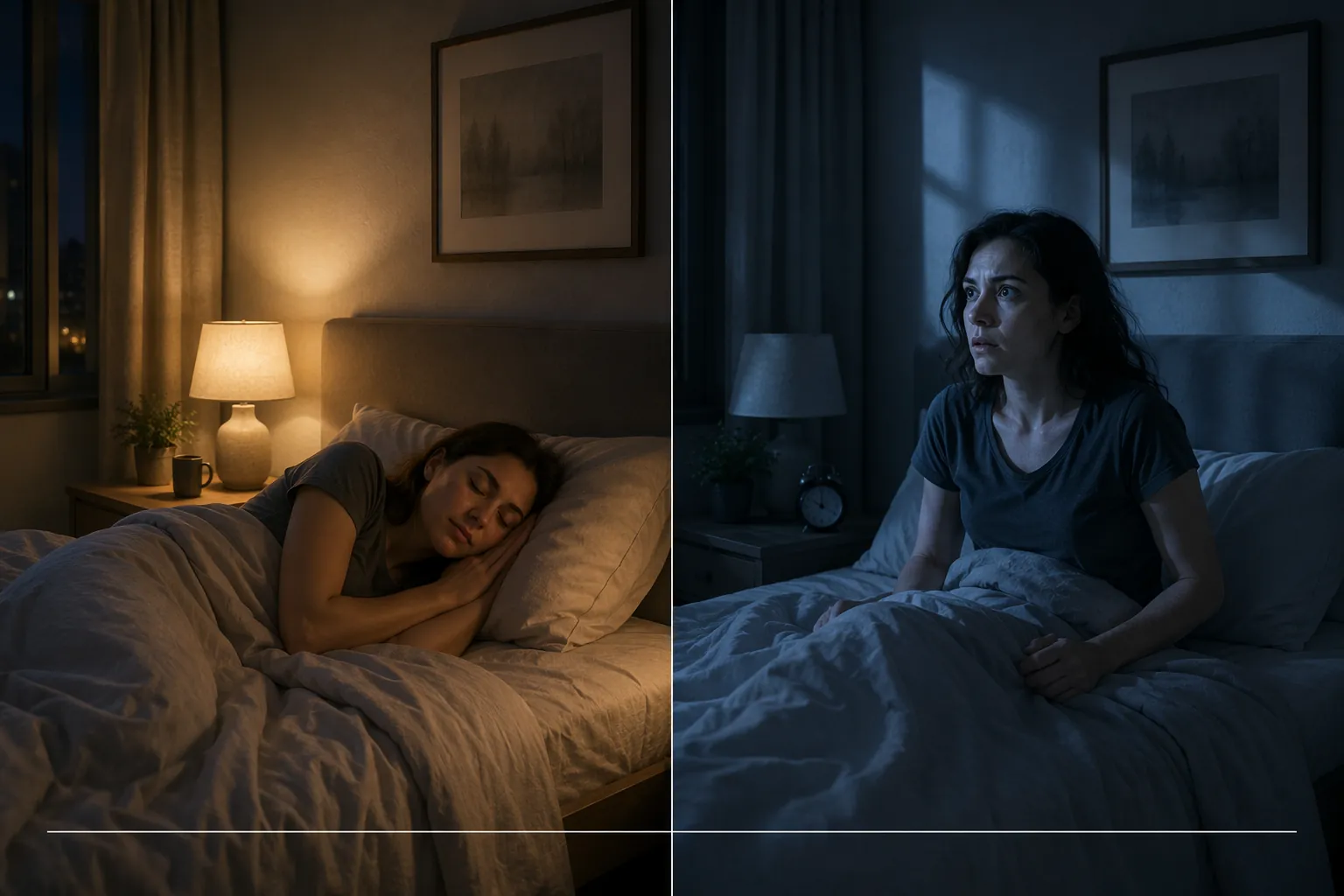
Why the Bed Can Start to Feel Unsafe
Earthquake anxiety has a cruel sleep logic. Night is quiet enough for small sounds to become signals. The body is still enough that a normal heartbeat, a truck outside, or the building settling can feel like the start of shaking. Bedtime also removes distractions, so the mind has room to replay what happened or calculate what could happen next.
Research from survivors of the 2017 Kermanshah earthquake found that stress was the sole significant predictor of sleep quality in the acute phase, with a reported beta of 0.57 and p less than 0.001. [3] That is a narrow finding, but it matches what many people experience: the more the threat system stays activated, the harder sleep becomes.
If you want the body-alarm explanation in more depth, read Why can't earthquake survivors sleep?. This article is mostly about the decision point: when that alarm response stops looking like short-term adjustment and starts looking like a treatable sleep or trauma condition.
What the Red Flags Look Like at Night
Earthquake-specific nightmares
A general bad dream after stress is one thing. A repeated dream that puts you back in the quake is different. The content may be literal, such as shaking walls, falling objects, damaged streets, or being unable to reach a child. It may also be symbolic but unmistakably tied to the event: the floor gives way, the room will not hold, the door cannot open.
The concern is not only the nightmare itself. It is what the nightmare teaches the next evening. If sleep becomes the place where the earthquake returns, the person may begin to fear sleep rather than welcome it.
Avoiding sleep on purpose
Avoidance can look practical from the outside. Someone stays on the couch with the TV on. They keep checking emergency alerts until 2 a.m. They decide they are “just not tired,” though they are exhausted. They sleep in clothes, shoes nearby, lights on, bag packed, and phone in hand—not as a temporary plan during active aftershock danger, but as a nightly requirement weeks later.
Some safety planning is reasonable after a quake. A charged phone, clear exit path, shoes near the bed, and local guidance can make sense. The red flag is when preparation becomes a ritual that must be repeated until sleep is no longer possible, or when the person avoids the bedroom because the bed itself feels like a trap.
Hypervigilance that does not soften
Hypervigilance is the body’s guard duty. Early on, it may be understandable: aftershocks, damage assessments, temporary housing, and official warnings can keep everyone alert. The concern grows when the environment has become safer but the body keeps acting as if the quake is imminent.
In sleep terms, that may mean waking at every creak, holding still to test whether the room is moving, checking the ceiling before lying down, or lying awake doing mental aftershock math. A person may spend so much energy trying not to be surprised that sleep becomes impossible.
Daytime function is starting to go
Sleep anxiety becomes more urgent when the day begins to shrink around it. The person misses work, makes dangerous driving errors, snaps at family, cannot focus in class, or stops doing ordinary tasks because the nights have taken too much out of them.
This is often where family members notice the problem first. They may not see the hours awake, but they see the change: the person is less patient, less present, more isolated, more dependent on someone else staying awake with them, or increasingly afraid of being alone after dark.
Alcohol or substances become the sleep plan
A drink can feel like relief when the bed feels unsafe. It may make the first drop into sleep easier. But when alcohol, cannabis, sedatives not prescribed for you, or other substances become the main way you can face bedtime, the sleep problem has gained a second problem.
This is not a moral failure. It is a sign that the current coping system is overloaded. It is also one of the clearest reasons to involve a clinician, because trauma symptoms, insomnia, medication safety, and substance use need to be handled together rather than in separate silos.
How to Use the One-Month Threshold Without Scaring Yourself
The American Psychiatric Association’s disaster coping guidance recommends seeking professional help if distress remains high after several weeks or if a person has persistent trouble functioning. [4] For sleep after an earthquake, that translates into a practical rule: if your nights are still badly disrupted around the one-month point, or if functioning is impaired sooner, do not keep treating this as ordinary restlessness.
Severity matters. If you survived a destructive earthquake, were injured, lost someone, lost housing, feared death, or remained in an unsafe environment, it is reasonable to seek help earlier. You do not need to wait a month if you are having severe nightmares, panic, dissociation, suicidal thoughts, escalating substance use, or you cannot function.
For someone who did not experience a destructive event but lives in a seismic zone, felt a mild quake, or became frightened after news coverage, the same red flags still matter, but the expected course may be milder. Recent anxiety that is already easing may respond to practical changes: reducing late-night quake checking, creating a simple safety plan once, returning to a stable bedtime rhythm, and using calming strategies without turning them into rituals.
For that acute, easing stage, it makes more sense to use direct sleep supports than to read about diagnoses at 3 a.m. The practical guide Qinghai Earthquake Sleep Anxiety? Try These Practical Tips is a better next step if your symptoms are recent and trending down.
What Professional Help May Be Looking For
A professional evaluation is not a courtroom where you have to prove the earthquake was “bad enough.” It is a structured way to ask what is now maintaining the sleep problem. Several treatable patterns can overlap.
- PTSD may be involved when sleep disruption comes with trauma re-experiencing, avoidance, persistent threat scanning, mood changes, and functional impairment.
- An anxiety disorder may be involved when fear of future earthquakes, bodily sensations, or nighttime uncertainty becomes persistent and difficult to control.
- Clinical insomnia may be involved when the sleep system has become conditioned around wakefulness, dread, clock-watching, irregular sleep timing, or learned fear of the bed.
- Substance-related sleep problems may be involved when alcohol or other substances are doing the work that sleep regulation, safety, and treatment need to do.
These are not character labels. They are treatment targets. The point of naming them is not to make the earthquake define you; it is to stop the nights from becoming smaller and more frightening.
Treatment Should Be Concrete, Not Shaming
For insomnia and sleep anxiety, cognitive behavioral therapy for insomnia, or CBT-I, is often a central evidence-based option. Cleveland Clinic describes CBT-I as a first-line treatment for sleep anxiety and reports that it is effective for 75% to 80% of people with insomnia. [5]
CBT-I is not someone telling you to “just relax.” It usually works on the behaviors and learned associations that keep insomnia going: spending long distressed hours in bed, using the bed as a monitoring station, irregular sleep timing, fear of wakefulness, and the cycle of trying harder and sleeping worse.
When trauma symptoms are prominent, CBT-I may need to sit alongside trauma-focused care rather than replace it. If nightmares, avoidance, panic, or intrusive memories are central, a clinician can assess whether PTSD-focused therapy, anxiety treatment, medication, or coordinated care is appropriate.
A simple way to decide where to start is to describe the night plainly: “I avoid bed,” “I wake from earthquake dreams,” “I check for aftershocks for hours,” “I can’t work the next day,” or “I’m drinking to sleep.” Those sentences give a clinician more useful information than trying to decide in advance whether you “count” as traumatized.
If You Are Trying to Sleep Tonight
If the earthquake was recent, you are physically safe, and your symptoms are easing, focus on the immediate night rather than the whole future. Make one safety check, not ten. Keep shoes, a phone, and any necessary emergency items in a predictable place. Then stop turning the bed into the command center.
If you are awake and escalating, leave the bed briefly and do something quiet until sleepiness returns. The goal is not to punish yourself for being awake; it is to prevent the bed from becoming the place where your body practices panic. For in-the-moment troubleshooting, use Can't Sleep at Night? A Real-Time Action Plan for Sleepless Moments or match the technique to the actual barrier with How to Fall Asleep Based on What's Actually Keeping You Awake.
If the same pattern has been going on for weeks, though, do not make tonight’s coping strategy carry the whole burden. Practical tips can support recovery, but they are not a substitute for evaluation when red flags are present.
Where the Line Starts to Shift
Earthquake-related sleep anxiety can be normal at first. It can also become treatable insomnia, PTSD, an anxiety disorder, or a combination. The difference is not whether you were scared. The difference is persistence, impairment, avoidance, nightmares, hypervigilance that does not fade, and whether substances have become part of the sleep routine.
Crisis Text Line has put the post-earthquake anxiety message simply: “It’s normal. And treatable.” [6] That is the steadier position than either minimizing the problem or declaring permanent damage.
If symptoms are recent and easing, use practical earthquake sleep strategies. If you want to understand why your body is still on alert, read the mechanism explainer. If sleep is still disrupted beyond about a month, or if the red flags are present now, seek professional evaluation and ask about evidence-based care such as CBT-I and trauma-informed treatment.
References
- Disturbed sleep linked to mental health problems in earthquake survivors, American Academy of Sleep Medicine.
- Sleep quality and post-traumatic stress symptoms among earthquake survivors, Nature, 2025.
- The predictors of sleep quality in the acute phase after the Kermanshah earthquake, PMC.
- Coping After Disaster and Trauma, American Psychiatric Association.
- Sleep Anxiety, Cleveland Clinic.
- Post-Earthquake Anxiety: It’s Normal. And Treatable., Crisis Text Line, July 17, 2019.
Read the full guide: Qinghai Earthquake Sleep Anxiety? Try These Practical Tips