
Qinghai Earthquake Sleep Anxiety? Try These Practical Tips
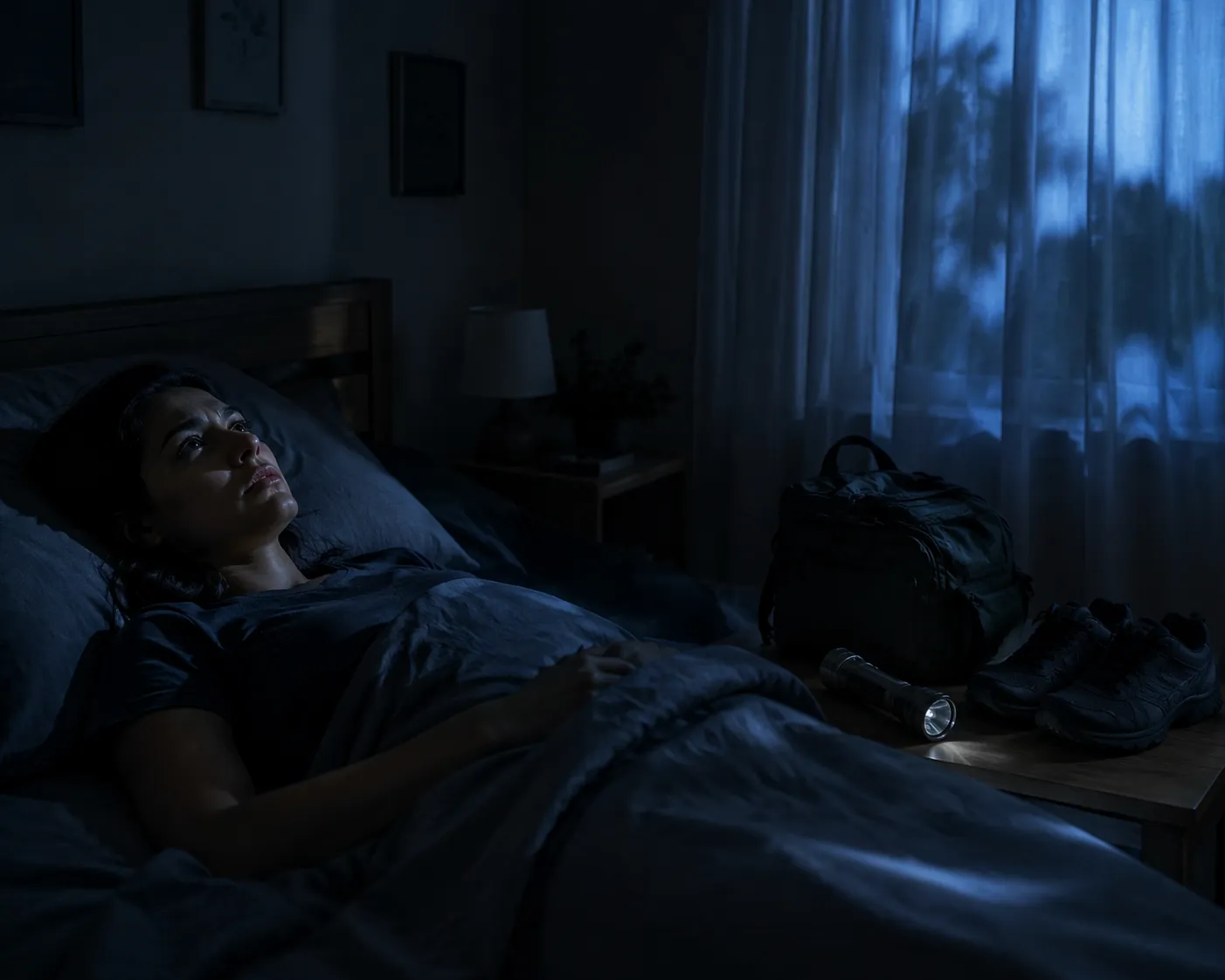
If you are scared to fall asleep because an aftershock might hit while you are unconscious, that fear is not foolish. It is your nervous system trying to keep watch after a real seismic event. In Qinghai, where people have been dealing with ongoing aftershocks, bedtime can start to feel like the least safe part of the day: lights off, shoes off, phone down, everyone else asleep.
That is different from ordinary insomnia. You are not just “having trouble relaxing.” You may be doing threat monitoring: listening for vibration, checking whether the building feels steady, planning how to wake family members, and rehearsing what you would grab if the room started moving again.
Research after larger earthquakes helps explain why this feels so physical. In a study of adults living in tent cities after the 2023 Turkey earthquakes, the absolute rate of insomnia increased by 57.5 percentage points after the disaster.[1] A separate study of adolescent earthquake survivors found that 89.4% of those with high earthquake anxiety had poor sleep quality, and high anxiety was associated with a 5.7 times higher risk of poor sleep.[2] Those studies are not Qinghai-specific, and the Turkey disaster was much larger, so the numbers should not be imported directly onto your situation. But they do support the basic point: after seismic threat, many bodies stay awake because they are trying to prevent being caught unprepared.
Make the Room Exit-Ready Before You Ask Your Body to Sleep
The first step is not to persuade yourself that nothing will happen. The first step is to remove the avoidable friction between “I feel shaking” and “I can move.” That matters because your brain is less likely to keep you on guard if it believes the next action is already prepared.
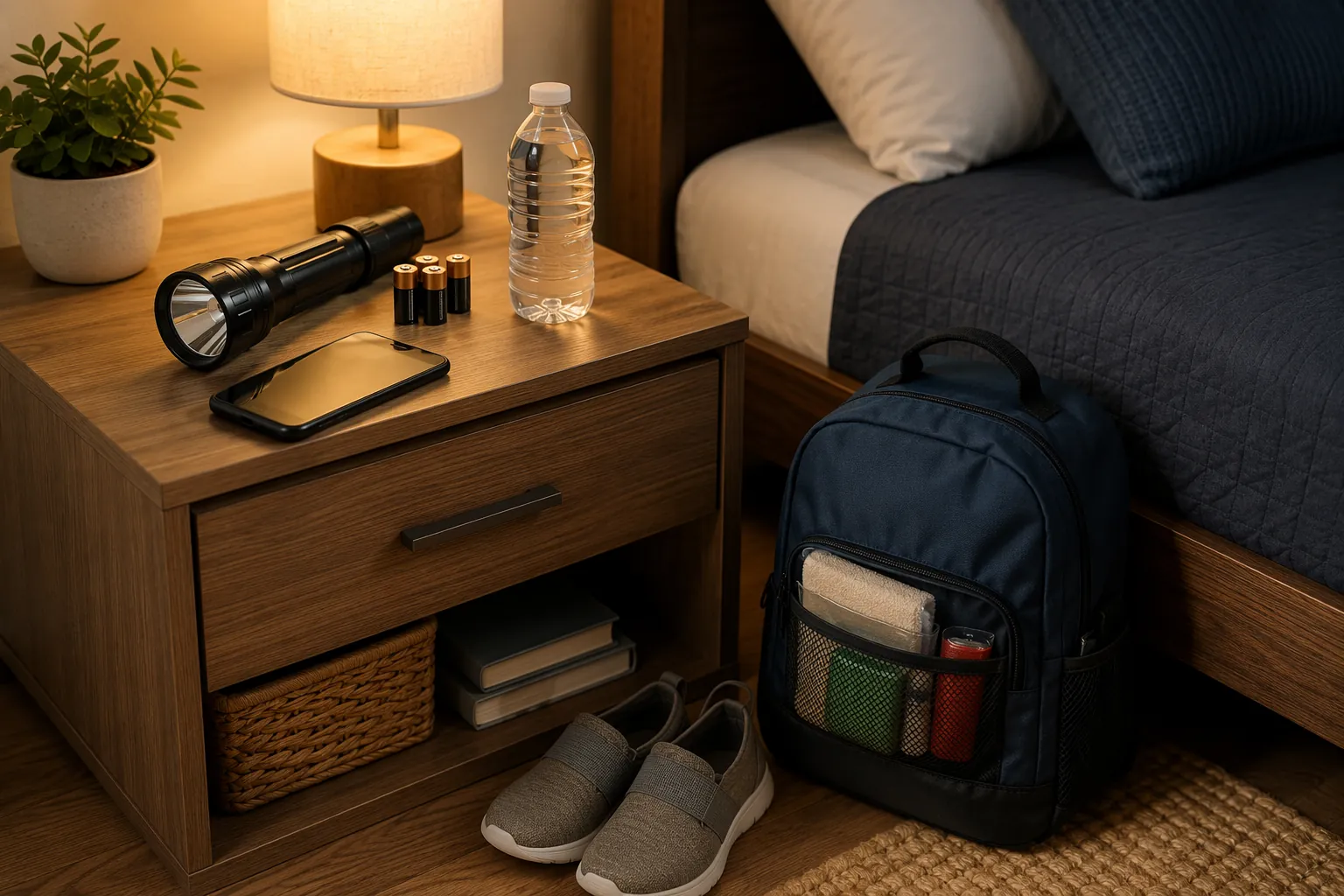
- Put sturdy slip-on shoes beside the bed, not across the room.
- Place a flashlight where your hand naturally reaches, and check that it works before lying down.
- Keep your phone charged and within reach, but do not keep refreshing alerts once your safety check is done.
- Set a small go-bag nearby with essentials you would actually need first, not every item you can imagine.
- Clear the path from bed to door so you are not stepping over furniture, cords, toys, or bags in the dark.
- Agree on a simple household plan: who picks up a child, who checks an older relative, and where you meet if you need to leave.
This is not overreacting. It is targeted preparation. Disaster-coping guidance commonly emphasizes restoring a sense of safety, connection, and control after frightening events, and clinical advice on earthquake anxiety also points toward practical grounding rather than vague reassurance.[3][4] For sleep, that preparation has a specific job: it lets the part of you that wants to stay awake say, “I have done the useful things.”
Keep the setup small enough that it can become a nightly routine, not a second emergency drill. If you spend an hour repacking the bag, comparing possible exits, and reading every aftershock update, the preparation has turned back into arousal. A good stopping point is when the next action is clear: shoes on, light in hand, phone available, path open.
Separate Useful Preparation From Prediction
After an earthquake, the mind often tries to solve the unsolvable part: exactly when the next aftershock will come, how strong it will be, whether the building will hold, whether sleep itself is dangerous. Some checking is rational. Endless prediction is not the same as safety.
| Useful preparation | Spiraling prediction |
|---|---|
| Putting shoes, flashlight, phone, and go-bag within reach | Replaying every possible aftershock scenario after the setup is complete |
| Checking one reliable update before wind-down | Refreshing feeds repeatedly in bed |
| Agreeing on a family response plan | Mentally testing the plan again and again without changing anything |
| Clearing the exit path | Scanning the room for new dangers until sleep is impossible |
When you notice yourself crossing into prediction, use a plain interruption rather than an argument. Crisis Text Line’s guidance on post-earthquake anxiety describes thought-stopping as one way to interrupt escalating anxious loops.[5] In bed, that can sound like: “Stop. I already prepared for the action I can take. Predicting the timing is not my job right now.”
The wording matters less than the boundary. Do not try to prove that an aftershock will not happen. You cannot prove that, and your anxious brain knows it. The more honest replacement is: “If shaking happens, I have a first move. Until then, my job is to rest.”
Use Breathing to Tell the Alarm System the Drill Is Over
Once the room is prepared, the next problem is body arousal. Your chest may feel tight. Your hearing may sharpen. Every truck, door, or pipe sound may seem meaningful. Slow breathing will not erase earthquake risk, but it can lower the internal alarm enough for sleep pressure to return.
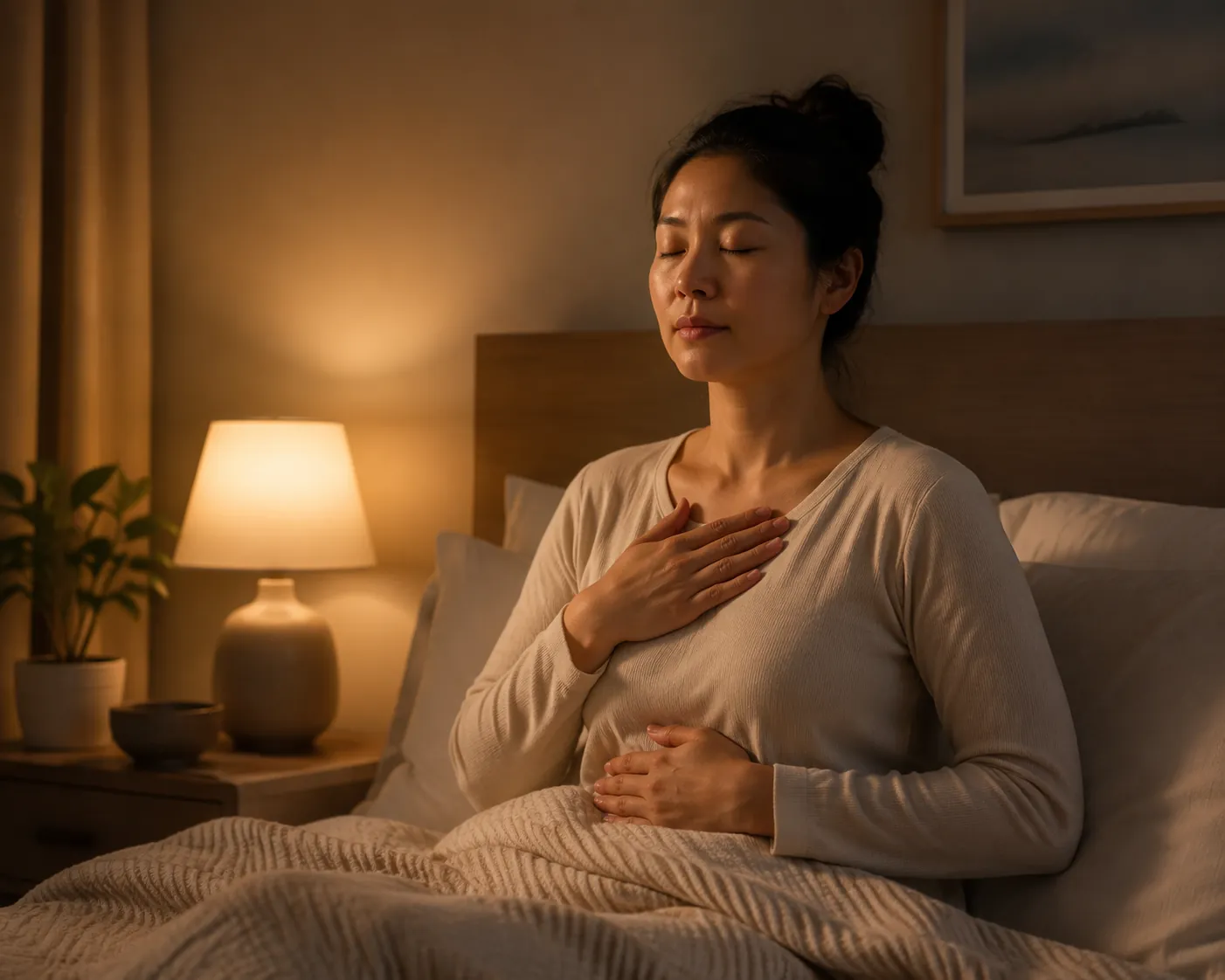
A simple pattern recommended in clinical coping advice is to inhale for a count of 5 and exhale for a count of 7.[3] The longer exhale is the important part. It gives your body a repeated signal that it does not need to stay braced every second.
- Lie down or sit with your back supported.
- Place one hand on your chest or belly if that helps you track the breath.
- Inhale gently through your nose for 5 counts.
- Exhale slowly for 7 counts, as if you are letting the body soften downward.
- Repeat for several rounds without forcing a deep breath.
If counting makes you more alert, make it looser: shorter inhale, longer exhale. If lying flat feels too vulnerable, start sitting up, then lower yourself after a few rounds. The goal is not perfect breathing. The goal is to give the body a rhythm that is stronger than the scanning.
Relax the Muscles That Are Waiting to Run
After earthquakes, many people sleep as if they might need to jump up at any second. Jaw tight, shoulders raised, calves ready, hands half-clenched. Progressive muscle relaxation works well here because it does not ask you to “just calm down.” It gives your muscles a sequence to follow.
Start at your feet. Tense the muscles gently for a few seconds, then release. Move to calves, thighs, hips, stomach, hands, arms, shoulders, face. Keep the tensing mild; this is not exercise. The useful moment is the release, when your body feels the difference between being braced and being supported by the bed.
If a sound interrupts you, do not treat that as failure. Pause. Identify it if needed. Then return to the last muscle group you remember. Earthquake-related sleep anxiety often improves through repetition, not through one perfectly calm night.
Keep Sleep Hygiene, But Make It Earthquake-Aware
Standard sleep advice can sound insulting after an earthquake if it ignores the fear in the room. Still, a few sleep-hygiene basics become useful once your safety setup is done.
- Choose one reliable information check, then stop using news as a bedtime sedative. It usually becomes fuel.
- Keep the same approximate sleep and wake window, even if sleep is lighter than usual.
- Avoid alcohol as a sleep tool; it can fragment sleep and make nighttime waking more frightening.
- If you cannot sleep after a while, sit somewhere dim and quiet rather than lying in bed rehearsing disaster scenarios.
- Use calming contact if available: a message to a trusted person, a quiet check-in with family, or sleeping near others for a few nights if that helps.
For people still in the first-night crisis phase, the companion guide How to Get Some Sleep After an Earthquake is the better starting point. This article is for the later stage, when the immediate shock has passed but your sleep system still behaves as if it is on duty.
What If You Wake Up After a Noise or Small Tremor?
Have a short script ready, because 3 a.m. is a bad time to invent one.
- Check for immediate danger.
- If action is needed, follow the household plan.
- If no action is needed, say: “That was a check. I am returning to rest.”
- Do 5-count inhale, 7-count exhale for several rounds.
- Restart progressive muscle relaxation from the feet or hands.
This keeps the wake-up from becoming a full investigation. You are allowed to check. You are also allowed to end the check.
When Self-Help Is Not Enough
Most post-disaster sleep anxiety eases as people regain safety, routine, and confidence in their response plan. But some sleep problems need more than bedside tools. In a report on survivors of the 2010 Haiti earthquake, 94% reported insomnia symptoms, and 42% had clinically significant PTSD two years later.[6] Haiti was a much larger and more devastating disaster than the Qinghai event, so those figures should not be read as a forecast. They do show why persistent sleep disruption deserves attention rather than shame.
Seek professional assessment if insomnia continues for more than two weeks, if nightmares keep returning, if daytime flashbacks interrupt ordinary tasks, if you are avoiding sleep because it feels unsafe, or if you are using alcohol or sedatives to get through the night. A clinician can help sort normal post-disaster arousal from symptoms that may respond to structured treatment.
If these steps are not enough, the next place to go is Evidence-Based Sleep Treatments After Earthquake Trauma, which covers options such as CBT-I and imagery-based nightmare treatment. If you are also dealing with evacuation or displacement stress, How to Sleep After Flood Evacuation Stress may also be relevant.
References
- Physical Symptoms and Coping Strategies With Earthquake Stress Among Adults Living in Tent Cities: A Cross‐Sectional Study — PMC, 2024.
- Earthquake anxiety and sleep quality among adolescent survivors — Nature Scientific Reports, 2025.
- Earthquake anxiety: How to cope — CNN, 2024.
- Coping After Disaster, Trauma — American Psychiatric Association.
- Post-Earthquake Anxiety: It’s Normal and Treatable — Crisis Text Line, 2019.
- Disturbed sleep, mental health problems common among survivors of Haiti earthquake — American Academy of Sleep Medicine, 2019.
Read the full guide: Is Earthquake Sleep Anxiety Normal or a Sign of PTSD?