
Is the Financial Stress Test Keeping You Up at Night?
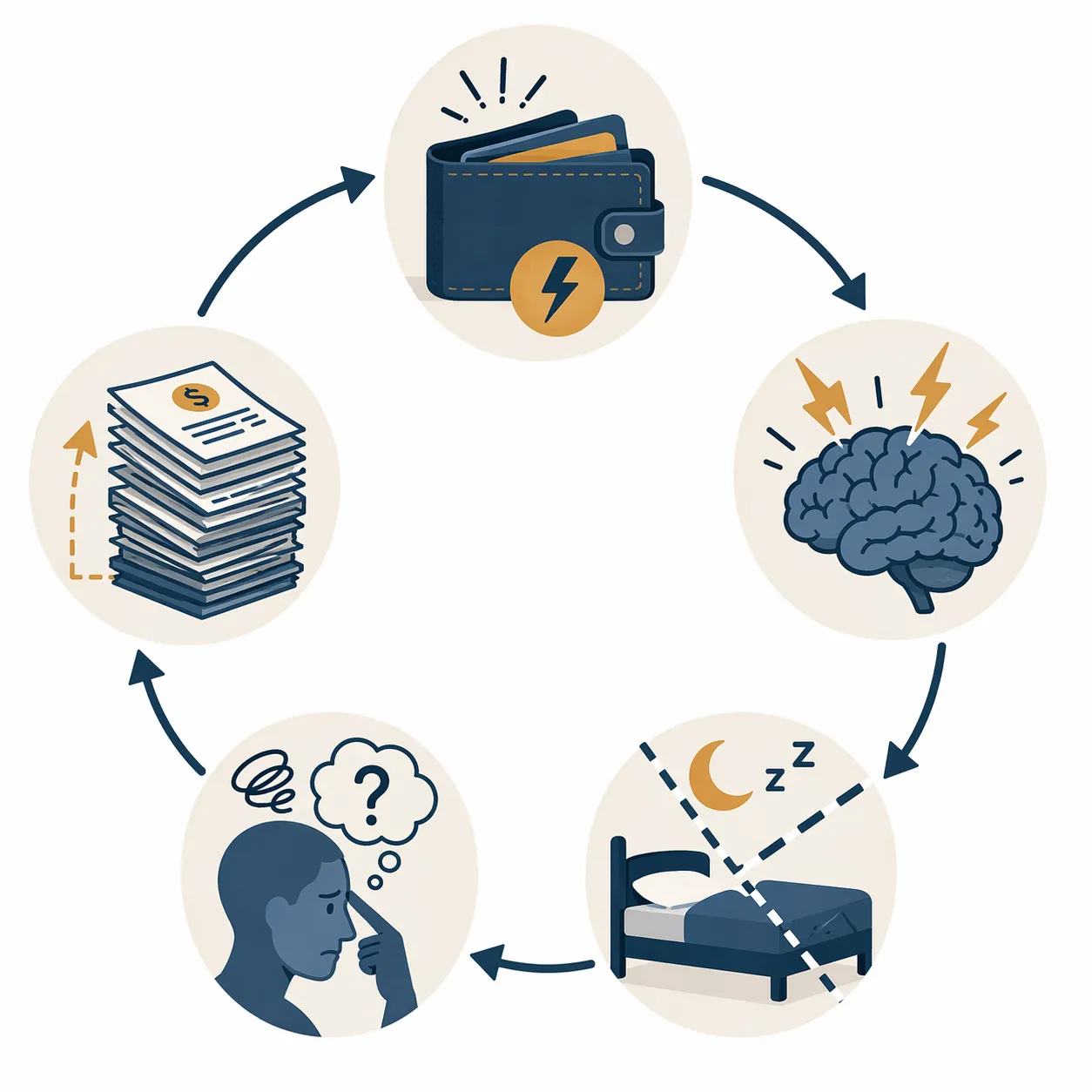
A “financial stress test” usually sounds like something banks take, not something a body takes at 2:17 a.m. But the personal version is familiar: lying still while the mind re-runs rent, insurance, groceries, debt, a possible layoff, or the bill that may already be late. Yes, the financial stress test impact on sleep is measurable. The strongest current evidence points to a specific pathway: money strain follows people into bed as cognitive and behavioral hyperarousal, including what one research team calls “stress-before-bed behaviors,” and that arousal shows up in insomnia symptoms, lower sleep satisfaction, and next-day impairment.

That distinction matters. Financial worry is often treated as if it were merely a failure to relax. The evidence is more concrete than that. In a 2025 longitudinal study from Rice University, researchers followed workers for nine months and used actigraphy validation to connect economic stress with sleep outcomes. The bridge between the two was not an abstract “money mindset.” It was bedtime arousal: checking, bracing, mentally rehearsing, and carrying financial threat-monitoring into the period when the nervous system is supposed to stand down. Those stress-before-bed behaviors helped explain the link between economic strain and insomnia symptoms, lower sleep satisfaction, and daytime impairment.[1]
How Money Worry Gets Into Bed
The Rice study is useful because it does not stop at “people who are stressed sleep worse.” It follows the process into the bedroom. Financial stress becomes a sleep problem when it changes what a person does and monitors before sleep: looking for bad news, mentally opening bills that are not physically in the room, calculating whether one shortfall can be moved to another week, and staying alert for consequences that cannot be solved at midnight.
That is hyperarousal in plain clothes. The mind is not wandering; it is working. The body is not simply “tense”; it is behaving as if a problem still requires surveillance. Bedtime becomes the day’s last accounting session, and sleep onset has to compete with threat detection.
In that setting, the problem is not only that worry feels unpleasant. It changes sleep opportunity into sleep resistance. A person may get into bed on time and still lose continuity because the pre-sleep period has been filled with checking, planning, and physiological readiness. This is why financial stress can produce a pattern that feels unfairly confusing: exhaustion without sleepiness, a quiet room with a busy body, and a morning that arrives before the nervous system ever fully disengaged.
Other stress domains show similar threat-detection patterns during sleep disruption. That does not mean every stressor is interchangeable, but it helps explain why money worry can feel so bodily. Financial problems carry deadlines, consequences, and uncertainty; the brain treats that combination as unfinished business. Readers who want a broader sleep-science comparison may recognize the same arousal logic in threat-focused stress, such as hurricane anxiety and sleep disruption or wildfire stress and sleep.
It Shows Up in Objective Sleep, Not Just Complaints
Self-reported sleep loss is easy to dismiss, especially by people who are used to functioning through strain. Polysomnography data in older adults make dismissal harder. In Hall and colleagues’ study, older adults with ongoing financial strain averaged 73.8% sleep efficiency, compared with 80.9% among those without ongoing financial strain. The authors characterized that difference as clinically meaningful and associated with increased mortality risk.[2]
Sleep efficiency is not a mood rating. It measures how much of the time in bed is actually spent asleep. A lower number can reflect more wakefulness after sleep onset, more fragmented sleep, or a night that looks long on the clock but short in actual recovery. For an older adult on a fixed budget, that matters because the body may be paying for financial uncertainty even when no one else sees the work being done.
This is where the personal financial stress test becomes more than a metaphor. It is not only the size of the bill. It is the absence of margin. A person with savings may worry intensely; a person without savings may have to keep scanning because one surprise expense changes the next meal, medication refill, rent payment, or transportation plan.
The Prevalence Numbers Are High Because the Worry Is Plausible
Survey data confirm that this is not a private oddity. In an American Academy of Sleep Medicine survey published in 2022, 87% of American adults reported losing sleep over financial worries.[3] A later Sleep Foundation report put the figure at 77%.[4] These numbers should not be mistaken for clinical diagnoses, and they do not prove that every person losing sleep has insomnia. They do show that financial worry is a common sleep disruptor, not an embarrassing exception.
The worry is also plausible in the current financial environment. A 2026 National Endowment for Financial Education poll reported that only 36% of Americans were certain they could handle an unexpected $2,000 expense.[5] That does not mean the other 64% are awake every night. It means many people enter bedtime with a realistic awareness that one car repair, medical bill, rent increase, or income interruption could overwhelm the plan.
This is why vague reassurance can land badly. If the threat is partly real, the body’s alertness is not irrational just because it is inconvenient. The clinical question becomes when vigilance has stopped helping and started eroding sleep, daytime functioning, and the capacity to respond.
Who Carries the Heaviest Sleep Burden
Financial stress can disturb sleep at any income level. A comfortable person can still lie awake over market losses, family obligations, debt, or retirement uncertainty. But the strongest vulnerability signals come from groups with fewer buffers, less control over income, or more exposure to consequences.
NHIS-based findings from Ryu and Fan show that financial worry and psychological distress do not fall evenly across circumstances. Unemployed adults had a 39% stronger association between financial worry and distress than employed adults, with β=0.329 versus β=0.236. The link was also stronger in households with income below $35,000 than in households at $100,000 or more, with β=0.293 versus β=0.195. Renters and unmarried adults also showed amplified effects.[6]
Those figures are about distress, not sleep efficiency. They still matter here because distress is one of the routes by which financial strain can become bedtime arousal. The unemployed applicant waiting for a callback is not doing the same nighttime math as someone choosing between investment accounts. The renter facing a lease renewal has a different exposure than an owner with more stability. The unmarried adult may have fewer built-in household buffers when a bill arrives.
Older adults deserve separate attention because retirement can convert financial worry into a daily sleep issue rather than a temporary crunch. Hall’s data connect ongoing financial strain with objectively lower sleep efficiency in late life.[2] For readers thinking specifically about retirement insecurity, the same mechanism is explored in Gen X retirement anxiety and sleep and in inflation-related sleep loss among retirees.
Adolescents show a related but distinct signal. In a 2025 Korean adolescent study, female adolescents experiencing severe financial hardship were 14% more likely to sleep less than seven hours and 52% more likely to sleep more than nine hours, a U-shaped pattern.[7] That study is not interchangeable with adult U.S. financial-stress data, and it should not be used to rank adolescent risk against adult risk. It does suggest that financial hardship can disturb sleep duration patterns even before a person is responsible for household finances.
| Evidence stream | What it adds | What not to overclaim |
|---|---|---|
| Rice University worker study | A longitudinal pathway from economic strain to stress-before-bed behaviors and poorer sleep outcomes | It does not prove every financial worry becomes insomnia |
| Older-adult polysomnography | Objective sleep efficiency is lower among older adults with ongoing financial strain | It is not a universal estimate for all adults |
| AASM and Sleep Foundation surveys | Many adults report losing sleep over financial worries | Survey prevalence is not the same as clinical diagnosis |
| NHIS vulnerability findings | Unemployment, lower income, renting, and unmarried status amplify distress linked to financial worry | The measures are distress-focused, not direct sleep recordings |
| Korean adolescent study | Severe financial hardship is associated with short and long sleep patterns in female adolescents | It is a separate population and context |
When Worry Starts Looking Like Insomnia
Temporary sleep loss before a bill deadline or job decision is different from a persistent insomnia pattern. The line is not drawn by how legitimate the worry is. A real problem can still produce a sleep disorder if the sleep disruption becomes frequent, conditioned, and impairing.
The practical signs are familiar: getting into bed and immediately starting calculations, avoiding the bank app all day and then checking it at night, waking early with a surge of dread, or losing so much sleep that the next day’s applications, calls, paperwork, or decisions become harder. At that point, the issue is no longer only whether the financial problem is solvable. It is whether sleep loss is now reducing the capacity to solve it.
For readers trying to tell the difference between a bad stretch and a pattern that needs more attention, an insomnia triage framework is more useful than another generic relaxation checklist. The important question is not whether money stress is “valid.” It is whether sleep continuity, daytime functioning, and emotional regulation are being persistently compromised.
The Feedback Loop Is Plausible, but Not Equally Proven at Every Link
The best-supported chain in the financial-stress literature is this: financial strain increases bedtime hyperarousal, and that hyperarousal is associated with poorer sleep outcomes. Rice’s longitudinal design is important because it gives that chain a timeline rather than a snapshot.[1]
The next part is clinically believable but should be stated more carefully: poor sleep can plausibly make financial problems harder to handle because sleep loss impairs executive function, attention, impulse control, and emotional regulation. A person who slept badly may be less able to compare options, make calls, open mail, tolerate uncertainty, or avoid panic-based decisions. But the complete loop — financial stress causing poor sleep, poor sleep causing worse financial decisions, and those decisions increasing financial stress — is not equally proven at every link in the specific financial-stress research.
That caveat matters at bedside. If someone is awake doing math in the dark, the most evidence-based statement is not that sleep loss has already damaged their finances. It is that financial strain can produce measurable sleep disruption through bedtime arousal, and once sleep is degraded, the next day’s coping capacity may be lower.
Money worry is not “just in your head,” and sleep loss is not a moral failure. The evidence supports a real pathway from economic strain to bedtime hyperarousal to poorer sleep, with the strongest burden falling on people who have fewer financial buffers. The next useful step is recognizing when temporary worry has become persistent insomnia, daytime impairment, or a nightly stress test the body can no longer pass.
References
- Losing sleep over money? Rice study reveals how financial stress follows workers to bed, Rice News, 2025.
- Financial strain is a significant correlate of sleep continuity disturbances in late-life, PMC.
- Financial and health-related worries keeping Americans up at night, survey shows, American Academy of Sleep Medicine.
- 77 Percent of Americans Lose Sleep Over Financial Worries, Sleep Foundation.
- Poll: Americans Feeling Stressed to Begin 2026, National Endowment for Financial Education, 2026.
- Financial worries and psychological distress among U.S. adults, PMC.
- Association between economic hardship and sleep duration among Korean adolescents, Nature Scientific Reports, 2025.
Read the full guide: Why You Can't Sleep Your First Night in the Boundary Waters