
Your Five-Star Weekend Guide to Meaningful Sleep Recovery
The most tempting Saturday sleep plan is also the one that often backfires: turn off the alarm, sleep until late morning, feel briefly rescued, then wonder why Sunday night is restless and Monday feels oddly hostile. That does not mean weekend recovery sleep is useless. It means the useful part has a narrower window than most tired people are told.
The evidence is not a clean yes-or-no verdict. In a UK Biobank analysis reported by EMJ Reviews, weekend recovery sleep was associated with lower risk of all-cause dementia and vascular dementia among adults with insufficient weekday sleep, with reported hazard ratios of 0.801 and 0.747 respectively in a sample of 88,592 adults; because this is being cited through the EMJ report rather than the original full text, those exact values should be treated as important but still worth verifying against the primary publication when available.[1] At the same time, controlled metabolic research has found that weekend catch-up sleep did not undo the effects of severe weekday restriction on excess calorie intake, reduced energy expenditure, and weight gain.[2]
So the practical question is not whether a weekend can help. It is how much recovery you can take before the weekend starts shifting your body clock, appetite timing, and Monday wake-up pressure in the wrong direction.

The Five-Star Weekend Flow
A five-star weekend for sleep recovery is not the weekend with the longest sleep. It is the one that gives the brain and body extra rest without making Sunday night and Monday morning pay for it.
| Weekend move | What to do | Why the timing matters |
|---|---|---|
| Anchor wake time | Wake within about one hour of your usual weekday wake time. | A stable wake time protects the circadian signal that makes sleep easier the next night. |
| Add modest catch-up sleep | Go to bed a little earlier or wake a little later, but avoid turning Saturday into a late-morning sleep marathon. | Extra sleep may help recovery, but large schedule shifts can move the body clock. |
| Use a short nap | If you are still depleted, take a 15- to 20-minute nap rather than sleeping deep into the morning. | A brief nap can reduce sleepiness without swallowing the day or weakening nighttime sleep pressure. |
| Front-load light, movement, and low-stakes pleasure | Put daylight, an easy walk, stretching, errands, or relaxed social time earlier on Saturday. | Morning signals help keep the weekend aligned instead of letting it drift. |
| Protect Saturday night | Use a wind-down that is actually timed: a warm bath about 90 minutes before bed, a cooler bedroom, and a low-stimulation close to the day. | The routine works best when it supports sleep onset physiology, not just a cozy mood. |
| Do not make Sunday a second experiment | Keep Sunday wake time close to Saturday’s and avoid a late nap. | Sunday is the bridge back to the week; pushing it later makes Monday harder. |
If weekday sleep has been chronically short, this flow will not erase the debt in one weekend. For a fuller look at the recovery timeline, see how many nights it takes to recover sleep debt. The weekend can still be used well, but it works better as a controlled repair period than as a collapse.
Why the Wake-Time Anchor Does So Much Work
Wake time is the quiet hinge of the weekend. Bedtime gets more attention because it feels like the moment of discipline, but wake time is what gives the circadian system a repeated morning cue. Mayo Clinic sleep guidance places a consistent sleep schedule, including weekends, at the top of its sleep tips, with the recommendation to limit the difference between weeknight and weekend schedules to no more than one hour.[3]
That one-hour boundary is not meant to punish a tired person. It is a practical compromise. If you normally wake at 6:30 a.m., a 7:15 or 7:30 Saturday wake-up gives you some relief while keeping morning light, breakfast, movement, and evening sleep pressure in roughly the same neighborhood. A 10:30 wake-up asks the body to run Saturday on a different time zone.
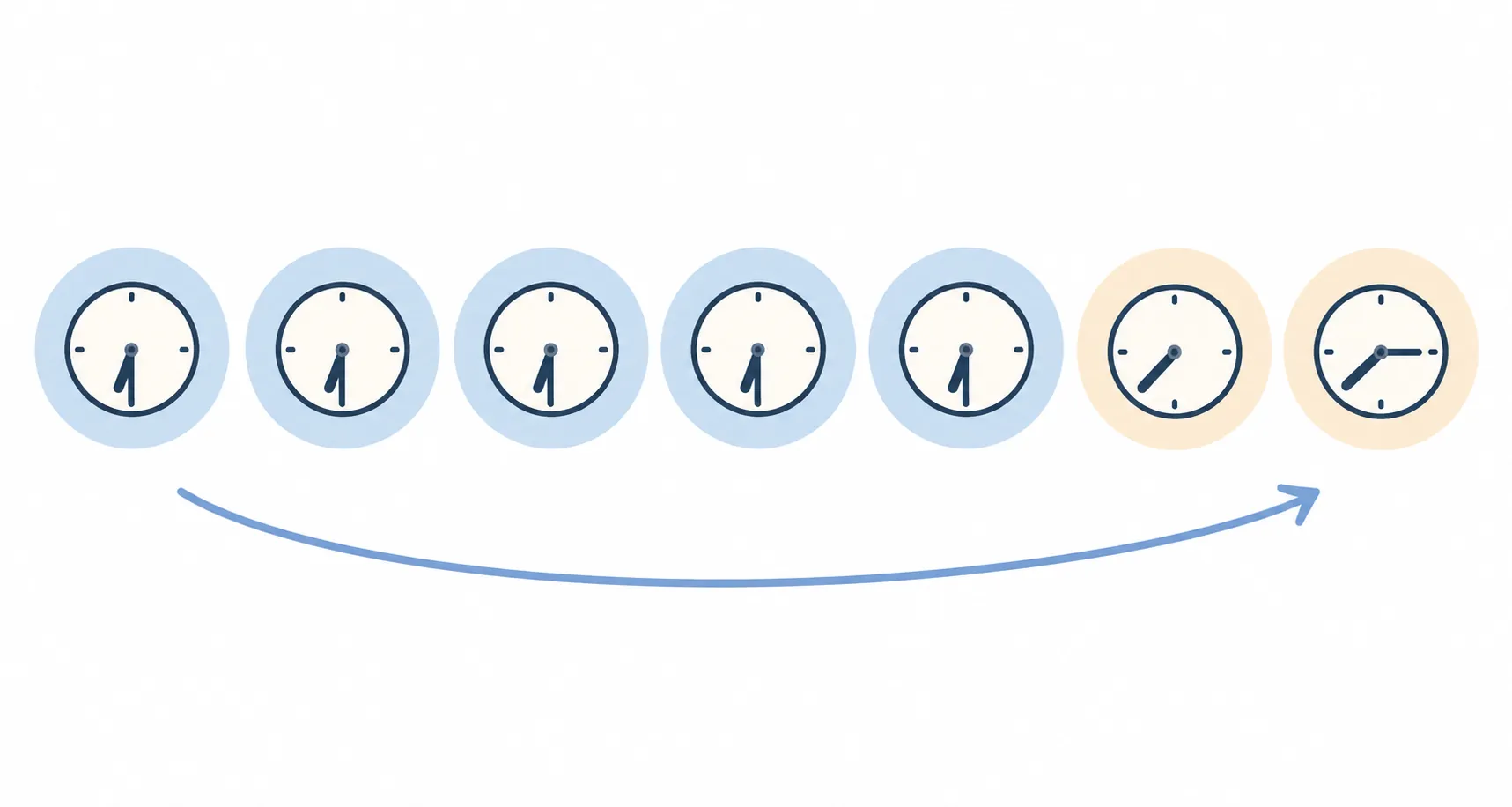
This is also where the phrase “sleeping in” becomes too blunt. There is a meaningful difference between allowing a modest extension and letting the entire first half of the day disappear. The first can be part of recovery. The second can delay the cues that help you fall asleep on time later.
For women, especially those already navigating midlife sleep disruption, the outer boundary deserves extra care. The American Heart Association reported on research linking more than two hours of weekend catch-up sleep with poorer cardiovascular health in women.[4] That finding does not prove that every long Saturday sleep-in causes harm, and it is not a reason to shame anyone who is exhausted. It is a reason not to casually recommend “sleep as late as you can” as if all catch-up sleep carries the same risk profile.
Readers dealing with perimenopause, pregnancy, ADHD, aging-related sleep changes, or shift work may need a more specific plan than a general weekend protocol can provide. The wake-time anchor still matters, but the obstacles around temperature, awakenings, medication timing, caregiving, or work schedules can change the best route.
Use a Nap Before You Use the Whole Morning
The nap-versus-oversleep decision is where many weekends are won or lost. If you wake within your one-hour window and still feel heavy, the cleanest next move is usually not to go back to bed for three more hours. It is to get up, collect the morning cues your body needs, and place a short nap later if sleepiness remains.
Harvard Health describes short naps of about 15 to 20 minutes as a way to reduce sleepiness while avoiding the grogginess that can come from longer naps.[5] Mayo Clinic similarly advises keeping naps short and avoiding late-day naps because they can interfere with nighttime sleep.[3]

A practical version looks like this: wake around your anchored time, get daylight, eat or hydrate normally, move a little, and then nap for 15 to 20 minutes in the early afternoon if your body is still asking for help. The point is not to prove toughness. It is to separate recovery from circadian drift.
A short nap also protects Saturday night. Long late naps can drain the sleep pressure that needs to build across the day. Sleeping until late morning can do the same thing by delaying the day’s starting signal. Either way, the bill often arrives as a restless night, a delayed Sunday wake-up, and a Monday morning that feels like an ambush.
What Weekend Recovery Sleep Can and Cannot Repair
The dementia finding is worth taking seriously because the outcome matters and the sample was large. In the EMJ-reported UK Biobank analysis, adults with insufficient weekday sleep who had weekend recovery sleep showed lower associated risk of all-cause dementia and vascular dementia.[1] That is an association, not a prescription to sleep until noon, and the report should not be stretched into a claim that weekend sleep prevents dementia.
The narrower and more useful reading is this: for people who cannot always get enough sleep during the week, some weekend recovery may be better than none for cognitive health. That matters because many adults do not have full control over weekday schedules. Caregiving, long commutes, early shifts, pain, hormonal changes, late events, and stress are not solved by telling someone to “just be consistent.”
Metabolic recovery is less forgiving. In Depner and colleagues’ 2019 Current Biology study, participants assigned to weekday sleep restriction followed by ad libitum weekend recovery sleep still showed increased after-dinner energy intake, reduced energy expenditure, weight gain, and reduced insulin sensitivity compared with baseline patterns.[2] Harvard Health’s discussion of the study summarized the practical message plainly: weekend catch-up sleep did not fix the metabolic effects of sleep deprivation on the waistline.[6]
The study’s restriction was severe: the weekday-restricted participants were cut to five hours in bed per night.[2] That may not perfectly match someone who loses 45 minutes most weeknights. Still, it blocks the most comforting but least useful conclusion: that a heroic Saturday sleep-in can make chronic weekday restriction metabolically harmless.
Make Saturday Morning Pull the Clock Forward
Once you are awake, the next hour matters. A five-star Saturday morning does not need to be ambitious. It needs to be legible to the body: light, upright posture, some movement, and enough structure that the day starts.
That can be a walk, an easy stretch, a quiet breakfast near a bright window, a low-key errand, or sitting outside with coffee. The activity does not have to be vigorous to be useful. Its job is to keep the recovery day attached to morning rather than letting it float toward afternoon.
This is also where relaxation belongs. Put the gentler pleasures early enough that they do not steal from sleep later: a slow breakfast, a bathrobe hour, reading in daylight, a walk without performance goals. Recovery feels more humane when the weekend contains softness, but softness works best when it does not erase the timing signals that make nighttime sleep possible.
Time the Relaxation Instead of Decorating It
Evening routines are often written as if any pleasant ritual automatically improves sleep. Some do. Some are just attractive delays. The difference is timing and mechanism.
A warm bath is a good example. Stanford Lifestyle Medicine recommends a hot bath about 90 minutes before bed to support the natural core body temperature drop that helps initiate sleep.[7] The bath is not magic because it is luxurious. It is useful because the warming and subsequent cooling are placed close enough to bedtime to assist sleep onset.
Bedroom temperature works the same way. Stanford Lifestyle Medicine lists 60 to 67°F as a recommended bedroom range for sleep.[7] A cooler room is not a design preference; it supports the body’s normal nighttime temperature pattern.
Mindfulness has a modest but real evidence signal when practiced as more than a last-minute rescue. In a 2018 systematic review and meta-analysis of 18 randomized controlled trials with 1,654 participants, mindfulness meditation improved sleep quality compared with nonspecific active controls, with an effect size of 0.33 at post-intervention and 0.54 at follow-up; reported adverse event rates were lower in mindfulness groups than in comparator groups.[8]
For a weekend protocol, that can mean 10 quiet minutes before the bath, a guided meditation before lights-out, or a breathing practice after the phone is put away. The exact format matters less than keeping it early enough and repeatable enough that it lowers arousal rather than becoming another task.
Sunday Is Not a Bonus Saturday
Sunday should feel easier because Saturday was handled well, not because it becomes the second half of a sleep experiment. Keep the wake time close to Saturday’s. If you need a nap, keep it short and earlier in the day. Avoid treating Sunday night as the moment when the week’s sleep discipline suddenly returns.
People who lose sleep to late games, travel, caregiving, or social obligations may need a more deliberate multi-night plan rather than one dramatic weekend. The same principle applies after accumulated sleep debt from events like a late match or time-zone-disrupting schedule; the goal is to rebuild without repeatedly delaying the clock.
If your weekday schedule is immovable, protect the pieces you can control: a wake time that does not swing wildly, a short nap instead of a late-morning disappearance, morning light, earlier movement, a cooler room, and a timed wind-down. None of these makes chronic sleep loss harmless. Together, they make recovery less chaotic.
A Measured Way to Recover
Weekend recovery sleep can be meaningful, especially for people whose weekdays are genuinely too short. The cognitive association reported in a large UK Biobank analysis argues against dismissing it.[1] The metabolic trial argues against romanticizing it.[2] The women’s cardiovascular caution argues against letting catch-up sleep stretch past the point where “more” still looks automatically better.[4]
A five-star weekend is the one where recovery sleep, naps, relaxation, temperature, and activity are arranged so Monday does not inherit Saturday’s repair work.
References
- Weekend Recovery Sleep Emerges as a Safeguard for Cognitive Function — EMJ Reviews
- Ad libitum Weekend Recovery Sleep Fails to Prevent Metabolic Dysregulation — Current Biology, 2019
- Sleep tips: 6 steps to better sleep — Mayo Clinic
- Is Sleeping In on Weekends Good for Your Health? — American Heart Association
- Sleep hygiene: Simple practices for better rest — Harvard Health
- Weekend catch-up sleep won't fix the effects of sleep deprivation on your waistline — Harvard Health, 2019
- 5 Simple Changes to Your Bedroom for Better Sleep — Stanford Lifestyle Medicine
- The effect of mindfulness meditation on sleep quality: a systematic review and meta-analysis — NIH/PMC, 2018
Read the full guide: Use Your Weekend Weather Forecast to Plan Better Sleep