
For sleep debt recovery, how many nights you need depends less on how bad you feel today than on the pattern that created the debt. A single shortened night is usually a several-night problem. A workweek of short nights is often more than a weekend problem. A months-long pattern should be treated as a longer recovery project, especially if concentration, reaction time, or mood are still off after sleep opportunity improves.
| Sleep debt pattern | Realistic recovery expectation | What the evidence can and cannot say |
|---|---|---|
| Acute single-hour loss, such as one late night | About 4 days of optimal sleep opportunity in one laboratory estimate | Useful as a planning anchor, but based on a small study with 12-hour time-in-bed opportunities |
| Weekly restriction pattern, such as 5-6 hours on weeknights plus weekend catch-up | More than 1-2 weekend nights; up to 9 days of extended opportunity in one mild hidden-debt study | Weekend catch-up may improve sleepiness before attention and performance fully recover |
| Chronic deficit over weeks or months | Often days to weeks, and sometimes longer if sleep opportunity returns but daytime function does not | Lab studies show incomplete recovery after standard recovery nights, but do not give a universal calendar number |
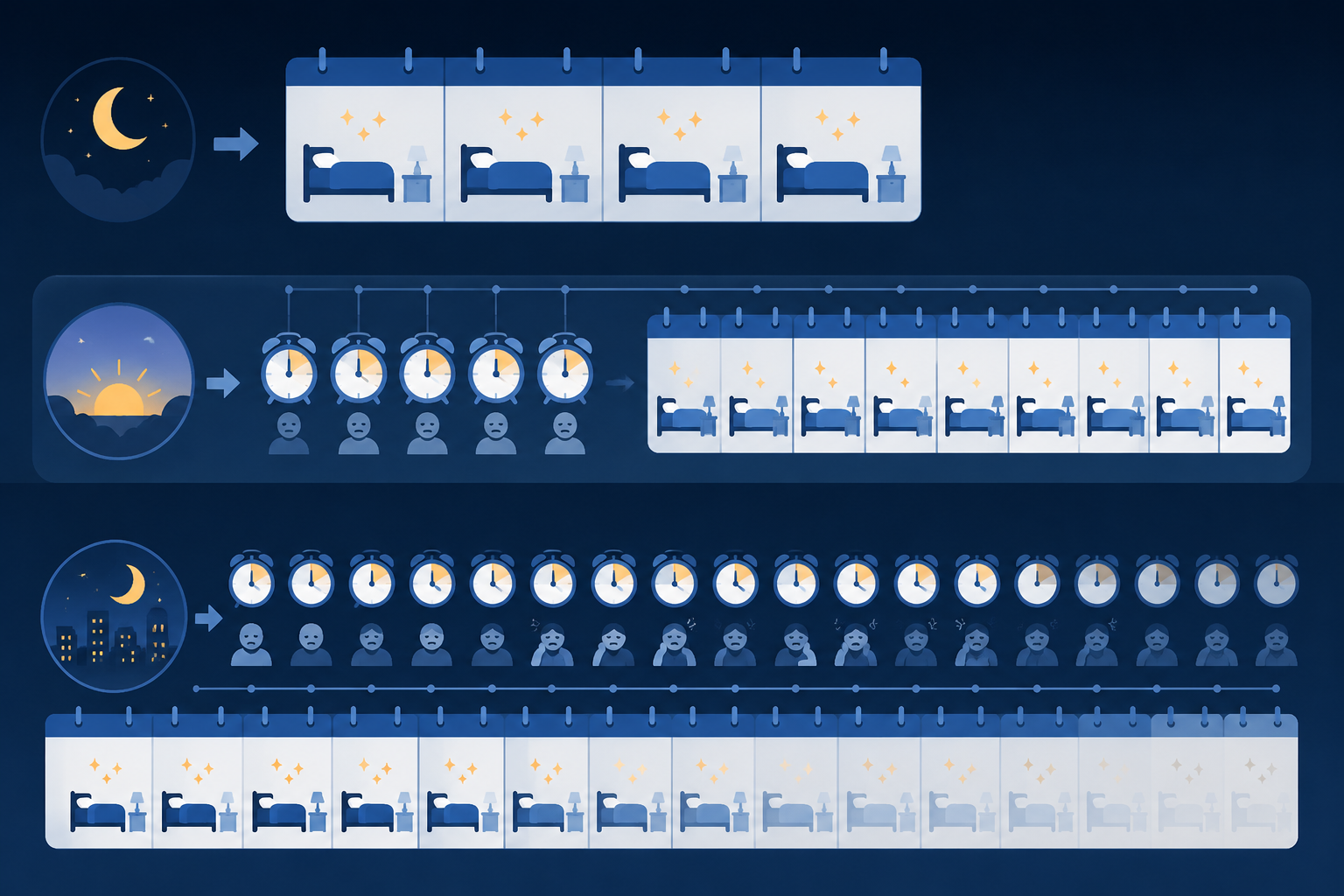
That answer is deliberately less tidy than “sleep in on Saturday.” It is also more useful. Sleep debt is not repaid like a bill with one dramatic deposit. The recovery clock changes depending on whether the loss was isolated, repeated, or allowed to become the body’s new normal.
The first split: one bad night, one bad week, or a long-running deficit
The mistake in many sleep debt estimates is averaging together people who are in very different situations. A parent who lost an hour last night, a resident coming off several restricted nights, and an office worker who has slept under their need for months are not asking the same biological question.
A cleaner way to plan is to classify the debt by duration first, then decide how conservative to be with recovery time. The target is not simply “more sleep”; it is repeated nights with enough sleep opportunity for the body to stop taking the extra time when it is offered. If you are unsure what counts as a reasonable sleep target, the evidence behind the 7-hour sleep recommendation is a better starting point than guessing from one unusually good or bad night.
The most concrete number comes from Kitamura and colleagues. In a small study of 15 healthy young Japanese men, participants appeared to carry about 1 hour of hidden daily potential sleep debt on average. Under a 12-hour time-in-bed recovery protocol, the researchers estimated that 1 hour of lost sleep took about 4 days to recover, and that all participants reached baseline only by day 9 of extended sleep opportunity.[1]
Those numbers are helpful because they puncture the one-weekend fantasy. They are also bounded. Fifteen young men in a lab with 12 hours available for bed are not the same as a 42-year-old caregiver trying to recover between school drop-off and a 9 a.m. meeting. The study gives a scale, not a universal prescription.
If it was one late night, think in several nights, not one
For a single mild loss, such as going to bed an hour late, the most defensible estimate is roughly 4 nights of good sleep opportunity. That does not mean you must sleep four unusually long nights. It means one normal-feeling night is not strong evidence that the debt is gone.
This is where the wording matters. Kitamura’s estimate came from “potential sleep debt,” not from asking people how terrible they felt after a single bad evening. The participants were given the chance to spend 12 hours in bed, and the researchers watched how their sleep changed across repeated extended opportunities. The body’s continued use of extra sleep time was the signal.[1]
In ordinary life, a reasonable response to one late night is simple: protect the next few nights from further cuts. Do not turn the next evening into a second test of resilience. A short nap may help some people function, but the recovery estimate here is about nights, not a single daytime patch.
If it was a restricted workweek, a weekend is usually too small
The common pattern is not one lost hour. It is five nights of pushing bedtime later, waking earlier, or lying awake while still needing to function. This is the pattern where people often feel noticeably better after sleeping in on Saturday and Sunday, then assume the ledger is clean.
The evidence does not support that confidence. In Belenky and colleagues’ dose-response study, people were assigned to restricted sleep opportunities of 3, 5, 7, or 9 hours for 7 days, followed by 3 days of 8-hour recovery sleep. After the more restricted schedules, three 8-hour recovery nights were not enough for complete performance recovery.[2]
This is not a perfect model of a normal workweek. Three and five hours in bed are severe restrictions. Still, the shape of the finding is useful: depth matters. A week of heavy restriction does not reliably resolve after a few standard-length nights just because the calendar moved into the weekend.
Banks and colleagues tested a question that looks even more like the way people bargain with sleep: what happens after several short nights followed by one generous recovery night? After 5 nights of 4 hours in bed, a single recovery night with up to 10 hours in bed did not fully restore vigilant attention, subjective sleepiness, or mood.[3]
That one-night result is especially relevant to the “I’ll catch up this weekend” plan. A long sleep may be genuinely helpful. It may reduce the sense of being wrecked. It may make Sunday feel human again. But if the preceding week was repeatedly short, one long night should be treated as the beginning of recovery, not the end of it.
For the weekly restriction pattern, a better planning rule is to allow extra sleep opportunity for several consecutive nights after the weekend. Kitamura’s 9-day extended-opportunity finding gives the upper end of one mild hidden-debt laboratory estimate, while Belenky and Banks show why standard or single-night recovery can be insufficient after more obvious restriction.[1][2][3]

Chronic sleep debt is not just a bigger weekend problem
When sleep has been short for weeks or months, the question changes. The issue is no longer whether two recovery nights are enough. They usually should not be expected to be. The more practical question is whether daytime function continues to lag after the person has restored adequate sleep opportunity for a sustained period.
Van Dongen and colleagues showed why repeated moderate restriction deserves respect. In their study, 14 days of 6 hours in bed per night produced cognitive performance deficits equivalent to 2 nights of total sleep deprivation.[4]
That finding does not mean every person sleeping 6 hours for two weeks is impaired in exactly the same way. Lab protocols compress and control reality. But it does mean a schedule that feels only moderately short can accumulate into serious objective impairment. Chronic restriction is not made safe by the fact that it is familiar.
For chronic debt, the honest answer is days to weeks, not a fixed number of nights. If the sleep opportunity returns but daytime function does not, the problem may no longer be simple sleep debt. Persistent insomnia, circadian misalignment, untreated sleep apnea, medication effects, mood disorders, caregiving interruptions, pain, and alcohol use can all keep recovery from behaving like a neat repayment schedule. When the main issue is insomnia rather than lack of opportunity, CBT-I is the better evidence-based treatment path than simply spending more time in bed.
Why feeling better can arrive before performance recovers
The most treacherous part of sleep debt recovery is that the body gives mixed feedback. Mood, sleepiness, and attention do not necessarily recover on the same timetable. A person can feel less awful before their reaction time, vigilance, or decision-making has returned to baseline.
Van Dongen’s study makes this problem hard to ignore. During chronic sleep restriction, subjective sleepiness ratings stabilized after 2 to 3 days, even while objective performance continued to decline.[4]
That is the part most people need for planning. Your internal meter may stop getting louder even while the cost continues to accumulate. The brain appears to normalize the bad state. It does not keep issuing a proportionally stronger warning every day.

Banks adds the recovery-side version of the same warning. After 5 restricted nights and one long recovery night, subjective sleepiness, mood, and vigilant attention did not all snap back together. Different measures recovered at different rates.[3]
This is why “I feel fine now” is a poor stopping rule after a restricted week. It may be true as far as it goes. It may mean sleep pressure has eased and mood has improved. It does not prove that the more fragile functions, especially sustained attention, have fully recovered. For the cognitive consequences of unpaid sleep debt, the more detailed discussion belongs in how sleep deprivation impairs the brain.
This distinction matters most when the next day has consequences: driving, clinical work, machinery, childcare, exams, trading sleep for deadlines, or any task where lapses matter more than general mood. The useful question is not only “Do I feel sleepy?” It is “Have I given my brain enough repeated recovery opportunities after the pattern that created the debt?”
How to use the numbers without pretending life is a sleep lab
The research gives useful boundaries, but the protocols are not ordinary life. Kitamura’s study used 12-hour time-in-bed opportunities and a small homogeneous sample of healthy young Japanese men.[1] Belenky used severe restriction schedules of 3 to 5 hours in bed for some groups.[2] Banks used 5 nights of 4 hours in bed before recovery.[3] Van Dongen’s 6-hour restriction protocol was controlled in a way real life rarely is.[4]
Those caveats should not make the findings useless. They should make the conclusion more modest. The studies do not let anyone calculate a personal sleep debt invoice down to the night. They do show that recovery is multi-night, that severity changes the timeline, and that subjective improvement can arrive before objective performance returns.
In practice, the recovery plan should be boring on purpose: create enough sleep opportunity, keep it consistent for several nights beyond the first day you feel better, and avoid adding new debt during the recovery window. If the obstacle is schedule chaos rather than insomnia, a stable wind-down routine can help protect the opportunity; the details are covered in sleep hygiene fundamentals. If you want to understand why interventions work differently depending on the mechanism involved, see mechanistic sleep improvement.
A practical planning rule
Use the smallest claim the evidence supports. After one mildly short night, think in the range of several nights, with about 4 days as a useful laboratory anchor for 1 hour of lost sleep.[1] After a repeated restricted workweek, do not count one or two weekend nights as full recovery; plan for continued extra sleep opportunity across the following week when possible.[1][2][3] After chronic restriction, expect a longer recovery period and pay attention to daytime function after sleep opportunity has been restored.[4]
Enough nights to feel better is often fewer than enough nights for the brain to fully recover. That is the safest way to interpret the research without turning it into miracle math.
References
- Estimating individual optimal sleep duration and potential sleep debt, Scientific Reports, 2016.
- Patterns of performance degradation and restoration during sleep restriction and subsequent recovery, Sleep, 2003.
- Neurobehavioral Dynamics Following Chronic Sleep Restriction: Dose-Response Effects of One Night for Recovery, Sleep, 2010.
- The cumulative cost of additional wakefulness, Sleep, 2003.
Comments
Join the discussion with an anonymous comment.