
How to Sleep When Flight Anxiety Strikes
The cruel part of flight anxiety is that it rarely stays in one lane. You worry you will not sleep before the flight, then the short night makes the flight feel harder, then your body treats the airport, the cabin, and every noise as evidence that it should stay alert. By the time you are buckled in, the problem may no longer be only “fear of flying.” It is a stress-sleep loop.
Sleep onset needs a body that is willing to stand down: lower vigilance, slower breathing, a cooler core temperature, and less sympathetic activation. Anxiety moves in the other direction. Heart rate rises, muscles brace, cortisol can stay elevated, body temperature may feel harder to settle, and the brain keeps scanning for threat. That is why a person can be exhausted and still unable to sleep in a plane seat. The body is tired, but it has not received enough signals that it is safe to power down.
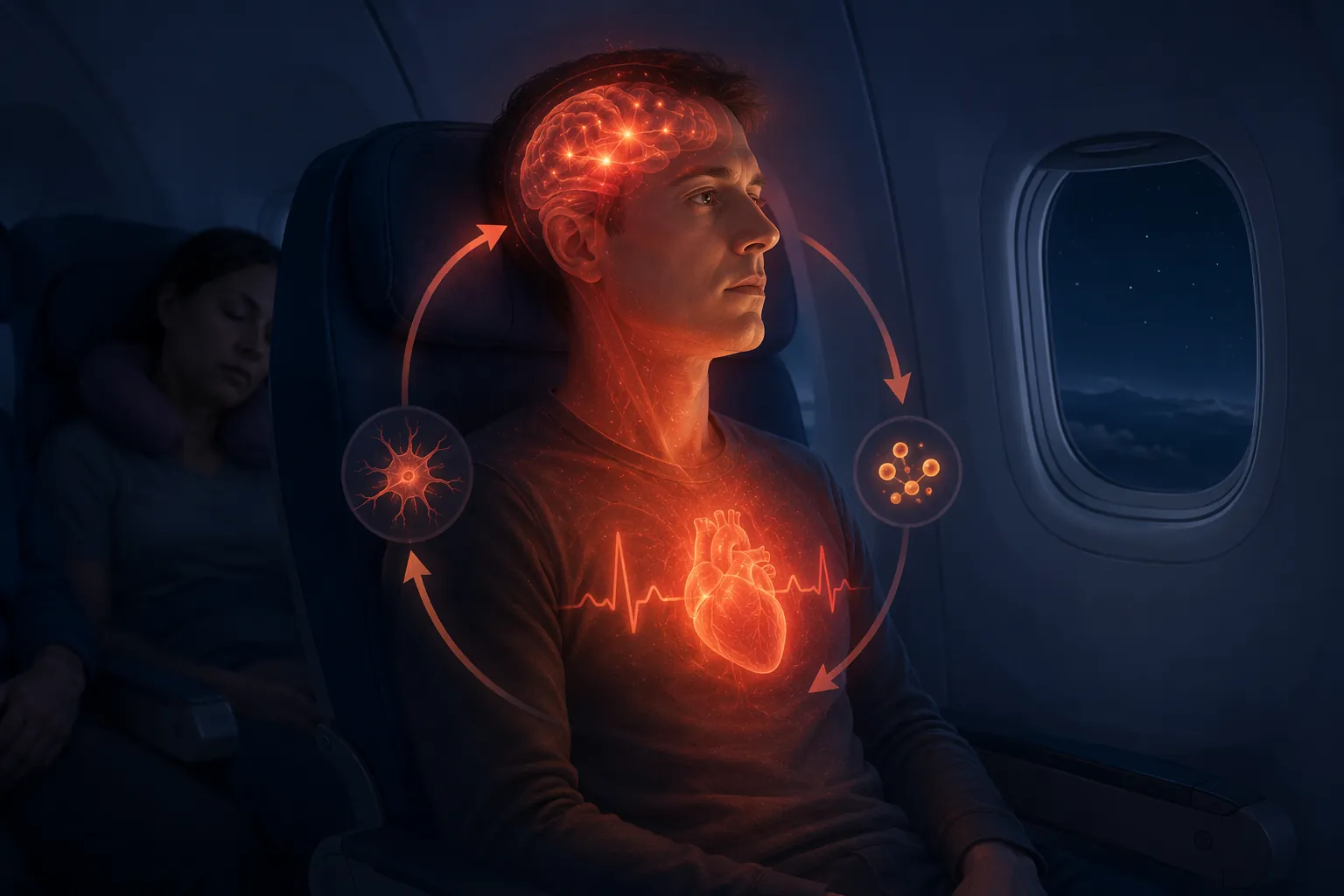
This is also why flight anxiety and sleep tips need to be more specific than “relax” or “just close your eyes.” The useful tools are the ones that interrupt the loop at a physical point: cooling the skin, slowing the exhale, giving the senses a task, reducing uncertainty before boarding, and avoiding substances that sedate briefly but make the second half of the flight worse.
Why does flight anxiety make sleep feel impossible?
An anxious brain is not only producing worried thoughts. It is preparing the body to respond. That preparation is useful if a threat requires action, but it is badly matched to sleep. A faster pulse, warmer skin, shallow breathing, and heightened attention all keep the nervous system closer to “monitor” than “restore.”
Cooling can help because temperature is one of the body’s sleep and stress signals. In a National Geographic discussion of fear of flying and travel anxiety, Yale-trained neuroscientist Dr. Brian Ramos describes using cold exposure, such as placing a cold drink on the forehead or eating chilled food, to help shift the nervous system toward parasympathetic “rest-and-digest” activity rather than sympathetic arousal.[1]
That does not mean a cold drink can is a cure for panic, and it should not be sold that way. It means the forehead, breath, and sensory system are places where an anxious traveler can intervene without needing the cabin to become quiet, spacious, or perfectly comfortable.
If it helps to know you are not strange for reacting this way, estimates of fear of flying vary rather than landing on one clean number; recent coverage discussing aerophobia places commonly cited ranges around 25% to 40%, while noting that prevalence estimates differ by source and definition.[2] The exact percentage matters less than the practical point: many people fly with a nervous system that is louder than their itinerary suggests.
What should I do before the flight if I am afraid I will not sleep?
Start before bedtime, not at midnight when you are already measuring the hours left. The goal is not to guarantee sleep. It is to lower the body’s starting level of arousal so the night before the flight is not spent rehearsing the flight in bed.
- Move decisions out of bedtime: confirm documents, transportation, medication timing, and alarms earlier in the day, then stop “checking one more thing” once the plan is written down.
- Create a short in-seat plan: choose the first three actions you will take if anxiety spikes, such as cold drink on forehead, longer exhales, then 5-4-3-2-1 grounding.
- Practice the tools once while calm: breathing and grounding are easier to find on a plane if your body has already rehearsed them outside a crisis.
- Protect the pre-flight sleep window from alcohol and late caffeine: both can make the body feel more activated when you need it to come down.
- Decide in advance what counts as “rest”: if sleep does not come, lying still with eyes closed, slow breathing, and reduced stimulation is still less costly than spending the night fighting your own body.
The written plan matters because anxiety loves open loops. If your brain keeps asking, “What if I panic on the plane?” give it a boring answer before you get there: “First I cool my forehead. Then I lengthen my exhale. Then I name what I can see, feel, hear, smell, and taste.” This is not dramatic, which is partly why it works. It gives the body a sequence instead of an argument.
What can I do in the seat when anxiety hits?
In the cabin, do not begin with the demand “I have to sleep.” Begin with “I have to make sleep more physiologically possible.” That means reducing heat, narrowing the threat scan, and slowing the breath enough that the body gets a different signal.
Use cooling as a first physical cue
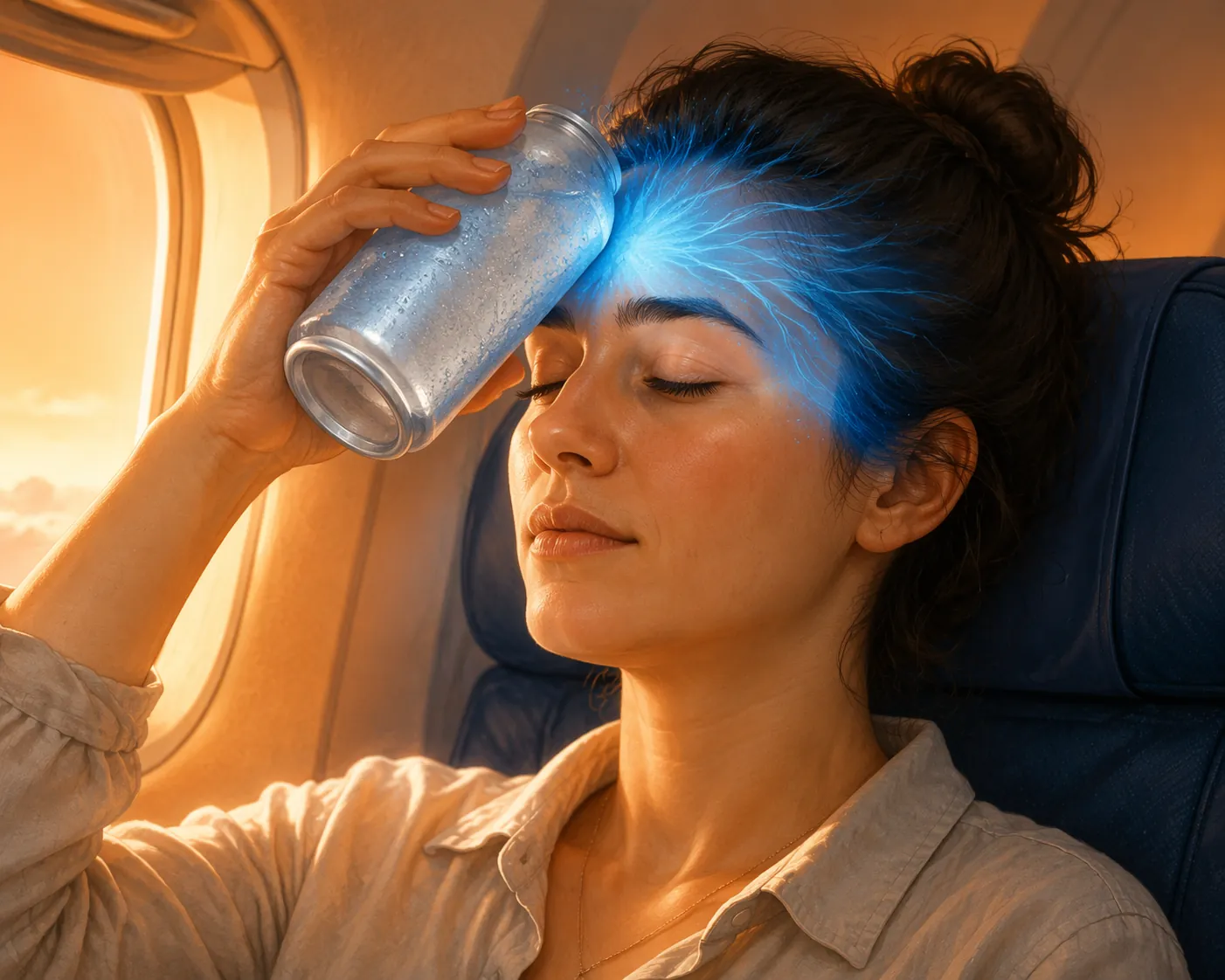
Ask for or buy a cold drink, wrap it in a napkin if needed, and hold it against your forehead, cheeks, or the side of your neck for short intervals. If you have chilled food, a cold bottle, or a cool damp cloth, those can serve the same purpose. The point is not toughness. The point is to give the nervous system a clear, simple sensation that competes with the heat and urgency of anxiety.
If you tend to get chilled easily, keep the cooling brief and pair it with a blanket over your legs or torso. A shivering body is not a sleep-ready body either.
Slow the exhale before chasing deep breaths
Many anxious travelers try to take huge breaths and then feel worse because they are already breathing high in the chest. Make the exhale the main event. Try breathing in gently through the nose, then exhaling longer than you inhaled. You can count if counting helps, but you do not need a perfect ratio. The useful change is the longer out-breath.
Keep your shoulders low, unclench your jaw, and let the next inhale arrive without forcing it. If you feel lightheaded, stop the pattern and breathe normally. Controlled breathing should make the body feel steadier, not like another performance to fail.
Give the senses a job: 5-4-3-2-1 grounding
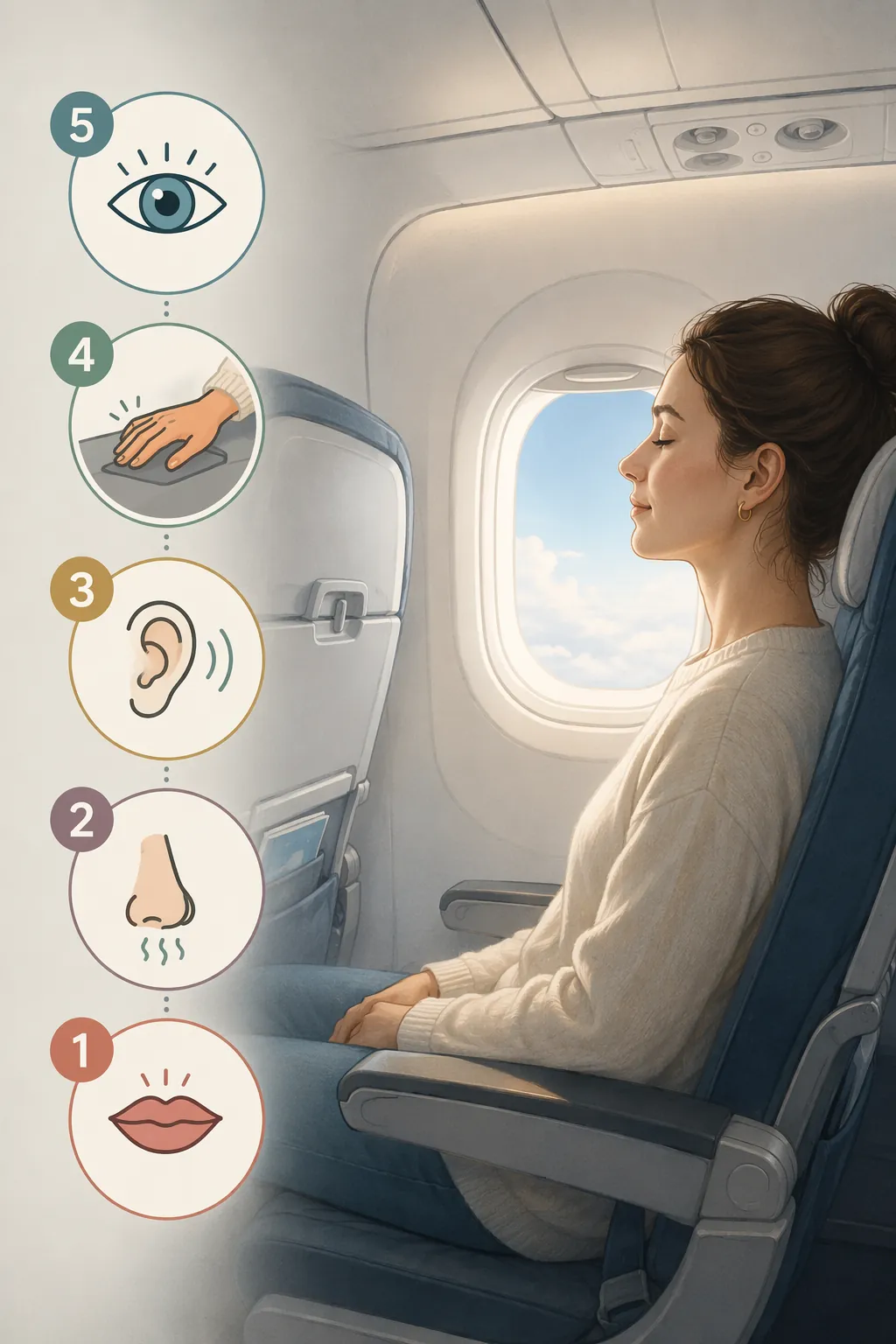
The 5-4-3-2-1 grounding technique is useful when anxiety turns inward and starts producing scenes you cannot stop watching. Texas Health describes the method as naming five things you can see, four things you can feel, three things you can hear, two things you can smell, and one thing you can taste as a way to interrupt catastrophic thinking in the moment.[3]
- Name five things you can see: tray latch, shoe, seat seam, overhead light, cup.
- Name four things you can feel: socks on feet, armrest under elbow, fabric on back, breath at nostrils.
- Name three things you can hear: engine sound, page turning, airflow.
- Name two things you can smell: coffee, hand lotion, cabin air, or simply “nothing strong” if that is true.
- Name one thing you can taste: water, mint, toothpaste, or the neutral taste in your mouth.
Use plain labels. You are not trying to make the cabin beautiful or convince yourself you love flying. You are moving attention from imagined threat back into present-time sensory information.
Should I take melatonin before or during a flight?
Melatonin can help some travelers with sleep timing, especially when the flight or destination shifts the usual sleep window. Johns Hopkins Medicine suggests a low dose range of 0.5 to 3 milligrams, taken 30 to 60 minutes before the desired bedtime when using melatonin for travel sleep.[4]
The safer rule is to test it at home first. Do not make the plane your first experiment with any sleep aid, even one sold over the counter. You want to know whether melatonin makes you groggy, nauseated, headachy, vivid-dream prone, or unexpectedly alert before you are strapped into a seat with limited options.
Timing also matters. Melatonin is a clock signal, not a knockout drug. Taking it at the wrong time can make your schedule feel more scrambled, especially across time zones. If your trip involves pregnancy, complex medications, bipolar disorder, seizure history, immune conditions, or a child’s dosing question, do not treat a travel article as enough medical clearance.
What should I avoid taking casually for flight sleep?
The most important safety rule is simple: do not take a new benzodiazepine, prescription sedative, antihistamine sleep aid, or other sleep medication for the first time on a plane. Texas Health’s flight-anxiety guidance includes this warning from Association of Professional Flight Attendants representative Allie Malis, because an unexpected reaction in the air can become a safety problem for you, crew, and nearby passengers.[3]
A medication that seems “mild” at home can behave differently when combined with sleep loss, altitude-related cabin conditions, dehydration, alcohol, jet lag, or the need to move through an airport after landing. Side effects such as confusion, imbalance, agitation, excessive sedation, or memory gaps are not small inconveniences when you still need to follow instructions, walk safely, care for a child, manage luggage, or handle a connection.
If a clinician has prescribed medication for panic, anxiety, or sleep during travel, follow that plan rather than improvising. Ask before the trip how and when to take it, what not to combine it with, whether you need a trial dose at home, and what to do if the first dose does not feel like enough. The risky moment is often the second unplanned dose, not the first planned one.
Alcohol is a poor sleep strategy in the cabin
Alcohol can make you drowsy at first, which is why it is tempting when anxiety feels embarrassing and immediate. The tradeoff is ugly: in-flight drinking can disrupt REM sleep, contribute to dehydration, and heighten anxiety as it metabolizes, according to physician commentary summarized by Healthline.[5]
If you are already anxious about losing control, alcohol can also make the night feel less predictable. Water, electrolytes if you use them, and a planned calming sequence are less glamorous, but they do not create the same rebound problem.
Who needs extra caution with flight anxiety sleep aids?
Generic travel-sleep advice often assumes a healthy adult with no pregnancy, no fall risk, no stimulant schedule, no hormone-related sleep disruption, and no complicated medication list. Many readers do not fit that template. The answer is not panic; it is matching the tool to the body that will actually be taking it.
Pregnancy
Pregnant travelers should be especially careful with sedatives, antihistamine sleep aids, supplements, and melatonin unless a pregnancy clinician has specifically cleared them. This article does not have enough pregnancy-specific evidence to declare melatonin safe or unsafe for flight sleep, and that uncertainty should not be covered over with a confident dose.
Non-drug tools are still worth using: cooling, breath pacing, sensory grounding, hydration, bathroom planning, and a realistic rest goal. For broader trimester-specific sleep support, see pregnancy insomnia remedies by trimester.
Older adults
Older adults should be cautious with any medication that can cause next-day grogginess, confusion, urinary retention, dizziness, or unsteadiness. A fall in an airport bathroom or on a jet bridge is not an acceptable price for a few hours of forced sleep. If you already take medications for blood pressure, pain, mood, bladder symptoms, allergies, or memory, ask a clinician or pharmacist before adding a sleep aid for travel.
ADHD adults
ADHD can make travel sleep harder for reasons that are not solved by a generic sleep mask: stimulant timing, delayed sleep rhythm, sensory sensitivity, restlessness, and the mental load of transitions can all matter. Do not abruptly change prescribed stimulant or non-stimulant medication just to sleep on a flight unless your prescriber has told you how to do it. A better first move is to plan sensory input: earplugs or noise reduction, a familiar playlist, a fidget that will not disturb a seatmate, and a written sequence for what to do when thoughts start branching.
Perimenopause
Perimenopause can make the flight-anxiety sleep loop more volatile because sleep may already be lighter, warmer, or more fragmented. Hot flashes, night sweats, cycle changes, and early-morning waking can make cabin heat and anticipatory anxiety feel amplified. Cooling tactics are especially practical here: dress in removable layers, keep a cool drink available, avoid alcohol as a sleep shortcut, and do not assume that the sedating product that worked in your thirties is still the right choice.
What if I sleep badly after I arrive?
A rough first night at the destination does not mean you failed. Travel insomnia can continue after landing because the brain may stay more vigilant in an unfamiliar sleep environment. Clayton Sleep Institute describes this “first-night effect” as a state in which part of the brain remains more watchful in a new place, which can make hotel or guest-room sleep lighter than usual.[6]
Treat that first night as a transition night. Keep the room cool, reduce light, keep your usual wind-down cues if possible, and avoid turning the bed into a command center for tomorrow’s plans. If you are awake, use the same sequence you used on the plane: cool the body, lengthen the exhale, ground the senses, and lower the demand from “sleep now” to “make sleep more likely.”
When should I get more help?
Get professional help if flight anxiety leads you to avoid necessary travel, panic symptoms feel unmanageable, you repeatedly rely on alcohol or unplanned medication to board, or sleep loss around travel is putting your work, caregiving, driving, or health at risk. A primary care clinician, sleep clinician, therapist, psychiatrist, or pharmacist may each have a role depending on whether the main problem is panic, insomnia, medication safety, or circadian timing.
For many mild-to-moderate cases, the most useful plan is still modest and physical: prepare before the night gets anxious, cool the body when arousal rises, slow the exhale, ground the senses, and be conservative with anything you swallow. Better sleep with flight anxiety usually comes from interrupting the loop in several small places, not from forcing the body to obey.
References
- Fear of Flying and Travel Anxiety, National Geographic
- Fear Of Flying On Rise? Here’s How Pilots And Doctors Ease Anxiety, Forbes, July 14, 2025
- Nervous Flyer? How to Deal with Flight Anxiety, Texas Health
- 6 Tips for Better Sleep When You Travel, Johns Hopkins Medicine
- What Doctors Really Think About Your In-Flight Anti-Anxiety Tricks, Healthline
- Travel Insomnia Explained, Clayton Sleep Institute
Read the full guide: How to Sleep When Storm Anxiety Hits in Hawaii