How to Sleep When Storm Anxiety Hits in Hawaii
You can know the storm is still offshore and still wake up at 2 a.m. listening for rain. You can have your phone charged, your windows checked, and your slippers by the door, and still feel your chest tighten after one more forecast update. That does not mean you are overreacting. It means your body has started scanning for threat before the threat has fully arrived.
For Hawaii residents in 2026, that scanning has context. As of July 26, 2026, NOAA’s Central Pacific outlook called for a 70% chance of above-normal hurricane activity, with 5 to 13 tropical cyclones expected during the June 1 to Nov. 30 season.[1] That forecast does not mean every island will be hit. It does mean more nights when people may check cones, compare models, remember closed roads, and try to sleep anyway.
Recent community trauma can make those nights louder inside the body. A 2026 MauiWES analysis of 2,453 adults after the 2023 Maui wildfires found higher risks of depression and anxiety among burn-zone residents, and it also found that much of the psychological impact was tied to housing instability and lost income rather than direct fire exposure alone.[2] That study is about wildfire trauma, not hurricane sleep. Still, it helps explain why a storm forecast can stir more than weather fear, especially when home, income, evacuation routes, and safety have already felt uncertain.
Why can’t I sleep when I know a storm is coming?
Storm anxiety interrupts sleep because the nervous system treats uncertainty as unfinished work. At night, there are fewer distractions. The wind is easier to hear. Alerts feel more urgent. If you have lived through fire, flooding, evacuation warnings, power loss, or unstable housing, the body may not wait for danger to be confirmed before it starts preparing.
That preparation can look like shallow breathing, a racing mind, repeated checking, a jumpy response to noise, stomach tightness, or waking after every gust. Some people experience a more specific fear of thunder and lightning. Cleveland Clinic describes astraphobia as an intense fear of thunder and lightning and notes that it affects about 8% of adults.[3] Not every person losing sleep before a Hawaii storm has a phobia. Many are having a stress response that makes sense in the conditions they are living through.
Weather itself may also disturb sleep through noise, heat, humidity, pressure changes, and disrupted routines. If you want the deeper sleep-science route, Restful Ground’s guide to how atmospheric rivers disrupt sleep explains some of the body pathways that can make storms feel physically activating before the conscious mind catches up.
What should I do before hurricane season to protect my sleep?
Preparation helps sleep when it reduces the number of decisions your brain has to make at night. It does not help when it turns into endless checking, shopping, refreshing, and rehearsing. The useful version is boring on purpose: decide ahead of time what you will check, who you will contact, where you will go, and when you are allowed to stop.
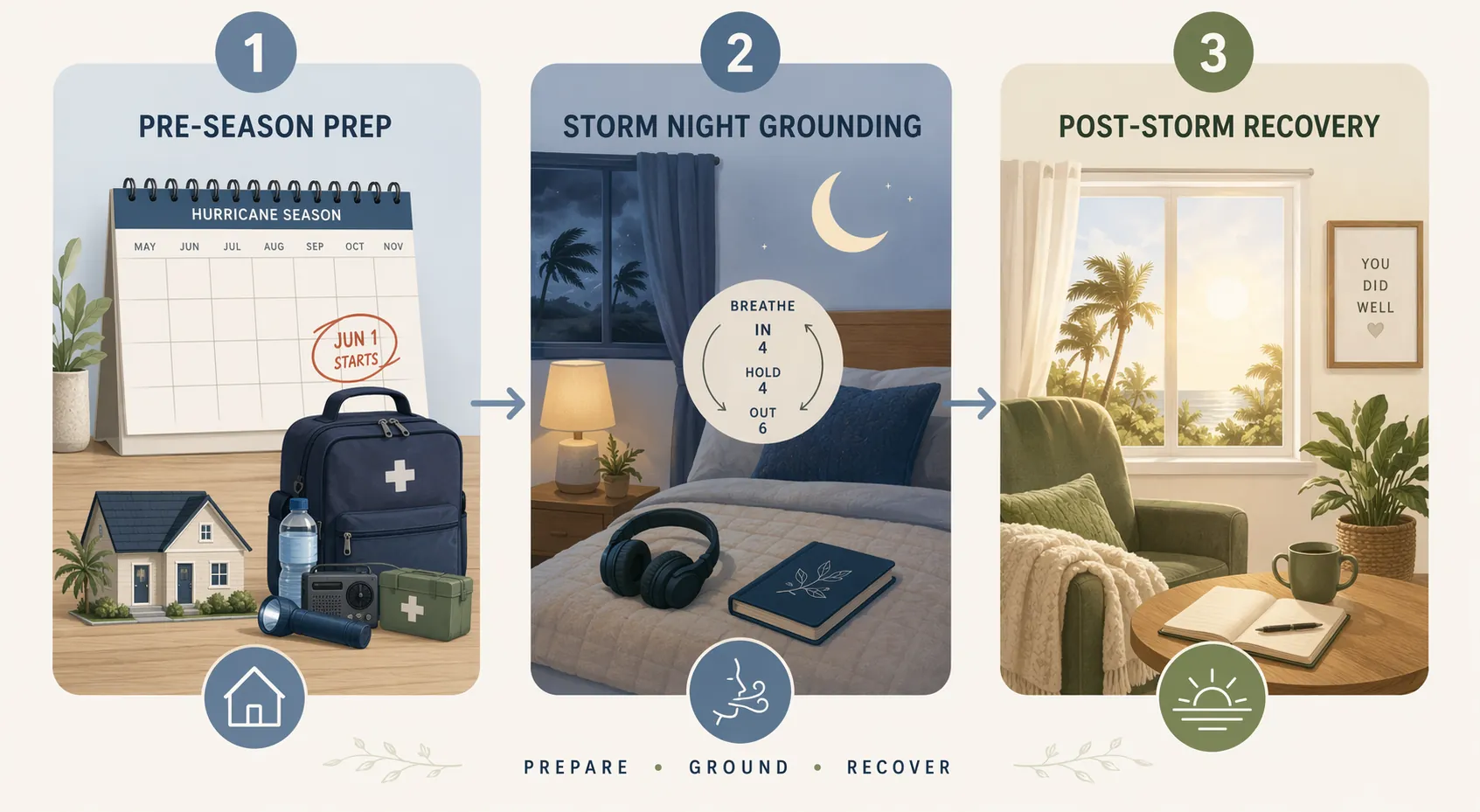
Ruben Juarez, director of MauiWES, put it plainly in Civil Beat: “Preparation is one of the most powerful tools for mental health during storm season.”[4] The point is not that a plan removes risk. The point is that a plan gives your nervous system fewer open loops to patrol at midnight.
| Before the season | Why it helps sleep |
|---|---|
| Choose one official weather source and one backup source. | Reduces late-night source-hopping and rumor checking. |
| Write down your household’s alert plan, including who wakes whom. | Stops your brain from rehearsing the same decision in bed. |
| Decide your evacuation threshold before you are scared. | Moves the hardest choice out of the most activated moment. |
| Prepare sleep-specific storm supplies: battery fan, earplugs, eye mask, medications, chargers, comfort item, and water nearby. | Protects the conditions that make rest possible during outages or noise. |
| Set a forecast-checking cutoff for ordinary nights. | Teaches the brain that preparedness has an ending point. |
For many Hawaii households, the evacuation part is the most emotionally loaded. A renter may not know where they would go if a road floods. An older adult living alone may worry about who will notice if power or cell service drops. A Lahaina survivor may already know that “just leave early” is not a simple sentence. If your plan depends on another person, confirm it in daylight, not while rain is hitting the roof.
Sleep planning should sit inside hurricane planning, not off to the side. If you take medication at night, know where it is. If heat makes you panic during outages, test your battery fan before you need it. If noise keeps you alert, keep earplugs or headphones where you can reach them without turning on every light. If a child or elder wakes easily, decide who responds first so the whole household does not become fully awake at once.
The stopping point matters. After your plan is written, choose a normal-night rule such as: check the official forecast after dinner, charge devices, review any changed alerts, then put the phone across the room. If there is no watch, warning, evacuation notice, or urgent local update, more scrolling usually feeds the alarm system rather than improving safety.
For a fuller phase-by-phase plan, use Restful Ground’s hurricane preparedness sleep strategies. If your storm anxiety is layered with hormonal sleep disruption, the guide to hurricane anxiety and sleep at every phase may be more specific.
How do I sleep the night a storm is forecast?
Start by separating safety actions from calming actions. If there is an official warning, evacuation order, flood threat, or unsafe condition, follow local emergency guidance first. Grounding is for the body after the necessary safety steps are handled; it is not a substitute for getting out of harm’s way.
Once you are where you are supposed to be, make the night smaller. Storm anxiety often grows when the brain tries to monitor the whole island, the whole forecast cone, every sound outside, and every possible “what if” at once. Give it a narrower job.
- Do one last practical sweep: doors, windows, water, medications, phone, flashlight, footwear, pet needs, and the next official update time.
- Say the stopping cue out loud: “The next useful check is at ___ unless an alert sounds.”
- Move the phone within hearing distance but out of your hand, with emergency alerts left on.
- Lower the sensory load: dim lights, reduce news audio, use earplugs if safe, and keep one low light available so you do not flood your eyes with brightness if you wake.
- Give your body a repetitive cue: slow exhale breathing, a familiar prayer, counting backward, or naming what is physically true in the room.
The phone rule is where many people lose the night. You may need alerts. You do not need to hold the device under your chin and watch the radar loop until your nervous system feels personally responsible for steering the storm. If another adult is present, split the monitoring: one person takes the first window, the other takes the second. If you are alone, write the next check time on paper so you are not negotiating with yourself every ten minutes.
A grounding sequence for the first wake-up
If you wake to wind, rain, or an alert that does not require action, do not start with “I have to sleep.” Start with orientation. Look at one stable object. Feel the mattress, the floor, or your own hands. Name the date, the place, and the next planned check. Then lengthen the exhale for several breaths. Long exhales are not magic, but they are a direct way to tell the body that it does not have to sprint while lying down.
After that, choose one low-effort focus. A familiar audiobook at low volume may work better than silence if every gust makes you listen harder. A fan, if safe and powered, can soften sharp noise changes. If heat is the problem, loosen bedding before you become fully irritated. If you need more detail on noise, heat, and anxiety together, see Restful Ground’s tropical storm sleep tips.
If you cannot sleep after a while, aim for quiet rest rather than a fight. Sit up, keep lights low, avoid the news unless a scheduled check is due, and do something that does not ask your brain to solve the storm. Fold a towel. Sip water. Read something dull. Return to bed when your body softens even a little. Rest is still useful on a night when sleep comes in pieces.
For a storm-night-only version, Restful Ground’s guide to sleeping during tropical storm anxiety keeps the focus on what to do while the weather is already moving through.
I survived the Maui wildfires or Kona Low flooding. What if storm nights bring flashbacks?
If rain, sirens, smoke memories, wind, darkness, or phone alerts pull you back into a past disaster, treat that as a trauma response, not a character flaw. Flashbacks and body memories can make the present feel unsafe before you have had time to think. The first task is not to debate the memory. The first task is to mark the difference between then and now.
- Name the present: “This is tonight. I am in ___. The current alert says ___.”
- Use contact with the room: feet on the floor, back against a wall, hands around a cool cup.
- Reduce replay fuel: avoid disaster footage, old videos, and comment threads when your body is already activated.
- Ask for co-regulation if possible: text a trusted person the simple sentence, “I’m safe but activated. Can you stay with me for a few minutes?”
The MauiWES findings do not prove what every survivor will feel during a hurricane forecast. They do show that disaster impact can travel through housing, income, displacement, and uncertainty, not only through direct exposure to flames.[2] That distinction matters in Hawaii, where one person’s storm anxiety may be tied to a burned neighborhood, another person’s to floodwater, and another person’s to not knowing where they could safely go.
For wildfire-specific sleep disruption, use Restful Ground’s guide to sleep disrupted by wildfire anxiety and smoke. If flood memories are the main trigger, the guide to flash flood anxiety sleep tips may fit better.
What should I do after the storm passes if my body stays wired?
After the danger passes, the body may still act as if it is on shift. That is especially common after a night of alarms, poor sleep, heat, cleanup, road uncertainty, or checking on other people. Do not expect your system to drop instantly just because the radar looks better.
Give the nervous system a clear recovery sequence: confirm immediate safety, check on essential people, eat something simple, hydrate, get daylight if it is safe, and return the sleeping area to normal as soon as you can. Put storm supplies back in their place instead of leaving the whole room looking like an emergency station for days. The visual reset tells the body the active watch has ended.
The next night, keep the routine gentle. You may need more sleep pressure, less news, and a short body-based wind-down rather than a perfect bedtime. If you are still unable to sleep after the weather has passed, Restful Ground’s post-storm sleep recovery guide focuses on what to do tonight, not someday.
What Hawaii-specific resources can help if I’m struggling?
If storm anxiety starts to feel unmanageable, use local crisis and support lines before you are at the edge. HI CARES 988 provides 24/7 crisis support in Hawaii.[5] The Disaster Distress Helpline is also available at 1-800-985-5990 for distress related to disasters. NAMI Hawaii and SAMHSA resources may help with ongoing mental health support, especially if the storm is stirring older trauma rather than only one bad night.
If you are supporting someone else, keep the offer practical. “Call me if you need anything” can be too vague for an activated person. Try: “I’ll text after the 8 p.m. update,” “I can be your backup if power goes out,” or “If an evacuation alert comes, you come here.” Specific help quiets more anxiety than general reassurance.
When is storm anxiety serious enough to talk with a doctor or therapist?
Storm anxiety deserves extra support when it keeps spreading beyond storm conditions. Consider talking with a clinician if you cannot sleep for several nights after the threat passes, avoid ordinary activities because of weather fear, have panic symptoms that feel hard to control, rely on alcohol or sedatives to get through forecasts, experience flashbacks or nightmares, or feel hopeless or unsafe.
Specific phobias are more common in women than men, and Restful Ground’s FAQ on why hurricane anxiety keeps women awake goes deeper into that pattern. But anyone can need help. The useful question is not whether your reaction is “normal enough.” It is whether your life has become smaller, your sleep has stopped recovering, or your safety is at risk.
There is no perfect Hawaii study that answers every question about hurricane forecasts, trauma, and sleep in one neat package. The best available answer comes from putting several evidence bases together: an active 2026 storm outlook, post-disaster mental health findings from Maui, known storm and thunderstorm fears, and practical disaster-preparedness guidance. Preparation, grounding, and recovery routines cannot erase hurricane season or what communities have already lived through. They can give the nervous system repeated signals that someone capable is in charge tonight.
References
- 2026 Central Pacific Hurricane Season Outlook, NOAA/National Weather Service, weather.gov/hfo/hurricaneOutlook2026
- MauiWES study reveals mental health crisis, UH Mānoa / UHERO, March 11, 2026, hawaii.edu/news/2026/03/11/mauiwes-mental-health-crisis
- Astraphobia, Cleveland Clinic, my.clevelandclinic.org/health/diseases/22101-astraphobia
- Extreme Weather Can Whip Up Anxiety. A Safety Plan Can Help, Civil Beat, June 2026, civilbeat.org/2026/06/extreme-weather-can-whip-up-anxiety-a-safety-plan-can-help
- HI CARES 988, HI CARES, hicares.hawaii.gov
Read the full guide: Why Hurricane Anxiety Keeps Women Awake and How to Sleep