
Why Pregnancy Insomnia Changes and What Helps Each Trimester
Understand why pregnancy insomnia feels different each trimester and which safe, evidence-supported remedies target the specific drivers of your current stage.
Pregnancy insomnia often changes its personality before it changes its severity. At eight weeks, the problem may be nausea, bathroom trips, and an odd kind of light sleep that does not feel restorative. Around the middle of pregnancy, sleep may briefly feel less chaotic, until restless legs or side-sleep discomfort starts appearing. By the last stretch, the wake-ups can come from several directions at once: reflux, bladder pressure, hip pain, fetal movement, shortness of breath, and the sheer difficulty of turning over.
That pattern matters because the best pregnancy sleep tips and insomnia remedies are not interchangeable. A nausea-driven 3 a.m. awakening does not need the same response as restless legs at 20 weeks or reflux at 36 weeks. Pregnancy insomnia is common overall: a 2024 meta-analysis of 44 studies including 47,399,513 participants estimated insomnia prevalence during pregnancy at 43.9%.[1] But the more useful question is smaller: what is waking you this week?
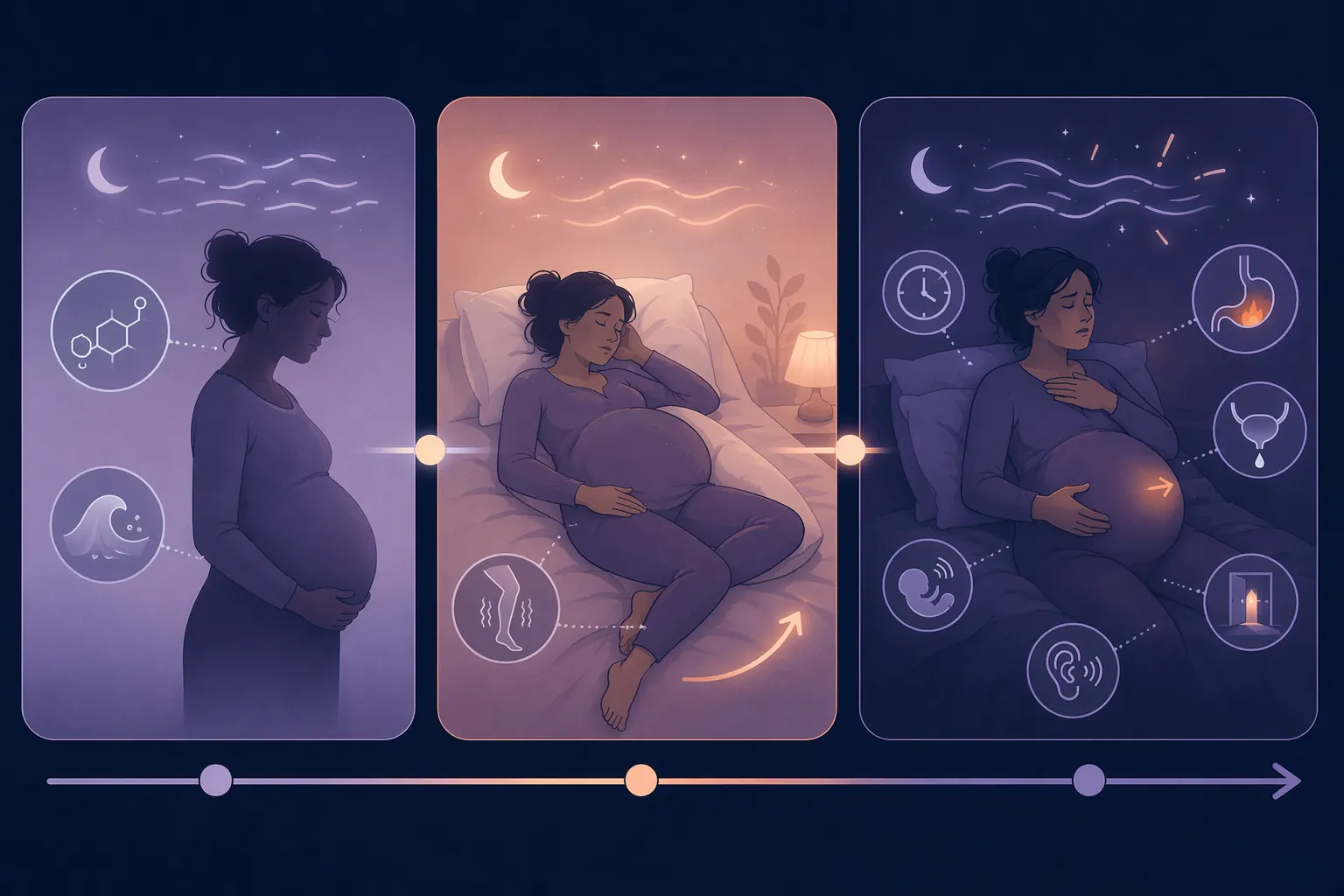
First trimester: more sleep, lighter sleep, more interruptions
The first trimester can be confusing because fatigue and insomnia can coexist. In a review of sleep across pregnancy, progesterone was associated with an increase in total sleep time of about 0.7 hours compared with before pregnancy, while sleep also became lighter, with more stage 1 NREM sleep and more nighttime fragmentation.[2] In plain terms: you may be spending more time in bed and still waking easily.
The same period brings nausea, breast tenderness, emotional arousal, and nocturia. First-trimester insomnia prevalence is often cited around 25%, lower than late pregnancy but high enough that a rough early start is not unusual.[2] The practical response is not to treat early pregnancy like a generic insomnia problem; it is to reduce the specific things that keep pulling sleep apart.
If nausea is the driver
Nausea-related waking often needs a food-and-timing plan more than a sleep plan. Many people do better when the stomach is neither empty nor overfull at bedtime. A small bland snack before bed, crackers kept within reach, ginger or vitamin B6 only if already cleared by a clinician, and avoiding a greasy late dinner are all aimed at the same target: preventing nausea from becoming the first thing the brain notices when sleep lightens.
This is also the trimester when naps can help without taking over the night. A short nap earlier in the day is different from a long late-afternoon crash that steals sleep pressure from bedtime. If the body is demanding rest, the goal is not heroic wakefulness; it is keeping recovery sleep from drifting so late that the night becomes even more broken.
If bathroom trips are the driver
Nocturia in early pregnancy is not always fixable, but it can sometimes be made less disruptive. Shift more fluids earlier in the day, keep hydration steady rather than panic-drinking at night, and reduce bladder irritants if they clearly affect you. The point is not fluid restriction; pregnancy is a terrible time to turn hydration into a discipline contest. The point is to stop accidentally concentrating most intake into the evening.
If you wake and cannot fall back asleep, keep the intervention boring: dim light, no scrolling, no clock-checking loop. Early pregnancy sleep is already easier to fragment; adding bright light and problem-solving at 3 a.m. teaches the brain that waking is the start of a second day.
Second trimester: the calmer window that can hide restless legs
The second trimester is often described as the easier sleep stretch, and for some people it is. Nausea may ease, bladder pressure may be less dramatic than it will be later, and the body may feel less ambushed by early hormonal change. But this is also when new problems deserve attention precisely because the rest of sleep may look better.
Restless legs syndrome is the one to catch early. Pregnancy RLS is commonly reported around 20% overall and rises into the 27% to 30% range by the third trimester.[2] It is not just “I feel uncomfortable.” Classic RLS is an urge to move the legs, often with crawling, pulling, or electrical sensations, worse at rest, worse in the evening or night, and temporarily relieved by movement.
That distinction matters because ordinary sleep hygiene rarely touches true RLS. A lavender pillow spray will not correct low iron stores, and forcing yourself to lie still can make the sensations more maddening. If the pattern fits, ask your obstetric clinician or midwife about screening and whether iron status should be checked. Do not self-prescribe high-dose iron; the useful step is getting the right lab context and pregnancy-specific dosing advice.
| What wakes you | What it suggests | First response |
|---|---|---|
| Urge to move legs, worse at night, relieved by walking | Possible restless legs syndrome | Ask about RLS screening and iron evaluation |
| Hip or shoulder discomfort after turning onto your side | Position transition problem | Add pillow support before pain becomes the nightly trigger |
| Lying awake after several bad nights, even when symptoms are quiet | Insomnia behavior becoming self-sustaining | Consider CBT-I skills rather than adding random sleep aids |
Use the second trimester to practice side sleeping
Side sleeping becomes more important as pregnancy advances. ACOG notes that lying on the left side can help increase blood flow to the heart, fetus, uterus, and kidneys, and helps keep pressure off the liver.[3] The second trimester is a good time to make that position workable before the abdomen is large enough to make every adjustment feel like furniture moving.
Support is not decorative here. A pillow between the knees can reduce hip torque. A wedge or small pillow under the bump can reduce pulling. A pillow behind the back can make side lying feel less like balancing on a ledge. A full pregnancy pillow is useful if it solves a real alignment problem; it is not a moral upgrade from using three ordinary pillows.
If you wake on your back, reposition and move on. Panic is not a sleep strategy. The practical aim is to make the preferred position easy enough that your sleeping body returns to it more often.
Third trimester: several small problems can stack into hourly waking
Late pregnancy insomnia can feel relentless because it is rarely one thing. By the third trimester, insomnia prevalence has been reported as high as 80%, and more than 98% of women in one reviewed sample reported nocturnal awakenings.[2] Those numbers are not a warning that you are doomed to poor sleep; they are evidence that the repeated wake-ups many people describe are not personal failure.
The mechanics are real. The uterus presses upward and downward at the same time: upward toward the diaphragm and stomach, downward toward the bladder and pelvis. Reflux becomes more common, nocturia intensifies, side-lying can strain hips and shoulders, and RLS may worsen. A single bedtime rule cannot cover that stack.
Separate reflux from insomnia before treating the insomnia
GERD affects an estimated 30% to 50% of people by the third trimester.[2] If burning, sour taste, coughing, throat irritation, or chest discomfort is what wakes you, the first remedy is reflux control, not a stronger sleep routine.
- Move the largest meal earlier, especially if dinner is currently close to bedtime.
- Avoid lying flat soon after eating; give digestion a head start.
- Use head-and-torso elevation rather than only stacking pillows under the neck.
- Notice personal triggers such as fried foods, acidic foods, chocolate, peppermint, or late caffeine.
- Ask about pregnancy-safe reflux medication if symptoms are frequent, painful, or reducing food intake.
Heat can make reflux, sweating, and discomfort feel worse at the same time. If the room is warm or weather is extreme, pregnancy-specific cooling adjustments may matter more than another insomnia rule; this guide to sleeping during a heat dome covers that situation without treating overheating as a willpower problem.
Nocturia needs timing, not dehydration
Late-pregnancy bladder pressure is anatomical. You can reduce some avoidable wake-ups, but you cannot schedule your bladder into acting nonpregnant. Front-load fluids earlier, sip rather than chug in the evening, and keep the path to the bathroom safe and dim. If you are waking often, the goal is to return to sleep quickly, not to make the trip stimulating.
Pain, burning, fever, blood in urine, contractions, leaking fluid, severe headache, visual symptoms, or sudden swelling belong in a clinician call, not in a sleep-tip experiment. Frequent urination can be normal; urinary symptoms plus warning signs need medical sorting.
Positioning is now a system, not one pillow
By the third trimester, comfort often requires supporting multiple pressure points at once: knees, belly, back, chest angle, and sometimes wrists or shoulders. If you are waking with hip pain, try changing the distance between the knees or adding a firmer pillow. If the bump pulls forward, support it directly. If reflux is present, combine side lying with upper-body elevation instead of solving each problem in isolation.
The best pillow setup is the one that reduces the number of wake-ups and the amount of effort required to resettle. A costly pregnancy pillow that traps you in place is not better than a cheap wedge that lets you breathe and roll. Evaluate the setup by the consequence: fewer painful turns, faster bathroom returns, less reflux, fewer fully awake stretches.
When short sleep becomes its own problem
Late pregnancy short sleep has been associated with meaningful outcomes, but the wording matters. In the Hashmi review, sleeping less than six hours per night in late pregnancy was linked to a 4.5-times higher cesarean section risk in a cited UCSF study; short sleep has also been linked with longer labor, gestational diabetes, preeclampsia, and postpartum depression.[2] These are associations, not a verdict on any one person lying awake tonight.
Depression also complicates the picture. In the 2024 meta-analysis, populations with high depression rates had higher insomnia prevalence than populations with low depression rates, 56.2% versus 39.8%.[1] So if insomnia arrives with persistent low mood, anxiety, loss of interest, intrusive thoughts, or a sense that you cannot cope, it deserves mental health attention, not just a darker bedroom.
CBT-I is the strongest cross-trimester tool when fixes are not enough
Cognitive behavioral therapy for insomnia is easy to undersell because it sounds like a lecture about habits. It is more specific than that. CBT-I targets the learned loop that can develop after weeks of disrupted sleep: more time in bed awake, more clock-watching, more dread before bedtime, more naps that erase sleep pressure, and more effort spent trying to force sleep.
The pregnancy evidence is stronger than most comfort advice. In a 2019 randomized clinical trial, CBT-I produced insomnia remission in 64% of pregnant participants compared with 52% in the control condition, and median time to remission was 31 days versus 48 days.[4] A 2020 randomized clinical trial of digital CBT-I found remission in 44% of participants compared with 22.3% receiving standard care, with benefits sustained at two-month follow-up.[5] A 2023 review summarized improvements not only in sleep quality but also in depression and anxiety symptoms during pregnancy.[6]
CBT-I does not replace treating reflux, RLS, pain, or nausea. It becomes important when those triggers have trained the bed to feel like a place for monitoring and waiting. In pregnancy, it should be adapted sensibly: severe sleep restriction is not something to improvise alone, and anyone with high-risk pregnancy concerns, significant mood symptoms, or extreme daytime impairment should work with a clinician.
Where medications and supplements fit
ACOG’s patient guidance emphasizes non-medication approaches for sleep problems in pregnancy, including healthy sleep habits and treatment of underlying disorders.[3] That is the right starting point, but it does not mean medication is never appropriate. It means the reason for taking something should be clear: nausea, reflux, allergies, pain, RLS, anxiety, or persistent insomnia may point to different choices and different safety questions.
Over-the-counter sleep aids, antihistamines, melatonin, magnesium, and combination products deserve pregnancy-specific review rather than casual bedtime experimentation. If you are comparing options, use a safety-focused guide such as Comparing Safe Sleep Aids for Pregnancy Insomnia. If the product includes diphenhydramine and acetaminophen, the ingredient-by-ingredient discussion in Tylenol PM's Two Ingredients and Pregnancy Sleep Safety is a better frame than treating it as one harmless “PM” pill.
Clinical reviews of sleep pharmacotherapy in pregnancy and lactation exist, but they are not a substitute for individualized advice.[7] This is especially true if you take other medications, have liver disease, have high blood pressure, have depression or anxiety, are at risk of falls, or are near delivery.
Herbal remedies should not get a safety pass because they sound gentler. Pregnancy safety data are often limited, supplement quality varies, and “natural” does not tell you dose, contamination risk, uterine effects, drug interactions, or fetal exposure. If an herb claims to solve pregnancy insomnia without a clinician’s input, that is a marketing claim before it is a safety claim.
A trimester-matched way to decide what to try tonight
Start with the dominant driver, not the longest list of tips. In the first trimester, that may mean nausea control, earlier hydration, and naps that do not swallow the evening. In the second trimester, it may mean catching RLS symptoms early and building a side-sleep setup before discomfort becomes entrenched. In the third trimester, it often means treating reflux, bladder disruption, positioning pain, and insomnia conditioning as separate problems that happen to meet in the same night.
- If nausea wakes you, adjust food timing and ask about pregnancy-safe nausea treatment.
- If your legs create the wake-up, ask about RLS screening rather than adding generic sleep hygiene.
- If reflux wakes you, move dinner earlier, elevate the torso, and ask about reflux treatment if symptoms persist.
- If bathroom trips wake you, shift fluids earlier while keeping hydration adequate.
- If you are awake even after the physical trigger improves, consider CBT-I.
- If you are considering medication or supplements, bring the specific product and dose to a clinician.
Escalate sooner for severe reflux, suspected RLS, persistent sleep under about six hours, major daytime impairment, loud snoring or breathing pauses, mood symptoms, or any pregnancy warning signs.
References
- Global prevalence of insomnia during pregnancy: a systematic review and meta-analysis, Frontiers in Psychiatry, 2024.
- Sleep disturbances and their management in pregnancy, PMC, 2016.
- Sleep Health and Disorders, ACOG.
- Cognitive Behavioral Therapy for Prenatal Insomnia: A Randomized Controlled Trial, Obstetrics & Gynecology, 2019.
- Efficacy of Digital Cognitive Behavioral Therapy for the Treatment of Insomnia Symptoms Among Pregnant Women: A Randomized Clinical Trial, JAMA Psychiatry, 2020.
- Essential Reads: Cognitive Behavioral Therapy for Insomnia During Pregnancy, MGH Center for Women's Mental Health.
- Sleep Pharmacotherapy for Common Sleep Disorders in Pregnancy and Lactation, CHEST, 2019.
Safety & eligibility read
Cross-check against other interventionsExplore the mechanism
Next step
Spot an error or have clinical feedback?
Because this article covers clinical, medication, or safety information, we use a moderated correction channel instead of open public comments. Let us know if something about “Why Pregnancy Insomnia Changes and What Helps Each Trimester” needs a closer look.
Send feedback on this article