If you are looking for the best horror movies to stream that affect sleep, the useful question is not which title has the loudest reputation. It is which one is most likely to leave your nervous system acting as if the threat has not ended. On that measure, the strongest public ranking comes from Mattress Online's analysis of 34,037 IMDb reviews, which counted sleep-related language in audience reactions rather than measuring anyone's sleep in a lab.[1]
That distinction matters. A review saying a movie gave someone nightmares is not the same thing as polysomnography. Still, for a sleep-protective horror fan choosing what to watch before bed, review language is a useful warning label. The analysis also excluded Paranormal Activity and A Nightmare on Elm Street because their titles could bias sleep-term counts, which is exactly the kind of methodological housekeeping a ranking like this needs.[1]
| Rank | Movie | Sleep-related IMDb review mentions | What the number can and cannot tell you |
|---|---|---|---|
| 1 | Insidious | 206 | The clearest sleep-sabotage signal in this dataset, especially for viewers sensitive to sudden threat cues.[1] |
| 2 | Scream | 196 | High mention count despite its meta-slasher tone, suggesting self-awareness does not necessarily lower bedtime cost.[1] |
| 3 | The Blair Witch Project | 166 | A dread-heavy outlier: less about repeated jolts, more about uncertainty that follows you into the dark.[1] |
| 4 | The Ring | 155 | Image-based dread with a long aftertaste, especially for viewers who replay visual cues after the movie ends.[1] |
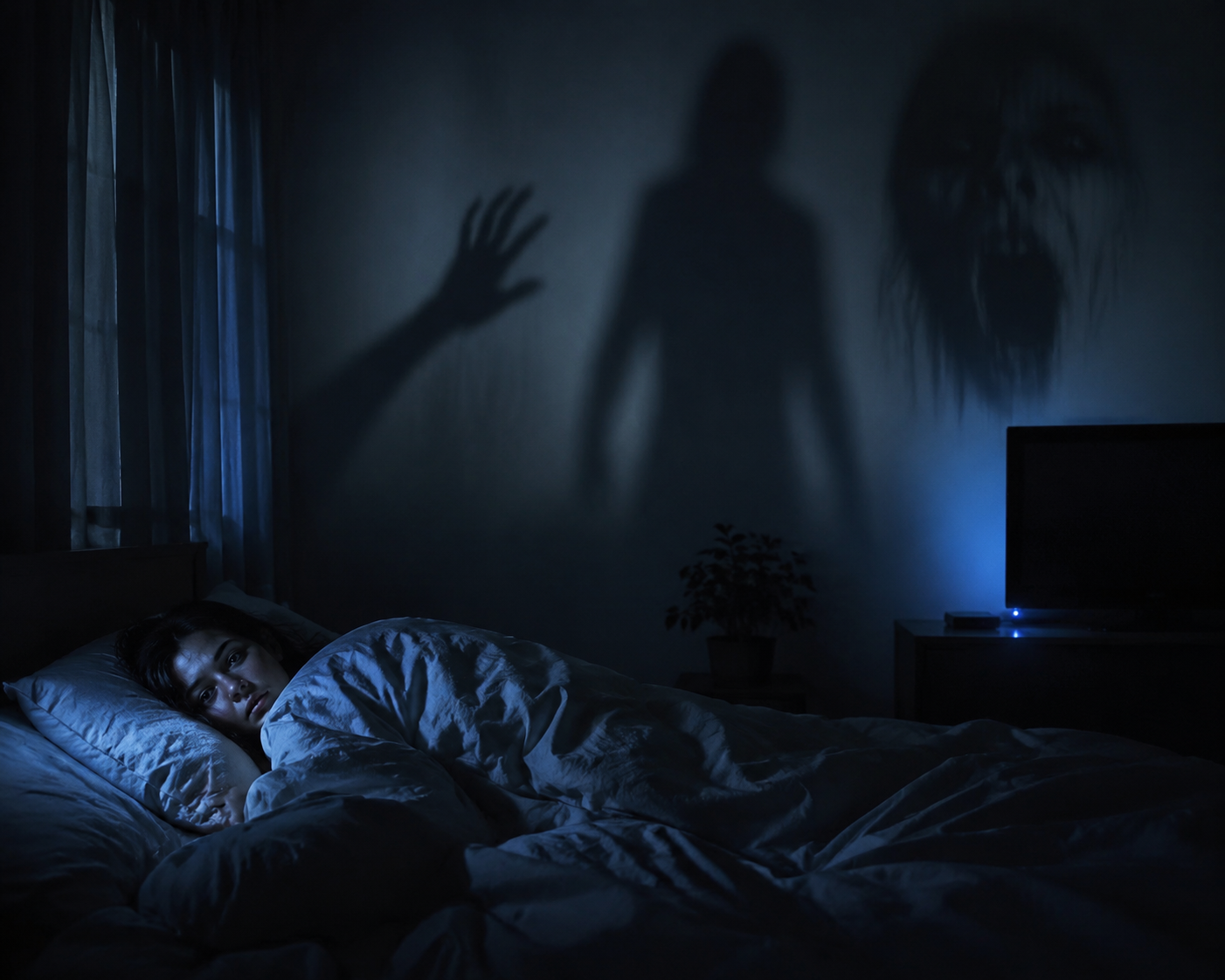
A second dataset points in the same general direction, with a larger caveat attached. In self-reported data from a Betway-sponsored sleep experiment cited by CBR, watching a horror movie before bed produced the worst sleep result among 14 tested pre-sleep activities: participants averaged 7 hours and 30 minutes of sleep, spent 26 minutes awake after initially falling asleep, reported 65% sleep quality, and reached 25.44% deep sleep, compared with 37.86% deep sleep after meditation.[2]
Those numbers should not be treated as clinical proof. The experiment was sponsored, self-reported, and not a peer-reviewed sleep study. But as a practical caution flag, it lines up with the IMDb-review ranking: horror before bed is not automatically a disaster, but it is one of the cleaner ways to make a brain keep checking the door after the credits.
The Ranking Is Really A Nervous-System Ranking
The top four are not identical horror experiences. Insidious is built around intrusion and sudden alarm. Scream uses slasher pursuit, phone-threat anticipation, and punctuated violence. The Blair Witch Project works by withholding certainty. The Ring plants an image and lets the viewer carry it. If they all show up in sleep-related reviews, that does not mean they disturb sleep through the same route.
For bedtime purposes, the most suspicious mechanism is repeated re-alerting. A film that startles you once may spike the body and let it settle. A film that keeps yanking you back into threat detection trains the evening around vigilance. By the time the TV is off, the room is quiet, and the lights are out, the nervous system has had practice scanning for the next interruption.
That is why a sleep-risk list should not be the same as a canon list. Plenty of elegant horror is tolerable at night. Some trashy horror is a terrible bargain if it leaves you waiting for a closet door to move. The question is not whether a movie deserves prestige. The question is whether it keeps the alarm circuitry warm.
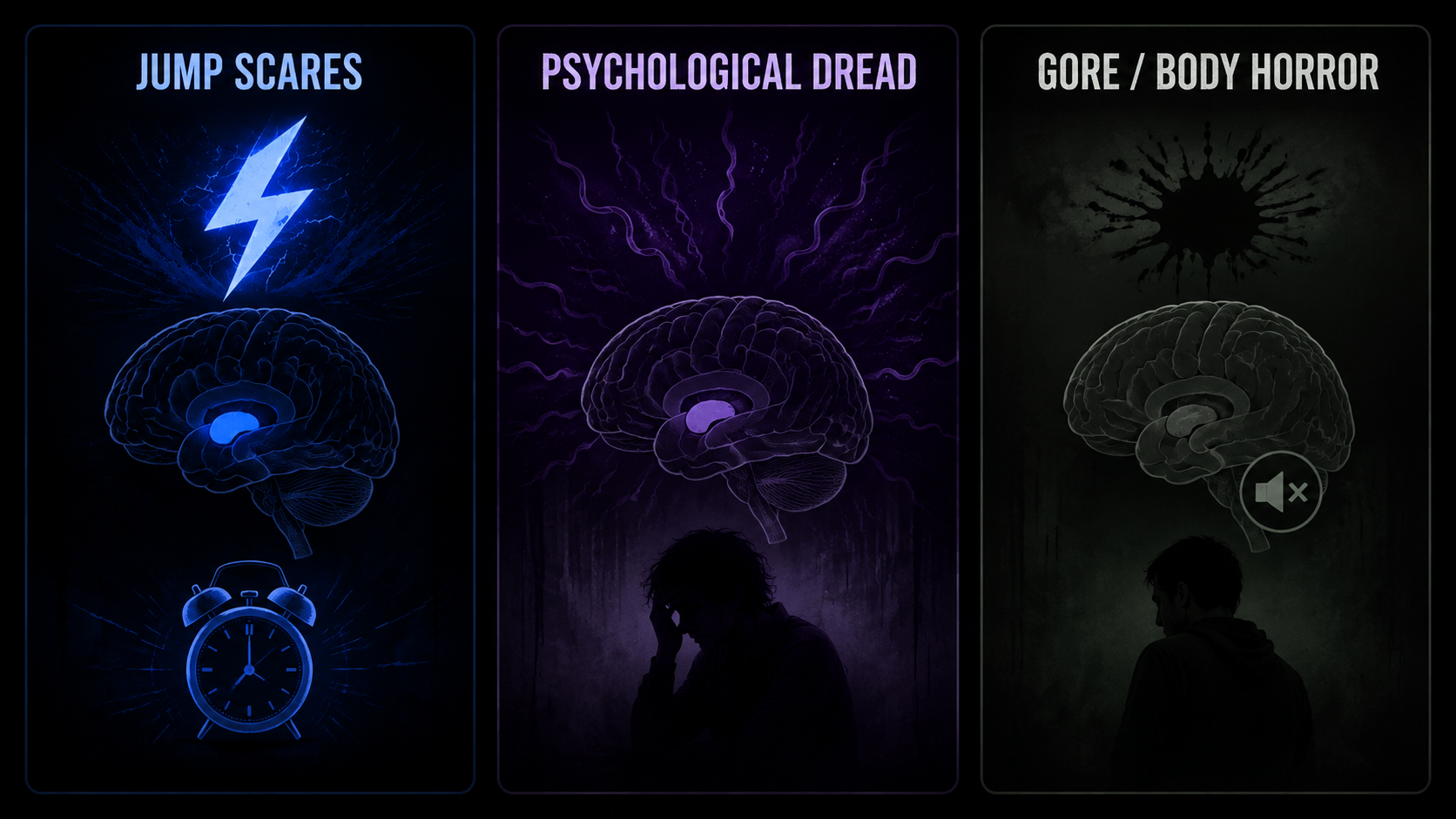
Why Jump Scares Are The Most Reliable Sleep Thieves
Jump scares have an unfair advantage over subtler horror because they do not need interpretation. A shape moves, the soundtrack punches, the face appears too close, and the body reacts before the viewer has time to issue a calm literary opinion. Experts interviewed by CNN describe horror as capable of activating the same threat systems involved in real danger; Jonathan Abramowitz of the University of North Carolina noted that the brain can respond to perceived threat in ways that resemble its response to actual threat.[3]
That does not mean the brain is fooled forever. It means the body may still have to metabolize the alert. Heart rate rises, muscles prepare, attention narrows, and the amygdala helps tag the stimulus as important. A good jump scare is over fast on screen. The body's bookkeeping is slower.
This is where the sleep cost shows up. Saatva's sleep explanation notes that horror can elevate cortisol and adrenaline for hours, and that this arousal can interfere with deep sleep and REM sleep.[4] That claim should be read as a mechanism explanation, not a movie-by-movie measurement. Still, it gives the Mattress Online ranking a plausible spine: the titles that keep appearing in sleep language are often the ones that keep the viewer's threat system from standing down cleanly.
Insidious is the obvious bedtime offender in this frame. Its top ranking does not prove it ruins sleep more than every other horror film for every person. It does suggest that many viewers had enough post-film sleep disturbance to mention it publicly. Its scare grammar also fits the risk profile: sudden appearances, domestic spaces that stop feeling safe, and a rhythm that makes quiet itself feel loaded.
Scream is more interesting because it is funny, self-aware, and culturally familiar. Familiarity can soften fear for some viewers, but the movie still repeatedly rehearses pursuit, ringing phones, masked intrusion, and explosive confrontation. The nervous system is not especially impressed that a film understands genre rules if it keeps making the body flinch.
Psychological Dread Has A Longer Fuse
Psychological dread is less consistent, but not harmless. It tends to work through rumination rather than startle: unfinished explanations, moral contamination, cursed images, unreliable reality, or the sense that the ordinary room has acquired a second meaning. That is why The Blair Witch Project and The Ring make sense in the top four even though their sleep damage is not purely jump-scare math.[1]
CNN's expert interviews also point to a viewer-dependent mechanism. Michael Grabowski of Manhattan University discussed embodied simulation: highly empathetic viewers can absorb a character's distress in a way that extends anxiety after the film is over.[3] That helps explain why one person can admire The Ring as atmosphere while another lies in bed replaying the image they most want to stop seeing.
The important word is "can." Psychological dread is not a guaranteed sleep destroyer. For some viewers, slow-burn fear is easier to contain because it gives the thinking brain something to organize. For others, especially people who are prone to nighttime rumination, it keeps generating mental tabs after the story has technically closed. If your problem is waking at 2 a.m. with the movie still assembling itself in the dark, dread may be your worse bet than gore.
Gore And Body Horror Are Not Automatically Worse For Sleep
Gore looks like the obvious villain because it is unpleasant by design. But unpleasant is not the same as sleep-disruptive. Body horror often leans on disgust, revulsion, and boundary violation. Those reactions can be intense, but they do not always produce the same repeated vigilance pattern as a film that keeps training the viewer to expect sudden attack.
That does not make gore bedtime-safe. If a specific image tends to replay in your mind, or if medical, bodily, or contamination fears are sticky for you, body horror can absolutely follow you into bed. The narrower point is that the sleep-risk ranking does not reward grossness alone. It rewards the kind of fear that keeps asking the body to stay ready.
How To Read The Top Titles Before You Press Play
| Movie | Main sleep-risk mechanism | Best bedtime judgment |
|---|---|---|
| Insidious | Jump scares, home-invasion unease, supernatural intrusion | Highest-risk choice if you need dependable sleep tonight. |
| Scream | Pursuit, sudden attacks, phone-threat anticipation | Riskier than its playful tone makes it look. |
| The Blair Witch Project | Uncertainty, helplessness, unseen threat | Avoid before bed if ambiguity makes you ruminate. |
| The Ring | Haunting imagery, delayed dread, cursed-media logic | Avoid before bed if visual images linger for you. |
This is also where streaming availability has to be handled modestly. As of July 19, 2026, rights can shift quickly by platform and region, so treat these as titles to check rather than fixed platform recommendations. The better pre-bedtime habit is to decide the risk category first, then see what is actually available, rather than letting an autoplay row choose your nervous-system experiment for the night.
If you want horror and still care about sleep, the safer lane is usually not "nothing scary." It is lower-startle horror, rewatchable horror, horror-comedy you already know, or eerie films whose images do not personally stick to you. The ranking is most useful when it prevents the worst mismatch: a high-alert movie on a night when your body has no time to calm down.
Your Fear Personality Changes The Bill
The same movie does not charge everyone the same price. BBC Future's discussion of Mathias Clasen and Coltan Scrivner's horror research describes three horror-fan patterns from an online study of about 400 participants, with a Danish haunted-house replication: Adrenaline Junkies, White Knucklers, and Dark Copers.[5] These are useful descriptive categories, not clinical sleep diagnoses.
- Adrenaline Junkies may enjoy the spike itself and recover quickly enough that the movie feels energizing rather than contaminating.
- White Knucklers may enjoy having survived the experience, but they are also more likely to carry bodily tension into bed.
- Dark Copers may use horror as a way to rehearse fear in controlled conditions, which can make some scary viewing feel regulating rather than destabilizing.
This nuance should soften the ranking, not erase it. If you know from experience that a jump-scare film leaves you happily tired, your own pattern matters. But if your history says otherwise, genre loyalty is a poor sleep aid. A movie can be excellent horror and still be the wrong choice for a night before an early alarm.
There is one more practical caveat for people with existing sleep issues. CNN's expert interviews note that frightening events can exacerbate parasomnias such as sleepwalking and night terrors in people predisposed to them.[3] That is not a reason for everyone to avoid horror. It is a reason for already vulnerable sleepers to treat high-startle movies differently from ordinary entertainment.
The Bedtime Rule That Actually Follows From The Data
If sleep matters tonight, move away from jump-scare-heavy titles first. Insidious sits at the top of the review-based sleep-sabotage ranking, and its mechanics fit what sleep science would predict: sudden threat, repeated vigilance, and a body that may need time to come down. Scream is not far behind, and its humor does not cancel its startle rhythm. The Blair Witch Project and The Ring deserve a different warning label: less shock, more mental residue.
Use the ranking as a risk guide, not a universal ban. On a free Saturday afternoon, the sleep cost may be worth it. At 10:45 p.m. before a workday, choosing a lower-startle rewatch is not cowardice; it is just refusing to let a good movie keep billing you after it ends. For more on the physiology behind that nighttime alertness, the same cortisol-melatonin conflict shows up in why anxiety gets worse at night.
References
- The Most Nightmare-Inducing Horror Movies, Mattress Online.
- Horror Movies Ruin Your Sleep According to New Study, CBR.
- Why some love horror and others have nightmares, CNN, Oct. 2025.
- This is Why You Can't Sleep After Watching Scary Movies, Saatva.
- The paradox of horror, BBC Future, Oct. 2025.
Comments
Join the discussion with an anonymous comment.