
Why Hot Weather Wrecks Sleep and Which Remedies Help
Hot weather wrecks sleep because sleep is supposed to begin with cooling. In the hours before you fall asleep, your core body temperature normally drops by about 0.5–1°C, or roughly 1–2°F. A warm bedroom makes that drop harder, so the body stays in a wake-ready state when it should be moving toward sleep.[1]
That is why the best remedies are not the most dramatic ones. The strongest options are the ones that lower the heat load around you: a cooler room, blocked sunlight during the day, moving air across exposed skin, and air conditioning when heat becomes unsafe. Baths, showers, hydration, bedding, and pajamas can help, but they do not all work through the same pathway or with the same evidence behind them.
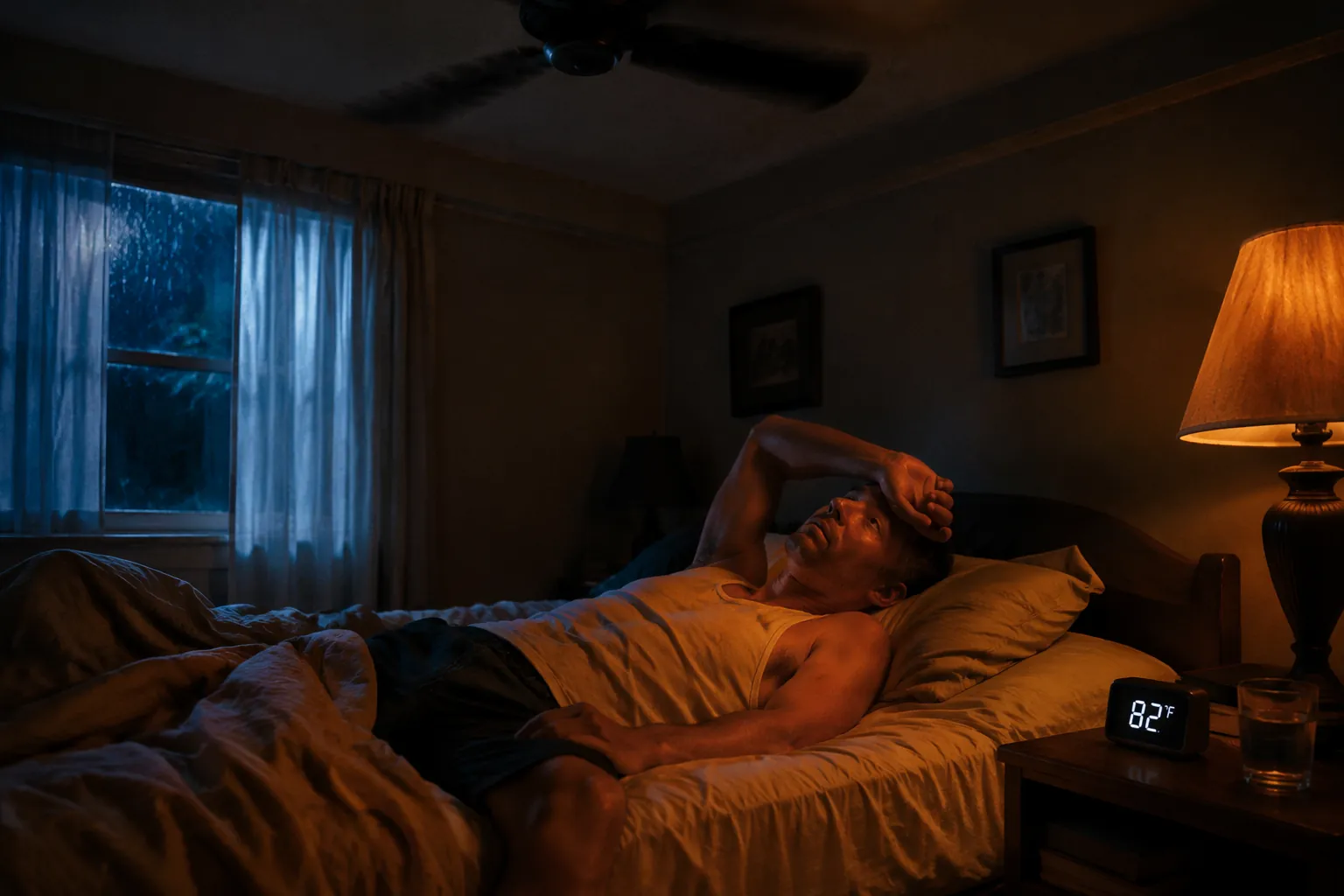
What Heat Does To Sleep
The body does not fall asleep by simply becoming tired enough. It also has to shift heat outward. Blood flow to the skin increases, heat leaves through the surface of the body, and core temperature falls. If the room is hot, humid, still, or sun-baked from the afternoon, that heat has nowhere useful to go.
The result is not just a sweaty feeling. Heat exposure has been linked with more wakefulness and less REM sleep and slow-wave sleep, the stages people usually mean when they say they slept deeply.[1] That explains the specific misery of a hot night: you may fall asleep late, wake more often, and still feel under-recovered even if you technically spent enough hours in bed.
REM sleep is a weak point in this system. During REM, thermoregulatory responses such as sweating and shivering are suppressed, which makes the sleeping body less able to defend itself against temperature stress while that stage is happening.[2] A hot bedroom can therefore disturb the very part of the night when the body is least equipped to compensate.
There is also a practical reason not to wait for the body to “get used to it.” In the sleep-temperature review, heat-related disruption did not disappear after five continuous days of exposure.[1] People may change their expectations after several bad nights, but that is not the same as restoring normal sleep architecture.
The Remedies Worth Trying First
If the room is too hot, start with the room. This sounds obvious until a list of summer sleep tips treats linen sheets, a glass of water, and mechanical cooling as if they are interchangeable. They are not. Environmental cooling has the clearest connection to the problem: it gives the body a cooler place to release heat.
| Evidence tier | What belongs here | How to use it |
|---|---|---|
| Strongest | Bedroom cooling, daytime shading, AC where available, fan over bare skin | Lower the heat around the body before and during sleep |
| Moderate | Warm bath 1–2 hours before bed, cool or lukewarm shower, daytime hydration | Support the body’s cooling sequence rather than trying to shock it cold |
| Emerging or supportive | Cotton or linen bedding, lighter sleepwear, cooling toppers | Improve comfort and heat dissipation, but do not rely on them as the main fix in unsafe heat |
Cool The Room Before You Cool The Bed
Cleveland Clinic recommends a bedroom temperature of 60–67°F for sleep.[3] Not every home can reach that range in July, and not every sleeper tolerates the same setting, but the target is useful because it makes “too warm” measurable. A cheap thermometer on the nightstand often tells the truth before your half-awake brain does.
If you have air conditioning, use it strategically rather than heroically. Cooling the bedroom before sleep can matter more than chilling the whole home all evening. During sustained extreme heat, though, AC is not just a comfort tool; it can be a safety tool. Fans and bedding tweaks should not be treated as replacements when indoor heat is dangerous.
If energy cost is the problem, combine approaches: close blinds before the sun hits the room, keep hot air out during the day when outdoor temperatures are higher, then ventilate when outdoor air is cooler. For more detailed AC-and-fan setups during prolonged heat, see Restful Ground’s guide to sleeping during a Dallas heatwave.
Use A Fan On Skin, Not Just Somewhere In The Room
Moving air helps most when it crosses exposed skin. A fan pointed vaguely at the ceiling may stir the room, but a fan that moves air over forearms, legs, or the side of the body helps sweat evaporate and carries heat away from the skin. A Lancet review identified forced ventilation, such as fan use over bare skin, as the most efficient rapid cooling method outside emergency settings.[4]
This is also where the energy math matters. European Insomnia Network recommendations note that electric fans can use up to 50 times less electricity than air conditioning.[5] That does not make a fan equal to AC in dangerous indoor heat, especially for older adults or people with medical risk. It does make a fan a reasonable first-line tool when the room is warm but not hazardous, or when AC is available only part of the night.
The Bath Trick Works Best When It Is Timed Right
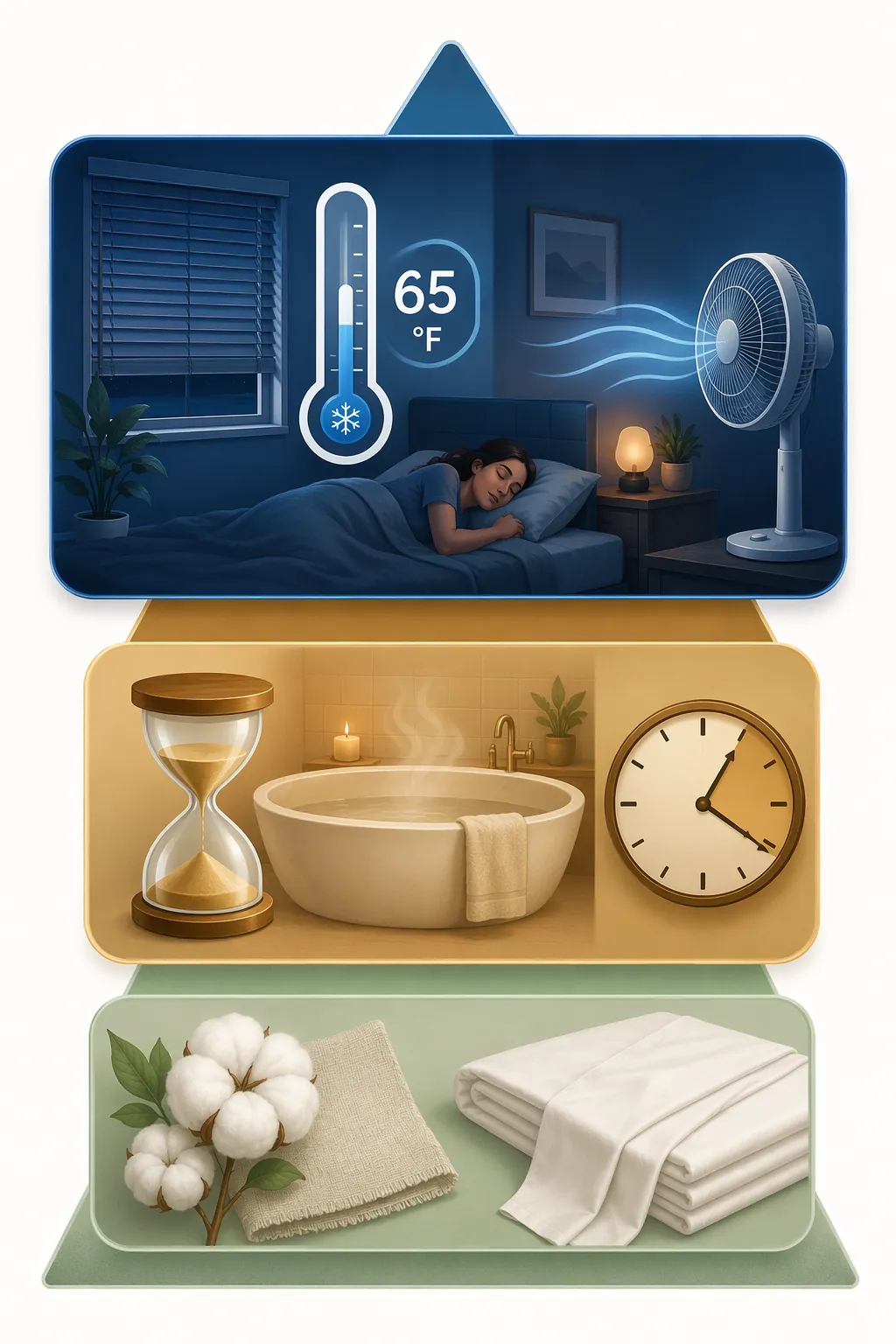
A warm bath before bed sounds wrong if the problem is heat. The useful part is not that the bath makes you hot; it is what happens afterward. Warm water increases blood flow to the skin, and when you get out, that skin blood flow can help the body release heat. Horne and Reid reported sleep EEG changes after body heating in a warm bath, and a later meta-analysis found that passive body heating from a warm bath or shower 1–2 hours before bed can improve sleep outcomes.[6][7]

The timing is the remedy. A warm bath too close to bedtime may leave you feeling overheated. A cold shower right before bed can feel satisfying for a few minutes, but it may increase alertness rather than help the body downshift; Psychology Today, summarizing sleep and temperature research, cautions that a cold shower before bed can activate the sympathetic nervous system.[8] If you want water as a cooling tool, a lukewarm or comfortably cool shower is usually the safer bet than an icy one.
During a heat dome, the warm-bath tactic needs more judgment. If the bathroom is stuffy, you are pregnant, you feel lightheaded, or your home is already holding heat, skip the clever timing experiment and lower the room heat instead. Restful Ground’s heat dome sleep guide goes deeper on when this tactic helps and when it is the wrong tool.
Hydration Helps Earlier Than You Think
Hydration belongs in the support category, not the miracle category. Being dehydrated makes heat harder to tolerate, and heavy sweating can leave you uncomfortable or crampy. But chugging water at bedtime is more likely to add bathroom trips than fix a hot room.
The useful version is daytime hydration: drink steadily, replace fluids after sweating, and pay attention to thirst, urine color, medications, and medical restrictions. If you have heart, kidney, or blood pressure conditions, hydration advice may need to come from your clinician rather than a sleep article.
Bedding Can Help, But It Cannot Rescue A Hot Room
Sheets and pajamas matter most when they stop trapping heat. Cotton and linen are reasonable choices because they tend to feel less clingy and allow more airflow than heavy, dense fabrics. Loose sleepwear, or less sleepwear, can give a fan more skin surface to work with.
Cooling toppers, gel pillows, and “breathable” fabrics are harder to rank. Some people find them genuinely comfortable. The evidence is not as strong as the evidence for changing the thermal environment around the sleeper, and product language often outruns what has been independently shown. If a topper warms up after 20 minutes, traps humidity, or makes you sweat more, your body has already given the review that matters.
The fastest bedding test is simple: remove layers before buying layers. Try one breathable sheet, a lighter blanket nearby rather than on top of you, and enough exposed skin for airflow. For common fixes that sound smart but can backfire, Restful Ground’s guide to cooling mistakes during hot sleep is the better place to troubleshoot.
Who Needs A Gentler Or More Serious Plan
Older adults may lose sleep at temperatures that younger adults dismiss as merely uncomfortable. In a 2023 study of older adults, sleep efficiency dropped by 5–10% as bedroom temperature rose from 77°F to 86°F.[9] A separate study found that mild heat exposure increased wakefulness and doubled whole-body sweat loss in older adults.[10] That combination matters: more wakefulness, more fluid loss, and often less physiological margin.
Pregnant people also need caution around heat. The goal is not maximal cooling or a dramatic cold plunge; it is steady heat reduction without overheating, dizziness, or large temperature swings. Use room cooling, shade, fans, loose clothing, and lukewarm showers. Avoid very hot baths, overheated bedrooms, and any strategy that leaves you faint or flushed.
Perimenopausal women often need two plans at once: one for the room and one for night sweats. A cooler bedroom can reduce the background heat load, but hot flashes may still break through. If heat waves and night sweats overlap, Restful Ground has more specific guidance on hot-weather sleep disruption in perimenopause and heat-wave night sweats.
When Heat Is More Than A Sleep Problem
A bad night is one thing. A hot indoor environment that keeps climbing is different. If there is a heat advisory, treat sleep as part of heat safety, not separate from it. Move to the coolest available room, use cooling centers if needed, check on older adults and people living alone, and do not rely on a fan alone when the indoor heat is extreme.
Climate-linked nighttime heat is already being studied as a sleep-loss issue. A USC-led study of 14,232 adults found that a 10°C increase in nighttime temperature was associated with 2.63 fewer minutes of sleep per night, with projected annual losses of 8.5–24 hours by 2099 depending on emissions and adaptation assumptions.[11] That number is context, not a bedtime instruction. Tonight’s question is still more immediate: lower the room heat first, support the body’s cooling sequence next, and keep the more cosmetic fixes in their proper place.
For a ranked heat-safety approach during official warnings, use Restful Ground’s guide to sleeping during a heat advisory.
References
- Effects of thermal environment on sleep and circadian rhythm, Journal of Physiological Anthropology, 2012.
- Thermoregulatory responses during slow wave sleep and REM sleep in man, Pflügers Archiv, 1982.
- What’s the Best Temperature for Sleep?, Cleveland Clinic.
- Reducing the health effects of hot weather and heat extremes: from personal cooling strategies to green cities, The Lancet, 2021.
- How to deal with sleep problems during heatwaves: practical recommendations from the European Insomnia Network, Journal of Sleep Research, 2023.
- Night-time sleep EEG changes following body heating in a warm bath, Electroencephalography and Clinical Neurophysiology, 1985.
- Before-bedtime passive body heating by warm shower or bath to improve sleep: A systematic review and meta-analysis, Frontiers in Neuroscience, 2019.
- Taking a Cold Shower Before Bed? Here's Why It May Hurt Your Sleep, Psychology Today, 2025.
- Nighttime ambient temperature and sleep in community-dwelling older adults, Science of the Total Environment, 2023.
- Effects of mild heat exposure on sleep stages and body temperature in older men, International Journal of Biometeorology, 2004.
- Rising temperatures may erode sleep, especially for older adults, Keck School of Medicine of USC, 2025.
Read the full guide: How travel weather delays affect sleep and stress