
How to Sleep Through a Heat Wave with Perimenopause Night Sweats
During a dangerous heat wave, perimenopausal night sweats create a unique medical risk. Learn how to tell vasomotor symptoms from heat stroke, and get tiered cooling strategies to sleep safely tonight.
At 2 a.m., the first question is not how to make the bedroom feel pleasant. It is whether you are having a familiar perimenopause night sweat, developing heat exhaustion, or seeing the first signs of heat stroke. During a dangerous heat wave, those can blur: a hot flash can soak your pajamas in minutes, while an overheated room can keep your body from recovering after the episode passes.
If you are lying there drenched, hot, and unsure what is happening, start with triage. Comfort measures come after you have ruled out the symptoms that should move you out of bed, out of the hot room, or into emergency care.

First Decide: Hot Flash, Heat Exhaustion, or Heat Stroke?
A typical hot flash is sudden, intense, and usually short. Cleveland Clinic describes hot flashes as episodes of sudden warmth, flushing, sweating, and sometimes chills; Johns Hopkins notes that they commonly last a few minutes, though the experience varies from person to person.[1][2] ACOG also describes hot flashes and night sweats as common menopause-transition symptoms that can disrupt sleep.[3]
Heat illness behaves differently. Heat exhaustion is not just “a bigger sweat.” It tends to last, often comes with weakness, dizziness, nausea, headache, or clammy skin, and it happens in the context of heat exposure. Heat stroke is the emergency: confusion, slurred speech, fainting, seizure, very high body temperature, or skin that may be hot and dry. Hartford HealthCare warns that heat exhaustion can progress to heat stroke in as few as 15 minutes, which is why waiting to “see if it passes” can be the wrong call during an active heat alert.[4]
| What you notice | More consistent with a perimenopause hot flash | More consistent with heat exhaustion | Possible heat stroke: call 911 |
|---|---|---|---|
| Timing | Sudden wave of heat, often lasting a few minutes, sometimes followed by chills | Symptoms continue or keep building after the sweating starts | Symptoms worsen rapidly or do not improve after cooling begins |
| Mental status | Clear thinking; you know where you are and can answer normally | Usually clear, though you may feel weak, anxious, or lightheaded | Confusion, slurred speech, unusual behavior, fainting, seizure, or inability to stay awake |
| Sweating and skin | Flushed, sweaty, often drenched; may feel chilled afterward | Heavy sweating, cool or clammy skin, weakness | Hot skin; sweating may stop, though heat stroke can still occur with sweating |
| Other symptoms | Palpitations or anxiety can happen, but they pass with the episode | Dizziness, nausea, headache, muscle cramps, thirst, weakness | Severe headache, collapse, vomiting with confusion, loss of consciousness |
| Context | Can happen even in a reasonable room, but heat may trigger or intensify it | More likely if the room stayed hot, you had little fluid, or you could not cool down | More likely after prolonged heat exposure, especially with medical risk factors or medications |
| What to do | Cool your skin, change damp clothes, sip water, reassess the room | Move to a cooler place, loosen clothing, use wet cooling or ice packs, sip fluids if alert; seek medical help if symptoms persist or worsen | Call 911, start cooling immediately, and do not try to sleep it off |
The most important line in that table is mental status. A perimenopause night sweat can be miserable and dramatic. It should not make someone confused, unable to speak normally, unable to stay awake, or unable to recognize where they are. Those signs override home management.
Duration matters too. If the heat wave has made the bedroom hot enough that the sweating never really stops, you may not be able to separate one hot flash from the room’s heat load. In that case, the safer question is not “Was this menopause or heat?” It is “Can this body cool down here?” If the answer is no, relocation or urgent help becomes part of the sleep plan.
Why Perimenopause Changes the Heat-Wave Equation
Hot flashes are not a failure of willpower, hydration, or bedding discipline. Yale Medicine explains the current understanding this way: as estrogen levels change, KNDy neurons in the hypothalamus become more active, narrowing the body’s thermoneutral zone—the range in which you feel neither too hot nor too cold. When that range narrows, a small internal or environmental temperature shift can trigger a full cooling response: flushing, sweating, and waking.[5]
That mechanism matters because a dangerous heat wave presses on the same system from the outside. The room may not feel unbearable at first. The sheets may simply feel a little too warm. But if your internal thermostat is already easier to trip, the margin between “uncomfortable” and “symptoms that need action” is smaller.
One Penn State H.E.A.T. project finding deserves special attention here: researchers reported that women ages 40 to 64 may be as physiologically vulnerable to extreme heat as men 65 and older.[6] That does not mean every perimenopausal woman has the same risk, and the precise heat and humidity thresholds should be read from the primary journal article before turning the finding into a personal cutoff. But it does challenge the casual assumption that heat vulnerability begins only in old age.
Nighttime heat adds another problem: sleep is when the body should get relief. Climate Central reported in 2024 that 2.4 billion people now experience at least two additional weeks per year of nights above 77°F in its modeled analysis of dangerous nighttime temperatures.[7] Duke Heat Policy Innovation Hub researchers, cited by Inside Climate News, have also linked overnight temperatures above 75°F with significantly increased heat-illness mortality.[8] Those figures do not diagnose your bedroom, but they explain why a warm night is not automatically a harmless one.
Check the Risk Layer Before Tonight
Before you build a cooling setup, look at what could make heat harder for your body to handle. Some people in perimenopause are also managing blood pressure, thyroid disease, depression or anxiety, allergies, bladder symptoms, diabetes, cardiovascular disease, or several medications at once. Those details can change the safety margin.
Clinical experts interviewed by Hartford HealthCare and Flow Space have highlighted several medication classes that may complicate heat response, including SSRIs, beta blockers, diuretics, antihistamines, thyroid medications, and anticholinergics.[4][9] The concern is not identical for every drug. Beta blockers, for example, may blunt a racing heart that would otherwise warn you of heat stress; anticholinergic medicines can interfere with sweating; diuretics can contribute to dehydration risk. Do not stop prescribed medication because of a hot night. Do treat those medicines as a reason to lower your threshold for calling a clinician, using a cooling center, or relocating before symptoms escalate.
- Call your clinician or pharmacist before the next hot night if you take several heat-relevant medicines or recently changed doses.
- Do not rely only on “I’ll feel my heart racing” if you take a beta blocker.
- Be cautious with alcohol, sedatives, or anything that may make it harder to wake, drink, move, or notice confusion.
- If you live alone, arrange a check-in during the hottest overnight hours when an alert is active.
A Tiered Cooling Plan for Sleeping Tonight
A flat list of cooling tips is not enough during a dangerous heat wave. The useful plan depends on whether you have working air conditioning, whether the room cools after sunset, and whether a fan is helping you lose heat or just pushing hot air over skin that is already struggling.
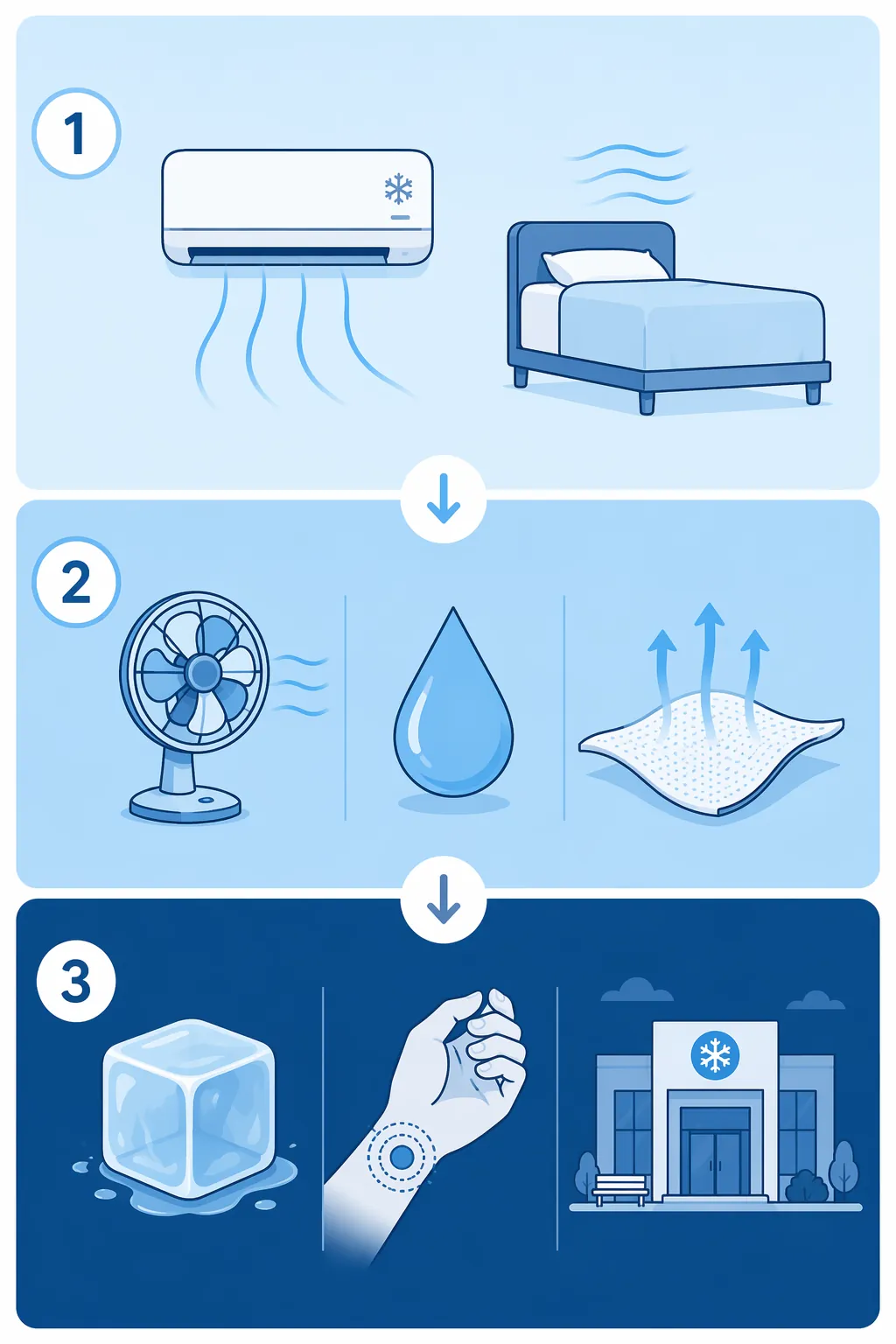
| Your situation tonight | Main goal | What to do before bed | What should change the plan |
|---|---|---|---|
| Reliable AC is available | Use the cool room as medical protection, not just comfort | Cool the sleeping area early, close blinds, keep the door closed if that preserves cool air, wear breathable sleepwear, keep water nearby, and use layers you can remove quickly after a sweat | If symptoms include confusion, fainting, persistent dizziness, or vomiting, do not stay home just because the AC is on |
| No reliable AC, but the room cools and fan use is still reasonable | Increase evaporation and reduce hot-flash triggers without overheating the room further | Use cross-ventilation if outdoor air is cooler, run a fan across damp skin or a damp cloth, use light bedding, sip fluids, take a lukewarm pre-bed shower, and keep a dry shirt or towel within reach | If the room remains very hot, humidity is high, sweating is sustained, or you become dizzy or nauseated, move to a cooler location |
| Indoor heat is severe or the room does not cool overnight | Get the body to a safer environment | Use wet-cooling while preparing to leave: damp cloths, ice packs wrapped in fabric on neck, armpits, inner elbows, or behind knees, and small sips of fluid if alert | Relocate to a cooled room, neighbor’s home, hotel, public cooling center, or emergency department depending on symptoms and access |
If You Have AC, Use It Strategically
When AC is available, the goal is not a perfect sleep temperature; it is recovery. Cool the sleeping space before you are exhausted, not after the third awakening. If the whole home cannot be cooled, choose one room and protect it: close blinds during the day, reduce heat from appliances, keep the door closed if that helps, and sleep there even if it is not your usual bedroom.
For perimenopause night sweats, make the bed easy to reset. A towel over the sheet, a dry top within reach, and a light cover you can push away are not glamorous interventions, but they shorten the time you spend awake and wet. That matters because repeated waking can leave you slower to notice whether the next episode feels different.
If You Do Not Have Reliable AC
Without AC, the plan depends on whether the air around you can still accept heat from your body. PBS News and HealthPartners both emphasize practical no-AC measures: block sun during the day, use breathable fabrics, reduce indoor heat sources, drink fluids, and use airflow when it helps.[10][11] Those measures are useful only if they are keeping you in the safer zone, not merely making a dangerous room feel a little less miserable.
Fans need a special warning. Public-health guidance commonly treats roughly 95°F as the point where fan-only cooling becomes unreliable or potentially unsafe, especially when humidity is high or the person has added risk factors.[12] Below that range, a fan can help by moving air across damp skin. Above it, the fan may act more like a convection oven, adding heat instead of removing it. The exact risk depends on humidity, health status, medications, and whether you can wet the skin.
If fan use is still reasonable, make it evaporative: aim airflow across a damp cloth, misted skin, or a lightweight damp towel rather than just blowing hot air at the bed. Keep water within reach, but avoid forcing large volumes at once. If you have been sweating heavily for hours, have heart or kidney disease, or take diuretics, ask a clinician about fluid and electrolyte guidance before the next heat event.
Skip the Ice-Cold Shower
A very cold shower can feel like the obvious answer when you are drenched, but it is not always the best pre-bed move. Sudden cold can constrict blood vessels near the skin, making it harder to release core heat afterward. A lukewarm shower or bath before bed is usually the better choice for lowering heat load without provoking a rebound.
For active overheating, use targeted cooling while you arrange a cooler place: damp cloths, wrapped ice packs at pulse points, and light clothing. Put cold packs at the neck, armpits, inner elbows, groin, or behind the knees, with fabric between ice and skin. If symptoms suggest heat stroke, start cooling but call 911 first.
When Leaving the Bedroom Is the Sleep Strategy
For some nights, the safest sleep advice is to stop trying to sleep in that room. A third-floor bedroom, sealed apartment, mobile home, or room over a heat-retaining roof can stay hot long after outdoor temperatures fall. If the room is not cooling, you are repeatedly drenched, and symptoms are spreading beyond the usual hot-flash pattern, the plan should shift from “optimize the bed” to “find a cooler place.”
- Move to the lowest, coolest room available, even if it is not where you usually sleep.
- Ask a neighbor, friend, or family member with AC before symptoms are severe.
- Use a public cooling center if one is open and reachable.
- Use urgent care or the emergency department when symptoms persist, worsen, or include red flags.
This is where advice often fails people without reliable AC. A cooling center that closes before bedtime does not solve a 2 a.m. problem. If your local options are limited, make the overnight plan early: transportation, medications, phone charger, water, keys, and a place where you can safely rest. Heat planning is harder when you are already dizzy.
Longer-Term Menopause Treatment Is Separate From Tonight’s Emergency Plan
If heat waves are turning manageable night sweats into repeated medical scares, it is worth discussing vasomotor-symptom treatment with a menopause-informed clinician. Hormone therapy can reduce hot flash frequency and severity for appropriate candidates, and nonhormonal options are available. Yale Medicine also describes fezolinetant, an NK3 receptor antagonist, as a treatment that acts on the KNDy-neuron pathway involved in hot flashes.[5]
Those treatments do not cool a dangerous bedroom tonight. They require medical screening, time, and follow-up. Their role is to reduce baseline vasomotor burden so future heat events may start from a less fragile place. During an active heat wave, the priority remains symptom triage, environmental cooling, and prompt care when the pattern is no longer clearly a hot flash.
Red Flags That Override Home Cooling
Call 911 or seek emergency help if any of these appear during a heat wave, even if the night began like your usual perimenopause sweating:
- Confusion, slurred speech, fainting, seizure, unusual behavior, or inability to stay awake
- Symptoms that keep worsening after moving to a cooler place and starting cooling
- Persistent dizziness, vomiting, severe weakness, chest pain, or shortness of breath
- Hot skin, stopped sweating, or concern for very high body temperature
- Being alone, medically high-risk, or on heat-relevant medications and unable to cool down
The safest goal tonight is not to prevent every sweat episode. It is to keep a perimenopausal body from crossing into heat illness while reducing the triggers that keep waking it. If the symptoms are unclear, choose the safer interpretation. A hot flash can wait for dry pajamas; heat stroke cannot.
References
- Night Sweats, Cleveland Clinic
- Managing Hot Flashes: Tips from a Menopause Expert, Johns Hopkins Medicine
- An Ob-Gyn’s Top Tips for Managing Hot Flashes, ACOG
- How to stay safe in extreme heat, St. Vincent’s Medical Center / Hartford HealthCare
- Hot Flashes, Yale Medicine
- Older women more vulnerable to heat than their male peers, researchers find, Penn State, 2024
- Dangerous Nighttime Temperatures, Climate Central, 2024
- Today’s Climate: Heat Wave Night Sleep, Inside Climate News, June 24, 2025
- Heat Stroke Women Over 40, Flow Space
- How to stay cool and safe in a heat wave, even without air conditioning, PBS News
- Tips for sleeping without air conditioning, HealthPartners
- Heat and Low Income, CDC
Explore the mechanism
Next step
Spot an error or have clinical feedback?
Because this article covers clinical, medication, or safety information, we use a moderated correction channel instead of open public comments. Let us know if something about “How to Sleep Through a Heat Wave with Perimenopause Night Sweats” needs a closer look.
Send feedback on this article