
Mechanism explainer
How to Fix Sleep Disrupted by Wildfire Anxiety and Smoke
Wildfire season disrupts sleep through both smoke inhalation and anxiety. This article provides an integrated protocol that addresses the physical effects of PM2.5 exposure and the psychological hyperarousal of wildfire anxiety to help you rest better tonight.
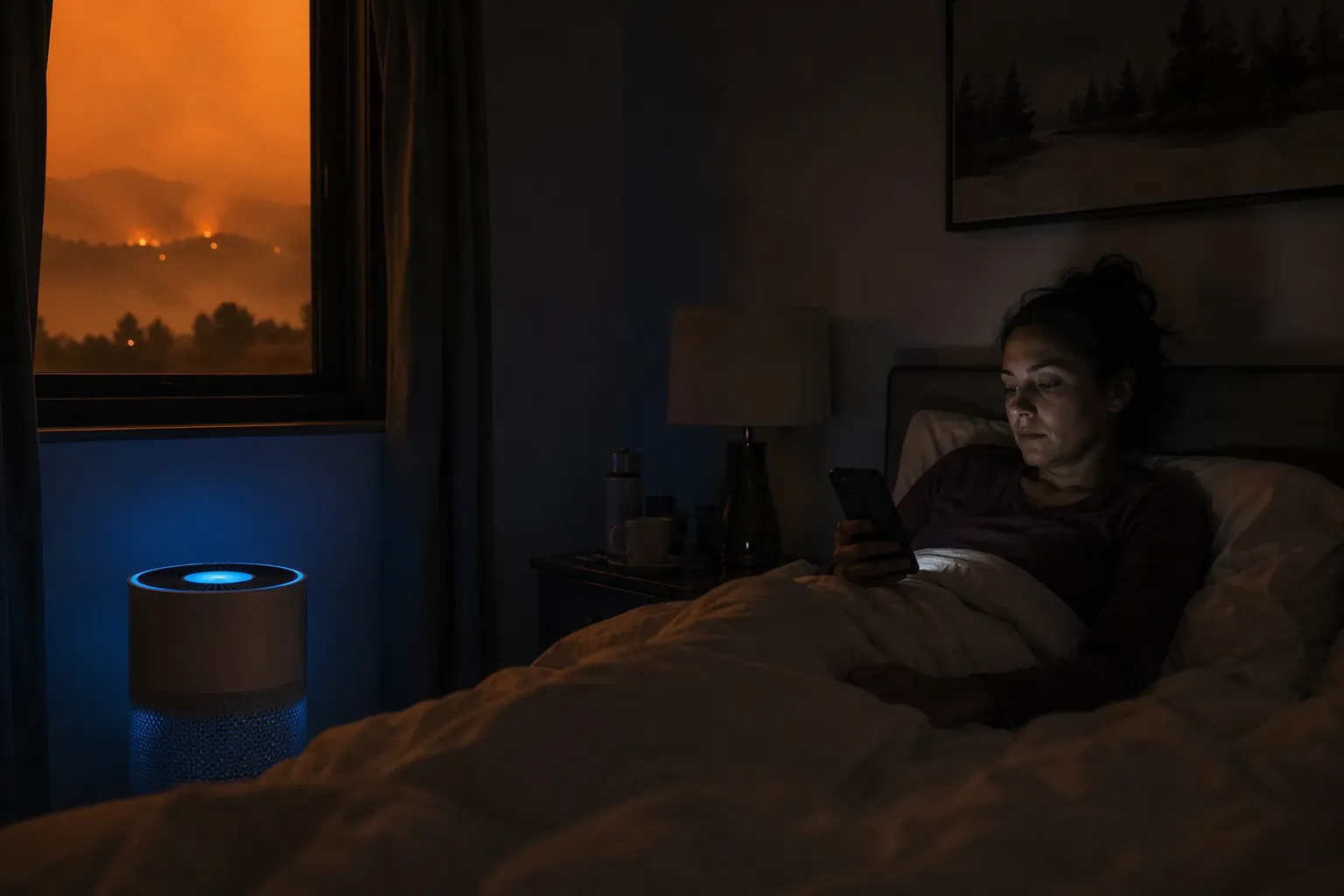
The hard part of sleeping during wildfire season is that the bedroom can be technically safe enough to stay in and still not feel safe enough to sleep in. The room smells faintly smoky. The air-quality app is one tap away. The alert feed is open because closing it feels irresponsible. Your body is tired, but it is also doing exactly what bodies do near threat: staying ready.
Useful wildfire anxiety sleep tips have to work on two fronts at once. Smoke exposure can irritate the airways and affect the brain-body systems that regulate sleep; wildfire anxiety keeps the threat system active through checking, imagining, planning, and listening for changes outside. If you only run the purifier but keep refreshing evacuation maps in bed, one pathway is still awake. If you only do breathing exercises while the room is leaking smoke, the other pathway is still awake.
First, Identify Which Pathway Is Still Active Tonight
Before trying to force sleep, do a quick split-screen check. One side is the air: smell, throat irritation, coughing, chest tightness, headache, heat, or a room that seems to hold smoke even with the windows closed. The other side is the alarm system: repeated checking, mental rehearsal, dread about family or pets, feeling that sleep itself would be a failure of vigilance.
| If this is active | Do this before bed | What it is trying to change |
|---|---|---|
| Smoke or air irritation | Make one sleep room as clean as you can; run filtration; close leaks; avoid indoor particle sources | PM2.5 exposure, airway irritation, and the physical discomfort that fragments sleep |
| Wildfire monitoring and anxiety | Move fire updates into scheduled check-ins; write worries and next actions; use relaxation and stimulus control | Hyperarousal, rumination, and the habit of making bed the command center |
| Both | Do the clean-room sequence first, then the anxiety-containment sequence | The body gets a lower-irritant room and the brain gets a defined stopping point |
That order matters. Air comes first because it is the part most likely to be missed when advice turns into generic “wind down” language. Wildfire smoke contains fine particulate matter, including PM2.5, and Sleep Foundation describes a pathway in which these particles can affect areas such as the frontal cortex and cerebellum and trigger inflammatory responses that may constrict airways and disturb sleep architecture.[1] A 2025 Harvard Chan report on a JAMA Network Open study also connected wildfire-specific PM2.5 with worsening mental health: a 10 μg/m³ increase was associated with increased emergency department visits for anxiety and depression for up to seven days after exposure.[2]
That does not mean every bad night during smoke season is caused by pollution alone. It means the clean split between “air-quality problem” and “anxiety problem” is too neat for the actual bedroom.
Make One Sleep Room Cleaner Than the Rest of the Home
The goal is not to make the whole home perfect. During smoke events, the practical goal is one room where the night’s air is better than the air outside and better than the air in the leakiest parts of the home. EPA guidance calls this a “clean room”: a room set up to reduce exposure to wildfire smoke indoors, ideally with a properly sized portable air cleaner and closed windows and doors.[3]
Choose the room with the fewest compromises, not necessarily the nicest bedroom. Look for a room with a door that closes, fewer exterior walls if possible, windows that seal better than the others, and enough space for the purifier to move air without being blocked. If the usual bedroom has a drafty sliding door and the smaller spare room seals better, the smaller room may be the better sleep room during smoke.
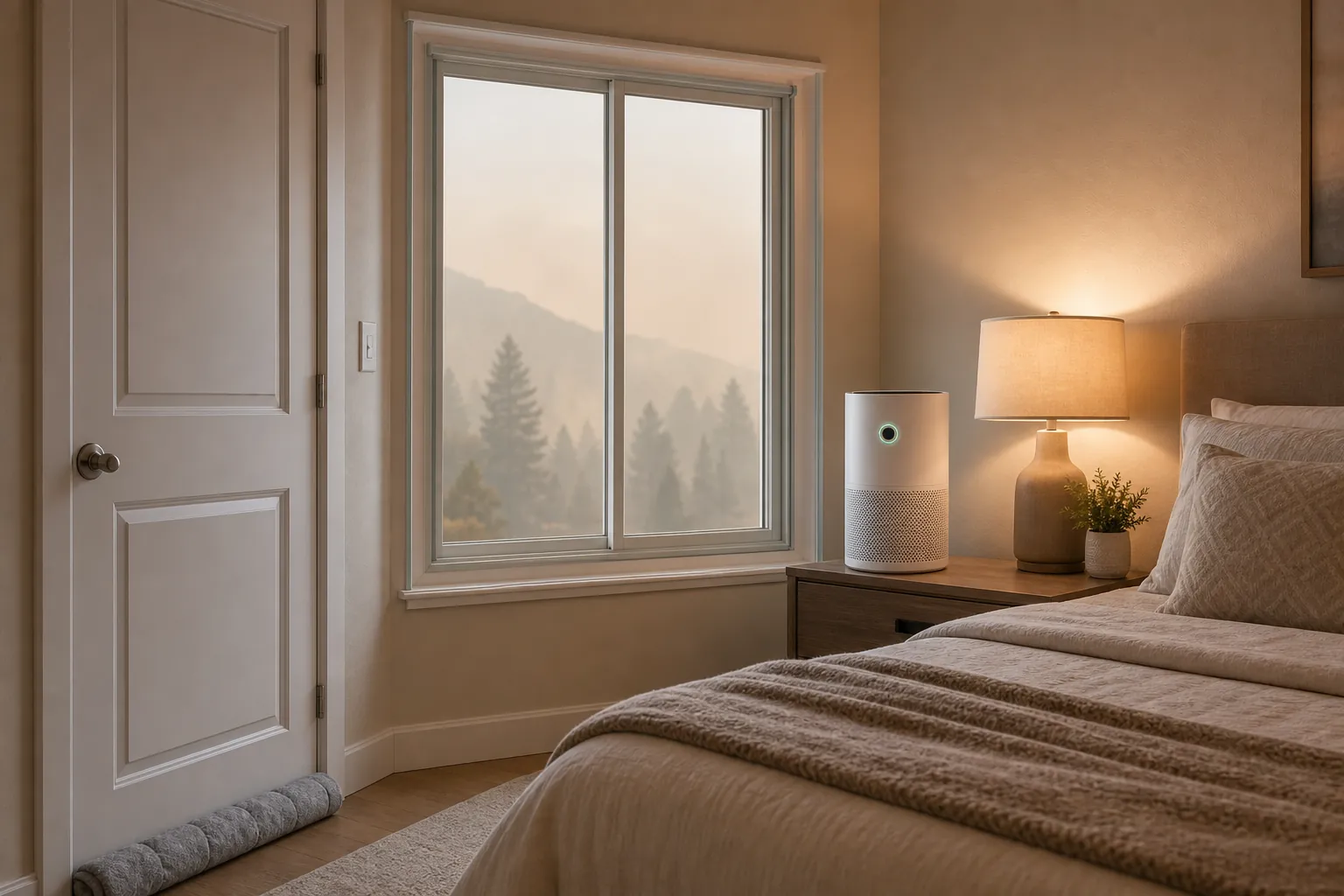
Run the HEPA purifier before you expect to sleep, not after you have already been lying awake for an hour noticing every smell. EPA guidance recommends using a portable air cleaner in the clean room; if the unit has a higher setting you can tolerate, running it on high before bed gives the room a head start.[3] Noise tolerance is real, especially for light sleepers, so the best setting is the strongest one you can actually sleep through after the initial clearing period.
- Close windows and doors in the sleep room, and reduce obvious gaps with practical, reversible fixes such as a rolled towel at the door base.
- Keep the purifier intake and outlet clear; do not wedge it behind curtains, laundry, or furniture.
- Avoid adding particles indoors: do not burn candles, incense, wood, or tobacco, and avoid frying or broiling food near bedtime when smoke is already a problem.
- If cooling is needed, avoid pulling smoky outdoor air directly into the room unless local emergency guidance says ventilation is necessary for heat safety.
The CDC’s wildfire smoke guidance similarly emphasizes reducing smoke exposure indoors and following local instructions, especially for people at higher risk from smoke, including those with heart or lung disease, older adults, children, pregnant people, and people who work outdoors.[4] If you are in a high-risk group, the clean-room plan is not a substitute for medical advice or evacuation instructions. It is a way to reduce one nighttime exposure pathway when staying put is the current guidance.
What if You Do Not Have a Purifier?
Not everyone can buy a purifier in the middle of smoke season, and not everyone controls their windows, lease, HVAC system, or room layout. Without a purifier, still choose the tightest room, close leaks as safely as you can, avoid indoor combustion, and reduce traffic in and out of the room. Those steps are not equivalent to HEPA filtration, but they are not meaningless. They lower the number of ways new particles are added while you sleep.
If smoke is severe, if indoor air remains visibly smoky, or if breathing symptoms are worsening, the answer is no longer a sleep optimization problem. Follow emergency instructions and health guidance for your area.
Move Fire Information Out of Bed
Continuous monitoring feels protective because wildfire conditions can change. The problem is that the brain learns very quickly: bed equals scanning, comparing, imagining, and waiting. The Sleep Health Foundation recommends coping with bushfire-related sleep disruption by managing uncertainty directly, including using planned information checks rather than constant checking, setting aside worry time, and practicing relaxation strategies such as progressive muscle relaxation.[5]
A scheduled check-in is not denial. It is a boundary around a necessary task. Pick a final update time that is late enough to be useful and early enough that it does not become the first stage of insomnia. Check the official sources you trust. Confirm the practical items: alerts, evacuation status, family plan, pets, medications, power, phone battery. Then stop the live search unless an alert interrupts you.
| Bedtime monitoring habit | Replacement |
|---|---|
| Refreshing maps every few minutes | One final official-source check-in, then notifications only |
| Reading social feeds in bed | Move the phone across the room or outside the bedroom after the check-in |
| Replaying what you would do if the wind shifts | Write the next action once: “If alert level changes, I will do X” |
| Trying to relax while still deciding | Finish decisions before relaxation begins |
Keep alerts audible if you need them. The point is not to make yourself unreachable. The point is to stop treating voluntary checking as if it were the same thing as receiving an emergency alert.
Use Worry Time Like a Firebreak
Worry time sounds too tidy for a smoky night until it is used for the right job. It is not a gratitude exercise. It is a place to separate solvable tasks from looping fears before bed.
- Set a timer for 10 to 15 minutes before the final wind-down period.
- Write the worry in plain language: “I am worried the smoke will get worse overnight,” or “I am worried I will miss an alert.”
- Write the next action if there is one: “The phone is charged, alerts are on, keys and medication are by the door.”
- If there is no new action, label it as monitoring urge, not new information.
- Close the notebook and move into the same short relaxation routine each night of the smoke event.
This is where wildfire anxiety resembles other disaster-triggered sleep disruption: the danger may be real, but the mind can keep producing rehearsals after the useful preparation is already done. If that pattern is familiar beyond fire season, the same sleep-threat loop appears in earthquake anxiety at night, where the body is waiting for an environmental cue it cannot fully control.
Relax the Body After the Decisions Are Done
Progressive muscle relaxation is more useful after the air and information problems have been handled. Otherwise the exercise has to compete with unfinished decisions. Once the sleep room is set and the final fire check is complete, use the same sequence each night so your body gets a repeated cue that the active phase is over.
- Start with the feet and calves: tense for a few seconds, then release.
- Move through thighs, hips, abdomen, hands, shoulders, jaw, and forehead.
- Use gentle tension, not strain; skip any area that hurts.
- When thoughts return to smoke or fire, note “already checked” and return to the next muscle group.
Breathing exercises can help some people, but during smoke events they should not be treated as proof that the air is fine. If deep breathing makes coughing, chest tightness, or panic worse, use gentler relaxation, sit upright, or follow medical guidance. A calming technique should not ask you to ignore airway symptoms.
If You Are Awake, Keep Bed From Becoming the Watch Post
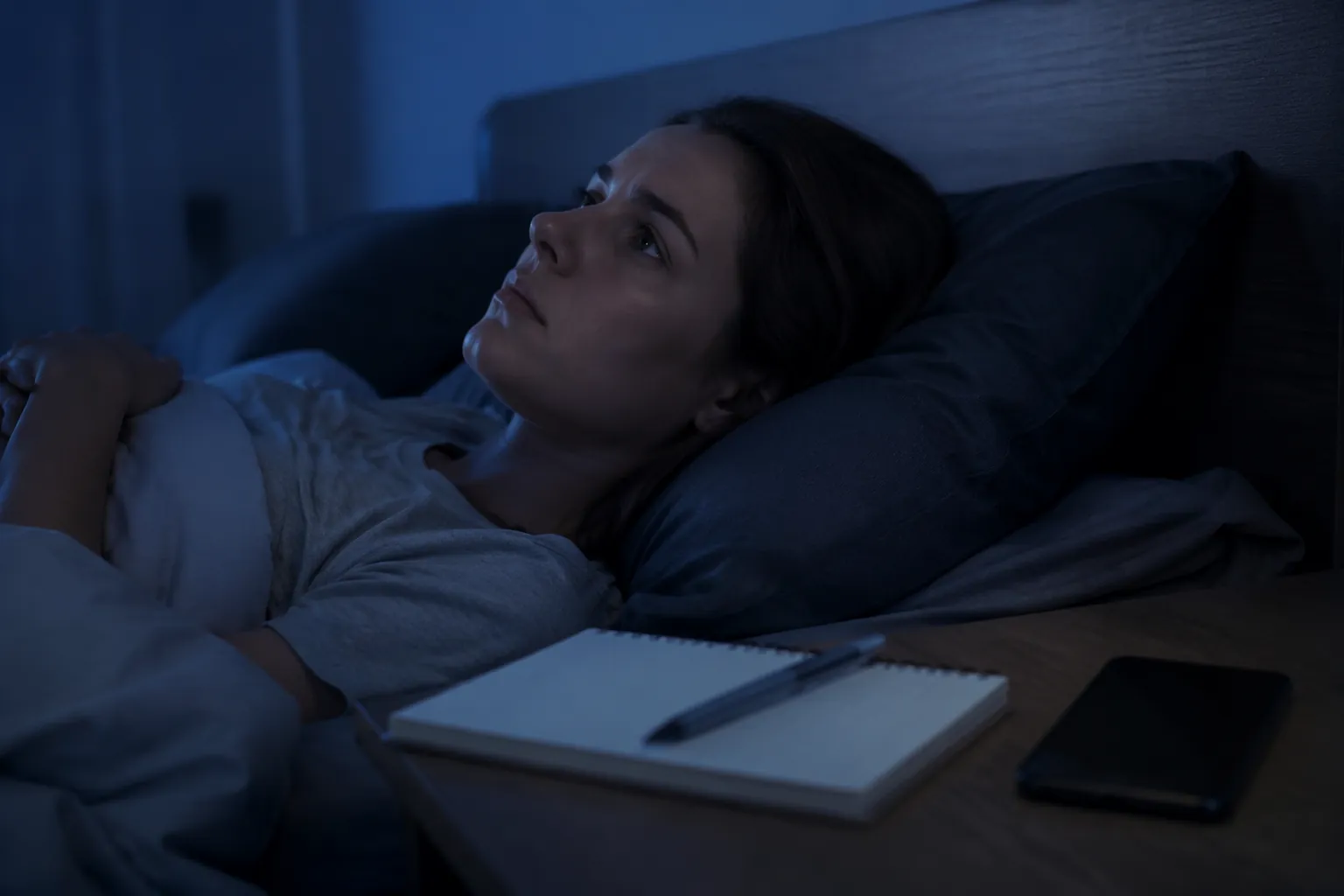
Stimulus control is usually taught as a simple insomnia rule: if you cannot sleep, get out of bed and return when sleepy. Wildfire season complicates that advice because leaving the cleanest room may mean moving into smokier air, a hotter space, or a room where the alert feed is waiting.
Adapt it instead of abandoning it. If you have been awake for a while and bed has turned into active monitoring, sit in a chair within the clean room if there is one. Keep the lights low. Do something dull and non-scrolling. Do not restart the full fire-map loop unless an alert or a planned check-in calls for it. Return to bed when sleepiness returns.
If the clean room has no chair, even sitting on the floor with a blanket for a short reset may be better than training yourself to conduct the night’s emergency operations from the pillow. This is not elegant. Smoke-season sleep rarely is.
Why Smoke Far From Flames Can Still Break Sleep
You do not have to see flames for wildfire smoke to matter. A scoping review by Eisenman and Galway notes that wildfire smoke can travel thousands of kilometers, which means people far from active fires can still experience smoke exposure and its health and well-being effects.[6] That matters for sleep because distant smoke can create the same nighttime puzzle without the clear social permission that comes with evacuation zones or visible fire.
The evidence base on wildfire sleep disruption is still smaller than the size of the problem suggests. A 2021 systematic review found only five studies on wildfire-related sleep disturbance, with self-reported insomnia among wildfire survivors ranging from 63% to 72.5%, roughly two to three times a general-population rate of about 30%.[7] Those numbers are useful as a warning, not as a precise prediction for any one community.
Smoke-exposed communities also report symptoms that look very familiar to anyone lying awake through a bad air night. In a study of Australian Capital Territory residents after the 2019-20 bushfire season, 45.3% of smoke-exposed respondents reported anxiety due to smoke and 37% reported disrupted or poor sleep; symptoms were more common among women and adults ages 25 to 54.[8] The sample was self-reported, so it should not be stretched into a universal rate. It still captures something important: smoke itself can become the stressor.
A 2023 study of wildfire survivors in the United States, Canada, and Australia sharpened that point. Nearly 50% of survivors had insomnia symptoms and nearly 30% had nightmares; smoke was the most significant trauma-related predictor of insomnia, and insomnia in turn predicted PTSD and nightmare symptoms.[9] That does not prove that every smoky night becomes trauma. It does show why dismissing smoke-season insomnia as ordinary nervousness misses the loop: exposure, poor sleep, and threat symptoms can reinforce one another.
When the Night Is More Than Situational Insomnia
Most people need a tonight plan first. Some people also need care that goes beyond a home protocol. The VA National Center for PTSD notes that after wildfires, people may have reactions such as trouble sleeping, intrusive memories, anxiety, irritability, and reminders that feel hard to manage.[10] If sleep disruption continues after the immediate smoke or threat period, or if nightmares, panic, intrusive images, or avoidance start narrowing daily life, that is a clinical signal, not a personal failure.
Research on more severely affected groups shows how closely wildfire trauma and sleep can overlap. In Psarros et al.’s study one month after wildfires, insomnia was present in 79.1% of people diagnosed with PTSD, and nightmares were reported by 46.5% of those with PTSD compared with 12.3% of those without PTSD.[11] Krakow et al.’s Cerro Grande Fire study found psychophysiological insomnia in 97% of fire-evacuee sleep-treatment seekers and presumptive sleep-disordered breathing in 94.8%, but that sample was already seeking treatment, so it should be read as a severity marker in a clinical subgroup, not a community prevalence estimate.[12]
Persistent insomnia is also where cognitive behavioral therapy for insomnia is worth naming, even though access can be frustratingly uneven. If the smoke event ends and your sleep system does not reset, a clinician trained in CBT-I can help separate conditioned insomnia from ongoing danger signals. The access problem is real enough that it has its own practical barriers, covered in this discussion of why CBT-I is so hard to get.
There are also ordinary overlaps that become less ordinary during wildfire season. If you are already in a life stage or health condition that disrupts sleep, smoke and threat monitoring can pile on. For example, women in the 25-to-54 age range were more likely to report symptoms in the Australian smoke-exposure study, and some readers in that group may also be dealing with hormonal sleep disruption; evidence-ranked options for that separate layer are covered in perimenopause insomnia treatments.[8]
A Tonight Protocol That Respects Both the Air and the Alarm System
- Choose the tightest practical sleep room and close windows and doors.
- Run the HEPA purifier before bed if you have one, then keep it on the strongest sleep-tolerable setting.
- Stop adding particles indoors: no candles, incense, smoking, wood burning, or smoky cooking near bedtime.
- Do one final official fire-information check-in, confirm the next action if conditions change, and leave alerts on.
- Write worries and action steps in a notebook so bed does not become the place where planning continues.
- Use progressive muscle relaxation or another gentle routine after decisions are finished.
- If you are awake and monitoring, reset within the clean room rather than scrolling in bed.
Use that sequence during smoke nights, then repeat it during the next smoke event so your body recognizes the pattern sooner. If breathing symptoms, high-risk medical conditions, evacuation concerns, trauma reactions, nightmares, or insomnia persist beyond the immediate situation, switch from a home sleep plan to clinical or emergency guidance.
References
- How Wildfire Smoke Pollution Can Impact Your Sleep — Sleep Foundation.
- Exposure to wildfire smoke linked with worsening mental health conditions — Harvard T.H. Chan School of Public Health, 2025.
- Create a Clean Room to Protect Indoor Air Quality During a Wildfire — EPA.
- Safety Guidelines: Wildfires and Wildfire Smoke — CDC.
- Bushfire Threat and Sleep Health: Coping with Uncertainty and Anxiety — Sleep Health Foundation.
- The mental health and well-being effects of wildfire smoke: a scoping review — 2022.
- A Systematic Review of the Impact of Wildfires on Sleep Disturbances — 2021.
- Physical and mental health effects of bushfire and smoke in the Australian Capital Territory 2019-20 — Frontiers in Public Health, 2021.
- Prevalence and Predictors of Sleep and Trauma Symptoms in Wildfire Survivors — 2023.
- What to Expect in the Wake of Wildfires — VA National Center for PTSD.
- Insomnia and PTSD one month after wildfires — 2017.
- Nightmares, insomnia, and sleep-disordered breathing in fire evacuees — 2004.
Supports these guides
Spot an error or have clinical feedback?
Because this article covers clinical, medication, or safety information, we use a moderated correction channel instead of open public comments. Let us know if something about “How to Fix Sleep Disrupted by Wildfire Anxiety and Smoke” needs a closer look.
Send feedback on this article