
How to Stay Safe During a Nighttime Earthquake in Japan
If an earthquake wakes you in Japan, do not get out of bed while the room is shaking. Stay on the mattress, turn face-down, cover your head and neck with a pillow, and hold onto the bed frame, mattress, or headboard until the shaking stops. That bed-adapted version of Drop, Cover, and Hold On is the shared advice from Earthquake Country Alliance, Ready.gov, the American Red Cross, and MCAS Iwakuni for people who are already in bed when shaking begins.[1][2][3][4]
This is the part that feels wrong when you are half-awake. Your body wants to stand up, find the door, grab the phone, or check whether the hallway is safer. In the dark, barefoot, in a room you did not arrange yourself, that instinct can put you exactly where the hazards are: broken glass, fallen lamps, sliding objects, open drawers, and furniture you cannot see.
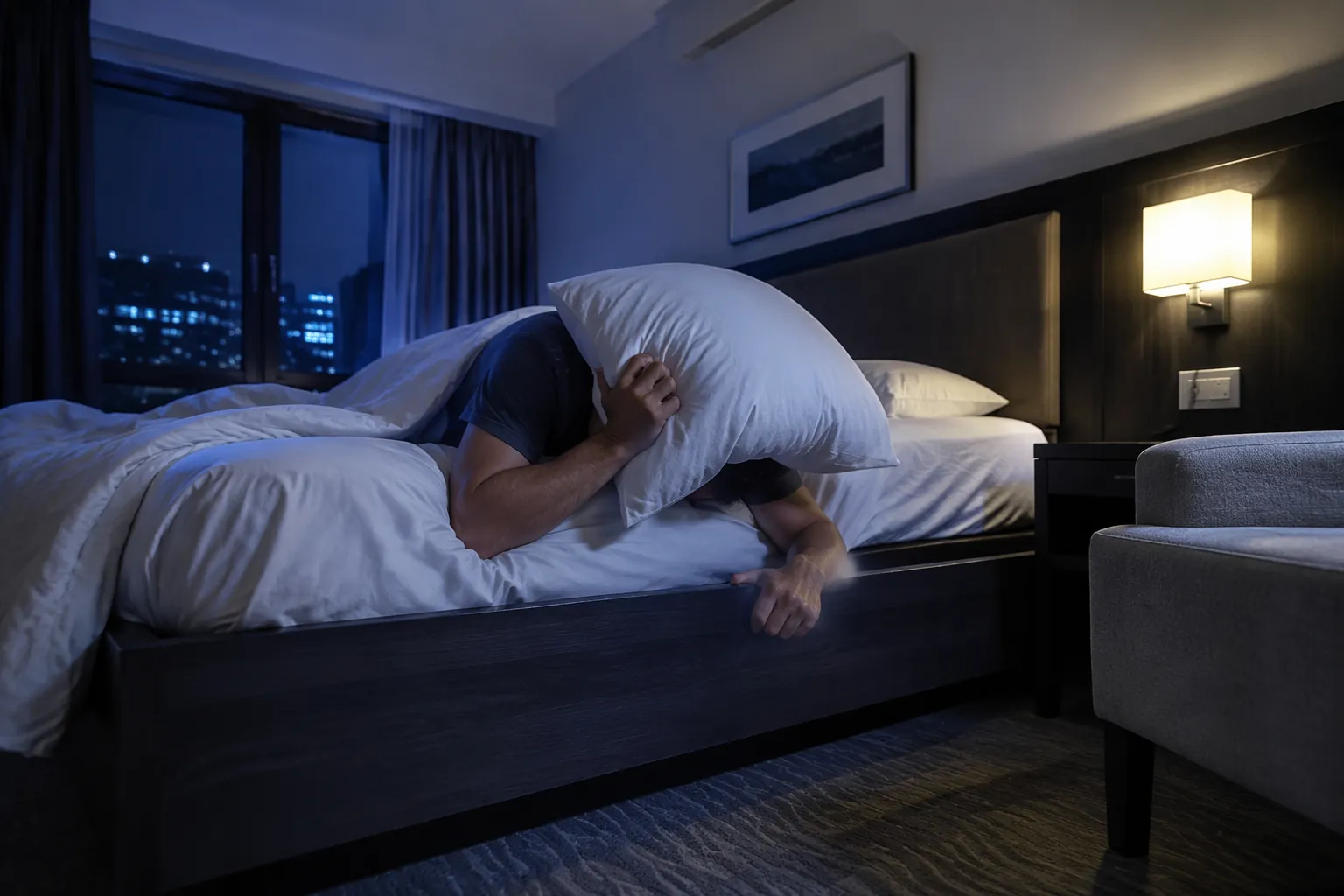
The nighttime protocol: face-down, covered, holding on
Make the action small enough to remember before your brain has fully caught up: face down, pillow over head and neck, hold on. If you have only one clear thought during the first seconds, let it be that.
- Stay in bed unless something in the bed itself is immediately unsafe.
- Roll or turn face-down so your body is low and stable.
- Pull a pillow over the back of your head and neck.
- Hold onto the bed frame, mattress edge, or headboard so the shaking does not throw you out of position.
- Wait until the shaking stops before standing.
The pillow is not a magic shield. It is a fast, available layer between your skull and what may fall or slide near the bed. The face-down position lowers your profile and helps keep your head from whipping backward. Holding on matters because a bed can move, especially on smooth hotel flooring, and a startled person can lose position without realizing it.
If you sleep with your phone on the mattress, do not sit up to read every line of the alert while the shaking is underway. If the phone is already in your hand, keep it there only if it does not interfere with covering your head and holding on. The job of the first seconds is not to diagnose the earthquake. It is to protect the body you will need after the shaking stops.
Why getting up is the dangerous instinct
Earthquake safety advice often sounds simple when the lights are on: move away from windows, avoid falling objects, find cover. A nighttime hotel room changes the difficulty. You may not know where the desk corner is. You may not remember whether the glass water bottle is on the bedside table or the floor. You may be barefoot. You may be dealing with a phone alert in another language while the room is already moving.
Earthquake Country Alliance and MCAS Iwakuni both warn against running or moving during shaking because glass and falling objects are major injury hazards.[1][4] That does not prove a separate Japan-only nighttime injury statistic, and it should not be inflated into one. It does give a practical rule for the exact setting travelers worry about: in a dark room, movement multiplies the hazards.
The doorway is not worth crossing the room for. The hallway is not safer while the building is moving. The stairs are not a refuge during shaking. If you are in bed, you already have padding under you, a pillow within reach, and a stable object to hold. That is enough to act.
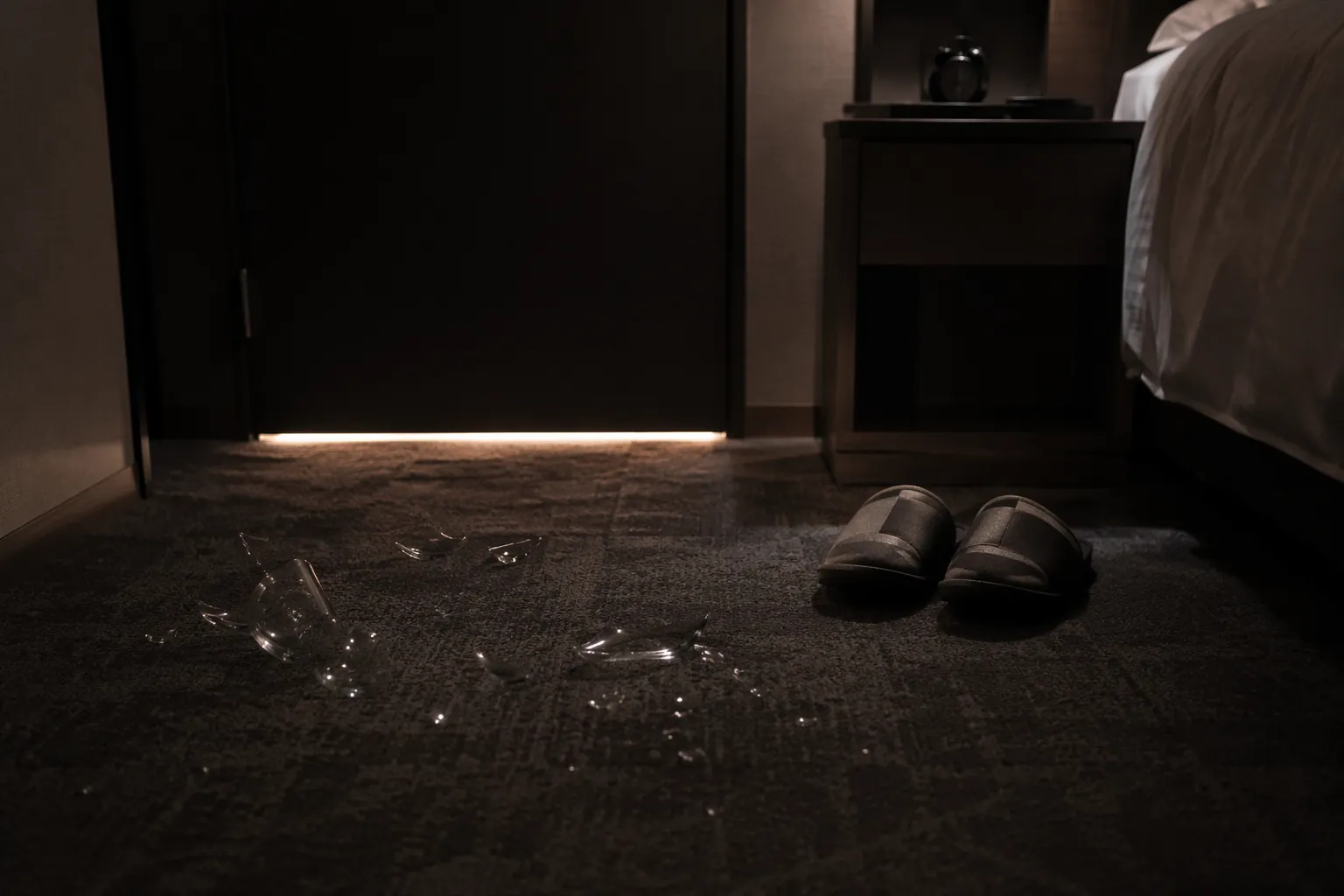
Bare feet deserve special attention because they are ordinary, not dramatic. A traveler who avoids a falling object can still be stopped by glass in the sole of the foot. Once you are injured, everything after the shaking becomes harder: finding shoes, reaching the door, helping a child, following hotel instructions, or leaving if an evacuation is ordered.
Why Japan changes the fear calculation, but not the first move
Japan’s earthquake reputation can make a traveler assume the safest choice is to escape the building as fast as possible. In many modern hotels and newer rentals, that is not the right calculation during shaking. Buildings constructed under Japan’s post-June 1981 Shin-Taishin standard are designed to withstand severe shaking, including Shindo 6 to 7 conditions, without collapse.[5] For a traveler in that kind of building, the more immediate danger is often what is inside the room: glass, lights, shelves, televisions, luggage, and unsecured objects.
That reassurance has boundaries. It does not mean every building in Japan is equally safe. Older wooden buildings, rural stays, very cheap older hostels, and converted properties may not offer the same assumptions as a modern hotel tower or newer apartment building. If you know you are in an older structure, you still do not run during shaking from a bed in the dark; you protect your head and neck first, then move when the shaking stops and it is safer to see and step.
Hotel guests have one additional reason not to bolt immediately: the building is not unmanaged space. Hotel earthquake guidance for Japan emphasizes that staff are trained, evacuation routes are marked, and guests should follow hotel or local instructions rather than self-evacuating during the shaking itself.[7] You may not understand the layout better than the people responsible for the building.
If your phone warns you first, use it as a cue, not a countdown
Japan’s Earthquake Early Warning system and related phone alerts can wake people before strong shaking arrives, but the useful window is measured in seconds, not minutes.[6][8] Treat the sound as a body-position cue: get low in bed, cover your head and neck, hold on. Do not spend those seconds choosing shoes, filming the room, packing a bag, or walking to the door.
The warning may not come before you feel movement. It may come in Japanese. It may sound after you are already awake because the bed is shaking. The protocol is the same either way, which is why it works for travelers: it does not require reading a screen correctly in the dark.
When the shaking stops, the instruction changes
After the shaking stops, staying frozen in bed is no longer the whole plan. This is when you slow the next minute down enough to avoid the second wave of injuries: stepping on glass, opening the wrong door, missing instructions, or moving into a damaged area.
| Order | What to do | Why it comes now |
|---|---|---|
| 1 | Put on shoes or sturdy slippers before standing. | Your first step may be onto glass or debris. |
| 2 | Check yourself and anyone with you for injury. | Pain and bleeding are easier to miss while adrenaline is high. |
| 3 | Grab only close essentials: phone, glasses, room key, medication, small bedside kit if you have one. | Do not turn this into packing while hazards may still be present. |
| 4 | Check immediate hazards you can safely assess, such as broken glass, fallen objects, smoke, or gas smell where relevant. | The room may have changed while you were protected in bed. |
| 5 | Open or confirm an exit route if it is safe, then follow hotel, building, or local instructions. | Evacuation decisions come after shaking, not during it. |
The shoe step is not decorative travel advice. Japanese earthquake-preparedness guidance commonly includes keeping shoes near the bed because broken glass is a predictable nighttime hazard.[6] If you are staying in Japan for even a few nights, place shoes where your hand or foot can find them without crossing the room. Slippers are better than bare feet; sturdy shoes are better than flimsy slippers if debris is likely.
The American Red Cross recommends keeping a bedside kit with items such as a flashlight, sturdy shoes, and other essentials for earthquakes.[3] For travelers, the smaller version is often enough: shoes, phone, glasses, room key, and any medication you would truly need if you had to leave the room. Put them in the same place each night. The value is not the gear itself; it is not having to search barefoot in the dark.
If you smell gas, see smoke, hear building alarms, or receive evacuation instructions, the situation has moved beyond the bed protocol. Put on shoes, take only what is within reach, and follow staff or official directions. Use stairs after shaking if evacuation is ordered and the route is safe; do not use elevators after an earthquake unless authorities specifically direct otherwise.
What to do before sleep in a hotel or rental
You do not need to turn a hotel room into a disaster project. Do the few things that still matter at 3 a.m.: place shoes by the bed, keep your phone and glasses in one reachable spot, notice the exit route before you sleep, and move heavy loose items away from the pillow area if you can do so easily.
If you control the room more fully, such as in a longer-term rental, furniture placement and securing become more important. For that broader setup work, use Restful Ground’s guide to preparing your bedroom for earthquake safety during sleep. For a short hotel stay, do not let a long preparation list bury the one action you most need to remember when the room moves.
If aftershocks keep you awake
After a noticeable quake, the body may stay alert long after the building is quiet. That reaction is not a failure of calm; it is a nervous system doing its job. Keep the nighttime protocol visible and boring: shoes by the bed, phone reachable, face-down and covered if shaking starts again, shoes before standing after it stops.
If the main problem becomes sleeping through aftershock worry, move to a recovery plan rather than rereading earthquake instructions all night. Restful Ground has separate guides on sleeping when you are afraid of aftershocks, sleeping when earthquake anxiety keeps you awake, and recovering sleep after an earthquake. Those are different problems from the first ten seconds.
For the first ten seconds, keep the answer simple. If you wake to shaking in Japan, remain in bed, turn face-down, cover your head and neck with a pillow, and hold on until the shaking stops. Then put on shoes before you stand.
References
Read the full guide: How to Stay Cool at Night in Extreme Heat — by Life Stage