
Permanent daylight saving time's unequal burden on sleep
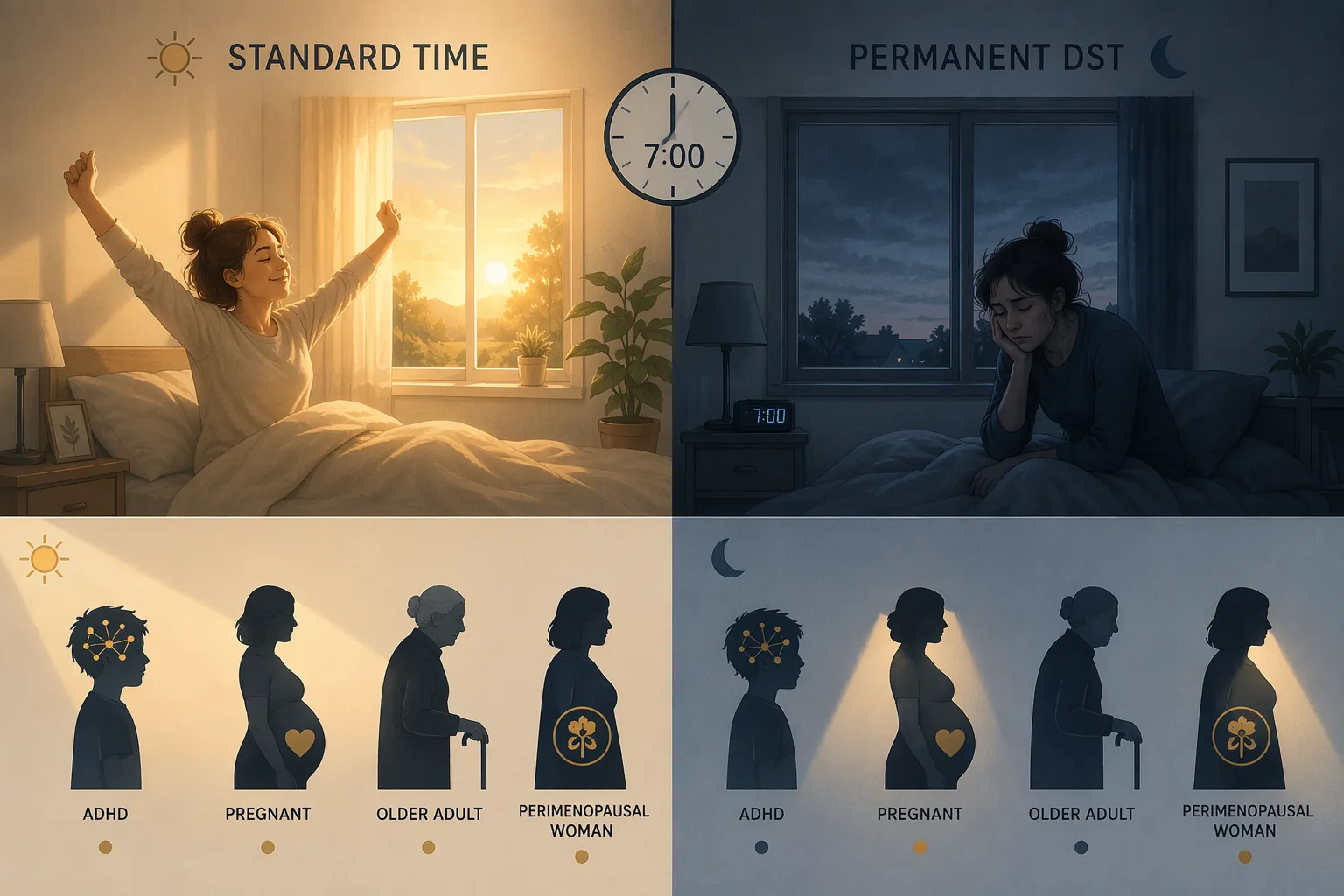
No. Permanent daylight saving time would not affect everyone’s sleep equally. It would move the clock forward year-round, which means darker winter mornings and more clock-time evening light. That combination matters most for people whose circadian systems are already harder to stabilize: adults with ADHD, older adults, pregnant people, perimenopausal women, and some chronotypes.
The problem is not simply “losing an hour.” The recurring spring clock change is disruptive, but permanent DST asks a different question: what happens when society keeps the later clock all winter? For many bodies, morning light is not decorative. It is the strongest daily cue telling the brain that daytime has started. Delay that cue, then add more evening light, and the sleep signal can drift later even when work, caregiving, medication schedules, school drop-off, nausea, pain, or night wakings do not drift with it.
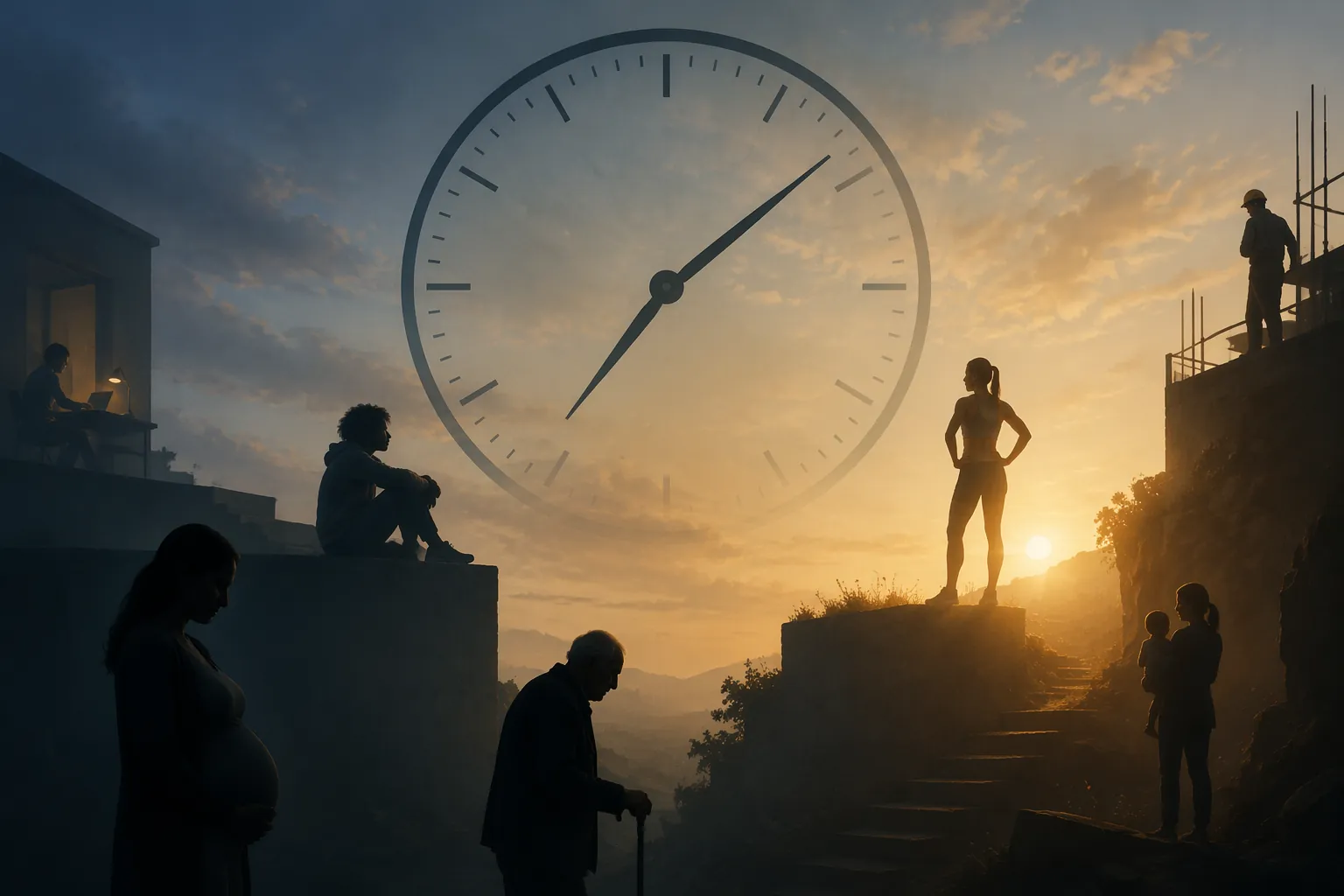
That is why sleep-medicine organizations tend to favor permanent standard time rather than permanent DST. The American Academy of Sleep Medicine’s position statement says permanent standard time is the better choice for health and safety because it aligns more closely with human circadian biology and preserves morning light exposure.[1] Stanford modeling published in 2025 reached a similar direction: under modeled assumptions, eliminating daylight saving time and staying on standard time would be healthier for most Americans than either clock switching or permanent DST.[2]
Those broad conclusions are useful, but they can flatten the people most likely to pay the price. Permanent daylight saving time does not distribute its sleep effects evenly because circadian vulnerability is not evenly distributed.
Why later sunrise is the central sleep problem
Under daylight saving time, the clock is set one hour ahead of standard time. In summer, many people notice the later sunset and treat the extra evening light as a benefit. In winter, the same clock setting pushes sunrise later. In some U.S. locations, permanent DST would make winter sunrise occur after 9 a.m., leaving many people commuting, taking medications, waking children, managing symptoms, or starting work before meaningful outdoor light is available.[3]
Morning light advances the circadian clock. Evening light delays it. That is the basic asymmetry. A policy that delays morning light and preserves evening light makes it easier for the body clock to run late. For a healthy adult with flexible mornings, that may feel like annoyance. For someone already prone to delayed sleep timing, fragmented sleep, thermoregulatory disruption, nausea, or weaker circadian amplitude, it can remove the very cue they use to stay functional.
If you want the broader physiology of seasonal clock changes, Restful Ground’s guide to daylight saving time sleep disruption covers the mechanism in more detail. Here, the more important question is who has less room to absorb that shift.
ADHD adults: when delayed sleep is misread as poor discipline
ADHD is one of the clearest examples of unequal burden because delayed sleep timing is already common in this population. CHADD’s ADHD sleep education describes daylight saving time as especially disruptive for people with ADHD, and ADHD-circadian literature commonly reports that a large majority of children and adults with ADHD have delayed sleep/wake timing. One estimate puts the figure at 73-78%, which should be read as an estimate rather than a precise universal rate.[4]
That number should not be treated as proof that permanent DST has been directly tested in ADHD adults. It has not, at least not in the direct population-specific way a cautious reader would want. But the mechanism is not vague. If a person’s circadian rhythm already tends to run late, weaker winter morning light and brighter evenings push in the same direction as the existing problem.
The consequence is not just bedtime. A later internal night can collide with morning stimulant timing, work start times, school responsibilities, appetite regulation, emotional control, and the executive function needed to carry out sleep advice in the first place. “Just go to bed earlier” is especially thin advice when the biological night has not arrived and the person’s planning system is part of the diagnosis.
For ADHD adults, permanent DST would likely make the hardest part of the day even less forgiving: waking before the body is ready, then being judged for inconsistency.
Older adults: darker mornings can become a safety issue
Older adults are often described as becoming more “morning type” with age, but that shorthand misses the practical point. Aging changes circadian timing, sleep depth, nighttime awakenings, and the strength of the daily rhythm. Morning light becomes an important stabilizer because it helps anchor wake time, alertness, and the day’s activity pattern.
Permanent DST would make that anchor arrive later during the season when daylight is already shortest. A person who wakes early because of age-related sleep changes may spend more of the morning in darkness, not because they chose an extreme schedule, but because the clock has been moved away from the sun.
This is where the debate stops being only about sleep preference. The public-health material summarized by Save Standard Time cites research linking later sunrises with higher motor vehicle crash fatality rates; the figure highlighted in the brief is a 21.8% higher fatality rate in locations with 30-minute-later sunrises.[3] That is an association, not a direct trial proving that permanent DST will cause a specific number of crashes among older adults. Still, it makes the mechanism visible: darker mornings change the conditions under which people move through the world.
For an older adult who drives to an early appointment, walks on uneven pavement, waits at a bus stop, or depends on a morning routine to prevent daytime napping, later sunrise is not an abstract clock preference. It changes light exposure, alertness, visibility, and timing all at once.
Perimenopause: evening light lands on an already unstable sleep-onset system
Perimenopause is not just “stress sleep.” Estrogen changes can affect thermoregulation, vasomotor symptoms, sleep continuity, and the timing signals that help the body move into sleep. Many people in this stage describe a maddening pattern: they are tired, they want sleep, but sleep onset has become unreliable.
Permanent DST would not create perimenopause insomnia from nowhere. The better-supported claim is narrower: later evening light can compound sleep-onset difficulty in a body already dealing with temperature swings, night sweats, and changing melatonin dynamics. When the circadian signal for sleep is delayed, a hot flash or anxious wakefulness has more room to become a long night.
This distinction matters clinically. There are no strong direct trials showing how permanent DST affects perimenopausal women as a separate population. The concern comes from established circadian physiology and perimenopause sleep physiology, not from a completed policy experiment in this group. That still deserves attention because policy does not wait for every subgroup trial before changing the environment people sleep in.
For readers weighing melatonin or timing-based approaches, Restful Ground’s guide to when melatonin actually works for insomnia is relevant because the issue is timing, not simply sedation.
Pregnancy: dark mornings add burden to a body already negotiating timing
Pregnancy changes sleep through many routes: nausea, reflux, urination, pain, fetal movement, anxiety, and shifting hormonal signals. Circadian timing is part of that picture. Melatonin production and light sensitivity matter during pregnancy, and sleep can become fragmented even before the newborn period begins.
Later winter sunrise under permanent DST would be especially unhelpful for someone who wakes nauseated, has to eat before feeling fully alert, or starts work before the sun is up. Morning light will not cure pregnancy nausea. But removing morning light makes it harder for the body to receive a strong daytime-start signal during a period when mornings may already be physically difficult.
That is not the same as claiming a clean permanent-DST pregnancy trial has measured effects on nausea, insomnia, or birth outcomes. The concern is an inference from pregnancy sleep physiology plus the known light-timing mechanics of DST.
Chronotype explains why the same clock can feel different
Chronotype is the body’s tendency toward earlier or later sleep and wake timing. Morning types often feel best when sleep and activity happen earlier. Evening types tend to become alert later and may prefer later social light. That preference is real, and it is one reason permanent DST remains politically attractive.
But chronotype preference is not the same as circadian resilience. A night owl may enjoy later evening light and still be harmed by a fixed early work start. A morning lark may lose the morning light that helps them function. ADHD, pregnancy, perimenopause, and older age can each add another layer of vulnerability on top of chronotype.
The most honest version of the argument is not “permanent DST is bad for every person in the same way.” It is that permanent DST gives the evening-light benefit broadly while concentrating the biological cost among people who have less control over their mornings.
What the evidence can and cannot prove
The strongest evidence is about circadian mechanism and population-level preference for standard time. The AASM position statement is explicit that permanent standard time better supports health and safety than permanent DST.[1] AASM’s myth-focused review also argues that permanent standard time better aligns social time with human biology and addresses common claims made in favor of daylight saving time.[5]
Seasonal clock research adds another reality check. Kantermann and colleagues reported that the human circadian clock’s seasonal adjustment is disrupted by daylight saving time, meaning the body does not simply absorb the clock change as a neutral administrative detail.[6] Stanford’s 2025 modeling adds a useful estimate of population health direction, though the model depends on assumptions about light exposure habits that may not match every household, shift schedule, climate, or screen routine.[2]
The weaker evidence is subgroup-specific permanent-DST outcome data. We do not have direct, long-term permanent-DST trials in pregnant people, perimenopausal women, ADHD adults, or older adults that neatly quantify each group’s added burden. That absence should prevent overclaiming. It should not be used to pretend the burden is unknowable. When a policy delays morning light and extends evening light, the predictable strain falls hardest on bodies already struggling with phase delay, weak circadian anchoring, fragmented sleep, or unstable sleep onset.
How to use this if you are in one of these groups
As of July 2026, the U.S. House has passed a permanent-DST bill, but it has not passed the Senate or been signed into law. If permanent DST is part of your policy debate, the sleep question to ask is not only whether people like brighter evenings. Ask who loses morning light, who must wake before sunrise, and whose sleep disorder, pregnancy symptoms, menopausal symptoms, medication schedule, fall risk, or attention regulation becomes harder to manage.
- ADHD adults should pay attention to delayed bedtime, morning medication timing, and whether darker mornings worsen sleep inertia or work-start functioning.
- Older adults should treat morning light as a health tool, not a lifestyle extra, especially if early driving, walking, or fall risk is part of the day.
- Perimenopausal women should watch for later sleep onset, more time awake after evening light exposure, and interactions with hot flashes or night sweats.
- Pregnant people should consider whether darker mornings make nausea, alertness, meals, work starts, or prenatal-appointment routines harder.
- Evening chronotypes should separate enjoying late light from functioning well under fixed early obligations.
Practical mitigation can help at the individual level: bright outdoor light as soon as it is available, dimmer evenings, consistent wake time, and careful timing of caffeine, exercise, screens, and melatonin when appropriate. Restful Ground’s guide to adjusting to daylight saving time sleep disruption can help with those steps. But mitigation advice should not be mistaken for evidence that the policy burden is equal.
Permanent daylight saving time is not just a universal one-hour preference. For circadian-vulnerable groups, it likely removes the morning light anchor they rely on while strengthening the evening cue that delays sleep. That unequal sleep burden belongs at the center of the public conversation, not in the footnotes.
References
- Permanent standard time is the optimal choice for health and safety: an American Academy of Sleep Medicine position statement — American Academy of Sleep Medicine, 2024.
- Study suggests most Americans would be healthier without daylight saving time — Stanford Medicine, 2025.
- Public Health — Save Standard Time.
- Spring Forward with ADHD — CHADD.
- Debunking myths about daylight saving time: ten things everyone should know about the benefits of permanent standard time — American Academy of Sleep Medicine.
- The human circadian clock's seasonal adjustment is disrupted by daylight saving time — Kantermann et al., Current Biology, 2007.
Read the full guide: How Would Permanent Daylight Saving Time Affect Mississippi Sleep?