
The misleading phrase is “only one hour.” Daylight saving time sleep disruption is not just a smaller serving of sleep. It is a forced mismatch between social clock time and biological time: the wall clock says morning, while the brain’s timing system may still be operating as if night has not fully ended.
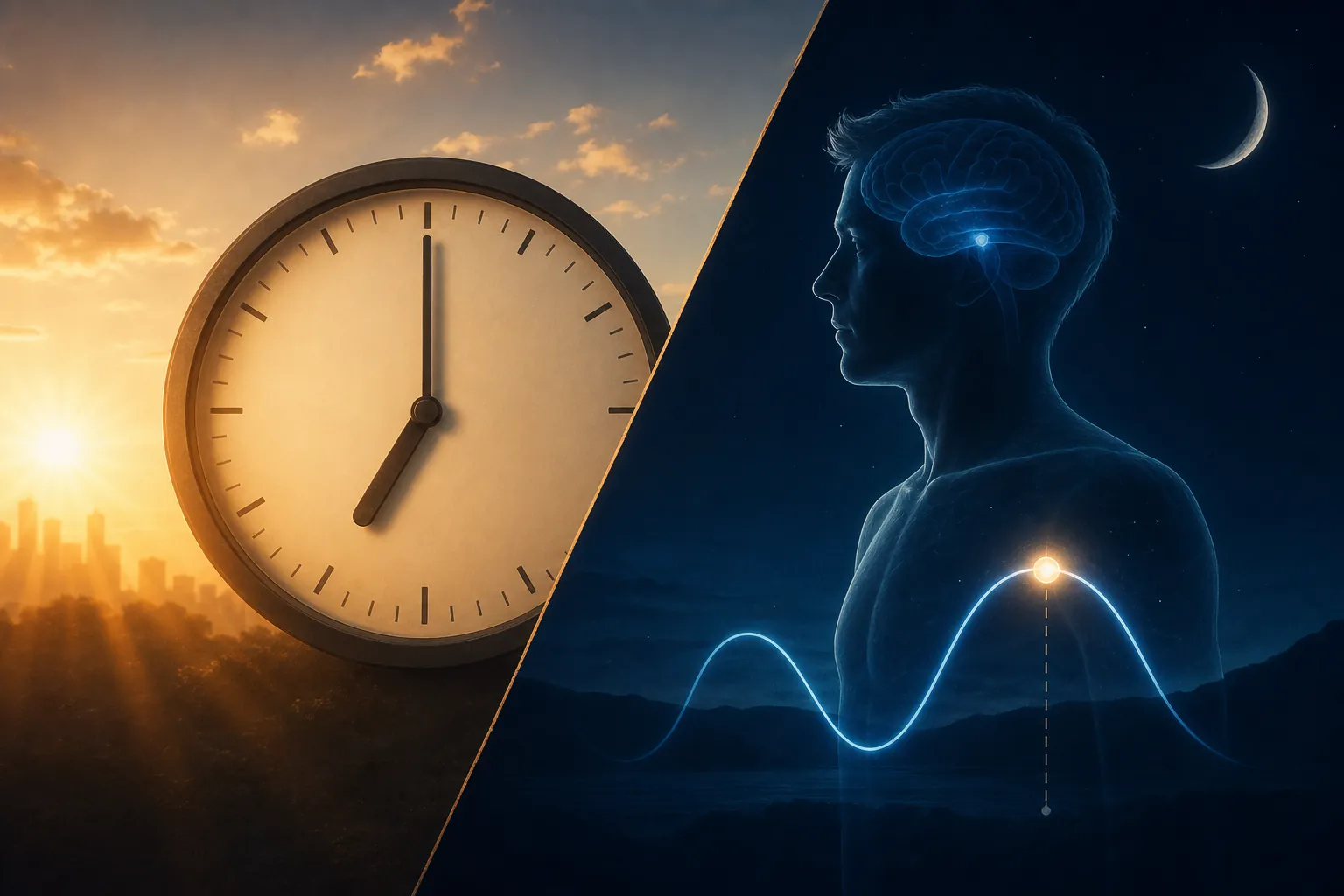
That distinction matters because the body does not read daylight saving time as a civic convenience. It reads light, darkness, sleep pressure, meals, activity, and habit. The spring clock change abruptly removes an hour from the night and asks millions of people to wake, commute, work, drive, and make decisions before their internal morning has properly arrived. On the Monday after the spring transition, people lose about 40 minutes of sleep on average, a number that is small enough to sound survivable and large enough to show up outside the bedroom.[1]
The main problem is not that people are fragile. The problem is that circadian timing is a biological control system, not a preference.
The Clock Change Hits the Master Clock
Deep in the brain, the circadian system coordinates the timing of alertness, sleepiness, body temperature, hormone rhythms, digestion, and many other daily patterns. Light is its strongest external signal. Morning light tends to move circadian timing earlier; evening light tends to push it later. This is why the timing of light exposure matters more than the motivational advice usually attached to the clock change.
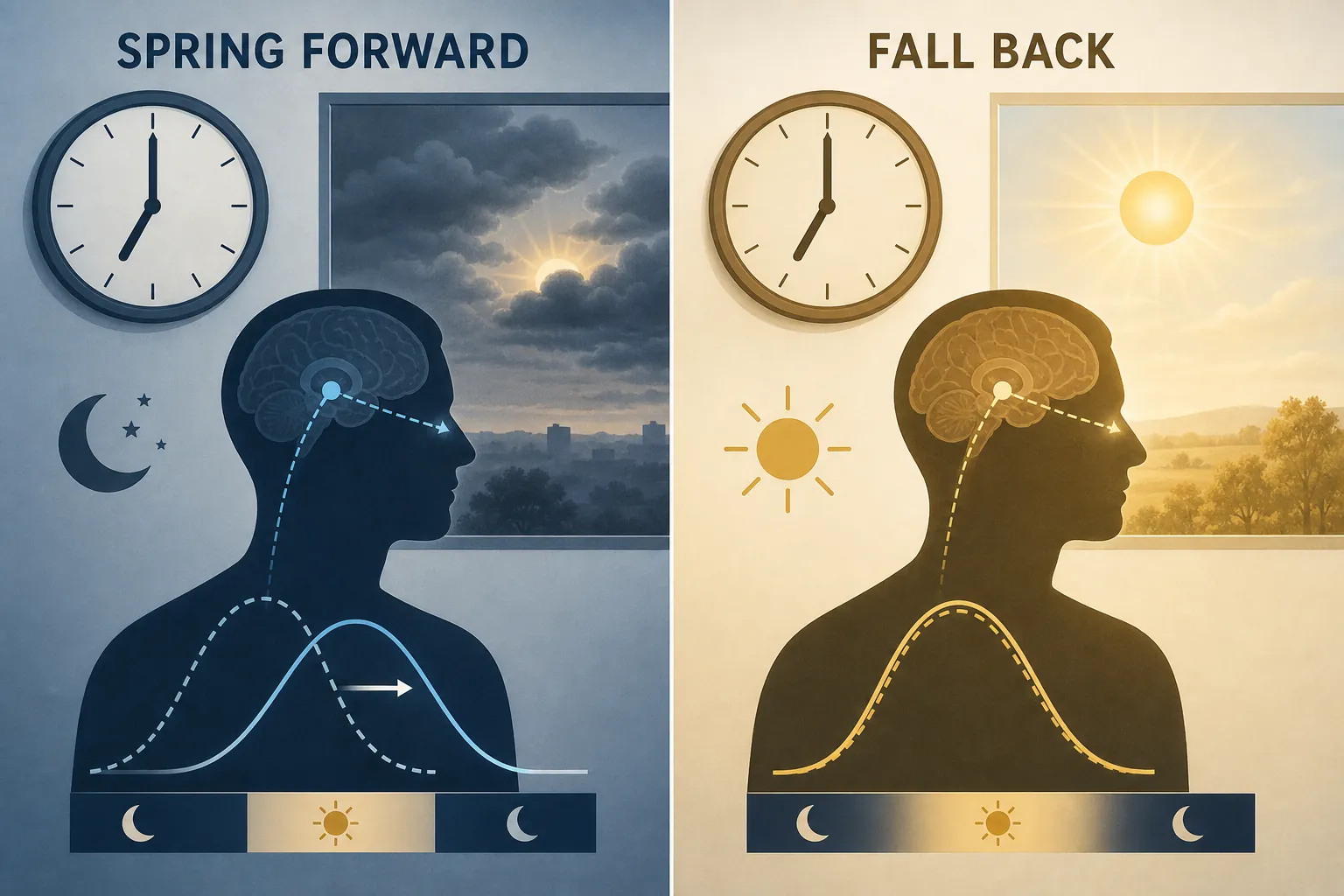
Spring forward removes one hour from the clock overnight, but it does not instantly move sunrise, melatonin timing, body temperature rhythm, or sleep drive by the same amount. A person who normally wakes at 7:00 is suddenly waking at what their body still treats as 6:00. If that person already runs late biologically, the gap is worse.
This is the same basic logic behind circadian hygiene: sleep timing is easier to stabilize when light, activity, and schedule point in the same direction. Daylight saving time does the opposite. It changes the social schedule first and leaves the nervous system to catch up afterward.
The cost is not distributed evenly. Evening chronotypes, adolescents, shift workers, caregivers, and adults who were already short on sleep have less room to absorb the imposed advance. For an evening-type sleeper, the spring transition does not merely shorten one night; it demands an earlier wake time from a rhythm that was already biased later. That is why discussions of delayed sleep phase belong in the daylight saving conversation, not as a rare exception but as a visible version of the same timing conflict.
Why Spring Forward Is the More Damaging Direction
Spring forward combines two insults: less sleep and a phase advance. Losing sleep makes people sleepier the next day. Advancing the clock makes people operate earlier relative to their body clock. Those are related, but not identical. A nap might reduce sleepiness; it does not necessarily repair circadian timing.
The traffic data make the public cost unusually plain. A Current Biology analysis cited in the American Academy of Sleep Medicine position statement found a 6% rise in fatal motor vehicle accidents during the week after the spring transition.[2] That does not prove every crash was caused by a sleepy driver, and it should not be inflated into a claim about all traffic risk everywhere. But it does show why “just one hour” is the wrong frame. A small average shift, applied to a large population during morning travel, can move real harm into public space.
Cardiovascular findings deserve more care than they usually get. Earlier research and clinical summaries have reported a roughly 24% increase in heart attacks on the Monday after the spring daylight saving transition.[3] That finding fits a plausible biological story: sleep loss, circadian disruption, morning sympathetic activation, inflammation, and stress can all matter for cardiovascular vulnerability.
But plausible is not the same as settled. A 2025 Duke study of about 170,000 patients found no significant heart attack increase around daylight saving time transitions, complicating the older spike narrative.[4] The right conclusion is not that the heart is irrelevant, and not that every spring Monday produces a predictable wave of heart attacks. The honest conclusion is narrower: poor sleep remains a major cardiovascular risk factor, acute circadian disruption is biologically plausible as a trigger in vulnerable people, and the specific daylight saving heart-attack signal is contested.
Stroke data point in the same general direction of caution without resolving every causal question. UT Southwestern, discussing American Academy of Neurology research, reports an 8% increase in strokes in the first two days after daylight saving time transitions.[5] The short time window matters. It is consistent with an acute disruption model, not with a vague complaint that seasonal time changes are annoying.
The spring transition is therefore not just worse because people dislike darker mornings. It is worse because the required behavioral change runs against the biology of waking. People are asked to rise earlier by the clock, often with less morning light to help advance the circadian system. The sleep loss is immediate; the circadian repair is slower.
Fall Back Is Easier, Not Harmless
The autumn transition often feels gentler because the clock moves in the easier direction for many adults: later by social time, with a possible extra hour in bed. It also returns the schedule toward standard time, which better matches morning light for many people. That does not mean everyone sleeps beautifully that week. Children, shift workers, people with fixed caregiving duties, and people with unstable sleep can still experience disruption.
Still, the direction matters. A 2025 BMJ cohort study of 683,809 patients in England found that the autumn return to standard time was associated with an 8% reduction in sleep disorder events, a 4% reduction in depression events, and a 2% reduction in cardiovascular disease events.[6] Those are healthcare-visit outcomes in England, not a universal measure of symptoms, and they should not be treated as proof that every person feels better after fall back. But the pattern is exactly what a morning-light alignment model would predict.
That distinction is important. The BMJ data do not show that the autumn clock change is a therapeutic intervention. They show that moving back toward standard time was associated with fewer recorded events in several health categories. The study strengthens the case that the light-clock relationship matters, while leaving room for differences in healthcare access, symptom reporting, work schedules, geography, and individual chronotype.
How Long Adjustment Actually Takes
There are two recovery timelines, and blurring them creates confusion. One is the acute adjustment after the clock changes. The other is the longer question of whether the body fully adapts to daylight saving time during the months it remains in place.
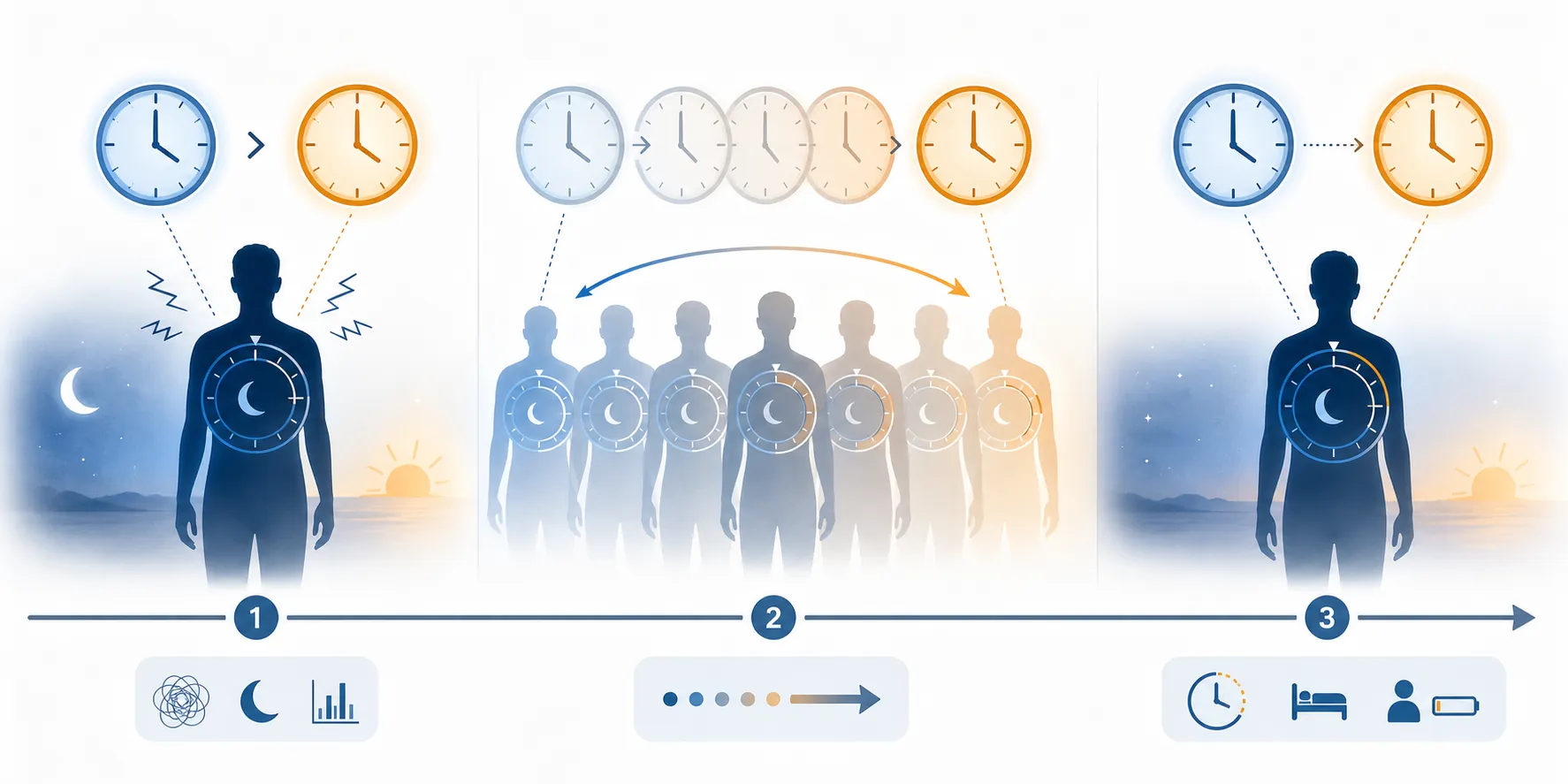
The acute phase is easiest to feel. The first one to two days after spring forward bring the sharpest mismatch: shorter sleep, darker wake time for many people, and a body clock that has not caught up. Over the next several days, morning light, consistent wake time, meals, activity, and sleep pressure can help move the rhythm earlier. Some people feel mostly adjusted within a few days; others need closer to a week or longer, especially if their schedule is already late, irregular, or sleep-deprived.
The longer timeline is less comforting. The American Academy of Sleep Medicine position statement notes evidence that the body clock does not fully adjust to daylight saving time even after months of exposure, creating ongoing circadian misalignment, often described as chronic social jet lag.[2] That is a different claim from “Monday is rough.” It means the clock change may introduce an acute disruption and then leave people living under a schedule that remains biologically less aligned than standard time.
This is also why the usual “you’ll get used to it” answer is too crude. People can become less aware of the disruption. Workplaces, schools, alarms, and routines can force behavioral adaptation. But subjective habituation is not the same as full circadian alignment.
Who Has the Least Margin
Daylight saving time does not land on a well-rested population with flexible mornings. It lands on teenagers whose biological sleep timing already shifts later, shift workers whose clocks may be repeatedly destabilized, evening chronotypes who are already fighting early social schedules, and adults who are chronically short on sleep.
| Group | Why the spring transition can hit harder |
|---|---|
| Evening chronotypes | Their internal night tends to run later, so an earlier clock wake time increases the gap between social time and biological time. |
| Teenagers | Later circadian timing and early school schedules can make the imposed advance especially unforgiving. |
| Shift workers | Irregular or overnight schedules can reduce the stabilizing effect of consistent morning light and sleep timing. |
| Already sleep-deprived adults | They have less reserve when the transition removes additional sleep and increases next-day sleepiness. |
These groups are often framed as people who need better habits. Sometimes habits matter. But the policy mismatch comes first: the clock changes for everyone at once, while biological timing differs across age, chronotype, work schedule, latitude, and position within a time zone.
What Helps Without Pretending the Problem Is Personal Failure
Recovery advice has a place, but it should not become a distraction from the mechanism. The useful goal after spring forward is to help the circadian system move earlier while protecting sleep duration as much as possible.
- Get bright outdoor light soon after waking in the days after spring forward, especially if mornings feel unusually heavy.
- Keep wake time stable for several days rather than repeatedly sleeping in and shifting the rhythm later.
- Reduce bright light exposure late in the evening if the goal is to fall asleep earlier.
- Move bedtime earlier gradually before the transition if your schedule allows, rather than expecting one abrupt early night to work.
- Treat driving, early meetings, and safety-sensitive work with extra caution during the first days after spring forward.
The familiar basics still apply: caffeine timing, alcohol, late heavy meals, and inconsistent bedtimes can all make adjustment harder. For a broader structure, sleep hygiene fundamentals are useful. They are just not the center of the daylight saving problem. The center is circadian timing.
If the disruption does not settle after the expected adjustment window, or if the clock change exposes a longer pattern of lying awake, dreading sleep, or spending excessive time in bed awake, the problem may no longer be ordinary DST adjustment. That is where an insomnia-specific approach such as CBT-I becomes more relevant than another round of generic seasonal tips.
The More Precise Way to Understand DST Sleep Disruption
Daylight saving time sleep disruption is not merely lost sleep, although the spring transition does cost measurable sleep. It is not equally harmful in both directions, because spring forward removes sleep and advances the social clock against biological timing, while fall back moves many people closer to morning-light alignment. And it is not fully answered by saying people adjust, because acute adjustment over days can coexist with chronic social jet lag during the months of daylight saving time.
The strongest evidence case is against spring forward: average sleep loss, fatal-accident findings, plausible neurological and cardiovascular stress, and disproportionate burden on people whose clocks already run late or irregular. The most honest uncertainty is around specific cardiovascular event estimates, where older signals and newer large-cohort findings do not all agree. That is not a reason to shrug at the clock change. It is a reason to describe the harm accurately.
References
- Daylight Saving Time: How This Time Change Affects Sleep — Sleep Foundation
- Daylight saving time: an American Academy of Sleep Medicine position statement — PMC/JCSM
- The dark side of daylight saving time — Harvard Health
- Daylight Saving Time May Not Trigger Heart Attacks After All, Study Finds — Duke University
- Why daylight saving time may be bad for your brain and health — UT Southwestern
- Acute effects of daylight saving time clock changes on mental and physical health in England — The BMJ
Comments
Join the discussion with an anonymous comment.