
How to sleep in Phoenix extreme heat
On July 24, 2026, Phoenix tied its hottest night on record: an overnight low of 97°F. The city was below 100°F for only three hours, which means the bedroom never got the reset that most heat-sleep advice quietly assumes will happen after dark.[1]
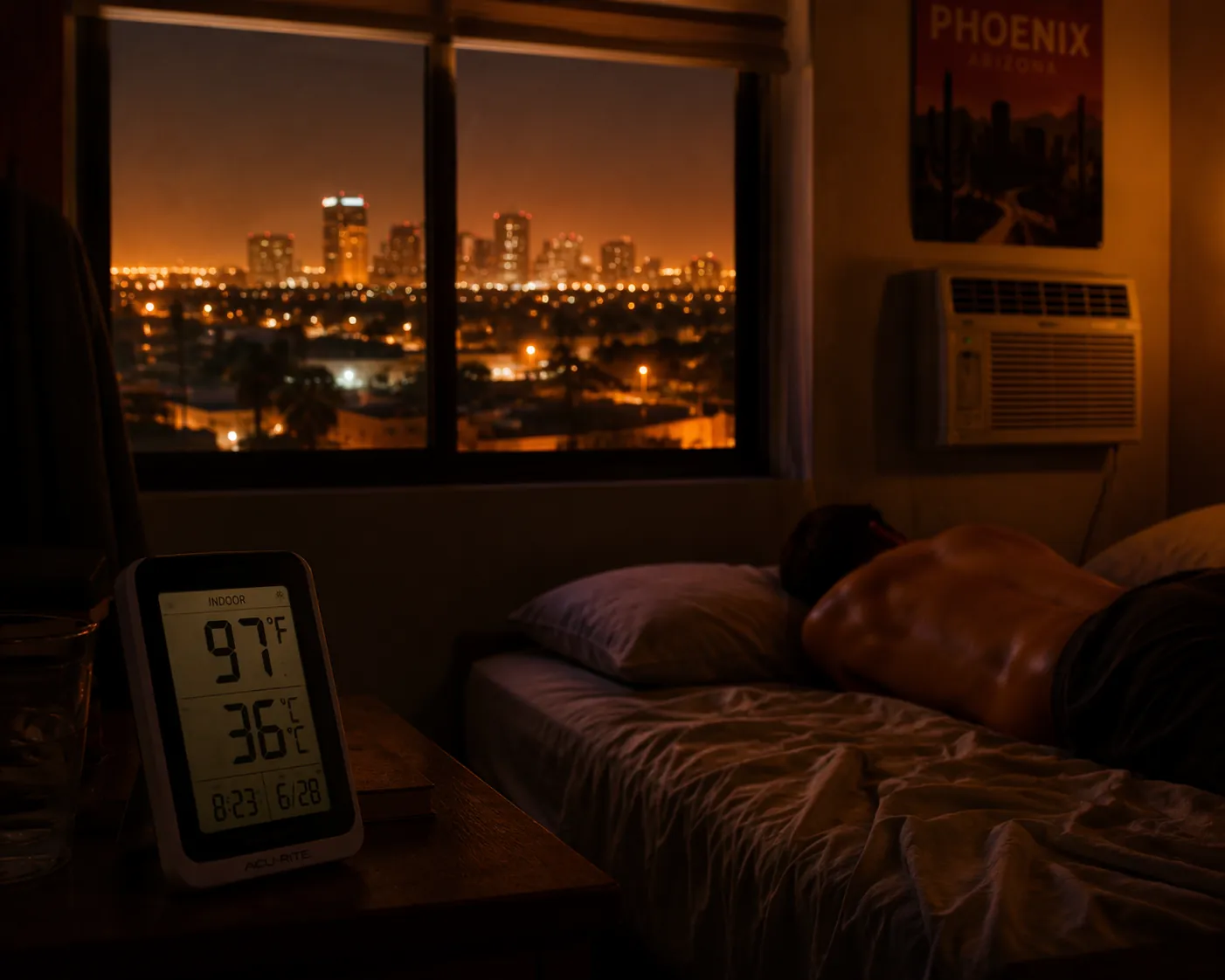
That is the first thing to understand about how to sleep in extreme heat in Phoenix: this is not the same problem as a warm upstairs bedroom in a city that cools into the 70s by 2 a.m. Opening a window into 90-something-degree air does not cool a room. A fan moving hot air across a dehydrated body can feel useful for a while, but it does not change the room temperature. “Sleep in a lower level” does not help the renter in a one-story apartment, the family in a block house, or the visitor in a third-floor short-term rental.
Phoenix used to average about seven nights a year with lows at or above 90°F from 1990 to 2020. In each of the past three years, it has logged more than 20 such nights. Summer nights in Phoenix have warmed 6.5°F since the 1970s, more than twice the national average cited in the same local reporting.[2] That shift turns sleep advice from a comfort question into a safety question.
Why Phoenix Breaks Ordinary Hot-Weather Sleep Advice
The body needs to shed heat to fall asleep and stay asleep. A cooler room helps that process; a room that stays hot keeps asking the body to work. The National Sleep Foundation’s commonly cited bedroom-temperature range of 60–67°F is useful as a target, but in Phoenix it can sound almost fictional during a bad July night. If the outdoor low is 90–97°F, passive cooling will not bring a bedroom anywhere near that range.
Large-scale sleep-temperature research supports the basic physiology: in a 2025 Nature Communications study using 23 million sleep records from 214,445 participants, each 10°C increase in ambient temperature was associated with 20.1% higher odds of sleep insufficiency, 9.67 fewer minutes of total sleep, and 2.82% less deep sleep.[3] That study was not a Phoenix-specific study, and its setting differs from an air-conditioned desert city. Still, it lines up with what Phoenix nights make plain: when heat stays high long enough, sleep becomes harder to protect.
The local danger is duration. Maricopa County’s medical director, Dr. Nick Staab, has warned that sustained heat combined with high overnight lows is the biggest risk for heat-related deaths.[2] The phrase “overnight low” can make 92°F sound like relief. In a bedroom, it may mean the body is still under load at the hour when it should be recovering.
If You Have AC, Treat It Like Heat-Safety Equipment
In Phoenix summer, air conditioning is not a luxury sleep upgrade. It is the main way to create a room where the body can stop fighting the night. The goal is not to chase a perfect 65°F bedroom if that would blow up the electric bill. The goal is to keep the sleeping space cool enough that the body can shed heat, the sleeper can stay hydrated, and vulnerable people are not left in a dangerous room until morning.
- Cool the sleeping room first. If the whole home is expensive to cool, close doors and focus on the bedroom where people will spend the longest continuous stretch.
- Start earlier than bedtime. A bedroom that has absorbed heat through walls, windows, and roof materials may not cool quickly after 10 p.m.
- Block late-day sun. Shades, curtains, and exterior shade matter most before the room heats up, not after the bed already feels warm.
- Use fans to distribute cooled air, not to pretend hot air is cool. A fan can make AC more effective across the bed, but it cannot replace room cooling during a 90°F-plus night.
- Check the room, not just the thermostat. A hallway thermostat can read differently from a west-facing bedroom, a nursery, or a room with poor airflow.
If wildfire smoke or indoor air quality is also a concern, AC settings get more complicated because ventilation, filtration, and recirculation all matter. For that specific overlap, see how your air conditioner affects sleep during wildfire smoke.
What setting is “safe enough”?
There is no single Phoenix sleep thermostat setting that fits every home, body, bill, and AC system. A pregnant person, an older adult on diuretics, and a healthy 25-year-old do not have the same heat margin. What matters is whether the room is actively cooled, whether the sleeper can stay comfortable without sweating through the night, and whether symptoms such as dizziness, nausea, confusion, headache, muscle cramps, or unusual weakness appear.
If the room still feels hot after the AC has been running, look for fixable problems before accepting a bad night as normal: a clogged filter, blocked return, closed supply vent, sun-exposed window, leaking duct, dirty outdoor unit, or a thermostat located far from the sleeping area. Renters may need to document indoor temperatures and submit maintenance requests in writing, especially when a unit cannot cool the bedroom during overnight heat.
If You Use an Evaporative Cooler, Watch the Trade-Off
Evaporative coolers can make sense in Phoenix because they work best in dry air. They cool by adding moisture as water evaporates. That is the whole trick, and it is also the limitation: the cooler can lower air temperature while raising indoor humidity. Once the room gets too humid, sweat evaporates less efficiently, the cooler performs worse, and the bedroom can feel clammy instead of safe.
Use an evaporative cooler as an active cooling system, not as a set-it-and-forget-it substitute for refrigerated air. It needs airflow, maintenance, and attention to indoor feel. Pads, water flow, and ventilation matter. During monsoon humidity or a stretch when the room stops cooling well, do not answer the problem with linen sheets and bedtime routines. Reassess the cooling source.
| Bedroom sign | What it usually means | Practical response |
|---|---|---|
| Air feels cooler and dry enough to sweat normally | The evaporative cooler is doing useful work | Keep airflow steady and monitor the room through the night |
| Air feels damp, sticky, or heavy | Humidity may be reducing sweat evaporation and cooler performance | Increase ventilation if the system requires it, or move to a better-cooled space |
| Room stays hot despite the unit running | The cooler, pads, airflow, or outdoor humidity may be limiting performance | Do not rely on bedding tricks alone; use another cooled space if needed |
When Cooling Is Limited, Cool the Body While You Find a Safer Room
Pulse-point cooling, frozen bottles, cool showers, and light bedding can reduce heat strain around the body. They are worth using. They are not magic room-cooling solutions. If the bedroom remains dangerously hot, these tactics buy relief and time; they do not turn a 95°F room into a safe sleep environment for everyone.
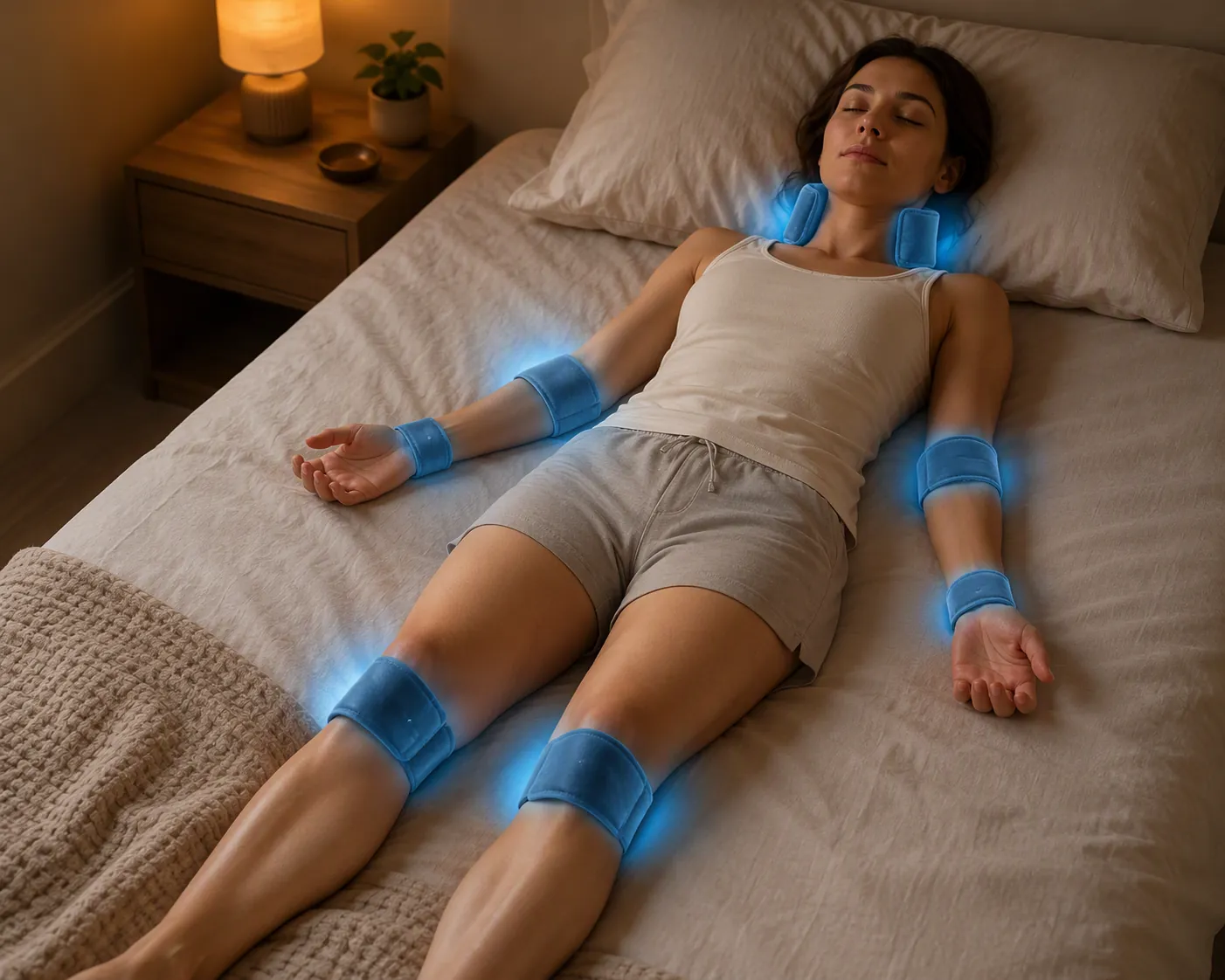
- Put a cool pack or wrapped frozen bottle near pulse points: inner wrists, sides of the neck, inner elbows, behind the knees, or ankles. Keep a cloth between ice and skin.
- Freeze a hot-water bottle or sturdy water bottle and place it near the feet or core area, wrapped so it cools without causing ice burn.
- Take a cool or lukewarm shower before bed. Avoid making it so cold that the body rebounds with shivering or discomfort.
- Use a single breathable layer and keep bedding minimal. This helps heat escape, but it cannot overcome a dangerously hot room.
- Drink earlier and steadily, then taper near bedtime if nighttime bathroom trips are a problem. Do not use dehydration as a sleep strategy.
For a broader ranking of non-AC bedroom tactics, see the best ways to cool a bedroom without AC. If the problem is a blackout or AC failure, start with sleeping during a power outage safely rather than treating the night like ordinary insomnia.
Who Should Not Wait for the Room to “Feel Extreme”?
Some people have less room for error in Phoenix overnight heat. That does not mean everyone else is invincible. It means the threshold for leaving a hot bedroom, calling for help, or using a cooling center should be lower.
Pregnancy
Pregnant people should avoid letting core body temperature exceed 102°F, and heat exhaustion can contribute to preterm labor. Mayo Clinic Health System guidance also names at least 64 ounces of water daily as a minimum during pregnancy, with more often needed in heat or activity.[4] A pregnant sleeper in a hot Phoenix bedroom should not wait until symptoms feel dramatic before moving to a cooler place or calling a clinician.
Older adults and medication heat sensitivity
Older adults sweat less efficiently, and common medications can make heat harder to handle. Diuretics, beta-blockers, and antihistamines are among the medications often flagged for heat-related thermoregulation concerns.[5] In Phoenix, the urban heat island matters here because the person may not get a cooler overnight window to recover from daytime exposure.
Perimenopause and night sweats
Perimenopause can already make temperature regulation feel unpredictable. External heat can stack on top of hot flashes and night sweats, especially when the bedroom never cools. For life-stage-specific heat guidance, see heatwave sleep tips for pregnancy, menopause, and older adults.
Local Help Belongs in the Plan, Not After the Crisis
If your bedroom cannot be actively cooled, plan where you will go before the worst part of the night. Maricopa County maintains Heat Relief Network information for cooling centers, hydration stations, and other heat resources; use the current county page rather than an old list of locations, because sites and hours can change.[6]
There is also a practical utility fact many people do not learn until they are already scared: Arizona utility companies cannot shut off power for nonpayment from June 1 through October 15.[7] That does not erase the bill, and it does not fix a broken AC unit, but it matters if fear of shutoff is keeping someone from running necessary cooling during dangerous heat.
Call the utility, ask about heat-season protections and payment plans, and document the conversation. If the home has a landlord, report cooling failures in writing. If someone in the home is pregnant, medically fragile, older, or taking medications that affect heat tolerance, say that clearly when asking for help. The person reading the email or answering the phone may not know your bedroom is still hot after midnight.
What About Caffeine, Bedtimes, and Sheets?
Regular sleep habits still help. Late caffeine can make a bad night worse. Alcohol can interfere with sleep and hydration. A consistent bedtime can support the body’s rhythm. Light bedding is better than heat-trapping layers. None of those changes solves a Phoenix bedroom that remains too hot for the body to cool itself.
That distinction matters because softer sleep hygiene advice often puts the burden back on the sleeper: relax better, plan better, choose better sheets. In Phoenix extreme heat, the first question is more basic: can the room or at least the sleeping zone be actively cooled enough for the body to recover?
There is no dedicated peer-reviewed Phoenix sleep-outcomes study that answers every local question. The practical answer comes from combining Phoenix’s overnight heat data, general thermoregulation research, and clinical caution. That is enough to reject advice that depends on cool night air when the night air is still in the 90s.
The Threshold
Use AC or a well-functioning evaporative cooler when you have it. Use pulse-point cooling, frozen bottles, cool showers, light bedding, and hydration to reduce body heat strain. But if the room cannot be actively cooled, if heat-illness symptoms appear, or if a vulnerable person cannot maintain a safe sleeping environment, the next step is a cooling center, utility-protection help, landlord repair action, or medical guidance—not another bedroom hack.
References
- Phoenix heat sets records for warm nights, hot days, Arizona Republic, July 24, 2026.
- Phoenix overnight lows have broken multiple records this summer, KJZZ, July 27, 2026.
- Nighttime ambient temperature and sleep quality: evidence from 23 million sleep records, Nature Communications, March 2025.
- Staying safe in heat during pregnancy, Mayo Clinic Health System.
- Beat the Heat: Summer Safety Tips for Phoenix Seniors, Comfort Keepers Phoenix.
- Extreme Heat, Maricopa County.
- Heat Safety: Staying Safe in Arizona’s Extreme Heat, NOAH Community Health.
Read the full guide: How to Sleep When the Heat Index Reaches 100