
Tired, sleepless after donating blood? It may be low iron
Yes, it can be normal to feel tired after donating blood. In a 6-day donor diary study, fatigue was the most common symptom, many symptoms improved by day 3, and only about 3% of donors reported severe problems on day 1.[1] If you are asking how to recover after donating blood and sleep better, the first answer is still the ordinary one: rest, fluids, food, and a quieter day or two.
That answer gets too thin when the fatigue does not fit the usual window, when eight hours in bed no longer feels restorative, or when your legs start feeling jumpy, crawly, achy, or impossible to settle at night. At that point, the issue may not be that you failed to hydrate or skipped the snack table. A whole-blood donation removes iron, and if your iron stores were already low or borderline, the donation can turn a modest reserve problem into weeks of poor recovery.

The recovery problem hydration advice misses
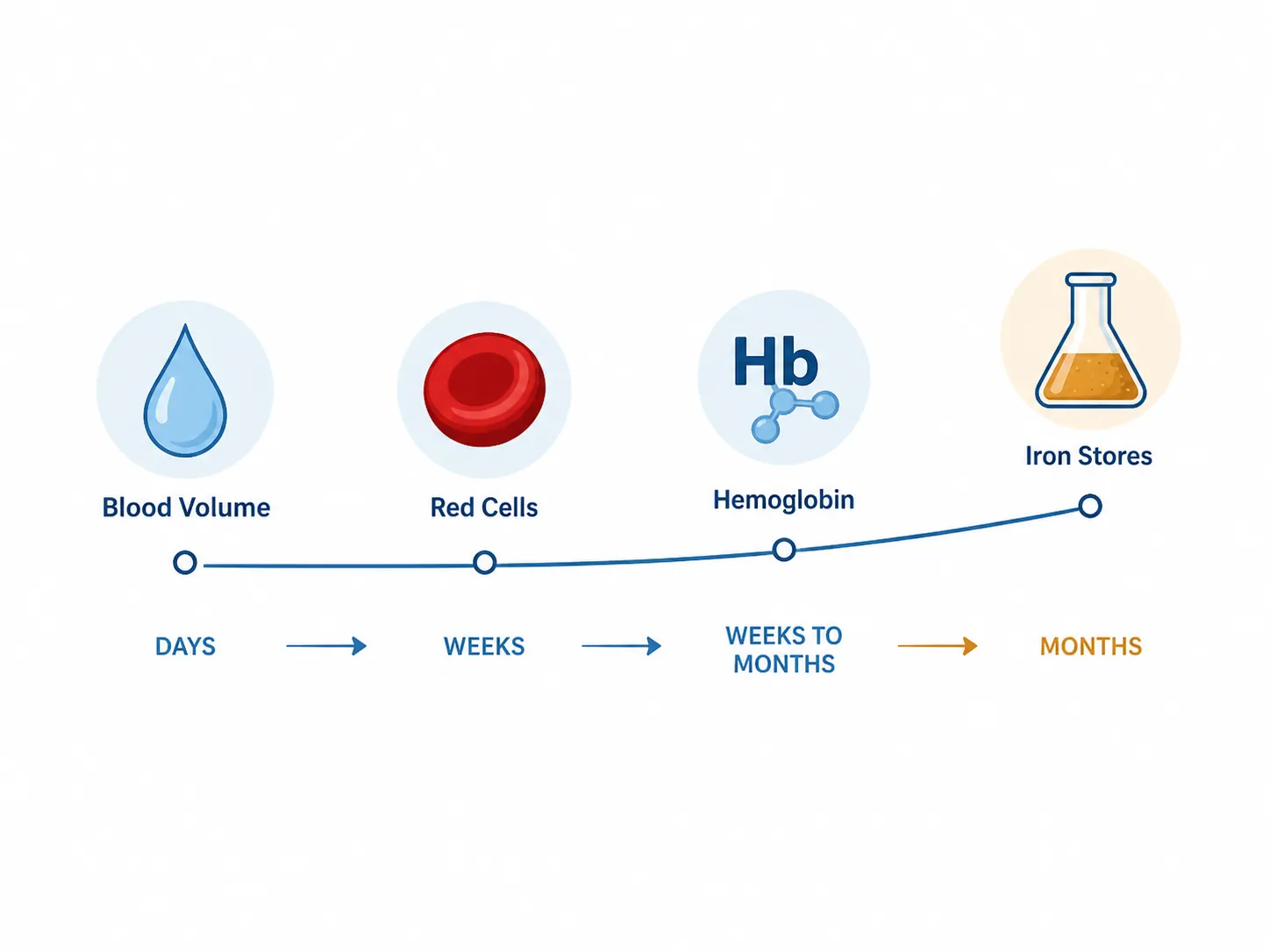
Blood volume is not the same thing as iron stores. You can replace fluid fairly quickly and still be carrying an iron debt. A whole-blood donation removes roughly 220–265 mg of iron, which matters most when the donor came in with little stored iron to spare.[2]
That is not rare. In a large ferritin analysis by Mast and colleagues, about 17% of blood donors had absent iron stores, defined as ferritin below 12 ng/mL. More than half of female donors and more than one-quarter of male donors had ferritin below 50 ng/mL.[3] Those figures are the reason persistent post-donation fatigue deserves a more specific question than “Did you drink enough water?”
Ferritin is a blood marker of stored iron. Hemoglobin is the oxygen-carrying protein checked at donation sites to decide whether you can donate that day. A normal hemoglobin screening result does not prove that your iron stores are comfortable. It can mean you had enough circulating hemoglobin to donate, while your reserve tank was already low.
| What is recovering | Why it matters after donation | Typical recovery pattern |
|---|---|---|
| Blood volume | Affects lightheadedness and short-term volume replacement | Often replaced much faster than iron stores |
| Red blood cells and hemoglobin | Affects oxygen delivery and exertional fatigue | Recovers over weeks, faster with iron in low-iron donors |
| Ferritin / iron stores | Reflects the reserve needed to rebuild blood and support iron-dependent body functions | Can take months to rebuild without iron replacement |
The HEIRS randomized trial is the useful anchor here because it followed donors by iron status and compared recovery with and without oral iron. With daily 37.5 mg elemental iron, hemoglobin recovered in about 4–5 weeks. Without iron, hemoglobin recovery took about 11–23 weeks. Ferritin recovered at about 11 weeks with iron, compared with more than 24 weeks without it; iron stores could take more than 180 days to rebuild without supplementation.[2]
That does not mean every tired donor needs iron pills. It means the timeline changes sharply when iron stores are low. The donor who feels mildly washed out for a day or two and steadily improves is in a different situation from the donor who is still unusually exhausted, more short of breath on stairs than usual, or sleeping badly two weeks later.
Why sleep can get worse when iron stores are low
Low iron is one plausible bridge between blood donation and worse sleep, especially when the sleep change has a restless-legs pattern: symptoms worse at rest, stronger in the evening or night, relieved by movement, and disruptive to falling asleep or staying asleep. That bridge is plausible, not proven for every donor.
In a Swedish donor survey, restless legs syndrome affected 14.7% of male donors and 24.7% of female donors. Female donors with restless legs were more iron-deficient and reported significantly worse sleep initiation, sleep maintenance, and sleep refreshment.[7] In a U.S. frequent-donor study, 9% of donors had probable restless legs syndrome and 20% had probable-or-possible restless legs syndrome; female sex roughly doubled the odds.[8]
This is also why perimenopause deserves special attention. Heavy or irregular bleeding can lower iron stores before donation, and women have about twice the restless-legs prevalence of men across the menopause transition even as menstrual blood loss eventually stops.[9] A perimenopausal donor with heavy bleeding is not being dramatic if she feels that a standard recovery handout does not describe what happened to her.
The donor evidence is mixed, though. The U.S. frequent-donor data did not establish a simple ferritin-to-restless-legs relationship, and a 2025 prospective Spanish donor study reported that 44.2% of donors had ferritin below 50 µg/L but found no ferritin–restless-legs association; gender was the only predictor.[8][10] So the careful conclusion is this: donation may worsen sleep through an iron-mediated pathway in some people, but blood donation should not be treated as a proven cause of restless legs syndrome.
If the leg symptoms are prominent, use that as a reason to get more specific care, not as a reason to self-diagnose. For deeper context on symptoms and diagnosis, see Restless Legs Syndrome: Symptoms, Diagnosis, and the 2025 Treatment Shift.
What to do if fatigue or restless sleep persists
If your symptoms are mild and clearly improving, basic aftercare may be enough: drink fluids, eat a real meal with iron-containing foods, avoid heavy exertion for the period your donation center recommends, and give yourself permission to go to bed earlier for a few nights. If symptoms persist, worsen, or show up as new restless-leg-type sleep disruption, the next step is ferritin-aware care.
- Ask your clinician whether to check ferritin, not just hemoglobin. Hemoglobin tells one part of the recovery story; ferritin helps show whether you had enough stored iron to rebuild comfortably.
- Tell the clinician about the donation date, donation frequency, menstrual bleeding pattern, pregnancy history if relevant, diet pattern, gastrointestinal symptoms, medications, and any prior anemia or iron deficiency.
- Describe the sleep symptom precisely: fatigue only, insomnia, waking often, leg discomfort, an urge to move, or symptoms that get worse at rest and at night.
- Do not treat iron like a general sleep supplement. Iron replacement is a medical decision, especially for older adults, people who no longer menstruate, people with gastrointestinal symptoms, and anyone with conditions that can raise iron stores.
The timing matters when iron is appropriate. The NIH Clinical Center advises donors who take iron after donation to use 18–27 mg of elemental iron daily for 60 days, and notes that taking iron soon after donating is useful because absorption is increased after blood loss.[4] The American Red Cross also gives frequent-donor iron guidance, including women under about 50 who donate 2 or more red cell units per year and men or women over about 50 who donate 3 or more red cell units per year.[5]
Those public recommendations are helpful starting points, not a private prescription. A clinician may suggest a different plan depending on ferritin, hemoglobin, age, bleeding, constipation risk, other medications, and whether there is a reason to look for blood loss outside donation.
If restless legs are the main sleep problem
Restless-legs care often includes iron assessment because iron status can be relevant even when hemoglobin is normal. Harvard Health notes that oral iron may be considered for restless legs when ferritin is 50 mcg/L or lower.[11] That threshold is not the whole diagnostic workup, but it gives you a concrete question to bring to a medical visit: “Given my symptoms after donation, should we check ferritin and treat low iron if it is present?”
Avoid starting high-dose iron on your own because the symptom pattern feels familiar from an online checklist. The safer route is to confirm whether iron stores are low, choose a tolerable form and dose with a clinician, and recheck as advised rather than taking iron indefinitely.
How long to wait before donating again
Donation eligibility intervals are minimums, not proof that your iron stores have recovered. General recovery resources describe blood volume as returning much faster than red cells, hemoglobin, and iron stores; red cell and hemoglobin recovery are usually discussed in weeks, while iron-store recovery can extend into months, especially without iron replacement.[2][5][6]
If you felt unusually depleted after this donation, it is reasonable to pause before scheduling the next one until you know more. A longer interval is especially worth discussing if you are a frequent donor, have heavy menstrual bleeding, are in perimenopause, are an older adult, follow a low-iron diet, or have had low ferritin before.
For some donors, the right plan is not “stop donating forever.” It is ferritin testing, iron replacement when appropriate, and a donation cadence that does not keep pulling from a reserve that never had time to rebuild.
When this is no longer routine recovery
Get medical advice promptly if fatigue is severe, worsening, associated with chest pain, fainting, shortness of breath at rest, black or bloody stools, unusually heavy bleeding, or neurologic symptoms. Also get help if new restless-leg symptoms repeatedly keep you from sleeping, because sleep loss can snowball even when the original trigger was temporary.
If your symptoms sit in the perimenopause cluster — heavy bleeding, new insomnia, possible restless legs, snoring, hot flashes, or unrefreshing sleep despite enough time in bed — the donation may be only one part of the picture. These guides may help you sort the next branch: Perimenopause Insomnia or Sleep Apnea?, Menopause Sleep Problems Aren't Just Hot Flashes, and Why You're Still Tired After 8 Hours of Sleep With Hypothyroidism.
Mild tiredness that improves over a few days can be ordinary post-donation recovery. Fatigue that lingers, feels disproportionate, or arrives with restless, uncomfortable legs at night deserves a ferritin-aware conversation before the next donation goes on the calendar.
References
- Six-day diary study of post-donation symptoms, Vox Sanguinis, 2021
- Oral iron supplementation after blood donation: a randomized clinical trial, JAMA, 2015
- Ferritin distributions and iron deficiency in blood donors, American Journal of Hematology, 2020
- After Donating, NIH Clinical Center
- Iron and Blood Donation, American Red Cross
- How your body replaces blood, NHS Blood Donation
- Restless legs syndrome among blood donors, Sleep Medicine, 2004
- Restless legs syndrome, pica, and iron status in blood donors, Transfusion, 2013
- Why Are Women Prone to Restless Legs Syndrome?, International Journal of Environmental Research and Public Health, 2020
- Prospective study of restless legs syndrome in a blood donor’s sample, European Sleep Research Society
- Are you missing this simple treatment for restless legs?, Harvard Health